
Can Therapy Help Gambling Addiction? What Evidence-Based Treatment Actually Looks Like
By Chris Beerman, LCSW, CADC — gambling and alcohol therapist, Chicago. Reviewed September 2026.
Yes. Psychotherapy can help gambling addiction, and cognitive behavioral therapy has the strongest research support.
That's worth saying plainly before anything else, because most people searching this question aren't looking for a philosophy of treatment. They want to know whether the thing they're considering has any chance of working.
The longer answer is more useful if you're actually deciding whether to book an appointment. Therapy for gambling is not supportive conversation about why you gamble. The best-studied version is active, structured work targeting four things at once: the beliefs that make the next bet feel reasonable, the situations that set off an urge, the money and the apps that make acting on that urge take seconds, and the life gambling has been quietly damaging in the background.
I'm Chris Beerman, MSW, LCSW, CADC, an addiction therapist in Chicago, and gambling is a primary focus of my practice. What follows is what treatment actually involves — including where the evidence is strong and where it's thinner than the internet suggests.
What the Research Actually Shows
The evidence points consistently in one direction in the short term and is noticeably more uncertain in the long term. Both halves of that sentence matter.
A 2023 systematic review and meta-analysis in Addiction, covering 29 randomized trials and 3,991 participants, found that cognitive behavioral techniques produced large reductions in gambling-disorder severity immediately after treatment, plus smaller but real reductions in how often people gambled and how much they wagered. A separate 2023 meta-analysis in the Journal of Behavioral Addictions, covering 29 trials and 3,083 participants, found a medium overall reduction in gambling severity across psychological treatments, with the largest effects for CBT and for therapy delivered face to face rather than remotely. An umbrella review in Clinical Psychology Review, pooling five meta-analyses across 56 studies and 5,389 participants, issued a strong clinical recommendation for CBT.
Those findings are usually where the summary stops, and it shouldn't. The umbrella review's "strong recommendation" is a technical term meaning moderate-to-high quality evidence of a clinically meaningful effect — its end-of-treatment evidence was rated moderate quality, and its follow-up evidence was rated low quality. The Addiction review found no significant effect at follow-up at all, detected publication bias, and concluded the benefit is likely overestimated and that CBT may not be reliably effective for everyone. The Journal of Behavioral Addictions review found risk of bias generally high and long-term effects largely unknown. (Those first and third studies also aren't independent confirmations of each other — the umbrella review includes the meta-analysis among its inputs.)
So the fair summary: CBT produces clear reductions in gambling by the end of treatment. Whether those hold afterwards isn't established, and not everyone responds. What happens in the months after treatment depends heavily on what else got built during it — which is most of what the rest of this article is about.
Problem Gambling and Gambling Disorder Are Not the Same Thing
Gambling Disorder is a formal diagnosis, and in the DSM-5-TR it's the only behavioral addiction classified alongside substance use disorders. It's defined by a pattern — preoccupation, escalating stakes to get the same effect, repeated failed attempts to cut back, restlessness when trying to stop, gambling to escape distress, chasing losses, lying about it, jeopardizing a relationship or job, and relying on others to bail you out financially.
Plenty of people have a genuine gambling problem without meeting that threshold, and treatment is appropriate for them too. You do not need a diagnosis to need help, or to call yourself an addict to start.
Assessment usually involves a validated screening measure. The UK's national clinical guideline on gambling-related harms recommends considering an up-to-date validated tool, giving the Problem Gambling Severity Index and the South Oaks Gambling Screen as examples. The PGSI is the one I most often start with, and there's a free version of it on this site — about two minutes, and nothing you enter leaves your device. What it can do is tell you roughly where you sit and whether the concern is worth taking seriously. What it cannot do is make a diagnosis. That takes a clinical conversation.
Why Gambling Is So Hard to Stop
People who have never had this problem tend to assume it's about money, or discipline. It's usually neither.
Gambling runs on a variable-ratio schedule — payoffs arriving after an unpredictable number of attempts. That's the schedule that produces the highest rates of a behavior and the greatest resistance to giving it up, and it's why a slot machine and a parlay both feel compelling in a way a guaranteed payout does not. The unpredictability isn't a flaw in the pull. It's the engine.
On top of that sits a set of beliefs about probability that feel obviously true from the inside and fall apart the moment you write them down. And on top of that is the fact that gambling now lives on a phone, which removed the last friction the whole thing had. Twenty years ago, acting on an urge required a drive. Now it requires unlocking a screen.
Then there's emotional regulation. For a lot of people gambling is doing a job — flattening anxiety, filling a dead evening, providing the only twenty minutes of the day that feels like something. Removing it without replacing that function is why so many attempts to quit collapse within a week or two.
The Three Levels Good Treatment Works On
If I had to compress everything below into one idea, it would be this: gambling treatment has to work on three levels at once, and treatment that only works on one of them tends not to hold.
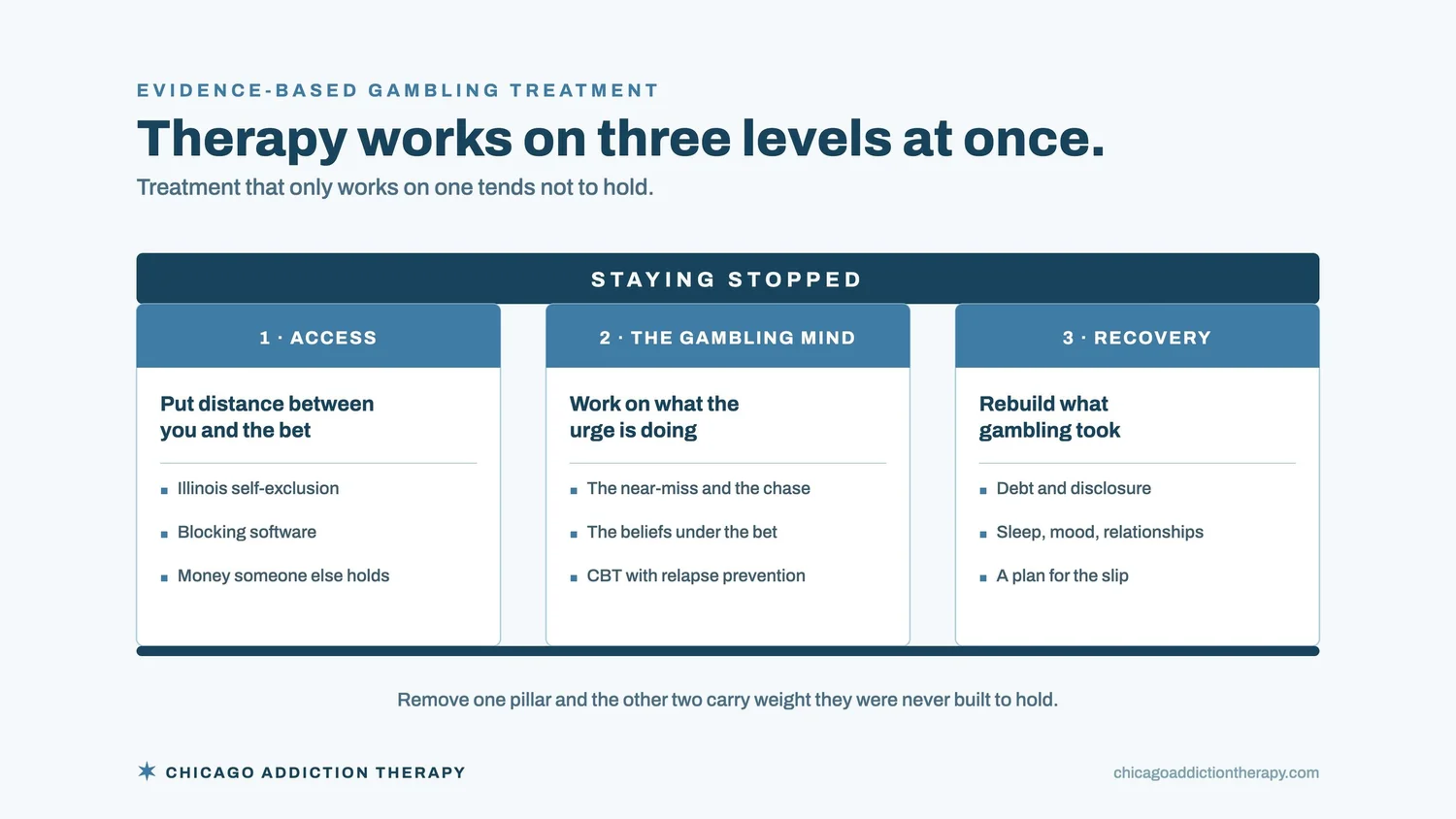
Access — the money, the apps, the accounts, the physical ease of placing a bet.
The gambling mind — the beliefs, the urges, the chasing, the emotional job gambling is doing.
Recovery — the debt, the relationships, the co-occurring problems, and the plan for the week it gets hard again.
Most people arrive expecting therapy to be entirely about the second one. In the first month, the first one usually matters more.
Level One: Why Treatment Starts With Access, Not Insight
This is the part generic therapy articles leave out, and it is often what makes the difference early.
Someone can understand perfectly well why they gamble, name every trigger, articulate the whole cycle — and still open a sportsbook at 11:30 at night. Insight is not a barrier. A barrier is a barrier.
The UK national guideline is unusually concrete here. It recommends clinicians actively discuss practical self-exclusion techniques: blocking software for online gambling, blocking gambling marketing messages, formal self-exclusion from land-based venues, systems that block gambling payments through a person's bank, and methods to limit access to money — for example, agreeing that a family member takes control of finances.
In practice we spend real session time on things that look administrative and aren't: removing stored cards, turning on bank-level gambling blocks, installing blocking software on every device rather than the obvious one, killing promotional emails and push notifications, changing who can see the accounts, and moving money somewhere that takes two days to reach.
Illinois runs a formal self-exclusion program through the Illinois Gaming Board. Two things surprise people: it covers Illinois casinos and sports wagering but not video gaming terminals — the machines in bars, restaurants and truck stops across the state — and the minimum term is five years, with in-person enrollment. It's a serious commitment and a genuinely useful one. I've written a full guide to how Illinois self-exclusion works.
None of this is a cure. What it does is buy you the ten minutes in which a decision is still possible.
Level Two: What CBT for Gambling Actually Targets
Gambling-specific CBT is not general talk therapy with a gambling topic. It targets a fairly specific set of beliefs and behaviors.
The beliefs
Gambling reliably produces a family of distorted thoughts about probability and control. They are worth listing, because most people recognize several immediately:
I'm due.
I can win it back.
That bad beat means I was actually right.
I'm better at this than the average bettor.
If I increase the bet size, I only need one win.
This isn't really gambling — I research the games.
I can't stop now, I'm down too much.
The work isn't arguing with these — arguing doesn't do much, and you've probably already tried. It's noticing them as they arrive, testing them against your actual record rather than your memory of it, and having something to do when they show up.
A 2024 review found people receiving CBT ended treatment with more favorable gambling beliefs, better coping and higher self-efficacy than those who got minimal or no treatment. These are the leading candidates for how CBT works — though the review didn't establish that changing them is what causes the gambling to reduce. Still a reasonable hypothesis rather than a settled finding.
The behavior
Alongside the beliefs, we map the pattern with more precision than most people have ever applied to it: what the triggers are, when they hit, what happens after a loss versus after a win, how money gets accessed, what the secrecy is protecting.
What comes up most: gambling after drinking; gambling when bored rather than distressed; compulsive odds- and score-checking that becomes its own habit loop; impulsive deposits; and the fact that wins are triggers too. Most people expect losses to be dangerous. Far fewer expect a good Sunday to be the thing that restarts everything.
Why Chasing Losses Gets Its Own Attention
Chasing deserves separate attention, because it's where a manageable problem becomes a serious one fastest, and because it's a chain rather than a single behavior.
The sequence runs: loss, then distress, then an urgent need to make the loss go away, then a larger or riskier bet, then a further loss, then greater urgency. Each turn raises the stakes and shortens the time between decisions.
What makes it clinically interesting is that you can intervene at every link — the distorted probability thinking, the emotional urgency, the inability to tolerate a loss staying unrecovered, the access to money that makes the larger bet possible, the impulsivity, the shame that stops anyone finding out early enough to help. Treatment attacks several at once rather than trying to talk someone out of the whole chain. I've written separately about how to stop chasing losses.
Learning to Have an Urge Without Obeying It
Cognitive work handles the thinking. It does considerably less for the physical experience — the restlessness, the tightness, the conviction that this feeling will not stop until a bet is placed.
I often bring acceptance-based strategies alongside gambling-specific CBT, particularly when the problem isn't believing the gambling thought so much as feeling unable to tolerate the urge that follows it. That means urge surfing, willingness, learning to treat a thought as a thought rather than an instruction, and reconnecting behavior to what actually matters to you rather than to what the urge is demanding. The goal isn't to make urges disappear — they fade on their own, usually faster than people expect. It's to be able to sit through one.
To be straight about the evidence: acceptance and commitment therapy doesn't have the gambling-specific research base CBT does. I use it because it addresses something CBT addresses less directly, not because the trials are equivalent.
Where Motivational Interviewing Fits, and Where It Doesn't
Plenty of therapy websites list "CBT and Motivational Interviewing" together as the two evidence-based treatments for gambling. The evidence is messier than that, and the nuance is worth explaining.
A 2015 meta-analysis found MI reduced gambling frequency for up to a year and spending in the short term. A more recent and more methodologically demanding meta-analysis, published in 2025 across seven trials and 796 participants, found essentially no difference between MI-informed interventions and controls on gambling frequency, spending or disorder severity — at end of treatment or at follow-up.
The 2025 authors' explanation matters more than that headline. None of the included interventions met proposed criteria for establishing MI integrity — that is, for demonstrating that the MI actually delivered was MI — and the interventions varied widely. Their conclusion was that earlier reviews probably overestimated MI's isolated effect — not that motivational work is useless.
Where MI genuinely earns its place is what the UK guideline recommends it for: strengthening confidence and commitment to change, and engaging people who are unsure or have reservations about starting treatment at all. That's a real and common problem, and a different job from being the primary mechanism of change. CBT as the treatment; motivational work for ambivalence and readiness. That's a more accurate map than listing them as equals.
What Actually Happens in Gambling Therapy
People ask "does therapy work" but what they usually want to know is what the therapist is going to do when they walk in. Here is what that looks like in my gambling addiction therapy practice.
Session one: getting the full picture
The first session is assessment, and it's more specific than people expect. What you gamble on, how often, how much you've wagered as distinct from how much you've lost, whether you chase, how you access money, what the debt actually is, what you've hidden and from whom, what you've already tried, how much you drink, whether attention or impulsivity have been lifelong issues, what your mood has been doing, what's happening at home and at work, and — directly — whether you've had thoughts of suicide. That last one isn't a formality; I'll come back to it.
We also talk about what you actually want, which is often unresolved. That's fine. You don't need to arrive having decided.
Sessions two and three: stop the bleeding
Early sessions are heavily practical: self-exclusion, closing or blocking accounts, financial transparency with someone you trust, removing access to credit, deciding what a partner does and doesn't get told, and identifying the two or three situations most likely to produce a bet in the next fortnight.
The middle: changing the cycle
This is where the CBT sits. The beliefs, the triggers, urge work, and finding out what job gambling has been doing so that something else can do it.
Later: relapse prevention
The UK guideline specifically recommends that CBT for gambling include a relapse-prevention component. In my practice that means naming your predictable high-risk setups — a windfall, a business trip, March, a fight, a stretch of bad sleep — deciding in advance what happens, identifying early warning signs, and agreeing who gets called.
For reference, that guideline suggests roughly 8 to 10 group sessions or 6 to 8 individual sessions of CBT — and it actually recommends group CBT first, with individual CBT where group isn't available or suitable. That's a UK service model rather than a US one, and individual work is what I offer, but it gives a sense of the scale of the core work.
Do You Have to Quit Gambling Completely?
You don't have to walk into a first appointment having committed to never gambling again. Ambivalence is normal, and treatment can start there — pretending it isn't present tends to make it stronger. But there's a difference between where treatment starts and where it usually leads, and I'd rather be honest about that than sound accommodating.
The UK national guideline recommends agreeing the aim of treatment collaboratively, and describes that aim as typically abstinence. For someone with established gambling disorder — repeated chasing, significant financial consequences, secrecy, multiple unsuccessful attempts to control it, repeated relapse — complete abstinence is usually the safest and most realistic goal, and attempts at controlled gambling tend to keep the whole cycle alive.
For someone earlier in the pattern, with fewer consequences, I'll sometimes explore a harm-reduction goal. That's my clinical judgment rather than something the guideline endorses — its alternative agreed goals are life-domain ones like finances, relationships and mental health, not reduced gambling. What I'll do is be straight about which situation yours looks like, and revisit it honestly if a moderation attempt isn't working. Repeatedly failing at controlled gambling is genuinely useful information, and a much better reason to change course than someone telling you to.
What About the Debt?
Therapy is not debt counseling and I'm not a financial advisor. But money is usually the loudest thing in the room and ignoring it doesn't work. What therapy handles is the psychological half: the pressure to win it back, the shame that makes it almost impossible to say the real number out loud, and the decisions being made from panic. For the financial half, nonprofit credit counseling exists and I can point you toward it.
One thing worth stating plainly: the belief that you can gamble your way out of gambling debt is the single most expensive idea in this entire problem.
None of this requires your life to have visibly come apart first. Plenty of the people I see are performing well at work the entire time, which is its own obstacle to getting help — see high-functioning addiction in professionals.
Gambling Rarely Travels Alone
The UK guideline lists the situations that should prompt a clinician to ask about gambling at all, and the list is instructive: depression, anxiety, psychosis, bipolar disorder, PTSD, personality disorder, ADHD, alcohol or substance dependence, and thoughts of self-harm or suicide.
The clinically important question is usually about direction. Did the mental health problem help drive the gambling? Did the gambling create or worsen it? Or are both running at once and feeding each other? Sometimes treating one improves the other. Sometimes they need concurrent treatment. And occasionally another condition is severe enough — the guideline gives severe PTSD and alcohol or substance dependence as examples — that it needs to be addressed first.
Two of these come up often enough in my practice to have their own articles: ADHD and gambling, and the relationship between gambling, anxiety and depression. Alcohol is the one people mention least and it belongs on the list — if drinking is part of the pattern, that's worth treating too.
What Happens If You Relapse?
A lapse is not the end of treatment, and treating it as catastrophic failure is one of the more reliable ways to turn a bad night into a bad month. We treat it as information instead. What was the setup? What preceded the urge by an hour? Which barrier failed, or which one had quietly been removed? What made calling someone feel impossible? Then the plan gets adjusted around what actually happened rather than what should have.
What to avoid is the gap — the stretch where someone stops coming to sessions because they're ashamed of what they'd have to report. If that's where you are, that's precisely the session worth keeping.
For a step-by-step version of that first day, read what to do after a gambling relapse.
Do Medications Help Gambling Addiction?
There is no FDA-approved medication for gambling disorder. The American Psychiatric Association states that plainly. Medication is sometimes used to treat a co-occurring condition such as depression or anxiety, which is a different thing from treating the gambling.
That said, there's a real signal for the opioid antagonists. A 2025 network meta-analysis of 16 placebo-controlled randomized trials (977 participants) found nalmefene reduced gambling severity on moderate-confidence evidence; naltrexone's effect on severity did not reach statistical significance, though it improved quality of life. Both were substantially less well tolerated than placebo — roughly eight-fold higher odds of dropping out because of side effects, though with very wide confidence intervals around that estimate. Olanzapine and topiramate were no better than placebo.
The UK guideline recommends considering naltrexone specifically when an adequate course of psychological therapy hasn't achieved the desired outcome, or when someone keeps relapsing despite having completed one — specialist-supervised, with liver and kidney function checked first and opioid use ruled out, and with continued psychological therapy considered alongside it. It's off-label there, as it would be here.
My position: medication isn't the first thing I think about for gambling disorder, and it's not a substitute for the work above. For someone relapsing repeatedly despite good treatment, it's worth a conversation with a qualified prescriber. I'm not one, but I coordinate with them.
Does Online Therapy Work for Gambling Addiction?
Yes, with one caveat. The 2023 Journal of Behavioral Addictions meta-analysis found face-to-face delivery produced substantially larger effects than remote. That's a comparison across studies rather than a head-to-head trial, and the "remote" category pooled different delivery formats, which limits what it tells you about live video sessions with a therapist specifically.
I see clients both ways. For people whose gambling happens alone on a phone at night, there's sometimes an argument for the structure of getting in a car and going somewhere. For plenty of others, online is what makes treatment happen at all, which beats the alternative.
If you are in Illinois and weighing it up, there is a fuller piece on online gambling therapy in Illinois — the first session, the research on internet-delivered treatment, and which gambling barriers can and cannot be put in place remotely.
How Long Does Treatment Take?
It depends on how long the pattern has been running and what else is going on. Most people begin weekly — early on that's about building enough structure to interrupt the cycle — and sessions usually space out later.
Many people notice real change in the first couple of months, particularly once the access barriers are actually in place. Rebuilding the parts gambling damaged — the finances, the trust, your sense of yourself as someone who does what they say — takes longer than stopping does.
When Gambling Has Become a Crisis
This needs saying directly. The UK national guideline describes gambling and gambling-related harms as a dominant risk factor for suicidal ideation and suicide attempts, even in the absence of other risk factors, and it recommends that clinicians ask about this directly. It also notes that risk may be highest immediately after a gambling episode.
If gambling losses have left you feeling trapped, hopeless, or like the people around you would be better off without you, please treat that as a mental health emergency rather than a financial problem you have to solve first. The debt is survivable. The crisis is the thing to address now.
Call or text 988 — Suicide & Crisis Lifeline, 24/7.
Illinois: 1-800-GAMBLER, or text GAMB to 833234 — the Illinois Department of Human Services gambling helpline, free and confidential, 24/7.
National: 1-800-MY-RESET — the National Council on Problem Gambling's helpline, call or text, with chat at 1800myreset.org.
You Don't Have to Hit Bottom First
The idea that treatment only starts working once you have lost everything is one of the most durable myths in addiction, and it costs people years.
It is not a clinical threshold. Look back at the diagnostic pattern earlier in this article and notice what is missing from it: a dollar figure. The criteria are behavioral — preoccupation, escalating stakes, failed attempts to cut back, restlessness when you try, chasing, lying, damage to a relationship or a job. You can meet most of them with your savings intact and your performance at work unchanged. Someone losing $300 a month they cannot spare, lying about it every week, and thinking about it in meetings has a more serious problem than someone who drops $10,000 at a table once a year and tells his wife about it on the drive home.
Waiting is the norm rather than the exception. A 2022 meta-analysis of 24 population studies estimated that around one in five people with problem gambling had ever sought help, and about one in twenty-five of those at moderate risk. Read the definition before the number: help there included telling family or friends and using self-help materials, not only seeing a professional. On the most generous available definition, four out of five people do nothing at all. The authors rated the overall risk of bias as high and found measurement inconsistent between studies, so treat it as an order of magnitude rather than a precise figure. The order of magnitude is the point.
What waiting costs is specific, and it is mostly not the next bet.
The debt is the part that compounds. Gambling behavior can change in weeks; a cash-advance balance does not care that you stopped. Secrecy compounds too — every month you say nothing adds to the size of what eventually has to be said, and how the disclosure happens tends to matter more to a relationship than the amount does. Wait long enough and you do not get to choose the disclosure at all. Your partner finds a statement, and the conversation starts on terms nobody designed.
The behavior also gets more automatic. Early on there is still a decision somewhere in the sequence. Later there is just the sequence — the notification, the app, the saved card, the deposit — running most of the way to a placed bet before anything that feels like choosing gets involved. That is harder to interrupt, and taking it apart is slower the longer it has been running.
There is no threshold you have to clear to be entitled to help with this. If you have tried to stop and have not stopped, that is enough information to start. The free gambling addiction test on this site will give you a rough sense of severity in about two minutes, but you do not need a score to justify a conversation.
How to Tell Whether a Therapist Actually Treats Gambling
A therapist can be very good at anxiety, depression, trauma or alcohol and still have seen very few gambling clients. That is not a criticism of them. Gambling-specific CBT targets a particular set of beliefs — the independence of events, near misses, skill in a chance context, the arithmetic that makes chasing feel rational — and none of that is standard clinical training. Neither is the practical half of the work: self-exclusion, blocking software, closing accounts, saved cards, access to credit, who holds the money.
The National Council on Problem Gambling suggests asking a prospective provider what problem-gambling-specific services they offer, whether the counselor is licensed and certified, what the treatment approach is, the format and duration, whether insurance covers it, whether family involvement is encouraged, what aftercare is provided, and what outcomes they can share.
Those are the right categories. These five are harder to answer vaguely:
How often do you treat gambling? Is it a regular part of your caseload, or something you see occasionally?
What does gambling-specific CBT look like in your practice? A specific answer names beliefs and behaviors. A thin one says we'll explore your triggers.
Will we work on access, or only on why I gamble? Self-exclusion, blocking, accounts, cards, credit. If none of that is on the table, a whole level of treatment is missing.
What happens if I place a bet in week six? There should already be a plan, not a reaction.
Do you have experience with what I actually do? Sports betting, online casino, poker, video gaming terminals and high-risk trading are not interchangeable.
On credentials: in the US, the CADC and its state equivalents indicate addiction-specific training. Gambling-specific certification is separate — the ICGC-I and ICGC-II, administered by the International Problem Gambling and Gaming Certification Organization, which require gambling-specific training hours, clinical hours treating gambling clients, consultation with a board-approved clinical consultant, and an exam. Illinois has its own credential as well, the Certified Problem and Compulsive Gambling Counselor (PCGC). Plenty of capable gambling clinicians hold neither, and holding one does not guarantee a good fit. What it tells you is that the person went looking for gambling-specific training rather than assuming addiction training covered it.
The tell, either way, is what the answers are about. If everything you hear is about willpower, hitting bottom, or a program you have to work, and nothing is about your accounts or your bank, you are probably not talking to someone who treats gambling.
Getting Gambling Treatment in Chicago and Illinois
Illinois has more gambling than most people realize and less treatment infrastructure than the numbers warrant. The state's most recent statewide assessment, conducted in 2021 for the Illinois Department of Human Services, found on a screening measure that 3.8% of Illinois adults — roughly 383,000 people — screened positive for a gambling problem, with a further 7.7%, about 761,000 adults, at risk. That fieldwork predates most of the online sports-betting expansion, so it likely understates the picture today.
One recent change is worth knowing. In July 2026, Illinois enacted Public Act 104-0626, adding gambling disorder throughout the state's Substance Use Disorder Act — letting licensed treatment programs provide gambling-disorder services as an adjunct to any level of care, requiring public education and a crisis and referral hotline, and extending recovery support services to gambling. It did not create a standalone gambling-disorder license, and it came with no new appropriation, so it doesn't by itself guarantee that a given service is covered. Ask a provider or the state helpline what you actually qualify for rather than assuming either way. For the full picture of what care exists and how to reach it, see how to find gambling treatment in Illinois.
I offer gambling addiction therapy in Chicago — in person in Logan Square, online throughout Illinois and Minnesota. Most of what I see is sports betting and online casino gambling rather than anything happening inside a casino. I also work with partners and family members.
If you want to talk it through, start with a free 15-minute consultation. You don't need to have it organized first, and you don't need to have decided anything.
Frequently Asked Questions
What kind of therapist should I look for?
One who treats gambling specifically. The section above sets out the five questions worth asking and what a thin answer sounds like.
Can therapy help if I'm not ready to stop?
Yes. Ambivalence is the normal starting point, not a disqualification. Motivational work exists precisely for that stage.
Do I have to go to Gamblers Anonymous?
No. Some people find GA genuinely valuable, particularly for the isolation. Others don't want it. It works well alongside therapy and it isn't a requirement.
Will my therapist tell my family?
Therapy is confidential, subject to the limited exceptions required by law. If privacy is the thing making you hesitate — because of your job, your license, or how much you've hidden — you can ask about it before booking anything.
References
Pfund RA, et al. Effect of cognitive-behavioral techniques for problem gambling and gambling disorder: A systematic review and meta-analysis. Addiction. 2023;118(9):1661–1674.
Eriksen JW, et al. Psychological intervention for gambling disorder: A systematic review and meta-analysis. Journal of Behavioral Addictions. 2023;12(3):613–630.
Pfund RA, et al. Cognitive-behavioral treatment for gambling harm: Umbrella review and meta-analysis. Clinical Psychology Review. 2023;105:102336.
Free BL, et al. Does cognitive-behavioral treatment affect putative mechanisms of change among individuals with problem gambling? Addictive Behaviors. 2024;158:108110.
Forman DP, et al. Motivational-interviewing-informed interventions for problem gambling and gambling disorder: A systematic review and meta-analysis. Psychology of Addictive Behaviors. 2025;39(4):365–374.
Ioannidis K, et al. Pharmacological management of gambling disorder: A systematic review and network meta-analysis. Comprehensive Psychiatry. 2025;137:152566.
National Institute for Health and Care Excellence. Gambling-related harms: identification, assessment and management (NG248). 28 January 2025. UK guidance for adults.
American Psychiatric Association. What Is Gambling Disorder? psychiatry.org.
Health Resources in Action. 2021 Statewide Assessment of Gambling and Problem Gambling in Illinois, for the Illinois Department of Human Services.
Illinois Public Act 104-0626 (SB 2749), enacted July 2026.
Written by Chris Beerman, MSW, LCSW, CADC — addiction therapist specializing in gambling disorder and alcohol-related concerns. More about Chris. Last reviewed and updated September 2026.
This article is general information, not a diagnosis or a substitute for individual clinical advice. NICE guidance is produced for the UK's National Health Service and covers adults; it is cited here as a synthesis of the international evidence, not as a US standard of care.