
Crypto Trading Addiction: When Investing Starts to Feel Like Gambling
By Chris Beerman, LCSW, CADC — gambling and alcohol therapist, Chicago. Reviewed September 2026.
Cryptocurrency is not inherently gambling. Buying Bitcoin does not mean someone has an addiction.
But the way a person trades can start to look remarkably similar to gambling.
The constant checking. The rush after a big move. Position sizes that keep creeping up. Staying awake to watch charts. Moving money between accounts. Telling yourself you will stop once you get back to even.
And perhaps the most important one: continuing to trade after you have already decided you need to stop.
That is when the question changes from is crypto a good investment? to something more useful:
Do I still have control over what I am doing?
What Is Crypto Trading Addiction?
"Crypto trading addiction" is not a standalone diagnosis in the DSM-5-TR.
That distinction matters, and any page that skips past it is selling you something.
Gambling disorder is the only behavioral addiction with a full diagnosis in the manual. Problematic trading does not have one. Researchers are still arguing about whether it is best understood as a form of gambling behavior, a separate behavioral addiction, or a pattern that overlaps with both. A 2025 systematic review of the theoretical literature found that most of the existing psychology on problematic trading has simply imported the framework used for gambling addiction — and its authors cautioned against assuming, in advance of the evidence, that the two are the same thing.
Clinically, the label matters less than the pattern.
If trading has become difficult to control and is causing financial, emotional, occupational or relationship problems, it deserves attention — whether you call it gambling, trading addiction, compulsive investing or nothing at all.
The asset is not the defining feature.
Loss of control is.
Why Crypto Can Become So Compulsive
Crypto has a handful of features that make a compulsive pattern unusually hard to interrupt. None of them are moral failings. They are design.
The market never closes
Traditional exchanges eventually force you to stop. The bell rings, the screen goes quiet, and the weekend arrives whether you wanted it or not.
Crypto does not do that. Prices move twenty-four hours a day, seven days a week, including holidays. There is always another candle forming, another piece of news, another reason to open the app.
For someone who is already preoccupied, that means there is no natural endpoint to the session. The stopping point has to be manufactured, deliberately, by you — which is a very different task from having one handed to you at four o'clock.
This is the single most underrated difference between compulsive crypto trading and compulsive stock trading, and it is why I treat "when does your trading day end?" as a clinical question rather than a scheduling one.
The feedback is immediate
A long-term investor can make a decision and wait years to learn whether it was right.
A crypto trader can feel dramatically right and dramatically wrong inside the same ten minutes.
Anticipation, result, disappointment, and immediately another opportunity — that short loop is a large part of what makes any activity habit-forming, and it is the specific structural feature that speculative trading shares with a slot machine.
Volatility supplies the arousal
A diversified portfolio moving half a percent does not produce adrenaline.
A thinly traded token moving twenty percent does.
The bigger and faster the movement, the easier it becomes to stop thinking about the underlying investment and start attending to the experience of the trade itself — the anticipation, the spike, the relief.
Eventually the goal shifts, usually without any conscious decision. You are no longer trying to build wealth.
You are trying to win.
There is always another opportunity
Crypto culture also manufactures a very particular fear of missing out.
Someone made forty times their money on a coin that did not exist last month. A new token is supposedly about to run. An influencer says the cycle is just starting. A chart posted in a Discord shows where the price is "obviously" headed.
The research base has caught up with this. A 2025 scoping review of thirteen studies covering more than eleven thousand traders identified social-media influence and herd behavior, alongside overconfidence, confirmation bias and the disposition effect — the tendency to hold losers and sell winners early — as recurring features of problematic cryptocurrency trading.
The result is a market that feels impossible to walk away from, because walking away means possibly missing the one that would have changed everything.
Is Crypto Trading Really Similar to Gambling?
There is real evidence of overlap, and it has improved a lot in the last two years. It is worth being precise about what it does and does not show.
A 2025 study in Public Health surveyed 700 cryptocurrency traders, drawn by sample-matching from a larger behavioral addiction project of more than four thousand adults, and scored them on the Problem Gambling Severity Index along with measures of gambling motives and gambling-related cognitive distortions.
33.7% scored in the problem-gambling range. Another 33.9% scored as at-risk. Only about a third scored as non-problematic.
Two things about that number.
First, what it is not. This is a cross-sectional survey of people who trade crypto, not a prevalence estimate for everyone who owns some. It cannot tell you whether the trading caused the gambling problems, the gambling problems led to the trading, or the same underlying tendency produced both. And the PGSI asks about gambling — so strictly speaking the finding is that crypto traders carry a great deal of gambling harm, not that their trading is gambling.
Second, what it is. The pattern inside the results is the part I find clinically useful. What predicted problem gambling most strongly was not enthusiasm or risk appetite. It was trading to cope — using the behavior to manage how you feel — which was associated with roughly four-and-a-half times the odds, and the inability to stop, at about three times the odds. Distorted beliefs about markets and luck raised the odds too. Trading for social reasons, oddly enough, was protective.
That maps almost exactly onto what walks into a therapy office. The people in trouble are rarely the ones taking the most risk. They are the ones who cannot not trade, and who are trading to feel differently.
A separate systematic review, published in 2023, pooled twelve studies on gambling and financial trading. Problem gambling rates among traders ranged enormously across studies — from 1.4% to 47.2%, with a median around 7.6% — and the shape of the finding was consistent: the riskier the asset and the more frequent the trading, the stronger the association with gambling harm. Day traders scored in the problem range roughly five times as often as non-day traders. Among people who both traded crypto and bet on sports, close to a third scored in the high-risk category.
None of this makes crypto ownership a disorder. What it does establish is that the speculative end of trading and the harmful end of gambling are not separate populations.
Investing vs. Compulsive Trading
One reason trading problems stay hidden for years is that the behavior comes with a respectable explanation ready to go:
"I'm investing."
Sometimes that is entirely true. A person can own cryptocurrency, understand what they are risking, and hold it for a decade without a single compulsive moment.
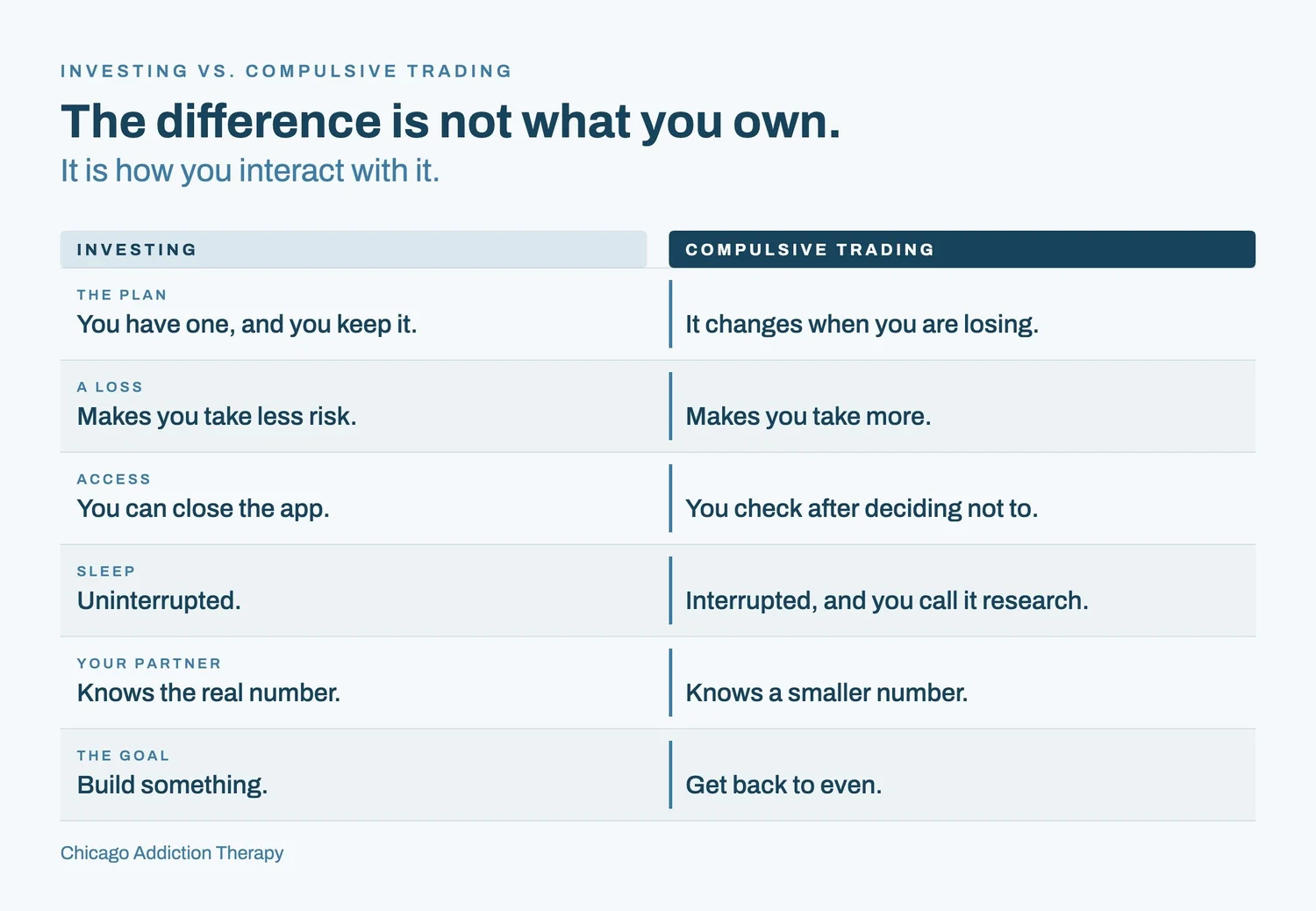
The distinction has very little to do with what you own and almost everything to do with how you interact with it.
Investing has edges. There is a plan. You know how much you are prepared to lose. A red day does not decide your mood. You can close the app, sleep through the night, and take a vacation without checking. You do not need the next trade to repair the last one.
Compulsive trading has none. The rules change when you are losing. Risk goes up when you are emotional rather than down. You check positions after deciding not to. You do not tell your partner the whole number. And your financial decisions slowly reorganize themselves around a single objective:
Getting back to even.
Ask yourself which column describes the last three months, not the version of yourself you intend to be next month.
The Clearest Signs Crypto Trading Has Become a Problem
No single item on this list proves anything. Any one of them can have an innocent explanation. What matters is the pattern, and how many of them you recognize.
- Checking prices compulsively throughout the day
- Checking during work, meals, conversations, or in the middle of the night
- Repeatedly deciding to cut back, and returning to it
- Increasing position sizes, leverage or overall risk
- Drifting from established assets into increasingly speculative coins and trades
- Feeling restless, irritable or anxious when you cannot check the market
- Trading mainly when you are bored, stressed, low, angry or anxious
- Hiding trades, losses, debts, transfers or balances from your partner
- Borrowing, or using money that was meant for something else
- Losing sleep, or letting work, relationships, exercise and other interests slide
- Replaying previous trades in your head
- Believing one large win would resolve the situation
- Continuing despite serious financial consequences
- Chasing losses
That last one deserves its own section.
Chasing Crypto Losses
Chasing is what happens when a loss creates an urgent need to trade again in order to recover it.
You lose ten thousand dollars.
Instead of becoming more careful, you size up — because getting it back now feels necessary rather than optional.
That position loses too.
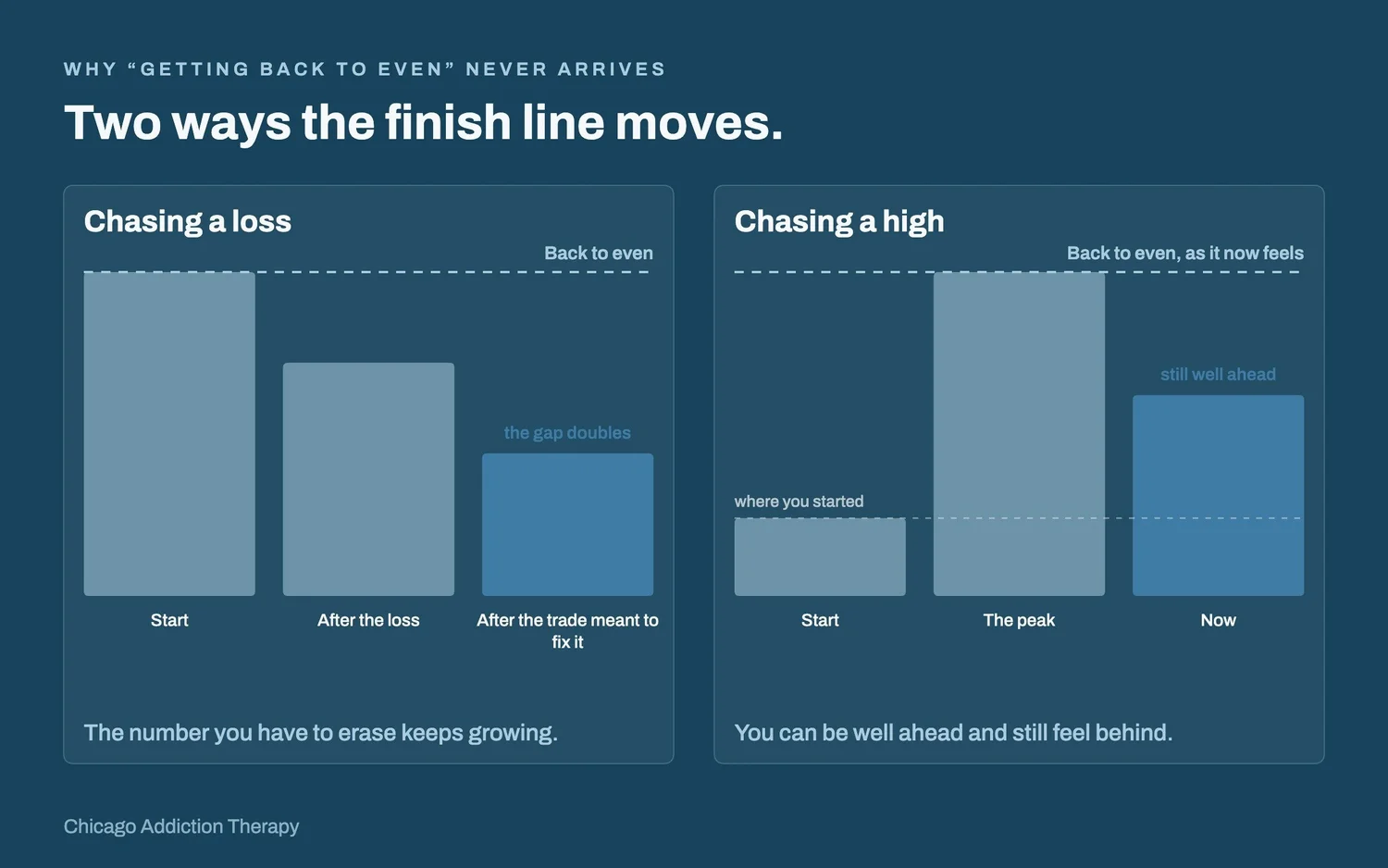
The original ten thousand is no longer the target. You are now down twenty, and twenty is the new number you have to erase.
Risk climbs. Decisions get faster. The rules you wrote for yourself in a calm moment stop applying, because this is an emergency and emergencies are exempt.
And the trade is no longer being judged on its own merits at all. Its job is to undo the one before it.
This is one of the clearest places where speculative trading starts to function like gambling. Chasing losses is a formal criterion for gambling disorder, and the internal experience is identical whether the screen shows a parlay or a perpetual futures position.
The dangerous thought is always some version of: I just need one good trade.
Often the single most important decision in recovery is a bleak-sounding one — accepting that the money is already gone. The market does not know your entry price. It does not know what your account used to be worth. It has no mechanism for making you whole, and no interest in doing so.
Big Wins Can Be Part of the Problem Too
Losses get the attention, but a great many compulsive patterns start with a win. Sometimes an enormous one.
Someone puts five thousand dollars into a coin and finds themselves holding forty.
That experience changes how risk feels. A result that depended heavily on timing, volatility and luck starts to feel like a skill that can be repeated. Position sizes grow to match the new normal. A two-thousand-dollar gain, which would have been a great week a year ago, becomes boring.
Then the market turns.
And instead of walking away with a substantial profit, the trader starts working to restore a previous account high.
This produces a strange, and in my experience badly under-recognized, version of chasing: you can be well ahead of where you started and still feel a hundred thousand dollars behind. The reference point has moved. You are not chasing money you lost; you are chasing money you briefly saw.
Which is why an account balance tells you almost nothing about whether trading has become a problem. Someone can be up, comfortable and outwardly successful, and still be entirely inside the cycle. That is also the pattern I see most often in high-functioning professionals, where nothing has visibly broken yet and that fact is itself being used as evidence that nothing is wrong.
A Better Question Than "Am I Addicted?"
People spend months arguing with themselves about whether their behavior is bad enough to deserve a word. It is not a productive argument, because the word is not what you need to decide.
These questions are more useful:
- Can I reliably follow the limits I set for myself?
- Can I stop when I intended to stop?
- Have I told my partner the whole number?
- Do losses make me reduce risk, or increase it?
- If I could never recover what I lost, could I still stop?
- Is trading improving my life — or has my life quietly reorganized itself around trading?
You do not have to lose everything before those questions are worth answering honestly.
If you want something more structured than self-reflection, you can take the gambling addiction test on this site. It is the Problem Gambling Severity Index, it is free, anonymous and scored instantly, and there is no email form.
Be clear about what it is, though. The PGSI is a screening tool for gambling harm, not a validated test for trading addiction, and its questions ask about gambling in plain language. There is no comparable public test for crypto. Researchers have developed and validated a Problematic Cryptocurrency Trading Scale, but the original publication did not establish a diagnostic cutoff, and I am not willing to build a website quiz that implies one exists.
What the PGSI is genuinely good for is the underlying pattern — chasing, escalation, concealment, guilt, consequences — and most people who are worried about their trading can answer its questions with the trading in mind and learn something real. Treat the score as information for a conversation, not as a diagnosis.
What Does Treatment for Compulsive Crypto Trading Look Like?
Here is the honest position: there is no body of clinical trials testing psychotherapy for cryptocurrency trading addiction specifically. Nobody has a validated "crypto addiction protocol," and any clinic advertising one is describing a product rather than a literature.
What exists is strong evidence for treating gambling disorder, and a great deal of transferable work on compulsive behavior, relapse prevention and the individual reasons a person cannot stop.
That evidence is worth stating precisely, including the part that is inconvenient. A 2023 umbrella review and meta-analysis found cognitive behavioral treatment clearly outperformed minimal or no treatment for gambling harm at the end of treatment — a large effect on gambling severity, smaller but real effects on how often and how much people gambled — and rated it a strong recommendation. But at follow-up, after treatment had ended, the difference from control conditions was no longer statistically significant.
The reasonable conclusion is not that therapy does not work. It is that stopping and staying stopped are two different problems, and a plan built only around insight and good intentions tends to decay. That shapes how I work: less time spent proving to you that trading is a problem, more spent building something that still holds in six months when the market runs and you feel fine.
In practice, treatment usually involves some version of the following.
1. Get an accurate picture of what actually happened
Compulsive trading survives on selective accounting. People remember the thirty-thousand-dollar winner in detail and lose track of the forty smaller losses around it.
So an early step is often reconstructing the real number: deposits, withdrawals, realized losses, open positions, debt, loans, money moved out of savings, money owed to family.
Seeing the whole figure at once is painful. It is also, reliably, the thing that ends the argument about whether this is serious.
2. Put distance between the urge and the trade
Insight is useful. Insight plus instant twenty-four-hour access to leverage is not a fair fight.
Depending on the situation that can mean deleting apps, killing price alerts, disabling margin and derivatives, closing exchange accounts, moving long-term holdings somewhere deliberately inconvenient, or handing account access to someone else for a defined period.
For people who intend to keep holding crypto as a long-term investment, the goal is usually to separate owning from trading — to make the position something you have rather than something you operate.
The principle is friction. A recovery plan that requires you to make the correct decision every single time you feel an urge is a plan that has already failed; the same logic sits behind the 24-hour shutdown plan I use with sports bettors.
3. Work out what trading is doing for you
Money is only part of it. Trading reliably supplies excitement, escape, hope, competence, identity, distraction, a sense of control, relief from boredom, and relief from anxiety or low mood.
That is why "trading to cope" showed up as the strongest predictor of harm in the research above, and it is why removing the behavior without addressing its function leaves a hole that something else usually fills.
It is also worth screening properly for what else is going on. Compulsive trading travels with anxiety and depression, sometimes with alcohol, and often with ADHD. Treating the trading while ignoring those is how people relapse.
4. Work on the thinking that keeps the cycle running
Compulsive trading comes with a fairly predictable set of thoughts:
- I know this market.
- I can't sell now.
- It always comes back.
- I've already lost too much to stop.
- I just need to get back to even.
- This is different from gambling, because I do research.
- If I stop now, it takes off without me.
In the moment these feel less like beliefs than like observations. Therapy slows that down, tests them against what actually happened in your own account, and helps you build rules that do not get rewritten by the last four hours of price action. Distorted market cognitions were one of the measured predictors of risk in the crypto study above, which is a reasonable argument for treating them as targets rather than as personality.
5. Handle the financial damage as its own project
Therapy is not financial advice, and I do not give it.
If the trading has produced debt, tax exposure, a drained retirement account or money owed to family, the psychological recovery and the financial recovery generally have to happen alongside each other, with the financial side handled by an accountant, an attorney or a financial counselor. The same principles apply as with gambling debt, and the sequencing mistake is the same too.
The trap sounds like this: I have to fix the money before I can stop trading.
That is the chasing cycle, wearing a suit. Continuing the behavior that created the hole is not a plausible method for filling it in.
6. Bring in the people it has affected
Trading losses are usually kept secret for a long time, and the concealment does its own damage — often more lasting damage than the money. If a partner has just found out, the discovery is its own event, and there is a separate piece here about what to do when a partner discovers the extent of it.
Do I Have to Give Up Investing Completely?
Not necessarily. But that is a different question from whether you have to stop compulsive trading, and the two get conflated constantly.
For some people, stepping away from speculative trading entirely is the cleanest answer, and the argument against it is usually just reluctance.
For others, recovery eventually includes a highly structured form of long-term investing — much less access, much lower frequency, much less risk, and ideally very little discretion in the moment.
Which of those fits depends on the person, the severity, and what has already been tried.
What does not work is continuing exactly the same behavior while promising yourself that this time the discipline will hold. If you have made that promise more than twice and broken it, that is not a character flaw to feel ashamed about. It is data, and it is the most useful data you have.
You Do Not Have to Lose Everything Before You Get Help
The most persistent myth about gambling and trading problems is that they only become real after a catastrophe.
You can still have the job. Still have savings. Still own the house. Still look, to everyone including yourself, like someone who is doing well.
And still know that your relationship with trading has changed.
I work with adults in Chicago on compulsive stock, options, crypto and other high-risk trading, in person and by telehealth across Illinois and Minnesota. Treatment is not about litigating whether you should have bought Bitcoin, or whether your thesis was right. It is about getting back control of your behavior, your money, and the amount of mental space the market is currently occupying. The work overlaps heavily with gambling addiction therapy, because the mechanism is the same even when the screen is not.
If you are wondering whether trading has crossed that line, you can read more about stock and options trading addiction therapy, or email me to schedule a confidential consultation.
Common Questions
Is crypto trading gambling?
Not by definition. Buying and holding an asset is not gambling, and plenty of people trade crypto without any loss of control. But the more speculative and frequent the trading becomes, the more closely it resembles gambling in both structure and consequences — and research consistently finds elevated rates of gambling harm among the most active traders. The useful question is not what category the activity belongs to; it is whether you can stop.
Is there a diagnosis for crypto trading addiction?
No. The DSM-5-TR contains gambling disorder but no diagnosis for problematic trading of any kind. A person whose trading has become compulsive may still meet criteria for gambling disorder, or may be treated for a compulsive behavior pattern without a formal label. The absence of a diagnostic code does not mean the absence of a problem, and it does not prevent treatment.
How is crypto different from day trading stocks?
Mostly in access and volatility. Stock markets close, which imposes an external stopping point; crypto trades continuously, so the stopping point has to be self-imposed. Crypto also offers far larger short-term price swings and, on many platforms, leverage that would not be available to a retail stock trader. The underlying psychology is largely the same, which is why the question of whether day trading is gambling applies here almost word for word.
Can you be addicted to trading if you are making money?
Yes. Profitability is not the criterion — control is. Some of the most entrenched patterns I see involve people who are still up overall but are now trading to restore a former account high, unable to stop, and hiding the extent of it. A winning account can conceal a compulsive pattern for years.
What if I only trade with money I can afford to lose?
That is a good rule, and it is worth keeping. But it addresses financial risk, not compulsive risk. Sleep, attention, work, honesty and relationships are not covered by it, and those are usually damaged first. If the sums are genuinely modest and everything else in your life is fine, that is reassuring. If you are describing modest sums while checking prices at three in the morning, the rule is doing more to reassure you than to protect you.
How do I talk to someone whose crypto trading worries me?
Lead with what you have observed rather than what you have concluded — the checking, the sleep, the change in mood after a red day — and avoid opening with a demand for the account balance, which usually produces a smaller number than the truth. If the money is shared, the financial protection and the conversation are separate tasks and both matter. There is more on this in the piece on what partners should do.
Do I have to give up crypto to get help?
No. You do not have to have decided anything before a first appointment, including whether you intend to stop. Deciding what abstinence would need to cover — all trading, speculative trading only, leverage only — is normally part of the work rather than a prerequisite for it.
If Trading Losses Have Become a Crisis
Large financial losses can produce intense shame, panic and hopelessness, and the risk that comes with those feelings is real. Clinicians who work with problematic trading are specifically advised to assess for depressive symptoms and suicide risk after significant losses.
If you are in a mental health crisis or thinking about suicide, call or text 988 for the Suicide and Crisis Lifeline. If you are in immediate danger, call 911.
If You Need Help Right Now
Gambling and related behavior — In Illinois, 1-800-GAMBLER, or text GAMB to 833234. Nationally, the National Council on Problem Gambling operates the National Problem Gambling Helpline at 1-800-MY-RESET (1-800-697-3738), free and confidential, call, text or chat, 24/7.
Alcohol and other substances — SAMHSA National Helpline, 1-800-662-HELP (4357), free and confidential, 24/7. In Illinois, the Illinois Helpline for Opioids and Other Substances, 1-833-2FINDHELP (833-234-6343).
In crisis — call or text 988 for the Suicide and Crisis Lifeline.
More options, including blocking software and money tools, are on the gambling resources page.
This article is for general information and is not medical, legal or financial advice, and it does not create a therapist-client relationship. It is not a diagnosis and it is not a recommendation to buy, sell or hold any asset. Screening tools indicate risk; they do not diagnose.
Research and Sources
Problem gambling among cryptocurrency traders — Xu T, Grubbs JB, Kraus SW. "Problem gambling in the crypto era: A study of gambling motivations and cognitive distortions amongst cryptocurrency traders." Public Health. 2025;244:105741. Cross-sectional survey of 700 cryptocurrency traders sample-matched from a larger behavioral addiction project (N = 4,363), scored on the PGSI, the Gambling Motives Questionnaire-Financial and the Gambling Related Cognitions Scale. Problematic gambling 33.7%, at-risk 33.9%, non-problematic 32.4%. Coping motivation predicted problematic gambling (OR 4.47, 95% CI 2.28–8.78), as did inability to stop (OR 3.18, 95% CI 2.22–4.54); interpretative bias and enhancement motivation predicted at-risk gambling; social motivation was protective. Not a prevalence estimate for cryptocurrency owners generally.
Trading and gambling across the literature — Lee U, Lewis LE, Mills DJ. "Association between gambling and financial trading: A systemic review." F1000Research. 2023;12:111. Twelve studies. Problem gambling prevalence among traders ranged from 1.4% to 47.2% (median 7.6%); 7.6% among day traders versus 1.4% among non-day traders; 30.7% scored high-risk among those engaging in both cryptocurrency trading and sports betting. Riskier assets and riskier trading behavior were associated with substantially greater problem gambling risk.
Whether problematic trading is its own condition — Loscalzo Y, Rogier G, Velotti P. "Problematic trading: a systematic review of theoretical considerations." Frontiers in Psychiatry. 2025;16:1505012. Finds that the psychological literature has largely imported the gambling and behavioral-addiction framework, that no settled independent definition exists, and cautions against applying the gambling framework aprioristically.
Mental health factors and cognitive biases — Jain L, Velez-Figueroa L, Karlapati S, Forand M, Ahmed R, Sarfraz Z. "Cryptocurrency trading and associated mental health factors: A scoping review." Journal of Primary Care & Community Health. 2025;16:21501319251315308. Thirteen studies, 11,177 participants. Reports anxiety and depression associated with volatility exposure; overconfidence, confirmation bias and the disposition effect; and social-media-driven herd behavior. Notes shared psychological traits between cryptocurrency trading and gambling.
Measurement — Menteş N, Yolbaş İ, Bulut M. "Development and verification of Problematic Cryptocurrency Trading Scale." Psychiatry and Clinical Psychopharmacology. 2021;31(3):310–318. A 16-item research instrument developed from DSM-5 criteria and internet addiction scales and validated across two samples. The original publication does not establish a diagnostic cutoff, which is why this site does not offer a "crypto addiction test."
Converging evidence — Özbek M, Topal G. "Problematic cryptocurrency trading among traders in Türkiye: a cross-sectional study of prevalence and associations with anxiety, depression, and problem gambling." Journal of Gambling Studies. 2026;42:409–423. Problematic trading in 26.3% of 596 traders, associated with anxiety, depression, problem gambling and trading frequency. A purposive online sample recruited through cryptocurrency social media groups, so the figure should not be read as a population prevalence.
Treatment evidence — Pfund RA, Ginley MK, Kim HS, Boness CL, Horn TL, Whelan JP. "Cognitive-behavioral treatment for gambling harm: umbrella review and meta-analysis." Clinical Psychology Review. 2023;105:102336. Versus minimal or no treatment at post-treatment: gambling disorder severity g = −0.91 (95% CI −1.33 to −0.49), gambling frequency g = −0.52, gambling intensity g = −0.32; rated a strong recommendation on Tolin criteria. At follow-up, differences from control conditions were not statistically significant (severity g = −0.14, frequency g = −0.10), which is the basis for the emphasis on maintenance and relapse prevention in this article.
Diagnostic status — American Psychiatric Association, Diagnostic and Statistical Manual of Mental Disorders, Fifth Edition, Text Revision (DSM-5-TR). Gambling disorder is the only non-substance-related disorder in the substance-related and addictive disorders chapter; four or more of nine criteria within twelve months, including preoccupation, escalation, unsuccessful efforts to cut back, restlessness when stopping, gambling when distressed, chasing losses, concealment, jeopardizing relationships or work, and relying on others for money. There is no diagnosis for problematic trading.
Helpline — National Council on Problem Gambling. As of 2026 the National Problem Gambling Helpline number is 1-800-MY-RESET, replacing the previous 1-800-GAMBLER branding at the national level; 1-800-GAMBLER remains in use for the Illinois helpline.