
Alcohol Addiction Therapy in Chicago
Therapy for adults who are questioning their drinking, or who already know. In person in Logan Square, Chicago, and online throughout Illinois and Minnesota.
Clinically reviewed by Chris Beerman, MSW, LCSW, CADC · September 2026
Most people who contact me about alcohol are still functioning. The job is intact, nobody has staged anything, and from the outside there is nothing to see. What has changed is quieter: the number of nights a week, how early it starts, how much of the day is spent managing it, and how a plan to have two turns into something else by nine o'clock.
You do not need a rock bottom, a diagnosis, or a word you are willing to say out loud in order to look at this. You need one honest conversation.
Schedule a Free 15-Minute Consultation
Or call or text (708) 665-5271, or check your coverage and book online with Headway.
Signs It Might Be Time to Get Support
Do you drink more than you plan to, or find it hard to stop once you start?
Losing track of how much, or how long, is one of the clearest signs it has become more than casual — particularly when it keeps happening after you have decided it won't.
Have you tried to cut back and found it harder than expected?
Difficulty cutting back when you genuinely want to often means your habits and your body have both adjusted around regular drinking. It is information, not a character verdict.
Do you drink to cope with stress, anxiety or difficult emotions?
Using alcohol for relief rather than enjoyment is one of the first patterns therapists look for, because it is the one that makes stopping hardest — the drinking is doing a job.
Has drinking affected your relationships, work or health, even if you are still functioning well day to day?
You do not have to reach a crisis for this to be worth addressing. High-functioning drinking still carries a real cost; it just gets paid quietly.
Those four questions are the short version. The free alcohol use test is the full one — ten questions from the WHO's AUDIT, about three minutes. Your answers are scored in your browser and never sent anywhere, not even to me.
You Don't Have to Call Yourself an Alcoholic
Plenty of people never come in because the only available word feels enormous and permanent, and the alternative — deciding it is fine — is easier this week.
The clinical picture is less binary than the vocabulary. Alcohol use disorder is diagnosed on a spectrum, from mild to severe, based on how many of a list of criteria fit you over the past year. Two people with the same diagnosis can be living very different lives. And a score on a screening questionnaire, including the one on this site, is not a diagnosis — it is a signal that something is worth a closer look.
So no, you do not have to accept a label to start, and I will not spend the first session trying to get you to. What I will do is ask what drinking is costing you and what it is doing for you, because those two answers together are what actually determines what to do next.
If you are still one question earlier than that, my guide to how to tell if you have a drinking problem is written for people whose life still looks fine from the outside.
Quitting or Cutting Back?
Not everyone who is worried about their drinking wants to stop completely, and being told that abstinence is the only acceptable goal is one of the most reliable ways to make someone leave and not come back.
Both goals can be legitimate. They are not equally appropriate for every person. NIAAA describes abstinence as the safest course while advising clinicians to negotiate goals with the person in front of them — and, where someone is not ready to abstain, to work in steps, starting with cutting out heavy drinking days. Whether moderation will hold for you is not something either of us can settle by arguing about it in advance. What settles it is what happens when you try, honestly, with the limits written down first.
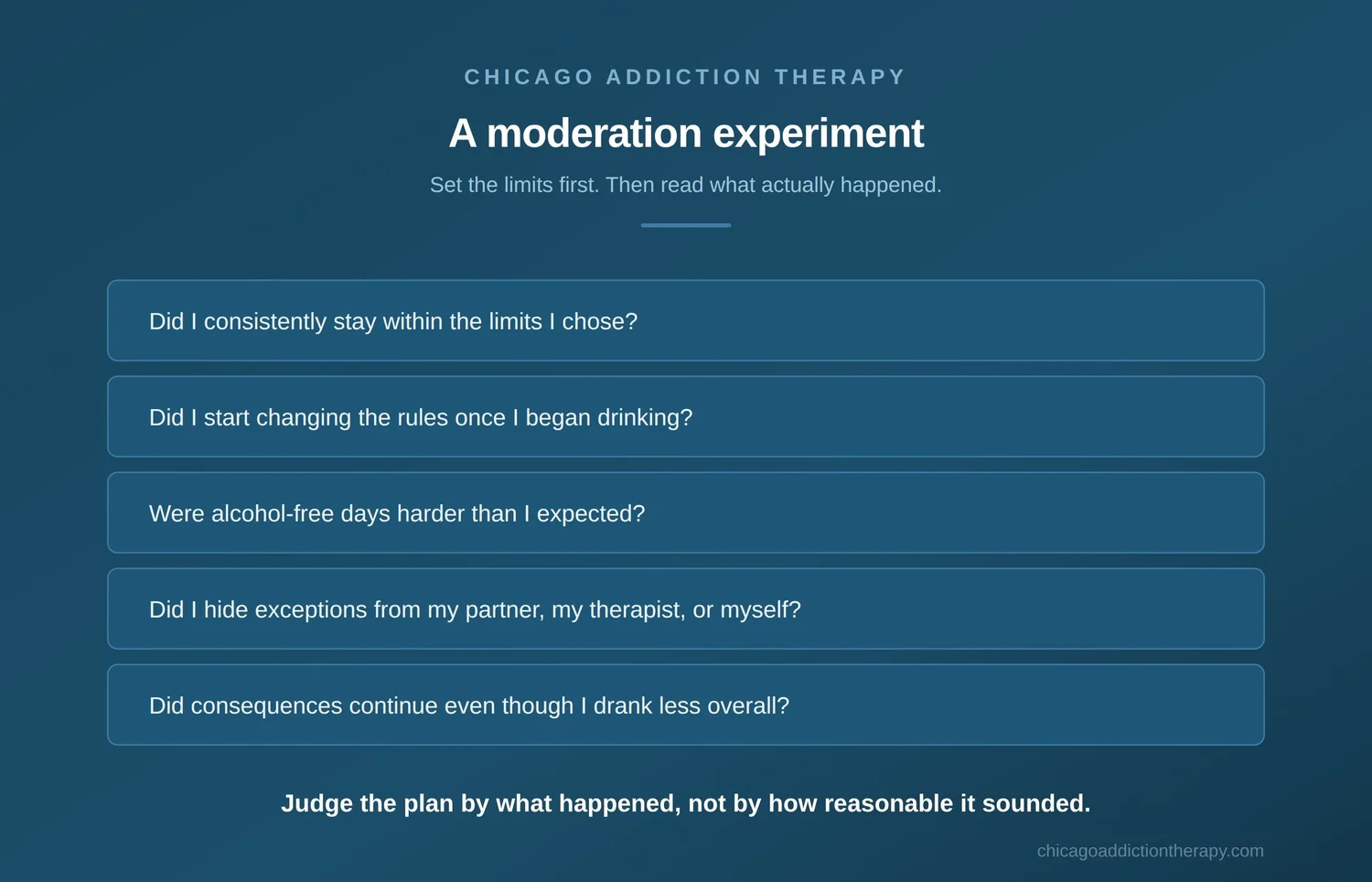
I have written at length about how to think that through in moderation versus quitting, including where the evidence for controlled drinking is genuinely encouraging and where it is thinner than people claim.
One Safety Point Before You Change Anything
If you drink heavily or regularly, don't abruptly stop without medical guidance, because alcohol withdrawal can sometimes be dangerous.
That is not a formality. Withdrawal from heavy, sustained drinking can begin within about eight hours of the last drink and can escalate into a condition that becomes life-threatening — shaking, sweating, a racing heart, confusion, hallucinations and, at the severe end, seizures. Anyone with those symptoms needs medical care, not a therapy appointment.
Medically supervised withdrawal is a different level of care from what I provide, and I am not the right provider for it. If that is where you are, start with your doctor or an urgent care, and I am glad to pick things up afterwards — that is often exactly when therapy starts to be useful. If you are not sure which level of care you need, my guide to choosing between therapy, IOP, rehab and detox explains what each one actually provides.
What Therapy Actually Looks Like
We start with the pattern, not the label. When it happens, what comes immediately before it, what the first drink is for, and what changes after the third. Most people have never laid this out in one place, and it is usually the point at which the behavior stops looking like a character flaw and starts looking like something with moving parts.
We work on what the drinking is doing for you. Almost nobody drinks problematically for no reason. It is doing something — flattening anxiety, ending the workday, making a social evening survivable, getting you to sleep, keeping grief at a manageable distance. Removing it without replacing the function is why so many attempts to stop last eleven days. This is the part that takes actual therapy rather than resolve. The anxiety version of this pattern, the drink as the only reliable off-switch, has its own guide: alcohol and anxiety: when drinking to relax keeps you stuck.
We change the environment, not just the intention. What is in the house, what happens between six and eight, who you see and where, and what you do with the hour when you used to pour something. Willpower is a poor tool against a routine, and a good tool against a routine you have already redesigned.
We plan for the specific hard weeks. A wedding, a work trip, the holidays, a bad anniversary, a fight. Relapse rarely arrives on an ordinary Tuesday; it arrives on a date you could have circled in advance. If your pattern is a workweek that holds and a weekend that doesn't, my guide to how to stop binge drinking on weekends is the plan for exactly those hours.
The methods behind that are cognitive behavioral therapy — the most studied approach for alcohol problems — and acceptance and commitment therapy for the part cognitive work does not reach, which is being able to have a craving without it deciding what you do next.
Medication Is Worth Asking About
There are three medications approved by the FDA for alcohol use disorder: naltrexone, as a tablet or a monthly injection, acamprosate, and disulfiram. NIAAA describes them as roughly as effective as behavioral treatment, notes that the two can be combined, and points out that they are vastly underused — only about 2.4% of adults with alcohol use disorder received medication for it in 2024, according to NIAAA's analysis of federal survey data.
I am not a prescriber. But if medication is something you want to explore, I would rather say so plainly than leave it out, and I can coordinate with your physician or psychiatrist. It is a reasonable question to raise with your doctor whether or not you ever work with me.
Who I Work With
I'm Chris Beerman, MSW, LCSW, CADC — an addiction therapist in Chicago.
I work with adults across the range: people who are simply uneasy about how much they are drinking, people who have tried to cut back several times, and people who have already decided they need to stop. A lot of my clients are managing something alongside the drinking — anxiety, sleep, grief, a job that runs on it socially, or gambling, which shows up with alcohol more often than most people expect. If cannabis, cocaine or pills are part of the picture too, see substance use therapy. I also work with partners and family members trying to work out what to do. If your career is the reason nobody has noticed, read high-functioning addiction in professionals.
How It Works
Start with a free 15-minute consultation. You can tell me what has been going on, ask whatever you want to ask, and get a sense of whether I'm the right fit. You don't need to have it organized first, and you don't need to have decided anything.
In person or online. I see clients in person in Logan Square, Chicago, and online throughout Illinois and Minnesota.
It's confidential. Therapy is confidential, subject to the limited exceptions required by law. If privacy is the thing making you hesitate — because of your job, your license, or how much you have kept to yourself — you can ask me about it before you book anything.
Online Alcohol Therapy in Illinois and Minnesota
You don't have to live near Logan Square to work with me. I also see adults by secure video anywhere in Illinois or Minnesota, the two states where I'm licensed. What counts is where you are during the session, not where you live, so if you'll be out of state on a session day, tell me in advance and we'll move the appointment rather than dial in.
For drinking, video has an advantage beyond skipping the drive: for a lot of people, the session happens where the drinking does. The kitchen where the first glass gets poured, what's in the fridge, the couch at nine o'clock are all within reach. We can go through what is actually in the house, plan the hour that used to belong to a drink, and work out next Friday from the room where Friday happens.
It can also be the more private option. Nobody sees you walk into an addiction therapist's office, and there's no drive to explain. What you need is a room with a door, and headphones help. If there's nowhere private at home, say so. That's a scheduling problem we can solve, not a reason to skip treatment.
The approach and the free consultation are the same whether we meet in person or by video. What online outpatient therapy can't do is manage withdrawal. If you drink heavily every day or have had withdrawal symptoms before, start with the safety point above and your doctor, and if you're not sure which level of care fits, read my guide to choosing between therapy, IOP, rehab and detox.
Cost and Coverage
I'm in-network with Aetna, Blue Cross Blue Shield of Illinois, Cigna, UnitedHealthcare, Oscar, and Oxford, through Headway. If you're using out-of-network benefits, I can provide superbills. You can check your coverage and book online with Headway.
If cost is the barrier, SAMHSA's national helpline below can refer you to state-funded and sliding-scale treatment in Illinois, including levels of care I don't provide. My alcohol resources for Chicago and Illinois page walks through the cost and insurance questions in more detail.
Frequently Asked Questions
Do I have to quit completely?
Not necessarily, and I won't decide that for you in the first session. For some people abstinence is the only thing that has ever held, and for some it is the medically safer course. For others, particularly earlier in the pattern, cutting back is realistic. What I will do is be straight with you about which one your situation looks like, and revisit it honestly if a moderation attempt isn't working. Repeatedly failing at controlled drinking is useful information rather than a verdict on you.
Do I have to go to AA?
No. Some people find AA genuinely valuable, particularly for the isolation. Others want nothing to do with it, and there are other options — SMART Recovery among them. It works well alongside therapy, and it is not a requirement for working with me.
What if I've tried to stop before and it didn't hold?
That is the normal history, not the disqualifying one. Most people arrive having stopped several times. What is useful is looking closely at what happened each time — what the week before looked like, and what the drinking came back to solve — because that is where the actual plan comes from.
I'm not sure it's bad enough to need therapy.
Then that is a good reason for a consultation rather than a reason to wait. Nothing about a fifteen-minute conversation commits you to a course of treatment, and "is this actually a problem" is a legitimate thing to bring to a first session.
What about the person in my life who is drinking?
I work with family members too, both alongside the person drinking and separately. My page for parents and family covers what that looks like. If it's your partner, start with what to do when your partner drinks too much.
Keep Reading: Alcohol and Substances
Is this a problem?
- Do I have a drinking problem?
- Alcohol and anxiety: when drinking to relax keeps you stuck
Changing how you drink
Choosing treatment
Related
Need Support Right Now?
Free, confidential support is available 24/7.
SAMHSA National Helpline — 1-800-662-HELP (4357). Free, confidential treatment referral and information, in English and Spanish.
Illinois Helpline for Opioids and Other Substances — 1-833-2FINDHELP (833-234-6343), or text HELP to 833234. Free and confidential, 24 hours a day. helplineil.org
If you're in a mental health crisis or thinking about suicide, call or text 988. If you're in immediate danger, call 911.
For meetings, medication questions, treatment navigation and support for family members, see the full alcohol resources directory.
Ready to Talk?
You don't need a rock bottom, and you don't need to have decided what you're going to do about it.
Start with a free 15-minute conversation.
Schedule a Free 15-Minute Consultation
Chris Beerman, MSW, LCSW, CADC · Chicago Addiction Therapy · Logan Square, Chicago · Serving Illinois and Minnesota