
Gambling Addiction Therapy in Chicago
Therapy for adults struggling with sports betting, online gambling, casino gambling, and high-risk trading. In-person in Logan Square and online throughout Illinois and Minnesota.
Schedule a Free 15-Minute Consultation →
Not sure how serious it is? Take the free gambling addiction test →
Most People Don't Come In After One Bad Night
They come in after two years of bad nights they've mostly kept to themselves.
By the time someone contacts me, they've usually already tried to fix it alone. They've deleted the apps. Set a limit. Promised their partner. Taken a week off and felt fine about it. Then something happened — a bad beat, a good day, a Sunday with nothing to do — and they were back.
That cycle is not a character problem. It's what gambling does to the part of your brain that predicts reward, and willpower is a poor tool against it. That's most of what therapy is for.
Who I Work With
I'm Chris Beerman, MSW, LCSW, CADC. I'm an addiction therapist in Chicago, and gambling is a primary focus of my practice.
I work with adults dealing with:
- Sports betting and online sportsbooks
- Live and in-game betting
- Online casino games and slots
- The video gaming terminals in Illinois bars, gas stations and gaming cafés
- Poker
- Daily fantasy sports
- Casino and table games
- High-risk trading in stocks, options, or crypto that has taken on gambling-like characteristics
I also work with partners and family members who are trying to figure out what to do — how to set a boundary, whether to take over the finances, and how to help without making it easier for the gambling to continue.
If it is your husband, wife or partner who has been gambling, start here — a guide to the financial picture, what Illinois law says about the debt, and how to tell genuine recovery from another promise. For a private look at how it’s affecting you, there is also Is Gam-Anon for me?, a 20-question check for partners and family.
Most of my gambling clients have never had a problem inside a casino. The gambling happens on a phone, alone, and often at night. If your career is the reason nobody has noticed, read high-functioning addiction in professionals.
What Treatment Actually Looks Like
Therapy for gambling is not being told to stop. You already know you could stop. That's rarely the part that's stuck.
We start with what you actually want
Some people arrive certain they need to quit completely. Others aren't sure they want to quit at all — they want the losses to stop, or their partner to stop asking, or to get back to gambling the way they used to.
I don't require you to have resolved that before we begin. Ambivalence is normal, and pretending it isn't there tends to make it stronger. We'll look honestly at what gambling is currently costing you and what you want to do about it, and your goal can change as the picture gets clearer.
We map the cycle
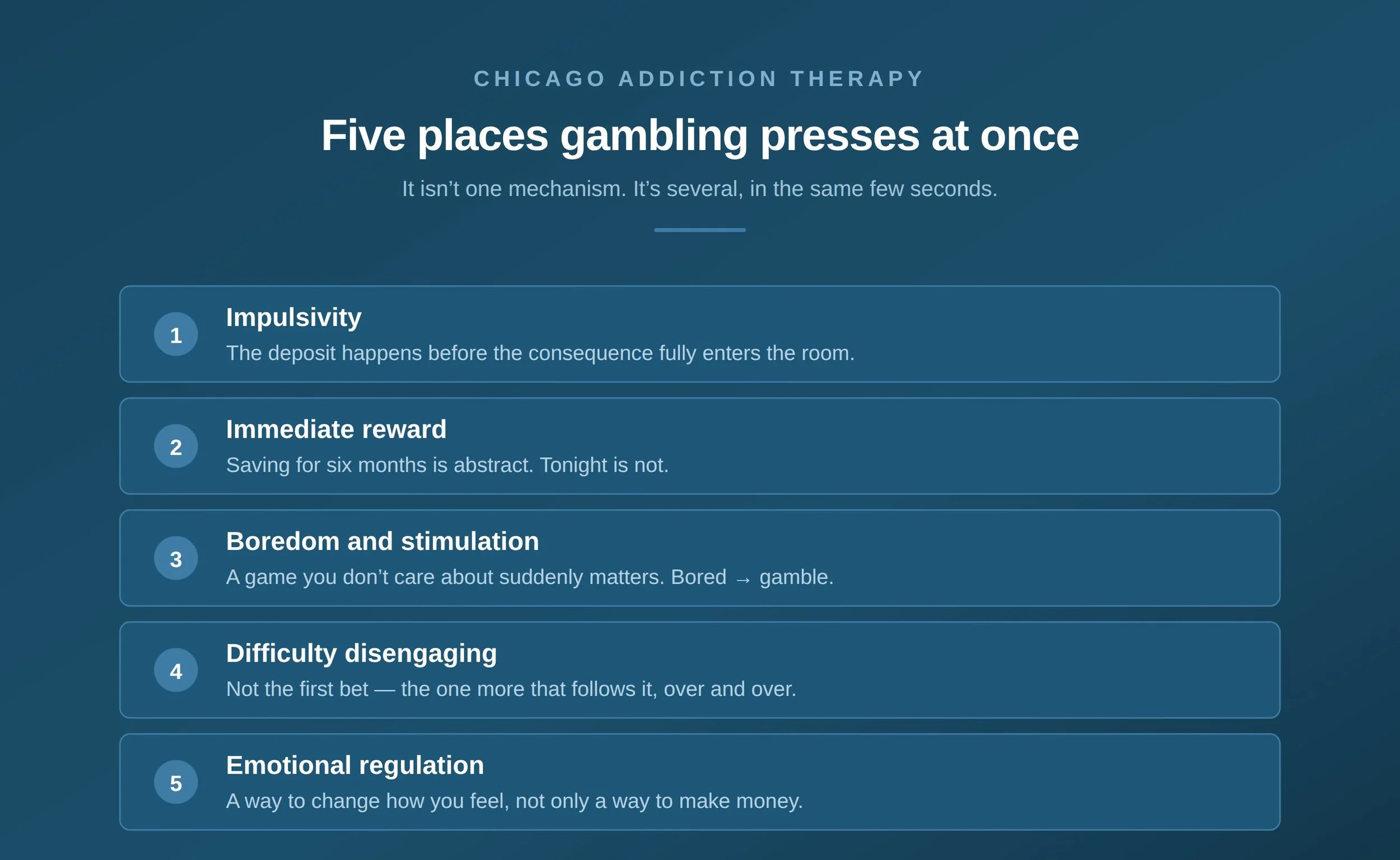
The early sessions are about understanding the pattern with some precision: what sets off an urge, when it hits, what you're feeling beforehand, how you get access to money, what the secrecy is protecting, and what happens after a loss versus after a win.
Most people have never laid this out in one place. It is usually the first time the behavior stops looking random.
We put real barriers between you and the money
This is the part people skip, and it's often what makes the difference in the first month.
Insight doesn't hold up well against a phone at 11pm. So we work on concrete access control — which can include app blocking software, removing stored payment methods, changing who has visibility into accounts, moving money out of easy reach, and using self-exclusion.
Illinois runs a free Self-Exclusion Program through the Illinois Gaming Board that covers Illinois casinos and sports wagering. Enrollment is in person and takes about half an hour. Individual sportsbook and casino apps also have their own limit and self-exclusion settings, which are worth setting up separately.
None of this is a cure. It buys you the ten minutes in which a decision is still possible.
We work on the thinking that makes the next bet feel reasonable
This is cognitive behavioral therapy, which is the most studied and best-supported approach for gambling problems. I've written up what the research on therapy for gambling addiction actually shows, including where the evidence is thinner than people assume.
Gambling produces a specific set of beliefs that feel completely rational from the inside: that a near-miss means you're close, that a loss makes a win more likely, that you're better at this than most people, that you're due, that this particular bet is different because you actually know something. We identify those, test them against what actually happened, and work on what to do when they show up.
We also work on the chase directly, because chasing is where a manageable problem becomes a serious one fastest.
We work on having an urge without acting on it
Cognitive work handles the thinking. It does less for the physical pull — the restlessness, the pressure in your chest, the sense that this feeling will not stop until you place a bet.
Using acceptance and commitment therapy, we work on being able to have that experience without it deciding what you do next. The goal is not making urges disappear; they fade on their own, and most people are surprised how quickly. The goal is being able to sit through one.
Alongside that, we work on what gambling has been regulating — boredom, stress, loneliness, anxiety, the day ending with nothing in it — and what else could do that job.
We involve the people around you, when it makes sense
Gambling runs on secrecy, and secrecy is exhausting to maintain.
If it's useful, I'll work with you on what and how much to disclose to a partner, and I can bring them into sessions. That often covers practical questions — who manages the money now, what gets checked, for how long — and the harder one underneath, which is how trust gets rebuilt after someone has been lied to about money.
We build a plan for the bad week
Relapse in gambling rarely happens on an ordinary day. It happens during a specific setup: a windfall, a business trip, March, a fight, a payout, a stretch of not sleeping.
Before we finish, we name yours and decide in advance what happens. And if it does happen, what to do after a gambling relapse is the plan for the first day.
Schedule a Free 15-Minute Consultation →
Do You Have to Quit Completely?
Not necessarily, and I won't decide that for you in the first session.
For some people, complete abstinence from gambling is the only thing that has ever worked, and continuing to gamble in any form keeps the whole cycle alive. For others — usually people earlier in the pattern, with fewer consequences — regaining control is realistic.
What I will do is be straight with you about which one your situation looks like, and revisit it honestly if a moderation attempt isn't working. Repeatedly failing at controlled gambling is itself useful information, and it's a much better reason to change course than someone telling you to.
What About the Debt?
Therapy is not debt counseling, and I'm not going to pretend to be a financial advisor.
But money is usually the loudest thing in the room, and ignoring it doesn't work. We'll deal with the parts that are psychological — the pressure to win it back, the shame that makes it hard to tell anyone the real number, the decisions being made from panic — and I can point you toward nonprofit credit counseling for the parts that are actually financial.
One thing worth saying plainly: the belief that you can gamble your way out of gambling debt is the single most expensive idea in this whole problem.
If you want the longer version — how to stop the financial damage growing, work out what you actually owe, and what the different debt options really mean — I've written a full guide to recovering financially after gambling losses.
How It Works
Start with a free 15-minute consultation. You can tell me what's been going on, ask whatever you want to ask, and get a sense of whether I'm the right fit. You don't need to have it organized first, and you don't need to have decided anything.
In-person or online. I see clients in person in Logan Square, Chicago, and online throughout Illinois and Minnesota. If you are elsewhere in Illinois, online gambling therapy in Illinois covers what telehealth treatment involves, what happens in a first session, and which gambling barriers can be set up over video. If you are in Minnesota, see gambling therapy in Minnesota — including the state-funded treatment Minnesota offers, which is worth checking first. Minnesota has no statewide self-exclusion list, so my guide to Minnesota gambling self-exclusion shows what you can block there.
Weekly to start. Most people begin weekly. Early on, that's about building enough structure to interrupt the cycle; later, sessions usually space out.
It's confidential. Therapy is confidential, subject to the limited exceptions required by law. If privacy is the thing making you hesitate — because of your job, your license, your family, or how much you've hidden — you can ask me about it before you book anything.
Cost and Coverage
I'm in-network with Aetna, Blue Cross Blue Shield of Illinois, Blue Cross Blue Shield of Minnesota, Cigna, UnitedHealthcare, Oscar, and Oxford, through Headway. If you're using out-of-network benefits, I can provide superbills.
Illinois residents may also qualify for state-funded gambling disorder treatment through IDHS’s Division of Behavioral Health and Recovery, regardless of insurance status. In July 2026, Illinois added gambling disorder to the state's Substance Use Disorder Act, which expanded what state-funded services can cover. It did not make gambling treatment Medicaid-eligible, so this is worth asking about specifically rather than assuming. The page on gambling disorder treatment in Illinois covers what the law changed and every route into care.
Ask About Insurance & Availability →
Frequently Asked Questions
Do I have to call myself a gambling addict?
No. Plenty of people come in because something has started to worry them and they want an honest read on it. You don't need a label or a diagnosis to start.
Is gambling addiction a real diagnosis?
Yes. Gambling Disorder is a recognized diagnosis, and it's the only behavioral addiction currently classified alongside substance use disorders. Making that diagnosis requires a clinical assessment. The free gambling addiction test on this site can flag it, but can't establish it.
Can you help with sports betting specifically?
Yes, and it's the most common thing I see. There's more on the sports betting therapy page. Mobile sportsbooks are built to be fast, constant, and always available, and in-game betting removes almost all of the pause between an urge and a bet. That changes what treatment has to address.
What about trading — is that really gambling?
Sometimes. There's a page on trading addiction that goes further into this. The question isn't the asset, it's the pattern. If you're trading to chase losses, sizing positions based on what you need to make back, hiding it, checking compulsively, and feeling the same relief-and-crash cycle, then it's functioning as gambling regardless of what the account is called.
Do I have to go to Gamblers Anonymous?
No. Some people find GA genuinely valuable, particularly for the part of the problem that is isolation. Others don't want it. It works well alongside therapy and it's not a requirement for working with me.
Is there medication for gambling?
There's no FDA-approved medication for gambling disorder. Some medications are used off-label with mixed evidence, and depression or anxiety alongside gambling may be worth treating on its own. I'm not a prescriber, but I can coordinate with one.
How long does treatment take?
It depends on how long the pattern has been running and what else is going on. Many people notice real change in the first couple of months, particularly once the access barriers are in place. Rebuilding the parts that gambling damaged — finances, trust, your sense of yourself — takes longer.
What if my partner is the one gambling?
I work with partners and family members too, both alongside the person gambling and separately — see For Parents & Family.
Keep Reading: Gambling
Is this a problem?
- Do I have a gambling problem?: the signs, and when they add up
- Can therapy help gambling addiction?: what the research says actually works
- Gambling addiction and mental health: how gambling, depression and anxiety feed each other
- Gambling and ADHD: why the two so often show up together
- Did Freud think gamblers wanted to lose?: what the “wish to lose” theory got wrong, and what it noticed
Getting back on your feet
Other forms of gambling
- Sports betting addiction therapy
- Trading and options addiction therapy
- Prediction market addiction therapy
- Whatnot and sports card break gambling
- Sweepstakes casino addiction
In Illinois
- Gambling disorder treatment in Illinois
- Gambling addiction in Chicago: signs, treatment options and where to get help
Need Support Right Now?
Free, confidential support is available 24/7.
Illinois gambling helpline — 1-800-GAMBLER. You can also text GAMB to 833234.
National Problem Gambling Helpline — call or text 1-800-MY-RESET, or chat at 1800myreset.org.
If you're in a mental health crisis or thinking about suicide, call or text 988. If you're in immediate danger, call 911.
Ready to Talk?
You don't need to hit a bottom first, and you don't need to have decided what you're going to do.
Not ready to reach out yet? Start with my free 24-hour plan to stop sports betting — it walks you through building the barriers today, on your own.
Start with a free 15-minute conversation.
Schedule a Free 15-Minute Consultation →
Chris Beerman, MSW, LCSW, CADC Chicago Addiction Therapy Logan Square, Chicago (708) 665-5271 Chris@ChicagoAddictionTherapy.com