
Stock & Options Trading Addiction Therapy in Chicago
Therapy for adults whose trading has stopped being about strategy. In person in Logan Square, Chicago, and online throughout Illinois and Minnesota.
Trading is the one that nobody stages an intervention over. You can lose a year's salary in a room where everyone assumes you are being responsible with your money, using an app your bank recommends, in a market the news covers as a matter of public interest. There is no walk of shame out of a casino at 4am. There is a laptop, and a number, and a story you can tell about why the next week will be different.
That is what makes this hard to catch early, and it is why most people who contact me about trading have been carrying it alone for a long time.
Schedule a Free 15-Minute Consultation
Not sure whether this is a problem yet? My guide to whether day trading is gambling walks through where the line actually falls.
Signs of Compulsive Trading
Do you trade to chase excitement rather than following a strategy?
Trading for the rush rather than the analysis is one of the clearest signs it has become compulsive — particularly when the trades you are proudest of are the ones you cannot explain afterwards.
Do you check charts or your portfolio constantly, even when there is no reason to trade?
Constant checking of stocks, options or crypto prices runs on the same reward loop as gambling. The tell is not how often you look; it is what happens in your body when you cannot.
Have you increased your position sizes, or taken on riskier options or leverage, to feel the same excitement?
Needing bigger risk to feel what smaller risk used to give you is tolerance, and it is a core feature of a developing problem rather than a sign you have gotten better at this.
Has trading affected your finances, sleep, work or relationships — even if you call it "just investing"?
Calling it investing does not change the pattern. If trading is costing you more than money, that is the part worth talking about.
Those four questions are the short version. The free gambling addiction test on this site is a fuller screen. Its questions are written about gambling rather than trading — but if trading is functioning as gambling for you, that is exactly where it shows up. It is anonymous, and nothing you answer leaves your device.
Why Trading Is the Hardest One to Call a Problem
Three things make this different from betting on a game.
The vocabulary launders it. Position sizing, conviction, thesis, risk management, cutting losers. Every compulsive trade has a name that makes it sound deliberate. When the language of the behavior is also the language of expertise, it takes a long time to notice you have stopped doing the thing the words describe.
The wins are real. A slot machine has no skill component to hide behind. Trading does — which means a genuinely good month can arrive in the middle of a genuinely bad pattern and function as proof that nothing is wrong. Intermittent reinforcement is hard enough to interrupt when the reward is random. It is harder when some of it is earned.
It is socially approved right up until it isn't. FINRA requires firms to hand day traders a risk disclosure warning them to be prepared to lose all of the funds they use, and not to fund day trading with retirement savings, student loans, second mortgages, emergency funds, or money set aside for education or living expenses. That document exists because those are the things people actually use.
Where the research sits, honestly: day trading and crypto trading show moderate to strong correlations with gambling engagement and gambling risk (Louderback, McCullock & LaPlante, Journal of Gambling Studies, 2024), and a 2025 study identified a distinct "gambling-trader" group in which roughly one in four scored in the problem-gambling range, against under 4% of ordinary stock traders. But problematic trading is not a standalone diagnosis in the DSM-5-TR, and a 2025 systematic review cautions against simply assuming it is gambling disorder wearing a different hat. You do not need that question settled to get help with it.
Crypto is the same pattern with the guardrails removed: it trades twenty-four hours a day, so nothing external ends the session. If that is the market you are in, start with crypto trading addiction.
If You Block Yourself, Check the Back Door
Blocking yourself on one platform does not always close every route back to it. Prediction markets are the clearest example: a brokerage app can route your order to the very exchange you excluded yourself from, and excluding yourself can leave you unable to sell positions you still hold.
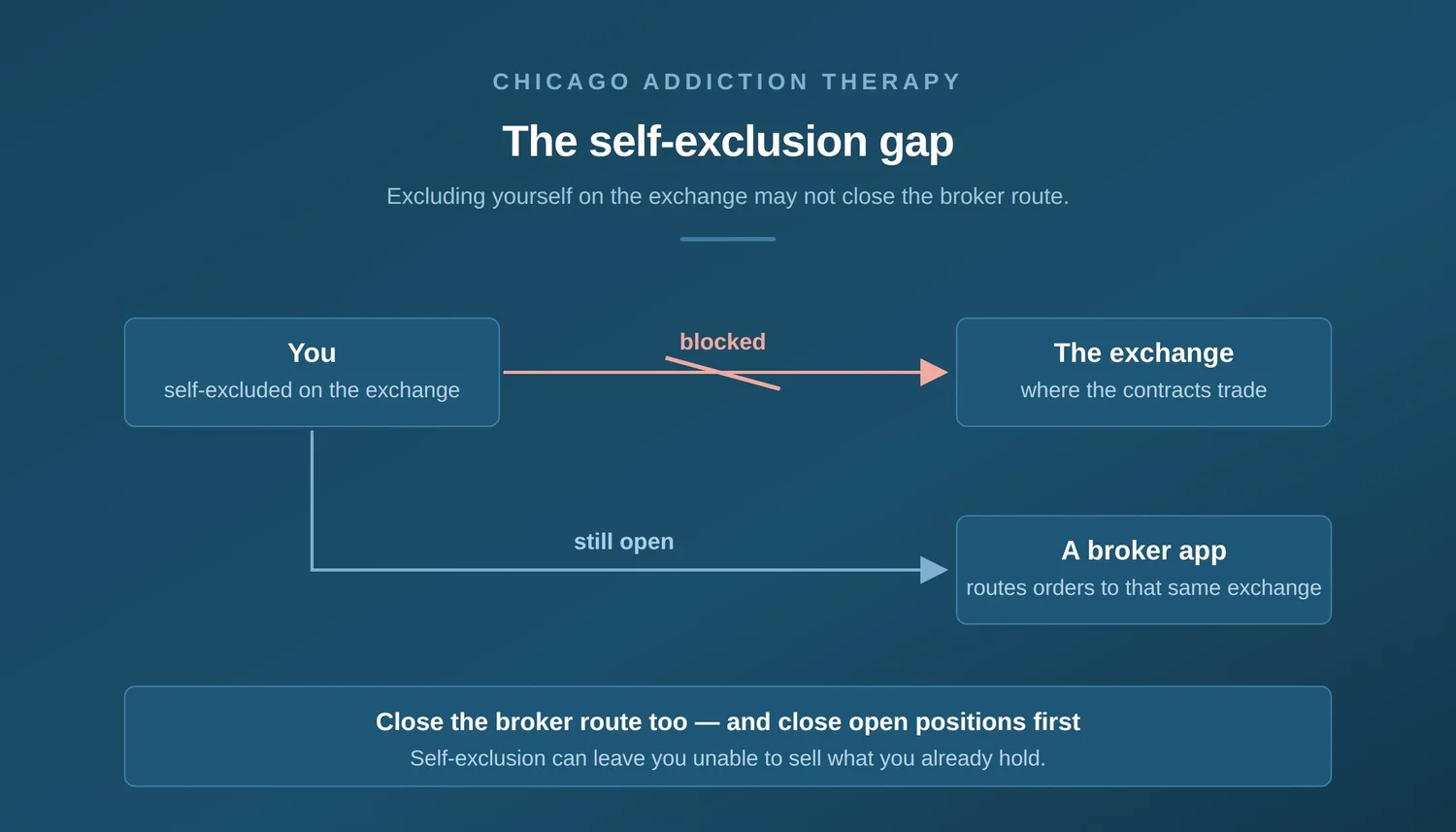
Close the broker route too, and close open positions first. If event contracts and prediction markets are part of your picture, where prediction markets sit relative to gambling covers the platforms and their exclusion rules in detail. If they're the main problem, my page on prediction market addiction therapy covers treatment for them specifically. For the step-by-step version — every platform, in the right order — see how to self-exclude from prediction markets. If you want to close every route at once rather than one at a time, the 24-hour shutdown plan walks through blocking the apps, locking down the devices and cutting off the money in a single day. It is written for sports betting, but the money and device steps apply the same way to a brokerage account.
What Therapy Looks Like for Trading Specifically
The general shape of how I work — mapping the cycle, cognitive behavioral therapy for the thinking, acceptance and commitment therapy for the urges — is on my gambling addiction therapy page. Four things are particular to trading.
We deal with the account, not just the urge. There is no self-exclusion list for a brokerage the way there is for Illinois casinos and sportsbooks, so access control has to be built by hand: taking the app off your phone, stepping down or surrendering options and margin approval, moving the bulk of your money somewhere with friction between you and it, adding a second person to accounts, and deciding in advance what happens to a windfall.
We separate investing from trading. Most people arrive braced to be told to liquidate everything, which is one reason they wait so long to ask. That is usually not the plan. Long-term holdings you never touch are not the problem; the problem is the account you check forty times a day. Drawing that line clearly, in writing, is often the first thing that makes the situation feel workable.
We work on the arithmetic that keeps you in. "I only need one good week to be back to even" is the most expensive sentence in this whole pattern, and it is usually wrong in a way worth working through on paper rather than arguing about.
We deal with the secrecy, and with your partner. Trading losses tend to stay hidden longer than gambling losses, because the account looks legitimate and the statements look like ordinary adult financial life. That means the disclosure conversation is usually bigger by the time it happens. If it is useful, I will work with you on what and how much to say, and I can bring your partner into sessions.
One thing worth naming plainly: a large, sudden loss is a genuinely dangerous moment, and thoughts of hurting yourself after one are more common than people expect. If that is where you are, please call or text 988 — and treat it as a reason to reach out sooner, not a reason to wait until you have it under control.
Who I Work With
I'm Chris Beerman, MSW, LCSW, CADC — an addiction therapist in Chicago. Gambling is a primary focus of my practice, and high-risk trading sits inside it.
I work with adults dealing with day trading, options, leveraged and inverse ETFs, crypto, margin, and event contracts on prediction markets. Some of my clients also bet on sports; for a lot of people the two run on the same underlying pattern, and it makes no sense to treat them separately. I also work with partners and family members trying to work out what to do about the money and the secrecy.
How It Works
Start with a free 15-minute consultation. You can tell me what has been going on, ask whatever you want to ask, and get a sense of whether I'm the right fit. You don't need to have it organized first, and you don't need to have decided anything.
In person or online. I see clients in person in Logan Square, Chicago, and online throughout Illinois and Minnesota.
It's confidential. Therapy is confidential, subject to the limited exceptions required by law. If privacy is the thing making you hesitate — because of your job, your license, or how much you have hidden — you can ask me about it before you book anything.
Cost and Coverage
I'm in-network with Aetna, Blue Cross Blue Shield of Illinois, Blue Cross Blue Shield of Minnesota, Cigna, UnitedHealthcare, Oscar, and Oxford, through Headway. If you're using out-of-network benefits, I can provide superbills. You can check your coverage and book online with Headway.
Illinois residents may also qualify for state-funded gambling disorder treatment through IDHS’s Division of Behavioral Health and Recovery, regardless of insurance status. In July 2026, Illinois added gambling disorder to the state's Substance Use Disorder Act, which expanded what state-funded services can cover. It did not make gambling treatment Medicaid-eligible, so it is worth asking about specifically rather than assuming.
Frequently Asked Questions
Is trading addiction a real diagnosis?
Not as its own diagnosis. Gambling disorder is the recognized one, and compulsive trading is usually assessed within that framework — though a 2025 review of the literature makes the fair point that the field has borrowed the gambling model without establishing that trading is the same thing. In practice this matters less than it sounds: what gets assessed is the consequences, across your finances, work, health and relationships.
What if I'm actually good at it?
Then that is worth taking seriously, and it does not answer the question. Skill and compulsion are not opposites. The useful test is not whether you can win; it is whether you can follow your own plan, and whether you can stop for a defined stretch of time having said in advance that you would.
Do I have to stop trading completely?
Not necessarily, and I won't decide that for you in the first session. For some people a full stop is what finally works. For others, keeping long-term investments while closing the accounts that enable day-to-day action is enough. What I will do is be straight with you about which one your situation looks like, and revisit it honestly if the middle path isn't holding.
What about the debt, the margin calls and the taxes?
Therapy is not financial planning, and I'm not an advisor. We deal with the psychological parts — the pressure to win it back, the shame that makes the real number hard to say out loud, decisions made from panic — and I can point you toward nonprofit credit counseling. Realized gains and losses are worth a conversation with an actual accountant, and worth having sooner than most people do.
Does crypto count?
Yes, and it is common. Twenty-four-hour markets, no closing bell, and leverage available to anyone remove most of the natural stopping points that even day trading still has.
Keep Reading: Trading
- Is day trading gambling?: how to tell the difference
- Crypto trading addiction: signs and treatment
- Are prediction markets gambling?: event contracts and the trading mindset
- How to self-exclude from prediction markets: Kalshi, Polymarket, Robinhood and more
- How to stop chasing losses: the same pull behind revenge trading
- Gambling debt and financial recovery
- High-functioning addiction in professionals
Need Support Right Now?
Free, confidential support is available 24/7.
Illinois gambling helpline — 1-800-GAMBLER. You can also text GAMB to 833234.
National Problem Gambling Helpline — call or text 1-800-MY-RESET, or chat at 1800myreset.org.
If you're in a mental health crisis or thinking about suicide, call or text 988. If you're in immediate danger, call 911.
Ready to Talk?
You don't need to have hit a margin call, and you don't need to have decided what you're going to do about it.
Start with a free 15-minute conversation.
Schedule a Free 15-Minute Consultation
Chris Beerman, MSW, LCSW, CADC · Chicago Addiction Therapy · Logan Square, Chicago · Serving Illinois and Minnesota