
Sports Betting Addiction Therapy in Chicago
Therapy for adults whose sports betting has stopped feeling like entertainment. In person in Logan Square, Chicago, and online throughout Illinois and Minnesota.
Sports betting used to require a trip somewhere. Now it is a tab on your phone that never closes, and the bet does not end when the game starts — it keeps reopening on every drive, every possession, every at-bat. That is the part people underestimate when they promise themselves they will cut back.
If betting has started costing you money you did not plan to lose, sleep, or the ability to watch a game without needing something riding on it, that is worth taking seriously before it gets more expensive.
Schedule a Free 15-Minute Consultation
Not ready to talk yet? Start with my step-by-step guide to how to stop sports betting, or take the free gambling addiction test — it is anonymous, and nothing you answer leaves your device.
Signs of a Sports Betting Problem
Do you check lines or place bets throughout the day, even at work or during family time?
Constant checking is one of the clearest early signs. Betting apps are built to keep you engaged around the clock, and live odds give you a reason to look every few minutes.
Have you increased your bet sizes, or added more parlays and more games, to get the same rush?
That is tolerance. Needing bigger or riskier action to feel what a smaller bet used to give you is a core feature of a developing problem, not a sign you have gotten more sophisticated.
Do you bet to chase a loss, or keep betting after telling yourself you would stop?
Chasing and breaking your own limits are the two clearest signs that the betting is running you rather than the other way round. Chasing is also where a manageable problem becomes a serious one fastest.
Has betting affected your finances, sleep, or relationships — even if you have not fully admitted it to anyone?
Consequences do not always arrive on schedule, whether you bet through DraftKings, FanDuel, BetMGM, Caesars, ESPN Bet, Fanatics, or a prediction market. Hiding how much of it there is, is itself one of the signs.
Those four questions are the short version. The free gambling addiction test on this site is the full one — nine scored questions from the Problem Gambling Severity Index, no email required, nothing stored.
Why This Is Harder to Stop Than It Used to Be
Three things changed at once, and all three work against you.
The pause disappeared. In-game and live betting removed almost all of the gap between an urge and a wager. There is no walk to a window, no waiting for kickoff, no friction at all — and friction is most of what used to stop people acting on a bad idea at 9pm.
The number of doors went up. Blocking yourself on one sportsbook does not close the others, and sportsbook self-exclusion does not reach prediction markets, daily fantasy, or a brokerage app offering event contracts. Real access control means closing several doors, not one.
The volume went up around you. In the study most often cited on this, published in JAMA Internal Medicine in 2025, searches for gambling help rose about 23% nationally after the Supreme Court cleared the way for legal sports betting — and Illinois ran about 35% higher than the model predicted. Separately, the 2021 statewide assessment commissioned by Illinois DHS (published 2022) put 3.8% of Illinois adults, roughly 383,000 people, in the problem-gambling range, with another 7.7% at risk. Illinois has not published a newer statewide study, so it is unclear how current prevalence compares. What has kept growing is the betting itself: Illinoisans wagered $15.4 billion and lost $1.48 billion with licensed sportsbooks in the year to June 2026, almost all of it on phones — the monthly series, operator shares and hold are on the Illinois sports betting data page.
None of this makes the problem a character flaw. It makes it a design problem, which is a better kind of problem to have, because designs can be changed.
The Football Week Is the Trigger
Relapse in sports betting rarely happens on an ordinary Tuesday. It happens on a schedule, and in the fall the schedule resets every few days.
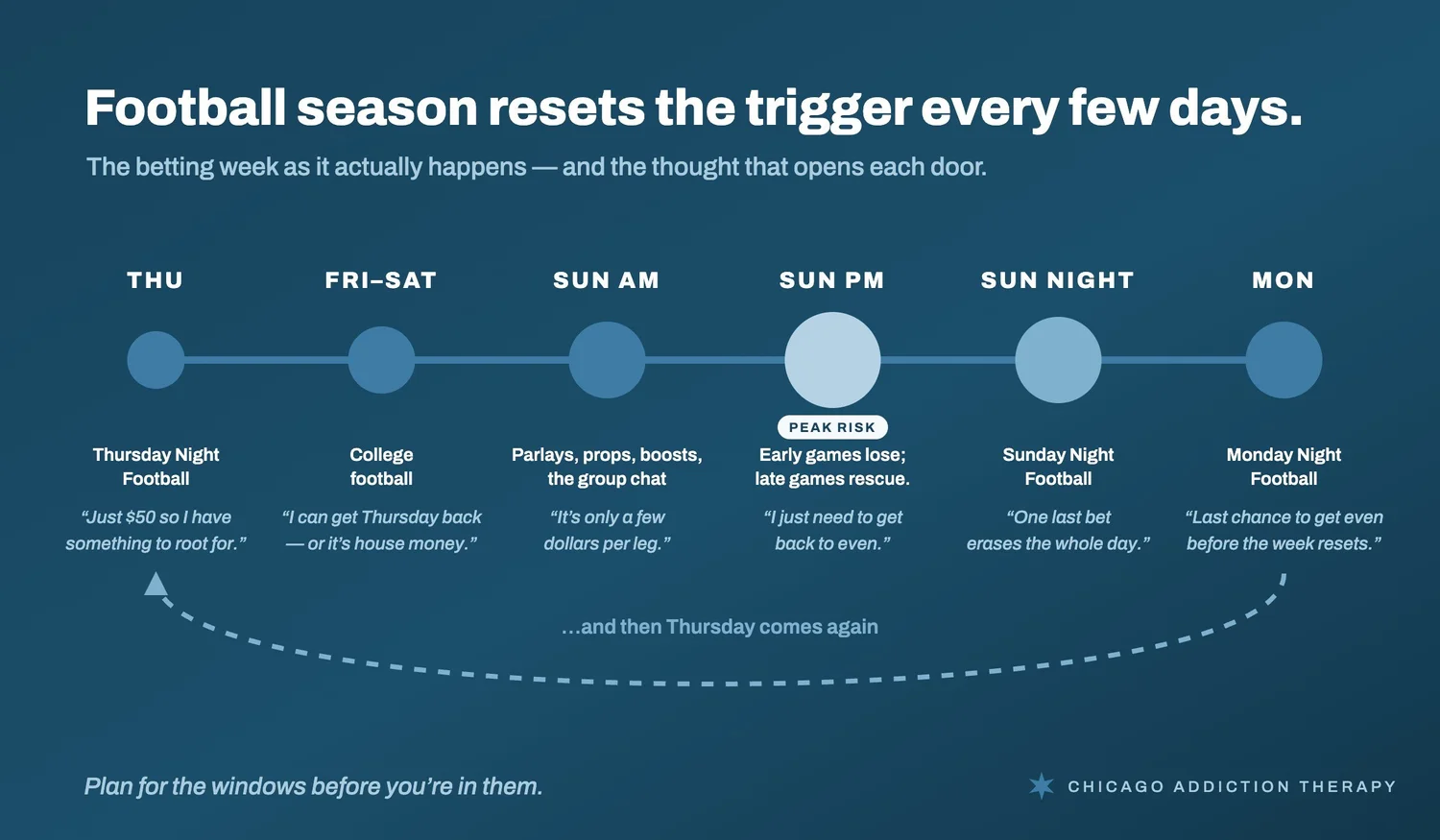
Thursday night gives you a reason to open the app. Saturday college games keep it open. Sunday morning is when the parlay gets built, Sunday afternoon is when the chase starts, and Monday night is the last chance to get even before the week begins again. Knowing your own version of this map is most of what a relapse plan is.
What Therapy Looks Like for Sports Betting Specifically
The general shape of how I work — mapping the cycle, cognitive behavioral therapy for the thinking, acceptance and commitment therapy for the urges — is on my gambling addiction therapy page. Four things are particular to betting.
We start with access, not willpower. Insight does not hold up well against a phone during a game. Early sessions deal with deposit limits, removing stored payment methods, blocking software, who can see the accounts, and self-exclusion. Illinois runs a free self-exclusion program through the Illinois Gaming Board covering Illinois casinos and sports wagering; enrollment is in person, and five years is the floor rather than the term. My Illinois self-exclusion guide covers how it actually works, and the free 24-hour betting shutdown plan is something you can start today without talking to anyone.
We close the back doors too. People self-exclude from sportsbooks and then find the same action on a prediction market or through a broker. If that is part of your picture, prediction markets and where they sit relative to gambling is worth reading, and it is worth naming in session rather than discovering in January. If prediction markets have become the main problem, my page on prediction market addiction therapy covers treatment for them specifically.
We build the plan around the calendar. Football season, March, the playoffs, a Sunday with nothing else in it. We name your high-risk stretches in advance and decide what happens during them before they arrive.
We work out what watching sport is going to look like now. This is the question people are most reluctant to raise, and the one that most often decides whether a change holds. For some people the answer is watching with friends and nothing riding on it; for others, stepping back from the sport for a season is what makes it possible. It is a real question and it deserves a real answer, not a lecture.
Who I Work With
I'm Chris Beerman, MSW, LCSW, CADC — an addiction therapist in Chicago, and gambling is a primary focus of my practice. Sports betting is the most common thing I see.
I work with adults. Most of my clients have never had a problem inside a casino; the betting happens on a phone, alone, and often at night. I also work with partners and family members trying to work out what to do — how to set a boundary, whether to take over the finances, and how to help without making it easier for the betting to continue.
How It Works
Start with a free 15-minute consultation. You can tell me what has been going on, ask whatever you want to ask, and get a sense of whether I'm the right fit. You don't need to have it organized first, and you don't need to have decided anything.
In person or online. I see clients in person in Logan Square, Chicago, and online throughout Illinois and Minnesota.
It's confidential. Therapy is confidential, subject to the limited exceptions required by law. If privacy is the thing making you hesitate — because of your job, your license, or how much you have hidden — you can ask me about it before you book anything.
Cost and Coverage
I'm in-network with Aetna, Blue Cross Blue Shield of Illinois, Blue Cross Blue Shield of Minnesota, Cigna, UnitedHealthcare, Oscar, and Oxford, through Headway. If you're using out-of-network benefits, I can provide superbills. You can check your coverage and book online with Headway.
Illinois residents may also qualify for state-funded gambling disorder treatment through IDHS’s Division of Behavioral Health and Recovery, regardless of insurance status. In July 2026, Illinois added gambling disorder to the state's Substance Use Disorder Act, which expanded what state-funded services can cover. It did not make gambling treatment Medicaid-eligible, so it is worth asking about specifically rather than assuming.
Frequently Asked Questions
Do I have to quit betting completely?
Not necessarily, and I won't decide that for you in the first session. For some people abstinence is the only thing that has ever worked. For others — usually earlier in the pattern, with fewer consequences — regaining control is realistic. What I will do is be straight with you about which one your situation looks like, and revisit it honestly if a moderation attempt isn't working.
I only bet small amounts. Is this still worth talking about?
Yes. The size of the bet is a poor measure of the problem. How much of your attention it takes, what happens when you try to stop, and what you are doing to keep it hidden are better ones.
What about the debt?
Therapy is not debt counseling, and I'm not a financial advisor. But money is usually the loudest thing in the room. We deal with the psychological parts — the pressure to win it back, the shame that makes the real number hard to say out loud, the decisions made from panic — and I can point you toward nonprofit credit counseling for the rest. My guide to recovering financially after gambling losses covers the debt side in full.
Is it too late if I've already tried to stop several times?
No. Repeatedly failing at controlled betting is useful information rather than evidence about you. Most people who come in have already deleted the apps more than once.
Keep Reading: Sports Betting
Stopping
- How to stop sports betting: a practical game plan
- The 24-hour betting shutdown plan: what to do today, free PDF
- How to self-exclude from sports betting in Illinois
What keeps you betting
- Parlay addiction: why same-game parlays are so hard to stop
- How to quit sports betting when all your friends bet
- Sportsbook promos and VIP offers: what the bonuses are really saying
Prediction markets
- Are prediction markets gambling?
- How to self-exclude from prediction markets: Kalshi, Polymarket, Robinhood and more
The numbers
Need Support Right Now?
Free, confidential support is available 24/7.
Illinois gambling helpline — 1-800-GAMBLER. You can also text GAMB to 833234.
National Problem Gambling Helpline — call or text 1-800-MY-RESET, or chat at 1800myreset.org.
If you're in a mental health crisis or thinking about suicide, call or text 988. If you're in immediate danger, call 911.
Ready to Talk?
You don't need to hit a bottom first, and you don't need to have decided what you're going to do about it.
Start with a free 15-minute conversation.
Schedule a Free 15-Minute Consultation
Chris Beerman, MSW, LCSW, CADC · Chicago Addiction Therapy · Logan Square, Chicago · Serving Illinois and Minnesota