
Therapy, IOP, Rehab, or Detox? How to Choose Alcohol Treatment in Chicago
By Chris Beerman, MSW, LCSW, CADC · Chicago Addiction Therapy · Reviewed September 2026
You know something needs to change about your drinking. Figuring out where to get help can feel like a second problem on top of the first. Search for alcohol treatment in Chicago and you will find therapists, hospital programs, intensive outpatient programs, residential facilities, and a wall of advertisements for detox. Many of them use the same language. It can be hard to tell what they actually provide, or which one you need.
The right starting point is not a program name. It is an assessment of four things: your medical safety, your drinking pattern, your mental health, and the support you have outside of treatment. Some people can begin with outpatient therapy. Others need more frequent care, or medical withdrawal management first.
I am an addiction therapist in Chicago, and my background includes work across detox, residential treatment, and outpatient care. Today I provide outpatient alcohol addiction therapy in Logan Square and online throughout Illinois and Minnesota. That history shapes one part of how I work that I think matters here: being honest about what weekly therapy can reasonably provide, and about when someone needs more than I offer.
You do not have to know the right program before you ask for help. But understanding the differences makes that first conversation more useful, and it makes you harder to sell to.
Alcohol treatment options at a glance
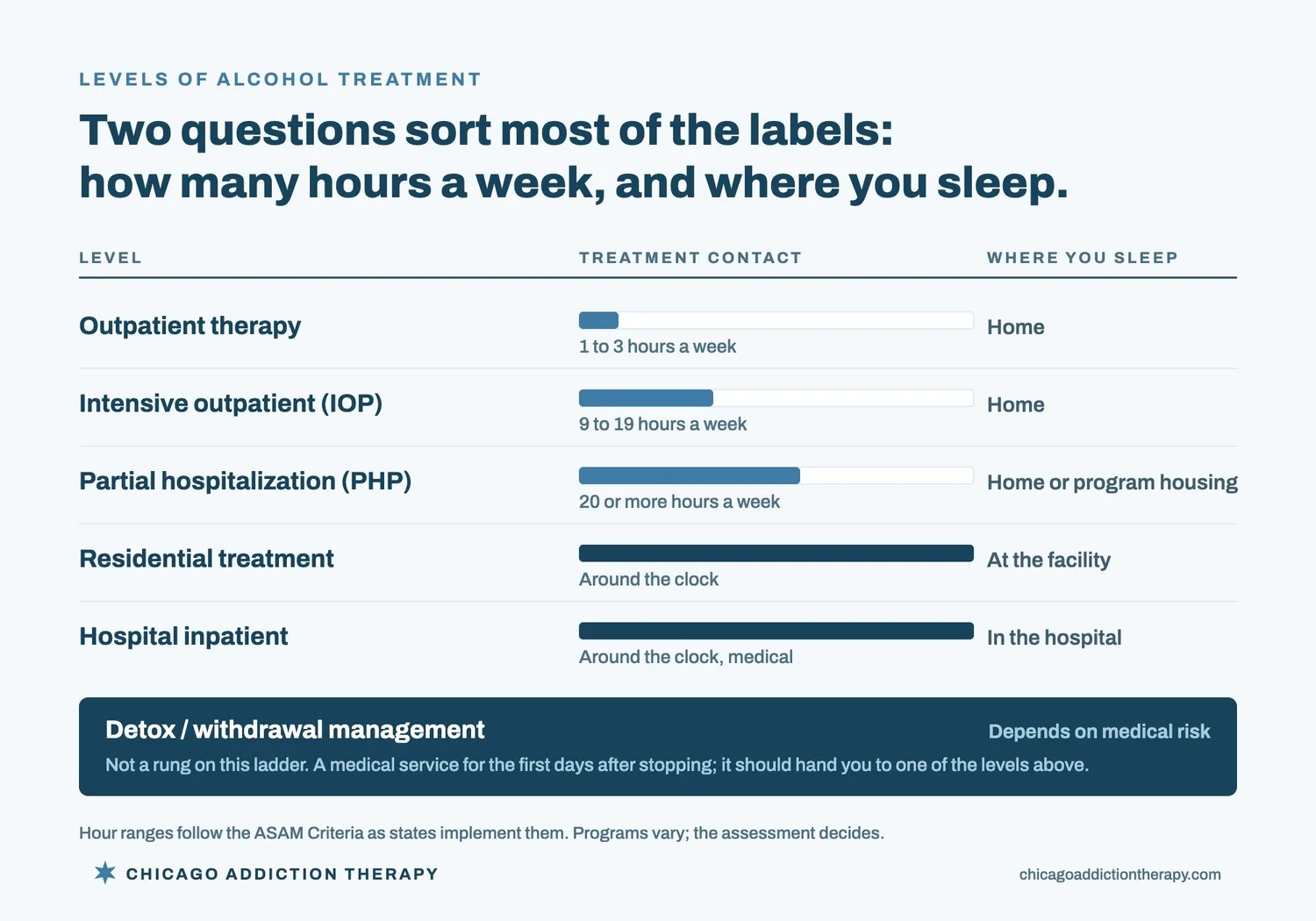
Treatment names describe different things. Some refer to where you sleep. Others refer to how many hours of care you receive in a week. One refers to a specific medical service. Here is the short version.
Outpatient therapy
Scheduled individual, group, or family sessions, usually one to a few hours a week, while you live at home. Medical care, if you need it, is coordinated separately.
Intensive outpatient program (IOP)
Several treatment sessions each week, mostly in groups, with more structure than ordinary appointments. You live at home and often keep working. States that implement the ASAM Criteria typically define IOP as roughly 9 to 19 hours of clinical services a week (Colorado HCPF summary of the ASAM Criteria, 4th edition).
Partial hospitalization program (PHP)
A fuller daytime schedule, generally 20 or more hours a week, while you return home or to separate housing overnight. ASAM’s fourth edition calls this level high-intensity outpatient, which is a more accurate name.
Residential treatment
A staffed, 24-hour treatment setting with a structured daily schedule. You live at the facility for the length of the program.
Hospital inpatient care
Around-the-clock medical or psychiatric treatment in a hospital, for needs that require hospital-level care.
Detox, or withdrawal management
Assessment, monitoring, and treatment of alcohol withdrawal. Where it happens depends on your medical risk and on what the service actually provides, which varies more than the ads suggest.
These are broad descriptions. Staffing, schedules, medical capability, and the actual content of a day vary from program to program. The National Institute on Alcohol Abuse and Alcoholism describes the same range, from outpatient through intensive outpatient, residential, and medically directed inpatient care, in its Alcohol Treatment Navigator.
“Rehab” is the least precise word on the list. When a friend, a doctor, or an admissions line recommends it, ask whether they mean residential treatment, an outpatient program, or something else entirely.
First, find out whether you need medical attention
If you may be physically dependent on alcohol, the first question is not which program to choose. It is whether reducing or stopping could cause dangerous withdrawal.
Tell a medical professional if you have experienced shaking, sweating, vomiting, or a racing heart when alcohol wears off; if you drink to relieve those symptoms; or if you have ever had a withdrawal seizure or delirium tremens.
Do not abruptly stop heavy, sustained drinking, and do not attempt a home taper based on an article, including this one. A clinician needs to assess your risk and recommend a setting that matches it.
If you are already experiencing possible withdrawal, seek prompt medical attention. Seizures, hallucinations, or severe confusion require emergency care: call 911 (MedlinePlus: Alcohol Withdrawal).
A therapy consultation cannot provide medical clearance. If you call me first, this is the conversation we will have before anything else.
Detox treats withdrawal. Recovery needs a plan for what comes next.
Withdrawal management can happen in an outpatient medical setting or an inpatient one, depending on your risks and the support you have at home. Outpatient withdrawal care still involves clinical supervision and medication; it is not the same as stopping on your own.
The American Society of Addiction Medicine’s clinical guideline is direct on the point that matters most: withdrawal management alone is not an effective treatment for alcohol use disorder. It should connect you to ongoing care (ASAM Clinical Practice Guideline on Alcohol Withdrawal Management).
Before you leave withdrawal care, ask four questions:
Who will provide my ongoing treatment?
When is the next appointment, and is it already scheduled?
Who will manage any medications I am leaving with?
What should I do if symptoms return, or if I start drinking again?
Getting through withdrawal is a real accomplishment. The next step deserves planning before you go home, not after.
When outpatient alcohol therapy may fit
Outpatient therapy can be appropriate when an assessment indicates that you can safely participate in treatment while living in your usual environment. That is the population I work with, and the honest version of who it suits is narrower than the marketing version.
In individual sessions there is room to examine your specific drinking pattern: when it happens, what alcohol does for you, what you have already tried, and where your intentions tend to change. Someone might arrive wanting to understand repeated weekend binges. Someone else wants help holding on to changes after a more intensive program. A third person is still asking whether moderation is realistic for them.
The work can include planning for the situations where you drink, examining the beliefs underneath the drinking, addressing anxiety or shame, and making practical changes at home and in relationships. Cognitive behavioral therapy and motivational approaches both have good evidence behind them (NIAAA: Treatment for Alcohol Problems).
The important question is what happens between appointments. Are you able to use what we discuss? Can you attend consistently? Is the plan producing change you can see? Do you have enough support during the hours when drinking is hardest to control?
Having a job and keeping appointments are real strengths. They do not, by themselves, establish that weekly therapy is enough. I have written elsewhere about how a successful career can hide a serious drinking problem; functioning well at work is not the same as being safe at home on a Friday night.
If you are still one question earlier, unsure whether your drinking is a problem at all, start with the free alcohol use test or my guide to how to tell if you have a drinking problem when your life still looks fine. If you have decided something has to change and are weighing moderation against quitting, that is a conversation outpatient therapy is built for.
When to consider an intensive outpatient program
An IOP provides more frequent, structured treatment while you continue living at home. Programs commonly combine group work with individual sessions and other services, but the actual mix varies, and so does the quality.
The practical difference from therapy is the amount of contact and support available across the week. An IOP is worth discussing when individual therapy keeps leaving a gap: you understand the plan during the appointment and repeatedly cannot carry it through before the next one. It is also a common step down after residential treatment.
Before enrolling, ask what a week actually looks like:
Which days and hours are required, and for how many weeks?
How much individual attention is included, as opposed to group time?
Who provides medical and psychiatric care, and is it on site?
What happens if you miss a session or return to drinking?
How does the program coordinate with an outside therapist, if you already have one?
In Illinois, licensed substance use treatment services use an initial assessment, based on the ASAM Criteria, to guide placement and movement between levels of care (Illinois Department of Human Services: Substance Use Services).
For a Chicago-area program, consider the real commute at the scheduled time. A program you can reliably reach at 6 p.m. on a Tuesday is more useful than one that looks manageable on a map.
What about partial hospitalization?
A partial hospitalization program, often called PHP or day treatment, generally provides a fuller daytime schedule than an IOP, and the newer ASAM language of high-intensity outpatient describes it better.
Despite the name, participants do not usually sleep in a hospital. Ask where treatment takes place, how much of the day it occupies, and what medical services are available on site.
The central question is whether you need substantial daytime structure while remaining safe outside the program overnight. That takes an assessment; it cannot be settled by comparing schedules. If a program offers separate housing, clarify whether it is included, what supervision exists there, and how it differs from residential treatment.
When residential treatment may be appropriate
Residential treatment provides care in a setting where you live at the facility. Its distinctive feature is the chance to receive treatment inside a structured environment through the day and the night.
A recommendation for it may reflect concern about your ability to make progress safely where you currently live. It should come with a clear explanation of what the residential setting will provide that outpatient care cannot. Ask that question directly:
“What specific need makes living at the facility appropriate for me?”
Also ask about medical staffing. A residential program should not be assumed to have hospital-level capability or to manage complicated withdrawal.
A useful assessment weighs medical and psychological needs alongside your environment, strengths, and available support. ASAM’s placement framework is built around six such dimensions, not one (About the ASAM Criteria).
You do not have to prove you are “bad enough” by accumulating more consequences first. You also deserve more explanation than a recommendation based on a brief phone call and an available bed.
How a clinician should help you choose
There is no number of drinks that determines whether someone needs therapy, an IOP, or residential care. A thorough conversation should cover:
Your current drinking, and what happens when you reduce it.
Previous withdrawal, treatment, and attempts to change.
Physical health, medications, and use of other substances.
Mental health symptoms and any immediate safety concerns.
Housing, relationships, and support.
Your goals, your preferences, and the practical barriers you face.
The recommendation should make sense in light of those findings, and the clinician should be able to explain it in ordinary language. What needs monitoring? Where is the current plan breaking down? What will additional treatment provide? How will we know when the level of care should change?
ASAM also recommends reassessment as your needs evolve. Placement is a clinical decision that gets revisited, not a permanent label (ASAM Criteria).
Medication can be part of the plan
You can ask about medication whether you are considering outpatient therapy or a more intensive program.
The FDA has approved three medications for alcohol use disorder: naltrexone, acamprosate, and disulfiram. None is addictive, they work best alongside counseling, and they have different uses and precautions, so a prescriber should review your goals, medical history, and other medications (NIAAA: Treatment for Alcohol Problems).
Ask: “Would medication be appropriate for me, and who would manage it?” If a program does not prescribe, ask whether it coordinates with someone who does. I am not a prescriber, but medical treatment can be coordinated with outpatient therapy, and often should be.
An Illinois option to ask about
The Illinois Helpline’s MAR NOW service connects people seeking help for alcohol or opioid use disorder with providers who prescribe medication for it. Call 833-234-6343 and ask about MAR NOW for alcohol treatment (Illinois Helpline: MAR NOW). Ask what evaluation is available, what it costs, and what follow-up involves. A prescription depends on a clinical assessment, and this service does not replace emergency withdrawal care.
Where to start looking in Chicago and Illinois
You do not need to begin with a list of facilities that call themselves the best. These resources can help you identify options and arrange an assessment:
Illinois Helpline. Call 833-234-6343 (1-833-2FINDHELP), text HELP to 833234, or visit helplineil.org. Explain that you are seeking alcohol treatment and describe your location, insurance, and transportation. You can also call about someone else.
NIAAA Alcohol Treatment Navigator. A step-by-step guide to finding providers, understanding treatment choices, and judging quality, with the questions to ask (Alcohol Treatment Navigator).
FindTreatment.gov. SAMHSA’s confidential locator for licensed treatment programs near a specific address. Contact programs directly to confirm current services, payment arrangements, and availability (FindTreatment.gov).
Your primary care provider. Ask for an alcohol-focused medical evaluation and help coordinating referrals, especially if withdrawal, medications, or other health concerns are involved.
My alcohol resources page. A vetted directory of Chicago and Illinois helplines, meetings, medication and cost help, with what to expect from each (alcohol resources for Chicago and Illinois).
When you call, you can start simply: “I’m looking for an assessment of my drinking and a recommendation about the right level of care. What does that involve?”
What to ask before committing to a program
A program should be able to describe its treatment clearly. You should understand who will work with you and what you will actually do during the hours you spend there. Useful questions include:
Why are you recommending this level of care for me?
Who conducts the assessment, and what are their qualifications?
What does a typical week include?
How do you address both alcohol use and mental health concerns?
Are medication evaluation and ongoing prescribing available?
How do you respond if someone drinks during treatment?
How do you involve family members, when appropriate and with consent?
What support is arranged when this phase of treatment ends?
These questions get you past a program’s description to the care you would actually receive. NIAAA’s Navigator offers a structured version of the same interview (Ten Questions for Alcohol Treatment Programs).
Listen for specific answers. If a provider cannot explain its recommendation or its services, ask again before making a nonurgent commitment.
Insurance, cost, and access
Treatment costs vary enormously. Ask both the provider and your insurer about coverage for the particular service, location, and clinicians involved. Before admission, clarify:
Whether the service is in-network for your exact plan.
Your deductible, copay, or coinsurance.
Whether prior authorization is required, and who requests it.
Which services are billed separately.
Whether housing, laboratory work, or medical visits add costs.
What happens financially if the treatment plan changes.
Request a written estimate when one is available. “We accept your insurance” does not tell you what you will owe.
If you are uninsured or the cost is unaffordable, ask about Medicaid, sliding-scale fees, payment assistance, and publicly funded treatment; eligibility and availability vary (NIAAA Navigator: Costs and Insurance). In Illinois, the Helpline is the front door to state-funded programs for people who cannot pay.
Do not delay emergency medical care while comparing program prices.
Plan for the week after treatment
Before choosing a program, ask how it prepares you for leaving. Who is following up? Is the appointment scheduled? Who will manage medication? What happens on the first difficult evening at home?
A discharge plan needs to fit the life you are returning to. That may include continued therapy, another level of care, medical follow-up, peer support, and practical changes in your household.
I want the plan to address the situations that brought you into treatment in the first place. If drinking happens after work, during conflict, or across the whole weekend, those parts of life need attention before the structured program ends, not after. If a partner or family member is part of the picture, they can be part of the plan too; I work with partners and families whether or not the person drinking is in treatment.
Frequently asked questions
Can I start with a therapist and move to a higher level of care later?
Yes, and it happens often. The condition is that the therapist is honest about what they see. If weekly sessions are not producing change, or if withdrawal risk or safety concerns emerge, a good therapist will say so and help you find the next level rather than keep you at a level that is not working.
Do I need to stop drinking before I can start therapy?
No. Many people begin therapy while still drinking, while questioning whether it is a problem, or while trying to moderate. What matters is that you can participate safely, which is the medical question above, and that we are honest about whether the plan is working.
Is an IOP the same as rehab?
“Rehab” has no fixed meaning. People use it for residential programs, for IOPs, and sometimes for detox. An IOP is a specific level of care: several hours of treatment a week while you live at home. Ask the person using the word which setting they mean.
What if I cannot afford any of this?
Call the Illinois Helpline at 833-234-6343 and say so. Illinois funds treatment for residents who cannot pay, through licensed community providers, and the Helpline can refer you to those programs and to sliding-scale options. Peer support meetings are free and available the same day.
Where my practice fits
I provide outpatient alcohol addiction therapy in Chicago. I do not provide medical detox, IOP, PHP, residential treatment, or emergency care, and I will tell you if what you describe calls for one of them.
We can discuss your drinking pattern, previous attempts to change, and what you need from treatment. You can begin therapy while questioning your drinking or while weighing moderation against quitting. A consultation can help establish whether my practice is a reasonable starting point; it is not a substitute for a medical assessment or a comprehensive program intake.
I see adults in person in Logan Square and online throughout Illinois and Minnesota. I am in-network with several major plans through Headway.
Schedule a free 15-minute consultation, or visit the alcohol resources page for more ways to find help.
You do not need to arrive knowing which level of care you need. You deserve an assessment, and a recommendation you can understand.
If you need help now
Illinois Helpline: 833-234-6343 (1-833-2FINDHELP), text HELP to 833234, helplineil.org. Free, confidential, 24/7.
SAMHSA National Helpline: 1-800-662-HELP (4357). Free, confidential, 24/7 treatment referral.
988 Suicide and Crisis Lifeline: call or text 988 if you are in crisis.
Emergency: call 911 for seizures, hallucinations, or severe confusion after stopping or cutting back on drinking.
This article is educational and does not replace medical advice or an individual clinical assessment. If you drink heavily or daily, talk with a physician before stopping or cutting back. Level-of-care descriptions reflect general practice and the ASAM Criteria as commonly implemented; individual programs vary.