
Online Gambling Therapy in Illinois: What to Expect From Telehealth Treatment
By Chris Beerman, LCSW, CADC — gambling and alcohol therapist, Chicago. Reviewed September 2026.
Most gambling problems I treat do not happen in casinos.
They happen on a phone.
A sportsbook is open during the commute home, on the couch, in bed at midnight, or during a slow hour at work. There is no drive, no cash changing hands, and often nobody else who can see what is happening.
Treatment does not necessarily require a drive across Illinois either.
If you are physically located in Illinois, gambling therapy can be provided by secure video. But online gambling therapy should be a great deal more than talking to someone once a week about why you ought to stop betting.
Good gambling treatment is practical. We look at what happens before the bet, how you get access to money, what happens after a win and after a loss, why the next bet starts to feel reasonable, and what has to change between sessions for the cycle to actually break.
And there is an argument for telehealth here that has nothing to do with convenience: treatment can happen in the same environment where the gambling does.
Can You Really Get Gambling Therapy Online in Illinois?
Yes.
The Illinois Telehealth Act lets a health care professional practice by telehealth within their scope of practice, and requires that care to be consistent with the standards that apply to seeing someone in person. Clinical social workers are named in the Act's own list of covered professionals.
One detail matters more than people expect:
Where you are physically sitting during the appointment is what counts — not where you live, and not where the therapist's office is. The Act requires a clinician treating a patient located in Illinois to be licensed or authorized to practice in Illinois.
So if you are in Illinois at the time of the session, I can see you under my Illinois clinical social work license, whether you are in Naperville, Rockford, Springfield, Peoria, Champaign or three miles from my office in Logan Square.
If you travel for work, that same rule is the one to keep in mind — it is worth a short conversation before you book, not a surprise on the day.
What Happens in the First Online Session?
You do not have to arrive prepared to call yourself a gambling addict.
You also do not have to have decided that you will never gamble again.
The first job is getting an accurate picture. That usually means working through questions like these:
- What are you gambling on, and how often?
- How much of your attention does it take up when you are not doing it?
- Have the bets got bigger, or more frequent?
- Are you chasing losses?
- How do you get access to money — and has any of it been borrowed?
- What have you not told your partner?
- What happens after a big loss? What happens after a big win?
- Have you tried to stop or cut down before, and what brought you back?
- Is alcohol usually involved?
- How are sleep, work, mood and your relationships doing?
- What do you actually want to change?
We may also use a validated screening measure. If you want to answer one before you ever speak to anyone, the gambling addiction test on this site is the Problem Gambling Severity Index — free, anonymous, scored instantly, no email form. A screening tool indicates severity and pattern; it is not a diagnosis, and it is one piece of an assessment rather than the assessment itself.
The point of a first session is not to frighten you with where this could end up. It is to establish how gambling currently works in your life.
What You Actually Do in Gambling Therapy
Eventually the work has to get more specific than "try not to gamble this week." Five things tend to make up most of it. The gambling addiction therapy page goes through the approach in full; this is what it looks like in practice over video.
1. Map the cycle
We want the sequence, not just the behavior. Something like: bad afternoon at work → open the app → one bet → lose → double the next one → three hours of chasing → panic → promise to stop → back on Thursday.
Once the sequence is visible, you can intervene earlier in it. The goal is not more willpower at the single moment when the urge is strongest. It is to change the run-up that keeps delivering you to that moment.
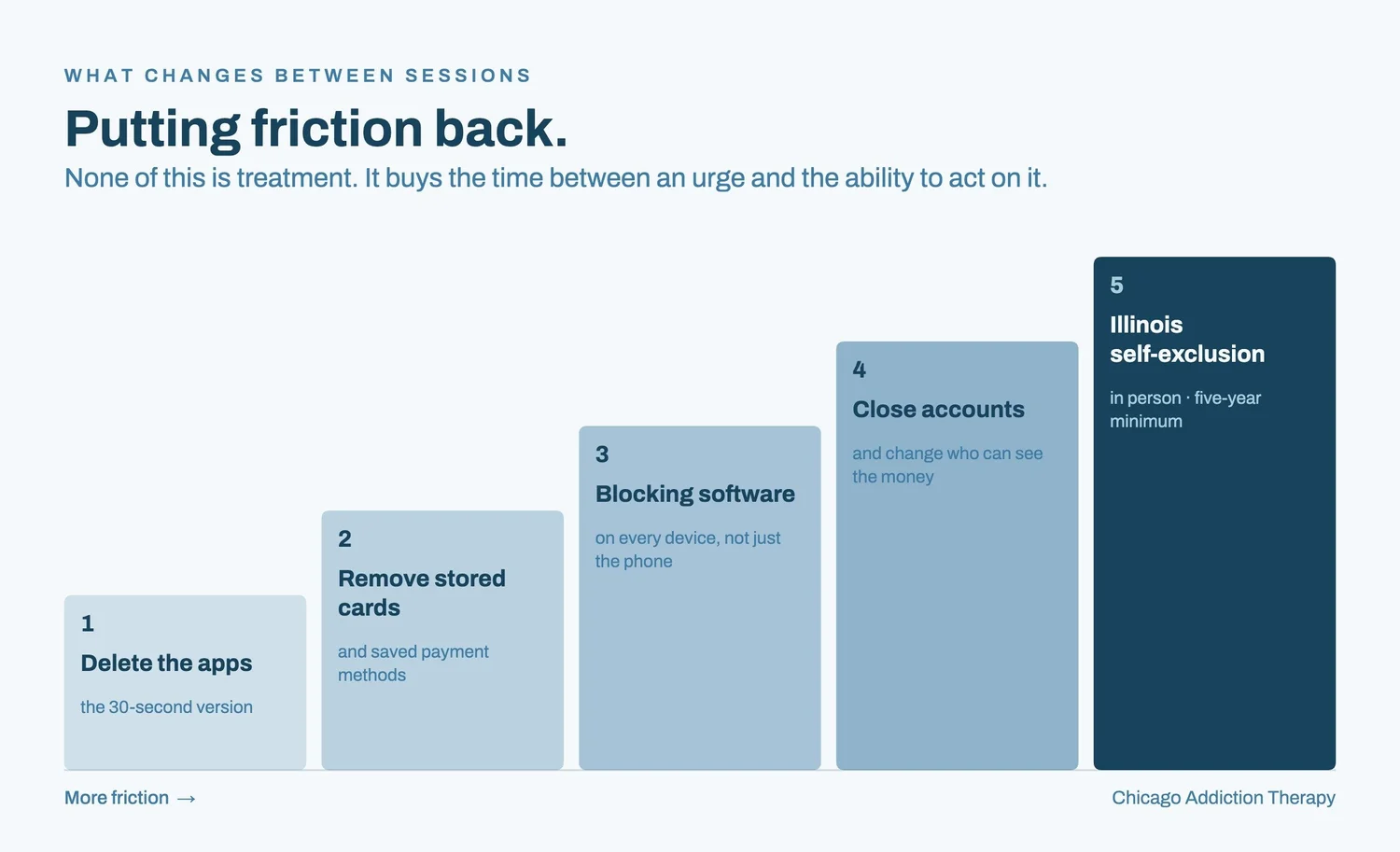
2. Put friction back
Modern gambling is engineered to remove friction: deposit in seconds, switch between books, bet live throughout a game, carry the whole thing in your pocket.
Treatment puts friction back — apps off the phone, stored cards removed, blocking software, limits, accounts closed, credit access changed, someone else with visibility over the money, and in some cases self-exclusion. None of it is a substitute for therapy. It buys the time between an urge and the ability to act on it, which is what makes the rest of the work possible.
3. Deal with chasing and the thinking behind it
A loss creates distress, and the next bet starts to look like the cure for the distress the last one caused. I just need to get back to even. One good bet fixes today. I'm due. At that point the bet is no longer a wager on an outcome — it is an attempt to make the previous loss disappear, which is why it escalates so fast. There is a whole piece on how to stop chasing your losses.
Alongside it sits the thinking: the near-misses you remember as almost-wins, the streak that feels like it must end, the win that felt like skill. The work is not arguing with yourself for hours. It is learning to notice when your brain has started generating reasons to gamble because gambling is what it wants to do.
4. Learn what to do with an urge
Urges rise and fall. If your standing response is to open an app, you may almost never have seen one all the way through. Part of treatment is finding out that an urge does not require a decision.
5. Plan for the situations you can already name
Relapse looks unpredictable afterwards. It usually was not. There was a game, a payday, a bonus, an argument, a bad day, a weekend alone, a few drinks, a push notification, or one small bet that seemed harmless. Those get identified in advance and planned for, rather than discovered again in real time.
Does Online Gambling Therapy Work?
There is gambling-specific research on this, and it is worth stating accurately rather than reassuringly.
A 2021 systematic review and meta-analysis pooled 13 randomized trials of internet-based treatment for gambling problems. It found a large pooled effect on general gambling symptoms (Hedges' g = 0.73 at post-treatment) and much smaller effects on gambling frequency (g = 0.29) and money lost (g = 0.19).
The finding I would draw your attention to is this one. Interventions with therapist support produced far larger effects than those without: g = 1.23 versus g = 0.39 at post-treatment, and the gap widened at follow-up. An app on its own and an app plus a clinician are not the same intervention.
A 2023 randomized trial then compared therapist-supported internet CBT against internet-delivered motivational interviewing for gambling disorder. Both groups improved meaningfully, and no significant difference emerged between them — though the trial was small and the authors were clear it was underpowered to detect one.
The wider evidence base for cognitive behavioral treatment of gambling harm is strong in the short term and much less certain over the longer term, which is an argument for building maintenance into the plan rather than an argument against therapy. The National Council on Problem Gambling lists online counseling among the formats gambling treatment can take, and names CBT and motivational interviewing among the approaches used.
So: online gambling treatment is not a watered-down substitute for the real thing. But the format is not what makes it work. A video call is a delivery method. What the hour contains, and whether the person on the other end understands gambling, is the part that matters.
Why Telehealth Makes Particular Sense for Gambling
The obvious advantage is that you do not have to commute to Chicago every week to see someone who specializes in this.
The more interesting one is that the gambling environment is usually right there during the session.
Your phone is there. So is the laptop, the banking app, the sportsbook accounts, the promotional emails, the notifications, and the chair you normally sit in on a Sunday. Instead of talking in the abstract about what you will do when you get home, we can do it while you are already home: work out which apps come off, find the payment method you forgot was stored, look at how the deposits actually happen, set up a blocking tool, walk through last weekend's relapse in the room where it took place.
That is the argument. The advantage of online gambling therapy is not only that you skip the drive. It is that treatment happens in the same environment as the gambling.
Telehealth also removes a very common exit: I'll deal with this when I have more time. For someone working long hours, traveling, raising children, without reliable transport, or living three hours from the nearest gambling specialist, losing the commute is often the difference between weekly treatment and no treatment.
If your gambling is mostly sports, the same logic applies with more force, because the trigger is a scheduled event you can see coming all week. There is more on that on the sports betting addiction therapy page. If it has taken the shape of options, crypto or prediction markets rather than a sportsbook, stock and options trading addiction therapy covers that version.
Do I Need a Gambling Specialist, or Will Any Online Therapist Do?
Fit with your therapist matters. So does general clinical competence. But gambling raises a set of problems that do not come up in ordinary work with anxiety or low mood.
Chasing losses. Distorted beliefs about probability. Immediate access to money at two in the morning. Self-exclusion. Financial safeguards and hidden debt. Partner involvement, and the fact that trust has usually been damaged separately from the money. Sports as a conditioned cue. Co-occurring alcohol use. And the genuinely counter-intuitive one: a big win can be more dangerous to recovery than a big loss.
The National Council on Problem Gambling suggests asking a prospective provider directly what problem-gambling-specific services they offer, what their credentials are, what their treatment approach is, what the format and duration look like, and whether family involvement is available. Those are reasonable questions to ask me too.
A therapist does not have to work only with gambling. But if gambling is why you are booking, it should not be treated as generic impulsivity.
Can Therapy Help Me Put Gambling Barriers in Place?
This is where being in Illinois actually changes the answer.
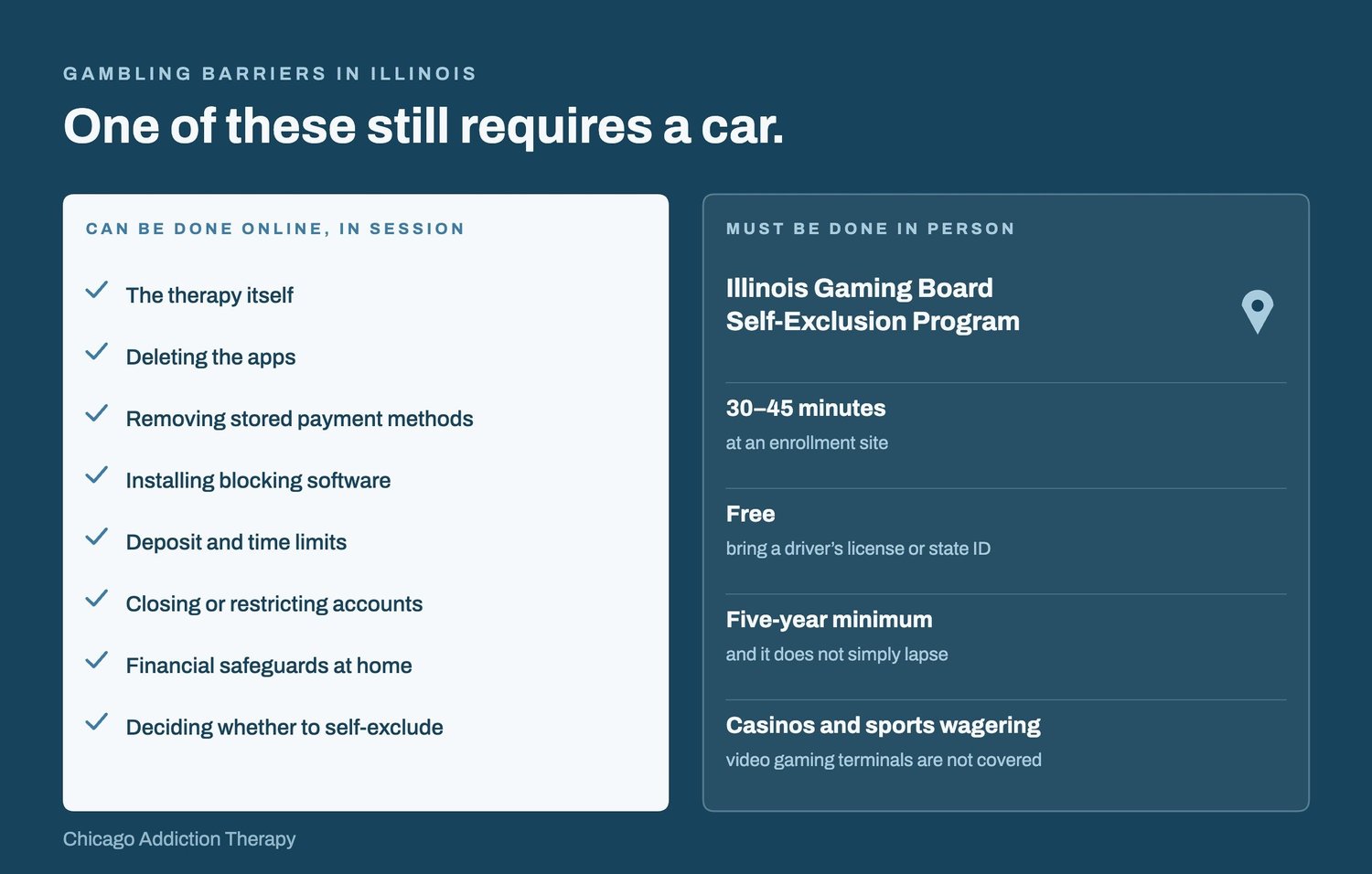
Most barriers can be set up during a session: deleting apps, removing stored cards, installing blocking software, using operator deposit and time limits, closing accounts, changing who can see the money, and deciding what a partner should have visibility over.
Self-exclusion is the exception, and the distinction is worth being precise about.
Illinois's statewide Self-Exclusion Program, run by the Illinois Gaming Board, cannot be joined online. Enrollment has to be completed in person, takes roughly 30 to 45 minutes, is free, and requires a driver's license or state ID. It covers Illinois casinos and sports wagering, and it carries a five-year minimum that does not simply lapse when the five years are up. As of March 2025 the Gaming Board reported 15,613 people on the list.
It also does not cover Illinois video gaming terminals — the machines in bars, restaurants and truck stops — which for some people is the gap that matters most. How to self-exclude from gambling in Illinois goes through the whole thing: what each program covers, what it does not, and what removal actually involves.
So the honest version is: the therapy can happen online. That particular barrier cannot. What we can do in session is decide whether it makes sense for you, work on whatever is stopping you from doing it, find your nearest enrollment site, and build it into a plan rather than treating it as the plan.
Because self-exclusion on its own does not address urges, debt, shame, boredom, alcohol, a damaged relationship or chasing. It removes one route. Those were never the same problem.
If you want something to do before your first appointment, the 24-hour betting shutdown plan is free, anonymous and designed for exactly that gap.
Privacy: Can My Employer or Family Find Out?
Telehealth carries the same professional obligations around privacy and confidentiality as any other clinical care, and the Illinois Telehealth Act requires telehealth services to comply with federal and state privacy, security and confidentiality law.
That is not the same as saying no record of anything exists. If you use insurance, billing generally creates a record that health care took place, and if you share a plan with someone, it is worth understanding what appears on their statements. If you have a specific concern — an employer, a professional license, a court matter, a security clearance — ask about it directly before treatment starts rather than assuming either way.
The practical side of telehealth privacy is more mundane and easier to get wrong. Use headphones. Find a room with a door. Do not take the session while driving. And if there is genuinely nowhere private in your home, say so — that is a solvable scheduling problem, not a reason to skip treatment.
What If I'm Not Sure I Want to Stop Completely?
You can still come.
You do not need to have accepted a label or committed to lifetime abstinence to book a first appointment. People start from all of these:
I think this is getting out of hand. My wife thinks I have a problem. I want to stop chasing. I want to find out whether I can control it. I'm not ready to give up football. I honestly don't know what I want yet.
All of those are workable starting points. My job is not to make you say something you do not believe — and it is also not to agree that a pattern is working when your own account of it says otherwise. If you have repeatedly set limits and not kept them, that is information, and we should treat it as information rather than as a character flaw.
If gambling has already produced debt, that is a related problem but not the same one, and the sequencing matters: I have to win some of it back first is chasing, and it is how a serious financial problem becomes a much larger one. Recovering financially after gambling losses covers that side. If you are reading this about someone else rather than yourself, the guide for partners is the better starting place.
When Online Therapy May Not Be Enough
Telehealth outpatient therapy suits a lot of people. It is not automatically the right level of care for everyone.
You may need more, or something different, if there are acute suicidal thoughts or you cannot keep yourself safe; severe depression or psychiatric instability; a need for residential or inpatient treatment; severe co-occurring substance use, particularly where withdrawal could be dangerous; an unsafe or unstable living situation; no private space at all; or a situation where no meaningful barrier to continued gambling can be put in place.
Large gambling losses can produce shame and panic very fast, and the risk that comes with them is real. If you are in a mental health crisis or thinking about suicide, scheduling therapy is not the first step — call or text 988. If you are in immediate danger, call 911.
How to Start
It is deliberately short:
- A free 15-minute consultation. You describe what is happening; I tell you whether I think I can help and what I would suggest.
- A first full session, which is the assessment described above.
- Weekly to begin with, where that makes sense, then less often as things stabilize.
I provide individual gambling therapy by telehealth to adults physically located in Illinois, and in person in Logan Square, Chicago. That includes sports betting, online casino play, traditional casino gambling, and gambling-like patterns in options, crypto and other high-risk speculation.
You do not have to wait for the losses to get bigger. You do not have to prove you have hit bottom. And you do not need a finished plan before you ask — the first step is just getting an accurate picture of what is happening and deciding what you want to do about it.
Email me to set up a consultation, or if you would rather start anonymously, take the gambling addiction test first.
If you are in Minnesota rather than Illinois, the same work is available to you and there is a companion piece covering it — including the state-funded option Minnesota runs, which is worth reading before you pay anyone privately: online gambling therapy in Minnesota.
Common Questions
Is this a virtual gambling treatment program?
Not in the sense that phrase usually carries. A "treatment program" generally means a structured, multi-week service: an intensive outpatient program with several group sessions a week, or a state-funded provider working under an Illinois Department of Human Services contract. What I offer is private-practice therapy — individual sessions with one gambling specialist, held remotely by video, scheduled around your week rather than a fixed curriculum. For many people that is the better fit: the work is tailored, nothing is pre-set, and it does not involve telling an employer you are in a program. For others — particularly when the gambling is daily, the money is in freefall, or there is heavy drinking alongside it — more structure is the right call, and I will say so in the first session rather than keep you in a format that is not enough. If cost is what is behind the question, Illinois funds gambling treatment for residents through state-contracted providers; the gambling resources page explains how to reach that route and the helpline that connects you to it. For a side-by-side look at every level of care in the state, see Illinois gambling treatment options.
What if I travel for work?
Tell me where you will physically be. A clinician generally has to be licensed or authorized in the state where the client is located at the time of the session, so a week in another state may mean rescheduling rather than dialing in. It is a normal thing to plan around, and much easier to sort out in advance than on the morning of the appointment.
Do I need to live in Chicago?
No. Telehealth is what makes it possible to work with a gambling specialist from anywhere in Illinois without driving to Chicago. What matters for licensure is where you are sitting during the session.
Do I have to stop gambling before my first appointment?
No. Part of what the first appointment is for is working out what kind of change is realistic and what you actually want. You do not need to arrive abstinent.
Can a therapist put me on the self-exclusion list?
No. Illinois self-exclusion is voluntary, and the Gaming Board requires you to enroll in person yourself. What therapy can do is help you decide whether to, and deal with whatever is making it hard.
Is online gambling therapy only for sports betting?
No. It covers casino games, online casinos, poker, slots and other gambling, and also stock, options, crypto and prediction-market behavior once it starts working like gambling.
How do I know if it is serious enough for therapy?
There is no loss threshold you have to reach first. Repeated failed attempts to cut down, chasing, secrecy, preoccupation, rising stakes, debt and difficulty keeping your own limits are all reasons to take it seriously now rather than later.
If You Need Help Right Now
Gambling — In Illinois, 1-800-GAMBLER, or text GAMB to 833234. Nationally, the National Council on Problem Gambling operates the National Problem Gambling Helpline at 1-800-MY-RESET (1-800-697-3738), free and confidential, call, text or chat, 24/7.
In crisis — call or text 988 for the Suicide and Crisis Lifeline.
More options, including blocking software and money tools, are on the gambling resources page.
This article is for general information and is not medical or legal advice, and it does not create a therapist-client relationship. Screening tools indicate risk; they do not diagnose. Illinois Gaming Board rules can change — confirm current requirements with the Board before enrolling in self-exclusion.
Research and Sources
Illinois telehealth law — Telehealth Act, 225 ILCS 150. Section 5 defines "health care professional" and names clinical social workers among the professions covered. Section 10 provides that a health care professional treating a patient located in Illinois through telehealth must be licensed or authorized to practice in Illinois. Section 15(a) limits telehealth to the clinician's scope of practice and requires it to be consistent with the standards of care for in-person services; Section 15(b) requires consistency with all federal and State privacy, security and confidentiality laws.
Effectiveness of internet-based gambling treatment — Sagoe D, Griffiths MD, Erevik EK, et al. "Internet-based treatment of gambling problems: a systematic review and meta-analysis of randomized controlled trials." Journal of Behavioral Addictions. 2021;10(3):546–565. Thirteen randomized trials. Post-treatment Hedges' g = 0.73 (95% CI 0.43–1.03) for general gambling symptoms, 0.29 (0.14–0.45) for gambling frequency, 0.19 (0.11–0.27) for money lost. Therapist-supported interventions g = 1.23 versus 0.39 without support at post-treatment, and 2.03 versus 0.33 at follow-up. The authors note high attrition (only 3 of 13 trials retained more than 80%), limited long-term follow-up data, and no probability sampling in any included study.
Internet CBT versus internet motivational interviewing — Mide M, et al. "Internet-delivered therapist-assisted cognitive behavioral therapy for gambling disorder: a randomized controlled trial." Frontiers in Psychiatry. 2023;14:1243826. Seventy-one treatment-seeking adults with gambling disorder randomized to eight weeks of internet CBT or internet motivational interviewing, both with weekly telephone support. No significant between-group differences post-treatment or at six months; within-group improvement across the combined sample on gambling symptoms (d = 0.52), depression (d = 0.89), anxiety (d = 0.69), cognitive distortions (d = 0.84) and quality of life (d = 0.60). The authors state the trial was underpowered to detect the hypothesized difference and that baseline severity was lower than expected.
Cognitive behavioral treatment more broadly — Pfund RA, Ginley MK, Kim HS, et al. "Cognitive-behavioral treatment for gambling harm: umbrella review and meta-analysis." Clinical Psychology Review. 2023;105:102336. Large effect on gambling disorder severity at post-treatment (g = −0.91) versus minimal or no treatment, rated a strong recommendation; differences from control conditions were not statistically significant at follow-up.
Treatment formats and approaches — National Council on Problem Gambling, Problem Gambling Treatment Options, which lists online counseling platforms among treatment formats and names cognitive-behavioral therapy and motivational interviewing; and Choosing the Right Treatment Program, which recommends asking providers what problem-gambling-specific services they offer, whether the counselor is licensed and certified, the treatment approach or philosophy, the format and duration, insurance coverage, and whether family involvement is encouraged.
Illinois self-exclusion — Illinois Gaming Board Self-Exclusion Program page and FAQs: enrollment is voluntary and completed in person by appointment, takes about 30 to 45 minutes, costs nothing, requires a valid driver's license or state ID, and carries a mandatory minimum of five years. The program covers Illinois casinos and sports wagering. Enrollment figure of 15,613 from the Illinois Gaming Board's Problem Gambling Awareness Month release, as of March 2025.
Helpline — Illinois Gaming Board (1-800-GAMBLER; text GAMB to 833234) and the National Council on Problem Gambling, whose National Problem Gambling Helpline is 1-800-MY-RESET as of 2026.