
My Partner Drinks Too Much. What Can I Do?
By Chris Beerman, MSW, LCSW, CADC · Chicago Addiction Therapy · Reviewed September 2026
You may have spent a long time trying to decide whether your partner’s drinking is serious enough to justify being this upset. They still go to work. They can be loving and dependable. They may go several days without drinking. When you bring it up, they point to those things, and you start questioning yourself again.
Meanwhile, you are watching how much they pour, deciding whether tonight is a good night to raise something important, covering responsibilities the next morning, or wondering which version of your partner will come home.
You do not need to prove that your partner has alcohol use disorder before addressing how their drinking affects you. You can describe what is happening, ask for change, set boundaries, and get support for yourself.
I am an addiction therapist in Chicago. I work with adults concerned about their own drinking and with the partners and family members affected by someone else’s alcohol use, often without the person drinking ever coming in. When you are the partner, one useful place to start is separating what you can influence from what you have been trying to carry alone.
Start with the impact you can describe
“How much is too much?” matters, but it can become a debate that goes nowhere. You say five drinks. They say three. You remember an argument. They remember you criticizing them. Before long, you are defending your right to be concerned.
Try getting specific about what drinking changes in your life:
You cannot rely on agreed-upon childcare or transportation.
Conversations become hostile or impossible to finish.
Shared plans are canceled because of drinking or its aftereffects.
You feel responsible for checking whether they can drive.
Money goes toward alcohol while other expenses become stressful.
You are hiding the situation from people you would ordinarily turn to.
Promises to change are followed by the same events.
These observations do not diagnose your partner. They identify what needs attention.
Alcohol use disorder is assessed through a pattern of symptoms, including impaired ability to control drinking and continued use despite consequences. Holding down a job does not rule it out; I have written about how a successful career can hide a serious drinking problem. A qualified professional can evaluate that question (NIAAA: Understanding Alcohol Use Disorder).
Your part of the conversation can begin with something simpler: “This is affecting me, and the current arrangement is not working.”
Choose a sober, reasonably calm time to talk
An intoxicated argument is unlikely to give you the clarity or agreement you want. If it is safe to have the conversation, choose a time when your partner is sober and neither of you is rushing. Focus on one or two recent examples rather than trying to present the entire history.
You might say:
“On Saturday, we agreed you would handle the morning with the kids. After you drank that night, you couldn’t follow through. I changed my plans again, and I’m becoming resentful. I want us to talk about getting help with the drinking.”
Or:
“I’m worried about how often our evenings end in an argument after you drink. I don’t want to keep repeating this. Would you be willing to schedule an assessment?”
The purpose is to make the concern understandable and to request a concrete next step. Ask how they see it, and listen. Their perspective may help you understand what alcohol does for them. You can listen without withdrawing your own account.
You also do not have to find perfect wording. A thoughtful conversation can still be met with defensiveness. Their response is not entirely determined by how well you phrase the concern.
Make the request concrete
“Please get it together” leaves everyone guessing about what change would mean. A more useful request might be:
Schedule an alcohol assessment.
Speak with a physician about drinking and medical safety.
Contact a therapist or treatment program.
Agree on sober arrangements for driving and childcare.
Set a time to revisit whether the plan is actually happening.
An assessment does not automatically mean residential rehab. Alcohol treatment can involve outpatient therapy, medication, more structured programs, or a combination, depending on the person’s needs (NIAAA Alcohol Treatment Navigator). If the options are confusing, my guide to choosing between therapy, IOP, rehab and detox explains what each level actually provides.
If your partner is willing, you can offer practical help: sitting with them while they make a call, helping identify providers, or arranging transportation. Try to leave ownership of treatment with them. You can support an appointment without becoming responsible for managing every appointment that follows.
A boundary describes what you will do
A boundary is most useful when it is specific, within your control, and possible to follow safely. “You need to stop drinking” is a request. “I will not ride with you after you have been drinking” describes an action you can take.
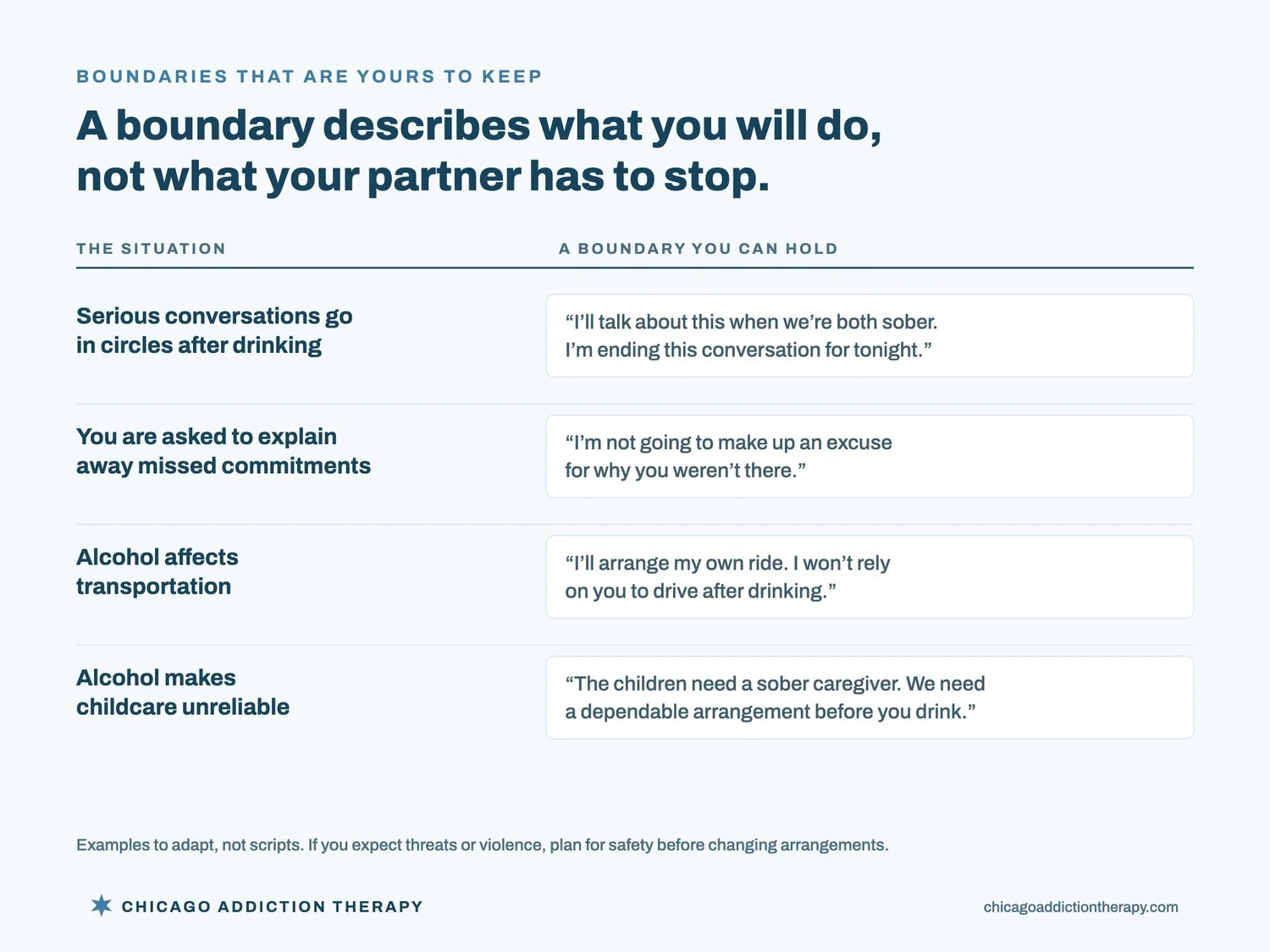
These are examples to adapt, not instructions to announce regardless of your circumstances.
A boundary may disappoint or anger your partner. That does not automatically make it unreasonable. But if you expect threats, retaliation, or violence, get help planning for safety before confronting them or changing arrangements.
Avoid setting consequences you cannot or do not intend to carry out. If you are unsure what is realistic, that is something you can work through in your own therapy.
Look carefully at the ways you cover for drinking
“Enabling” can become another word that makes partners feel blamed. You may have taken over responsibilities because someone had to. You may have covered an absence because you were embarrassed, frightened about the financial consequences, or trying to protect the children. Those choices usually have a context.
A more useful question is: Which things am I doing to keep life safe and functioning, and which things am I doing to keep the drinking hidden?
For example, caring for a child whose parent is intoxicated addresses a safety need. Calling the parent’s employer with a made-up illness conceals what happened. You can begin changing the second pattern without abandoning the first.
Do not interpret “stop rescuing” as permission to leave someone in medical danger or to let children face preventable harm. You also do not have to create a crisis to make the drinking “real.” Start with one response you can change safely: stop inventing explanations, decline to purchase alcohol, or tell one trusted person what has been happening. I go further into this distinction in how to help without enabling.
You do not have to become the alcohol monitor
Counting drinks, inspecting bottles, and searching for evidence can take over your attention. Sometimes this begins because your partner’s account no longer matches what you see. You want certainty before you act. But your wellbeing cannot depend on successfully investigating every evening.
You can make decisions using what you already know: whether agreements are kept, whether you feel safe, whether responsibilities are handled, and whether the situation is improving.
If a clinician recommends monitoring as part of a treatment plan, discuss who will manage it and what role you are willing to have. Agreeing to support treatment does not obligate you to become its sole supervisor.
What if your partner says you are overreacting?
You do not have to resolve the entire disagreement in one conversation. Try returning to the specific impact:
“You may see the amount differently. I’m talking about the missed commitments and the arguments. Those are happening, and I need to decide how I’m going to respond.”
If they refuse an assessment, you can still seek support. Their refusal does not require you to keep the same household arrangements indefinitely.
You can also notice what happens after the conversation. Is there curiosity, follow-through, and willingness to revisit the issue? Or does the discussion end with a promise that repeatedly disappears? A sincere apology may matter. It does not, by itself, tell you whether the pattern is changing.
What the research says a partner can actually do
Partners are often told they have two options: detach completely, or stage a confrontation. There is a third, and it has the best evidence. Community Reinforcement and Family Training, or CRAFT, teaches the concerned partner to change how they respond to drinking and sobriety at home, to stop shielding the drinker from natural consequences, and to invite treatment at the moments it is most likely to be accepted. In a meta-analysis of the controlled trials, CRAFT got roughly two-thirds of treatment-refusing drinkers into treatment, about three times the engagement of Al-Anon-style approaches and twice that of a planned confrontation (Roozen et al., 2010).
That is not a guarantee, and it is not a technique for controlling another adult. It is a reason to believe that what you do at home matters, and that you do not have to choose between giving up and going to war. I use CRAFT with partners and family members; it is one of the things we can work on together.
What meaningful change can look like
There is no single performance that proves recovery. Look for sustained actions relevant to the problems you have named:
Following through with assessment and treatment.
Being honest about drinking and setbacks.
Taking responsibility without making you the cause.
Participating in a workable safety plan.
Repairing missed responsibilities.
Respecting your boundaries and your need for support.
You do not have to feel reassured immediately because your partner has started treatment. Trust may need repeated experiences of reliability. If they return to drinking, the response matters: do they disclose it and reconnect with support, or hide it and insist that you stop asking?
These observations can help you assess the relationship. They are not a scoring system for diagnosing recovery.
Get support that is yours
You may have been waiting for your partner to agree to therapy before allowing yourself to seek it. You can begin independently.
Al-Anon offers support for people affected by someone else’s drinking. It provides a place to hear from others dealing with similar relationship concerns (Al-Anon: Support for Partners).
SMART Recovery Family & Friends offers free online and in-person meetings focused on coping and communication. Select the Family & Friends option in its meeting finder (SMART Recovery Family & Friends).
Individual therapy can help you clarify boundaries, address anxiety and resentment, and consider decisions you have been postponing. My parents and family page explains the ways I work with people affected by a loved one’s drinking, and the alcohol resources page lists more options in Chicago and Illinois.
You can seek help without deciding today whether you will stay, leave, or give the relationship more time.
When safety needs to come first
Alcohol does not excuse threats, intimidation, violence, or coercive behavior. If you are afraid of your partner, seek individual safety support before attempting a joint confrontation or couples session. The National Domestic Violence Hotline offers confidential support at 800-799-SAFE (7233) or by texting START to 88788. Use a safer device if your communications may be monitored. Call 911 for immediate danger.
There is also a medical concern: abruptly stopping heavy, sustained drinking can cause dangerous withdrawal. Encourage medical evaluation rather than trying to force a sudden detox at home. Seizures, severe confusion, or hallucinations require emergency care (MedlinePlus: Alcohol Withdrawal).
Frequently asked questions
Should I pour out the alcohol or hide it?
Usually not. It tends to start a fight about the bottles rather than a conversation about the drinking, and it makes you the enforcer. Declining to buy alcohol, and deciding what you will and will not do around drinking, are boundaries you control. Removing another adult’s alcohol is an attempt to control theirs.
Can I go to therapy about this if my partner refuses to?
Yes. Most of the partners I see come alone, at least at first. The work is about your decisions, your boundaries, and how you respond at home, none of which requires the person drinking to participate.
Is it my job to get them into treatment?
No. It can be your choice to invite it, and there are ways of inviting that work better than others. But the appointment, the follow-through, and the drinking itself belong to them.
What if they drink again after starting treatment?
A return to drinking is common early on and is not by itself a verdict on treatment. What tells you more is what happens next: whether they say so, reconnect with their clinician, and pick the plan back up, or hide it and ask you to stop noticing.
You can care about your partner and take your own life seriously
You may love your partner, understand why they drink, and still be unable to keep living with the current pattern. You do not have to settle whether they are a good person before addressing harmful behavior. Nor do you have to wait until things become worse to ask for help.
I provide support for adults affected by a partner’s alcohol use, in person in Logan Square and online throughout Illinois and Minnesota. A first conversation can focus on what is happening at home, what you have already tried, and what you need next. It does not require your partner’s participation.
Schedule a free 15-minute consultation, or explore the alcohol resources page. If it is gambling rather than drinking, or both, the guide for partners of someone with a gambling problem covers the parallel situation.
If you need help now
National Domestic Violence Hotline: 800-799-SAFE (7233), text START to 88788, thehotline.org.
Illinois Helpline: 833-234-6343 (1-833-2FINDHELP), text HELP to 833234, helplineil.org. Free, confidential, 24/7, including for family members.
SAMHSA National Helpline: 1-800-662-HELP (4357). Free, confidential, 24/7 treatment referral.
988 Suicide and Crisis Lifeline: call or text 988 if you or someone you love is in crisis.
Emergency: call 911 for seizures, hallucinations, or severe confusion after stopping or cutting back on drinking.
This article is educational and does not replace medical advice or an individual clinical assessment. If you or your partner drink heavily or daily, talk with a physician before stopping or cutting back.