
How to Stop Binge Drinking on Weekends: A Therapist’s Guide
Written by Chris Beerman, MSW, LCSW, CADC
Monday morning, you're done.
You're tired of losing part of Sunday, scrolling back through your messages to see what you said, or having the same conversation with your partner again. You decide next weekend will be different.
By Wednesday you feel better. Work is going well. You've exercised, slept, and handled what you needed to handle. Friday arrives, and a few drinks sound reasonable again.
Then you drink more than you meant to.
If that sequence is familiar, the question you're probably asking is: "I can go all week without drinking. Why can't I stop once I start?"
Not everyone's weekend runs this way, but it is one of the most common patterns I see. Changing it starts with looking closely at the gap — what you intend before drinking, what changes during the evening, and what brings you back to the same decision the following Monday. A useful plan addresses those moments before you're in them. That is what this guide is for.
I'm Chris Beerman, MSW, LCSW, CADC, an addiction therapist in Chicago. I work with adults who are questioning their drinking, trying to cut back, or ready to stop. You don't need to decide what to call yourself before taking this pattern seriously.
Can you have a drinking problem if you only drink on weekends?
Yes. Daily drinking is not required for alcohol use disorder. Clinicians assess the pattern over time — difficulty controlling how much you drink, unsuccessful attempts to cut down, craving, and continuing despite consequences — and a successful workweek doesn't rule any of those out. (NIAAA: Understanding Alcohol Use Disorder)
Binge drinking and alcohol use disorder also mean different things.
NIAAA defines binge drinking as drinking enough to bring blood alcohol concentration to 0.08% or higher. For a typical adult that is about five or more drinks for men, or four or more for women, in roughly two hours. Those are approximate thresholds, not safe targets — harm can happen below them. (NIAAA: Understanding Binge Drinking)
A binge-drinking episode does not, by itself, establish an alcohol use disorder. It still deserves attention, particularly when it keeps happening.
It also helps to count what is actually in the glass. One U.S. standard drink contains about the same amount of alcohol as:
a 12-ounce beer at 5% alcohol
a 5-ounce glass of wine at 12%
a 1.5-ounce shot of spirits at 40%
A strong pint or a generously poured cocktail can hold two or three standard drinks. (NIAAA: What Is a Standard Drink?)
If you want a starting point for evaluating your own pattern, the free alcohol use test on this site uses the ten-question AUDIT and is scored in your browser. A screening score can guide a conversation; it cannot diagnose you or tell you whether stopping is medically safe. And if you're one question earlier than this — not sure it's a problem at all — my guide to how to tell if you have a drinking problem is written for people whose life still looks fine from the outside.
Before changing your drinking, consider withdrawal risk
If you drink heavily and regularly, have had withdrawal symptoms before, or drink to relieve shaking or other symptoms, get medical guidance before abruptly stopping or sharply reducing alcohol.
Withdrawal can become life-threatening. Shaking, sweating, vomiting, or a racing heart after cutting back warrant prompt medical attention. Seizures, hallucinations, or severe confusion are emergencies — call 911. (MedlinePlus: Alcohol Withdrawal)
The plan below is about habits, situations, and support. It is not a home-detox plan.
What changes between Monday and Friday?
Start with what you expect the first drink to do.
Maybe Friday is the first time all week you feel allowed to stop working, and alcohol marks the line between being productive and being off duty. Maybe social situations make you uneasy and drinking makes the first hour easier. Maybe your friends meet at bars and you don't know how to stay connected without joining in. Or maybe you drink at home because the weekend feels empty once the work disappears.
Those are different situations, and they need different plans.
If drinking is relief from a demanding week, filling Friday with more obligations will leave you just as hungry for relief. If it is company, staying home alone with nothing arranged leaves the main problem untouched.
So ask yourself: What am I hoping will feel different after the first drink?
Then ask: What happens after that first benefit wears off?
Most people, when they're honest, enjoy the first hour and dislike almost everything that follows. Seeing both halves clearly is what explains why the pattern continues — and where the change has to happen.
How to stop binge drinking on weekends: make the plan before Friday
1. Reconstruct the last weekend in detail
"Things got out of hand" doesn't tell you where to intervene.
Choose one recent episode and write down what happened:
What did you intend before the evening started?
Where were you, and who were you with?
Had you already been thinking about drinking during the day?
When did you first change the plan?
What did you tell yourself at that point?
What happened afterward?
Look earlier than the drink you regret most. Maybe you planned dinner but agreed to an open-ended bar night. Maybe you had drinks at home before meeting friends. Maybe you stayed when the group moved to another place even though you'd already wanted to leave.
For someone else, the decisive moment was Thursday, when they accepted plans they knew would be hard to hold.
Pick one point in that sequence that you can change before next weekend.
2. Decide what you are actually trying to do
"I'll be better" leaves too much undecided.
Are you planning an alcohol-free weekend? Working with a clinician on cutting back? Trying to find out whether moderation is realistic for you?
The goal should be clear enough that you can evaluate it afterward.
If you repeatedly lose control once drinking begins, take that history seriously when you choose the next step. You don't have to keep running the same experiment because you wish it would work. My guide to alcohol moderation versus quitting walks through that decision in detail.
If moderation is an appropriate goal for you, define it before you drink and keep an accurate count. Changing the rules mid-evening, repeatedly, is itself useful information to bring to treatment.
An alcohol-free weekend is a concrete goal when stopping is medically safe, and it doesn't require you to resolve every question about the rest of your life first.
3. Give Friday evening a specific shape
Pay particular attention to the transition out of work.
If you usually finish the day, open a drink, and then decide what to do, try deciding the evening in advance:
Finish work at a defined time.
Eat dinner instead of leaving it until late.
Arrange an activity or a conversation you look forward to.
Decide where you'll be during the hours you usually drink.
Have something ready for the quieter part of the evening afterward.
The details should fit the job alcohol does for you. You might need company, rest, movement, entertainment, or permission to do very little.
You don't have to turn Friday into a self-improvement project. Make room for an evening that feels worth having.
4. Make social plans that support your goal
You can change how you see people without making a declaration about every future invitation.
Meet for breakfast. Choose an activity with a defined ending. Arrange dinner without the automatic move to a bar afterward.
Where you expect pressure to drink, prepare a short response and practice saying it:
"I'm taking this weekend off."
"I'd like to hang out, but I'm not drinking tonight."
You can say more to someone you trust. You don't owe the whole group a clinical history.
NIAAA's drink-refusal guidance is essentially this: avoid the situation where you can, prepare a clear, firm, friendly response and rehearse it out loud, ask someone for support, and plan a way out if the pressure gets too great. (NIAAA Rethinking Drinking: Building Your Drink Refusal Skills)
Arrange transportation that lets you leave on your own. If you drink, do not drive. And if one particular setting ends the same way every time, skip it while you build a routine that works.
5. Prepare for the moment you want to change the plan
A plan has to account for wanting a drink.
That sounds obvious, but it is easy to plan as though Friday's motivation will feel exactly like Monday's. Write down a response to your most predictable situations. For example:
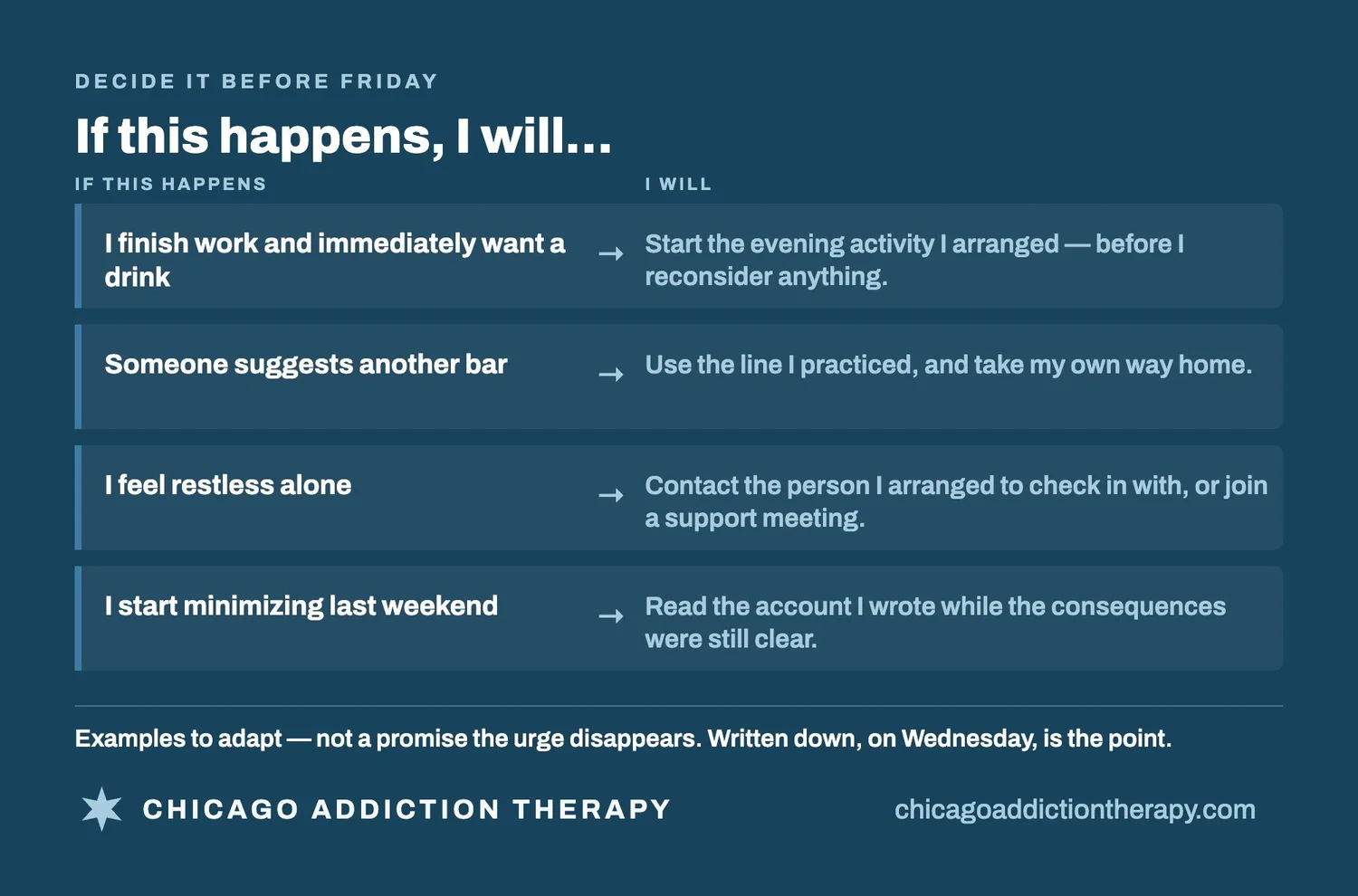
If I finish work and immediately want a drink — I start the evening activity I arranged before I reconsider anything.
If someone suggests another bar — I use the line I practiced and take my own way home.
If I feel restless alone — I contact the person I arranged to check in with, or join a support meeting.
If I start minimizing last weekend — I read the account I wrote while the consequences were still clear.
These are examples to adapt, not a promise that the urge will disappear. You can notice the thought "I've earned this" without settling the question while standing at the bar. Change the setting, contact support, and give yourself room to follow the decision you made earlier in the week.
If cravings overwhelm your plans again and again, that is a reason to add treatment, not a reason to plan harder.
6. Give yourself something to keep on Saturday and Sunday
What would you like to get back?
It might be breakfast with your partner, being present with your kids, a walk, a class, or a morning that doesn't begin with checking for damage.
Choose something you actually value. It doesn't need to be impressive.
Don't make the next morning a punishment, or a test of whether you can outwork the night before. Completing a workout doesn't tell you anything about whether your drinking is under control.
The question is whether your weekend is becoming more like the one you wanted.
What if your limits stop mattering after the first drink?
This deserves its own conversation.
You may be good at following plans in most of your life and still find that your drinking limits become negotiable once you start. Alcohol impairs decision-making and impulse control, which makes every later decision in the evening harder than the first one. (NIAAA: Understanding the Dangers of Alcohol Overdose)
Review what has happened across attempts, not just the last one. Have you tried drinking only beer, starting later, limiting yourself to certain friends, or taking a break and coming back with new rules? What happened when you resumed?
One unsuccessful attempt doesn't prove change is impossible. Repeated unsuccessful attempts do mean the plan deserves reassessment.
If nearly every approach returns you to the same place, talk to a qualified professional about abstinence and about more support than you currently have. You don't need another blackout or another argument to justify that conversation.
What to do if you drink more than you planned
First, safety.
If someone can't be woken, is breathing slowly or irregularly, or has a seizure after drinking, call 911. Suspected alcohol poisoning is an emergency; don't leave the person alone to sleep it off. (NIAAA: Alcohol Overdose)
Once immediate concerns are handled and you're sober, go back to the plan.
Write down the point where it changed. If you have a therapist, a prescriber, or a recovery support person, tell them what happened. You don't have to wait for a successful weekend to reconnect. NIAAA's own advice after a drinking episode is the same: get back on track right away, reach out, work out what led up to it, and "don't run yourself down — it doesn't help." (NIAAA Rethinking Drinking: Recovering from a Drinking Episode)
Then make one concrete adjustment. Maybe you need to skip a particular event, tell someone sooner, get the alcohol out of the house (when that is medically appropriate), or look at a different level of care.
If you hurt someone, acknowledge the specific impact and follow through on what repair requires. Repeated promises about next weekend get exhausting for everyone involved, and the people around you can find their own footing on my page for partners and family.
You can take responsibility without spending days attacking yourself. The useful question is what you'll do differently, and what help you need in order to do it.
When weekend drinking needs professional support
Consider an assessment if you keep drinking more than you intended, have tried repeatedly to change without it holding, or keep going despite effects on your relationships, health, or responsibilities.
Therapy can begin with one recent weekend. We look at the circumstances around the drinking, what you were seeking from it, and where the plan became hard to follow.
That work usually includes changing routines, preparing for social situations, responding to cravings, and addressing the anxiety, loneliness, or other things alcohol has been helping you manage. It also includes an honest look at whether weekly therapy is enough support, or whether you need more.
And if what the weekend drinking is really doing is quieting anxiety, read alcohol and anxiety: when drinking to relax keeps you stuck.
Evidence-based alcohol treatment can involve behavioral therapy, medication, and mutual-support groups, and more intensive care is right for some people. A treatment assessment is how you find out what fits. (NIAAA: Treatment for Alcohol Problems)
Medication is worth raising with a physician or other qualified prescriber. I don't prescribe, but I will say so when medication belongs in the conversation, and I can coordinate with the person who does. You don't have to exhaust every self-help strategy before asking about it.
The alcohol resources page lists meetings, treatment navigation, and cost help if you need more than one starting point.
Start with the weekend you want to change
You may still be uncertain whether you want to quit for good. You may simply know that losing control on Friday or Saturday, again and again, is taking more from your life than you want to give it.
That is enough to bring to a conversation.
I provide alcohol addiction therapy in Chicago, in person in Logan Square and online throughout Illinois and Minnesota.
In a free 15-minute consultation we can talk about what has been happening and whether working together makes sense. Bring three things: what you intended last weekend, what actually happened, and what you want to be different.
Schedule a free consultation, or begin with the free alcohol use test.
Need support right now?
Free, confidential support is available 24/7.
SAMHSA National Helpline — 1-800-662-HELP (4357). Free, confidential treatment referral and information, English and Spanish.
Illinois Helpline for Opioids and Other Substances — 1-833-2FINDHELP (833-234-6343), or text HELP to 833234. Free and confidential, 24 hours a day. helplineil.org
If you're in immediate danger or thinking about harming yourself, call or text 988.
This article is for general information and is not a substitute for individual medical or mental health care. If you drink heavily or regularly, talk with a physician before stopping abruptly, because alcohol withdrawal can be dangerous.