
By Chris Beerman, LICSW (MN), LCSW (IL), CADC — gambling and alcohol therapist. Reviewed September 2026.
If gambling is getting harder to control, you do not have to find a treatment center near your house, and you do not have to wait until the consequences get bad enough to justify it.
I am licensed in both Minnesota and Illinois, which means I can provide gambling therapy by secure video to anyone who is physically located in Minnesota during their sessions — Minneapolis and St. Paul, but also Rochester, Duluth, St. Cloud, Mankato, and the parts of the state where finding a therapist who actually specializes in gambling is the hard part.
But how telehealth works is probably not your real question.
Your real question is what actually happens in gambling therapy — because good treatment involves considerably more than checking in once a week about whether you gambled.
One more thing before that, because most private practices leave it out: Minnesota funds gambling treatment, and for some people that is the better option. There is a section on it below, with the eligibility conditions the state actually applies.
You Do Not Have to Lose Everything First
A gambling problem does not always look like financial collapse.
You may still have the job. You may still have savings. Your partner may know little or nothing about what has happened. You may even still be ahead.
And you can still know that something has changed. Most of the people I work with recognize several of these:
- Betting more than you intended to
- Chasing losses
- Checking odds, scores or account balances constantly
- Depositing again after telling yourself you were finished
- Hiding bets, losses, debt or transfers
- Gambling while drinking
- Raising stakes because the smaller amounts stopped registering
- Gambling to get away from stress, boredom, anxiety or low mood
- Thinking constantly about getting back to even
- Trying to stop, and finding your way back
You do not have to decide whether you are an addict before you contact a therapist. A more useful question, and an easier one to answer honestly:
Am I still reliably in control of this?
What I Work On
Gambling looks different than it did ten years ago, and the problems that come with it have changed shape too.
Sports betting
Sportsbooks, live in-game betting, parlays, prop bets and a constant feed of betting content make an unusually repetitive cycle. For a lot of people the tell is that watching the game has quietly become secondary to having money on it — and that losses stopped producing caution and started producing bigger bets. More on that on the sports betting addiction therapy page.
Casino gambling
Slots, table games and poker, where frequency, time and stake size creep up together. The recurring feature is a promise that the next trip will be different, followed by the same trip.
Online gambling
The easier gambling is to reach, the less friction sits between an urge and a bet. That matters enormously for someone trying to stop: a relapse no longer requires a drive and a plan. It can take ninety seconds on a phone. In Minnesota, where online casinos and sports betting aren’t legal, that can mean offshore sites or sweepstakes casinos, which Minnesota’s attorney general considers illegal gambling.
Stock, options and crypto trading
Not all investing is gambling. But speculative trading starts to function like it when someone repeatedly breaks their own risk limits, sizes up after losses, monitors compulsively, hides the activity, or believes one more trade is required to recover the last one. The label matters less than whether you can stop. See stock and options trading addiction therapy and the piece on crypto trading addiction.
What Happens in the First Sessions
Treatment starts by understanding the actual pattern, which means looking at a good deal more than how often you gamble:
- What you gamble on, and when it escalated
- How much money has genuinely gone in and out — not the remembered version
- Whether there is debt, and who knows about it
- What happens in the hour before you gamble
- Whether alcohol or anything else is usually involved
- Previous attempts to stop, and what ended them
- The periods when it was easier to control, and what was different
- What it has cost you in your relationships
- Anxiety, depression, ADHD or anything else in the picture
- What you believe the next bet is going to accomplish
The goal is to understand the system around the gambling. Once that is visible, it can be changed.
If you want a more structured starting point before you talk to anyone, the gambling addiction test on this site is the Problem Gambling Severity Index — nine questions, about two minutes, free and anonymous with no email form. A screening tool indicates risk and harm; it does not diagnose. If you are reading this about someone else, there is a separate partner gambling test.
Treatment Is Not Mostly About Willpower
People usually arrive knowing exactly what they are supposed to do. Stop betting. Delete the apps. Stay out of the casino. Do not chase.
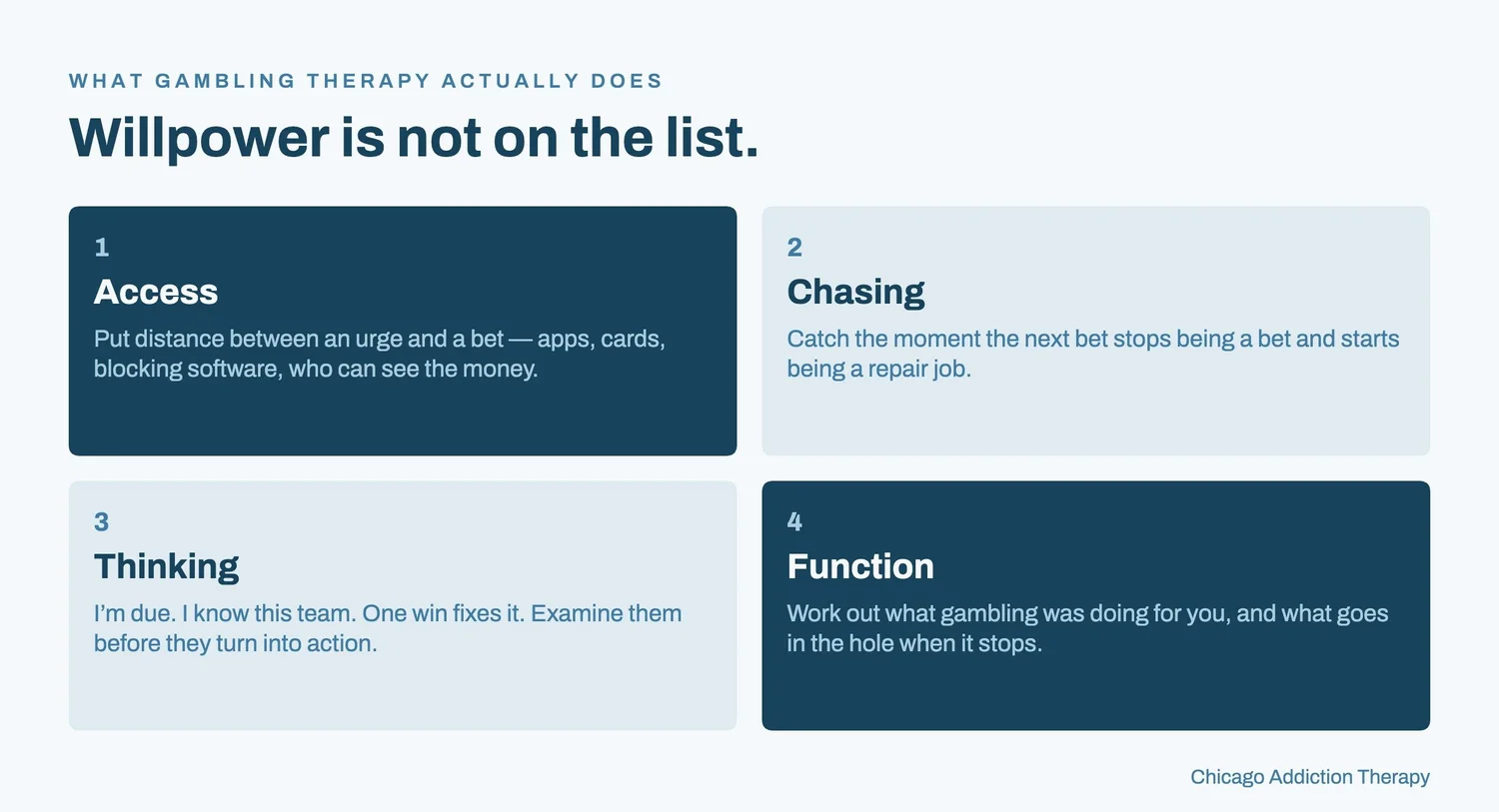
The difficulty is doing any of that at the moment an urge actually arrives. Which is why effective treatment needs more than motivation. Four things carry most of the work.
1. Make gambling harder to do impulsively
An early priority is usually putting distance between an urge and the ability to act on it: closing or restricting accounts, removing apps and saved payment methods, blocking software, changing who has access to money, reducing exposure to gambling content, bringing a trusted person into the financial safeguards, and in some cases self-exclusion. Minnesota has no statewide self-exclusion list, so that step goes casino by casino and app by app; my Minnesota gambling self-exclusion guide walks through each one.
None of that is a substitute for therapy. It makes therapy more likely to work. If gambling stays instantly available every time you feel an urge, you are asking yourself to make the right decision several hundred times. Friction changes that arithmetic.
If you want to start today rather than at your first appointment, the 24-hour betting shutdown plan walks through the first day, free and anonymously.
2. Interrupt chasing
This is the pattern I watch most closely.
You lose two thousand dollars. Now the next bet has a different job. It is no longer a wager you think has value — it has to erase the last one. If it loses, the amount you need back goes up again, and risk rises at exactly the point where judgment is getting more emotional. That is how a manageable loss becomes a serious financial problem faster than people expect.
The work is learning to notice when a decision is being driven by the need to undo what already happened. The previous loss is already a loss. The next bet cannot reach backwards and change it. There is a fuller piece on how to stop chasing your losses.
3. Get at the thinking behind the bet
Compulsive gambling arrives with a set of unusually persuasive thoughts: I just need one win. I'm due. This is a better bet than the last one. I can't stop while I'm down this much. If I quit now I've locked in the loss. I know this team. I have a system.
Therapy helps you catch these earlier and examine them before they turn into action. I draw on cognitive behavioral therapy, acceptance and commitment therapy, motivational interviewing and relapse prevention, depending on what is actually driving it. The aim is not to eliminate every urge or gambling thought — it is to get better at having one without obeying it.
4. Work out what gambling is doing for you
Money is the obvious part. It is rarely the only reason someone continues. Gambling reliably supplies excitement, relief from boredom, escape from anxiety or low mood, something to focus on, competition, hope, a sense of competence, and a break from other problems.
If it has become one of your main ways of managing how you feel, removing it leaves a hole. Part of treatment is deciding what goes in it.
Dealing With the Money Honestly
Financial damage produces enormous shame, and shame feeds more gambling. Someone loses twenty-five thousand dollars and becomes convinced the only acceptable outcome is winning it back before anyone finds out. That is usually where it accelerates.
One of the more important moves in recovery is separating two problems that have got fused together: the gambling problem, and the financial problem the gambling created. Continuing to gamble is not a reliable solution to the second one.
Depending on the situation, that can mean getting an accurate accounting of debts and losses and bringing in a financial counselor, accountant or attorney. Therapy is not financial advice and does not replace it — but it can help you stop making the number worse while you start dealing with it. There is more in recovering financially after gambling losses.
What If My Partner Has Just Found Out?
A lot of treatment starts here. A bank statement. A maxed card. A second sportsbook account. Money that is not where it should be. Or a disclosure that finally happened because hiding it stopped being possible.
At that point there are two problems, not one: the gambling, and the damage the secrecy did to the relationship. Stopping does not automatically repair the second. Partners generally want information immediately — how much, are there other accounts, is there debt I do not know about, how can I be sure this will not happen again — and rebuilding trust takes longer than stopping does.
Treatment may involve financial transparency, boundaries, reduced access, and the slower work underneath. Partners can also get support in their own right, whether or not the person gambling is ready. See the guide for partners — and note the Minnesota funding below, which covers concerned significant others specifically.
Do I Have to Quit Completely?
You do not have to decide that before the first appointment.
Some people arrive certain they want to stop entirely. Others want to know whether controlled gambling is realistic for them. Both are workable starting points, and the most useful evidence is your own history: if you have set betting limits, deposit limits, time limits and rules about what you will and will not bet on, and abandoned them repeatedly, that pattern deserves weight.
The goal is not to impose an answer. It is to reach one that is supported by what has actually happened.
Minnesota Pays for Gambling Treatment — Read This Before You Pay Me
Minnesota runs something most private practices do not mention on their Minnesota pages.
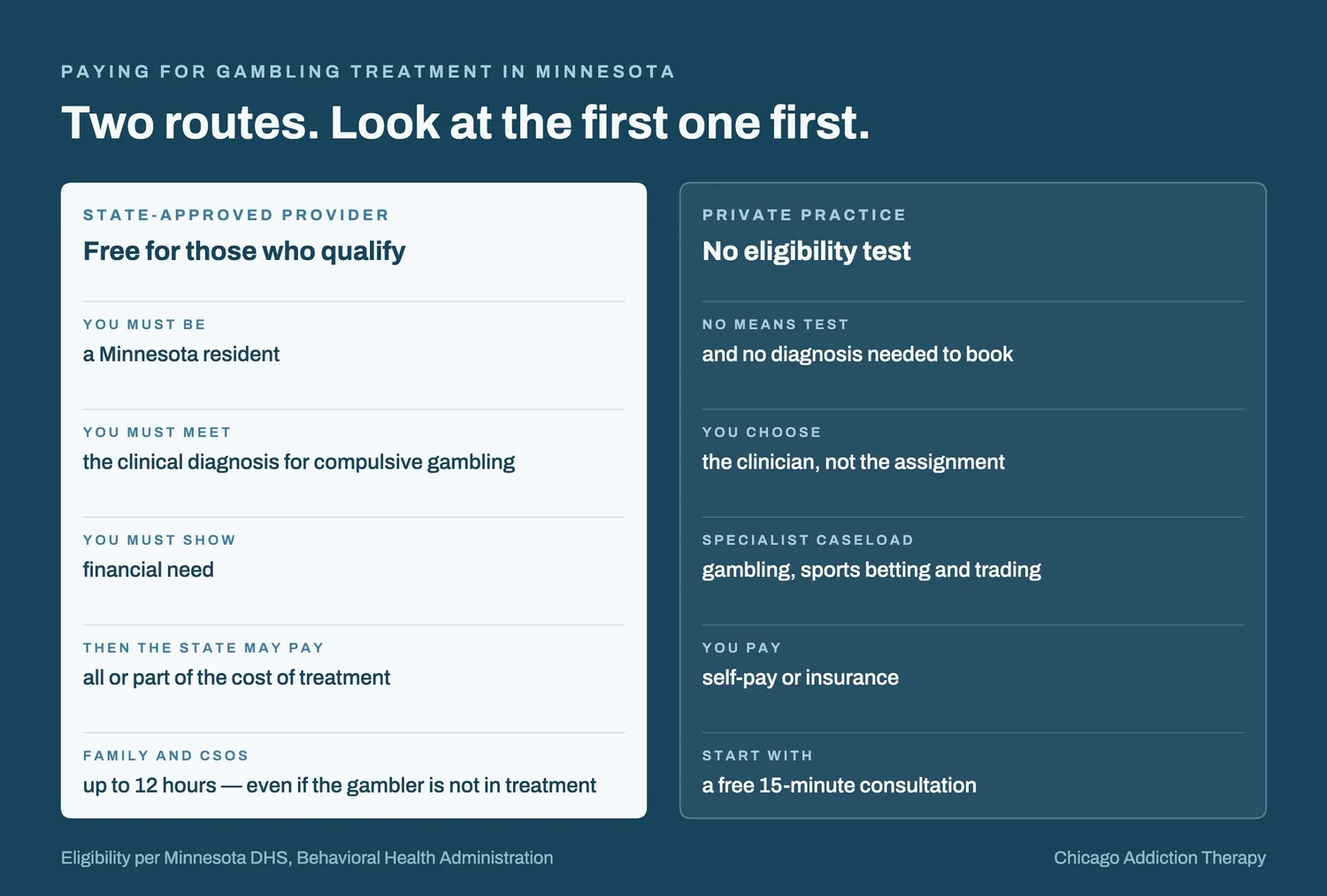
The Behavioral Health Administration at the Minnesota Department of Human Services oversees problem gambling treatment, and it maintains a network of state-approved gambling treatment providers across the state. In the department's own words, those providers "offer free help for people who qualify in Minnesota."
Two conditions decide whether you qualify, and it is worth knowing them before you get your hopes either up or down. State funds are available for Minnesota residents who meet the clinical diagnosis for compulsive gambling and demonstrate financial need; for those who do, the state may pay all or part of the cost of treatment.
There is a second provision that is genuinely unusual, and family members routinely do not know it exists:
Minnesota will pay for up to 12 hours of intervention services for a family member or concerned significant other who is a Minnesota resident and is negatively affected by someone's gambling — and that person can be seen even if the gambler is not in treatment.
If you have been trying to work out what to do about someone else's gambling and assumed nothing was available to you until they agreed to get help, that is not the case in Minnesota.
Chicago Addiction Therapy is a private practice, and I am not a state-approved provider. So the honest framing is this: if you meet those conditions and cost is a real constraint, the state program may be the better fit, and you should look at it first. The state-approved provider directory is filterable by county, and the programs and services page sets out the funding.
What private practice offers instead is no eligibility test, your choice of clinician, and — in my case — someone whose caseload is specifically gambling, sports betting and compulsive trading rather than general mental health with gambling as one of many presentations. Whether that is worth paying for is a reasonable thing to decide with the actual alternatives in front of you.
The objective is getting appropriate help. It does not have to be from me.
What Online Gambling Therapy Actually Looks Like
It is individual psychotherapy over secure video rather than in an office. Sessions are scheduled like any other appointment. Because I hold a Minnesota clinical social work license, I can work with you anywhere in the state, as long as you are physically in Minnesota at the time of the session — that last detail is what licensure turns on, not where you live, so if you travel for work it is worth a conversation before booking.
For some people telehealth also makes treatment easier to pursue privately. There is no gambling-treatment office to be seen walking into. You need a room with a door, headphones, and not to be driving.
The Illinois version of this page goes into the format in more depth, and most of it applies here too: online gambling therapy and what telehealth treatment involves.
When Online Outpatient Therapy Is Not Enough
Telehealth outpatient therapy works when the level of care matches the severity of the situation. It is not automatically the right answer.
Acute suicidal thoughts or an inability to stay safe, severe psychiatric instability, severe co-occurring substance use where withdrawal could be dangerous, an unsafe living situation, no private space at all, or a situation where no meaningful barrier to gambling can be put in place — any of those may call for something more structured. Part of my job at the first appointment is saying so if it applies, and pointing you somewhere better.
Gambling losses can produce shame and panic very quickly. If you are in a mental health crisis or thinking about suicide, scheduling therapy is not the first step — call or text 988. If you are in immediate danger, call 911.
How to Start
- A free 15-minute consultation. You describe what has been happening; I tell you whether I think I can help, and what I would suggest — including if that is the state program rather than me.
- A first full session, which is the assessment above.
- Weekly to begin with where that makes sense, spacing out as things stabilize.
Many of the people I work with are still functioning well everywhere else in their lives. The problem is narrower than that, and harder to say out loud: they have stopped being able to trust themselves around gambling.
If that is familiar, we can start by getting a clear picture of what is happening and deciding what has to change first.
Email me to set up a consultation, or read more about how I work on the gambling addiction therapy page.
Common Questions
Do I have to live in Minnesota, or just be there?
Be there. Licensure follows your physical location at the time of the session, not your mailing address. If you are a Minnesota resident sitting in another state that week, tell me in advance rather than on the day.
Is the state program actually free?
For people who qualify, the state may pay all or part of the cost. Qualifying means being a Minnesota resident who meets the clinical diagnosis for compulsive gambling and can demonstrate financial need. Family members and concerned significant others have their own, separate provision — up to 12 hours — and do not need the person gambling to be in treatment.
Can I get help if the gambler in my life refuses treatment?
Yes, on both routes. Minnesota funds intervention services for affected family members independently, and you can also see a private therapist as the client in your own right. You do not need anyone's permission or participation to get support for yourself.
Do I need a diagnosis before my first appointment?
No. Assessment is part of the work, not a prerequisite for it. You also do not need to have decided whether you intend to stop.
Is this only for sports betting?
No. Casino gambling, online casino play, poker, slots, and stock, options, crypto or prediction-market trading once it starts behaving like gambling.
How do I know it is serious enough?
There is no loss threshold you have to hit first. Repeated failed attempts to cut back, chasing, secrecy, preoccupation, rising stakes, debt and difficulty keeping your own limits are all reasons to take it seriously now rather than later.
Minnesota Gambling Resources
Minnesota problem gambling helpline — 1-800-333-HOPE (1-800-333-4673), free and confidential, for information and referral to services in your area. You can also text HOPE to 53342 or use the chat at the Minnesota Alliance on Problem Gambling. Minnesota DHS separately runs a motivational text messaging program: text EncourageMeMN, or AnimameMN for Spanish, to 53342 — available to people who gamble and to people affected by someone else's gambling.
State-approved treatment providers and funding — Minnesota Department of Human Services, Behavioral Health Administration.
Peer support in Minnesota — Gamblers Anonymous Minnesota, 1-855-222-5542. Gam-Anon Minnesota, for families, 1-888-435-7166.
Self-exclusion and blocking — Minnesota keeps no statewide list. How to block gambling in Minnesota covers each tribe's casinos, the racetracks, apps, sweepstakes sites and pull-tabs.
In crisis — call or text 988 for the Suicide and Crisis Lifeline.
More blocking tools, money safeguards and support options are on the gambling resources page.
This article is for general information and is not medical, legal or financial advice, and it does not create a therapist-client relationship. Screening tools indicate risk; they do not diagnose. Program rules and funding can change — confirm current eligibility with the Minnesota Department of Human Services or a state-approved provider rather than relying on this page.
Sources
State-approved providers — Minnesota Department of Human Services, State-approved gambling treatment providers: "State-approved gambling treatment providers offer free help for people who qualify in Minnesota." Directory is filterable by county.
Funding and eligibility — Minnesota Department of Human Services, Gambling programs and services: "State funds are available for treatment for compulsive gamblers, their families and/or concerned significant others. Minnesota residents who meet the clinical diagnosis for compulsive gambling and demonstrate financial need may have all or part of the cost of treatment paid." And: "The state will also pay for up to 12 hours of intervention services for a family member or concerned significant other who is a Minnesota resident and is negatively impacted by problem or compulsive gambling. A family member or concerned significant other may be seen even if the gambler is not in treatment."
Helpline and oversight — Minnesota Department of Human Services, Get help: 800-333-HOPE for free, confidential information and referral; motivational text messaging via EncourageMeMN or AnimameMN to 53342; the Behavioral Health Administration oversees problem gambling prevention and treatment. Helpline number, text keyword and live chat confirmed against the Minnesota Alliance on Problem Gambling.
Telehealth — Minnesota Statutes 62A.673 defines a health care provider for telehealth purposes as one "licensed or registered by the state to perform health care services within the provider's scope of practice and in accordance with state law." In practice this is why the state you are physically in during a session is the one that matters.