
Gambling Disorder Treatment in Illinois
If gambling has become harder to control, there is treatment in Illinois designed specifically for it.
You do not need to have lost everything. You do not need to be gambling every day. And you do not need to decide whether you are an "addict" before talking to someone.
The question is simpler: is gambling causing problems in your life, and are you having trouble changing it on your own?
Treatment can help with sports betting, online casinos, video gaming terminals, casino gambling, poker, daily fantasy sports and other forms of gambling. It can also address what often comes with the gambling: debt, secrecy, anxiety, alcohol or substance use, damaged relationships and repeated attempts to stop.
I'm Chris Beerman, MSW, LCSW, CADC, an addiction therapist in Chicago. Gambling is a primary focus of my practice. I see clients in person in Logan Square and by telehealth throughout Illinois.
Looking for treatment now? Start with a confidential 15-minute consultation.
Schedule a free consultation →
Not sure how serious the problem is? Take the free gambling addiction test first. It takes about three minutes and is completely anonymous.
What Is Gambling Disorder?
Gambling disorder is the clinical name for what most people call gambling addiction. In the DSM-5, the diagnostic manual clinicians use, it means persistent, recurrent gambling that causes significant distress or impairment, shown by at least four of nine criteria over twelve months. Those criteria include needing to gamble with more money to get the same excitement, restlessness when trying to cut back, repeated unsuccessful attempts to stop, chasing losses, lying about gambling, and relying on other people to cover money problems it has caused.
A screening questionnaire is not a diagnosis, but it is a useful place to start. The gambling addiction test on this site uses the Problem Gambling Severity Index, and Do I Have a Gambling Problem? walks through the most common signs.
What Changed for Gambling Disorder Treatment in Illinois in 2026?
Illinois made a significant change to its behavioral-health law on July 24, 2026.
Public Act 104-0626 amended the Illinois Substance Use Disorder Act, a law that was previously built around substance use, so that gambling disorder now runs through the state's prevention, treatment and recovery framework. It took effect the day it was signed.
Among other changes, the law:
- formally defines "gambling" and "gambling disorder" in the Act
- brings gambling disorder into the Department of Human Services' prevention, early-intervention and recovery-support work, including school and college awareness programs
- allows licensed treatment programs to add gambling-disorder treatment as an adjunct to any level of care, from outpatient through intensive outpatient/partial hospitalization and residential/inpatient, and to recovery homes
- permits the Department to award grants for local gambling prevention, recognition and response projects
- expands the state's gambling public-education program, including a toll-free hotline and website, subject to state funding.
What the law did not do matters too. Reporting at the time noted that it came with no new dedicated funding and does not make gambling treatment reimbursable by Medicaid. And it does not mean every treatment center in Illinois now offers specialized gambling treatment. Availability, insurance coverage and clinician expertise still vary.
But the change is important. Illinois now treats gambling disorder in the same framework as substance use disorders: a behavioral-health condition that warrants specialized assessment and treatment, rather than simply a money problem or a failure of self-control.
What Does Gambling Disorder Treatment Actually Look Like?
Good gambling treatment involves more than talking once a week about whether you gambled.
The work usually starts by understanding the cycle. What happens before you place a bet? What happens after you lose? What happens after you win? Where does the money come from? What makes gambling available when an urge hits? And what thought makes another deposit seem reasonable even after you have already decided to stop?
Treatment usually works on several of these areas at once.
1. Understanding Your Gambling Pattern
We look at the gambling itself:
- what you gamble on, how often, and how much time you spend thinking about it
- what triggers an episode
- what happens during a win and after a loss
- whether alcohol or drugs are involved
- whether you chase losses
- what you have already tried in order to stop.
The dollar amount matters, but it is not the only measure of severity. Someone can lose a large amount of money without having gambling disorder. Someone else can lose considerably less and still experience real loss of control, secrecy, relationship damage and distress.
2. Making It Harder to Place the Next Bet
Willpower becomes much less useful when gambling is available on a phone in seconds. So treatment often includes practical barriers:
- Illinois self-exclusion
- closing sportsbook and casino accounts
- gambling-blocking software
- removing saved payment methods and turning on bank gambling blocks where available
- changing access to credit and, for a while, restructuring household finances
- another person involved in financial accountability.
These steps are not a substitute for therapy. They put enough distance between an urge and the ability to act on it for therapy to work. If you need to start today, the 24-Hour Betting Shutdown Plan walks through the first steps in order.
3. Treating Chasing and Gambling-Related Thinking
One of the most important parts of treatment is understanding the thinking that makes the next bet feel reasonable. Common examples:
I can get back to even.
I know this team better than the market.
I can't stop after losing that much.
One win would fix everything.
I'm due.
I'll quit after the season.
These thoughts become especially convincing during an urge. Gambling-specific cognitive behavioral therapy works directly with them. The UK's national clinical guideline on gambling-related harms, NICE NG248 (2025), recommends CBT as a core psychological treatment, including a relapse-prevention component. Motivational interviewing is often used alongside it when someone is still unsure whether they want to change. The evidence is covered in more detail in Can Therapy Help Gambling Addiction?
4. Dealing With the Money
Gambling problems and financial problems become intertwined very quickly. Treatment may involve looking honestly at gambling debt, credit cards and personal loans, money borrowed from family, depleted savings or retirement accounts, hidden accounts, unpaid taxes, access to joint finances, and the pressure to win the money back.
The goal is not for your therapist to become your financial adviser. The goal is to make sure the financial damage does not keep driving the gambling. Trying to gamble your way out of gambling debt is one of the most dangerous parts of the cycle. The guide to gambling debt and financial recovery covers the practical side.
5. Addressing Anxiety, Depression, Alcohol and Other Problems
Gambling rarely exists in isolation. Some people gamble when they are bored or lonely. Others use it to escape anxiety, depression, relationship problems or work stress. Alcohol can dramatically lower the ability to follow limits that seemed completely reasonable earlier in the day.
Treatment should take these into account rather than treating every gambling episode as an isolated decision.
6. Planning for Relapse
A good treatment plan assumes there will eventually be a difficult day. A big game. A bonus hitting your checking account. An argument with your partner. A gambling ad at exactly the wrong moment. Or the thought that after three months without gambling, you should finally be able to control it.
Relapse-prevention work identifies those situations before they happen and builds a response to them. If a relapse has already happened, read what to do after a gambling relapse.
What Levels of Gambling Treatment Are Available in Illinois?
The right level of care depends on how severe the gambling has become and what else is going on.
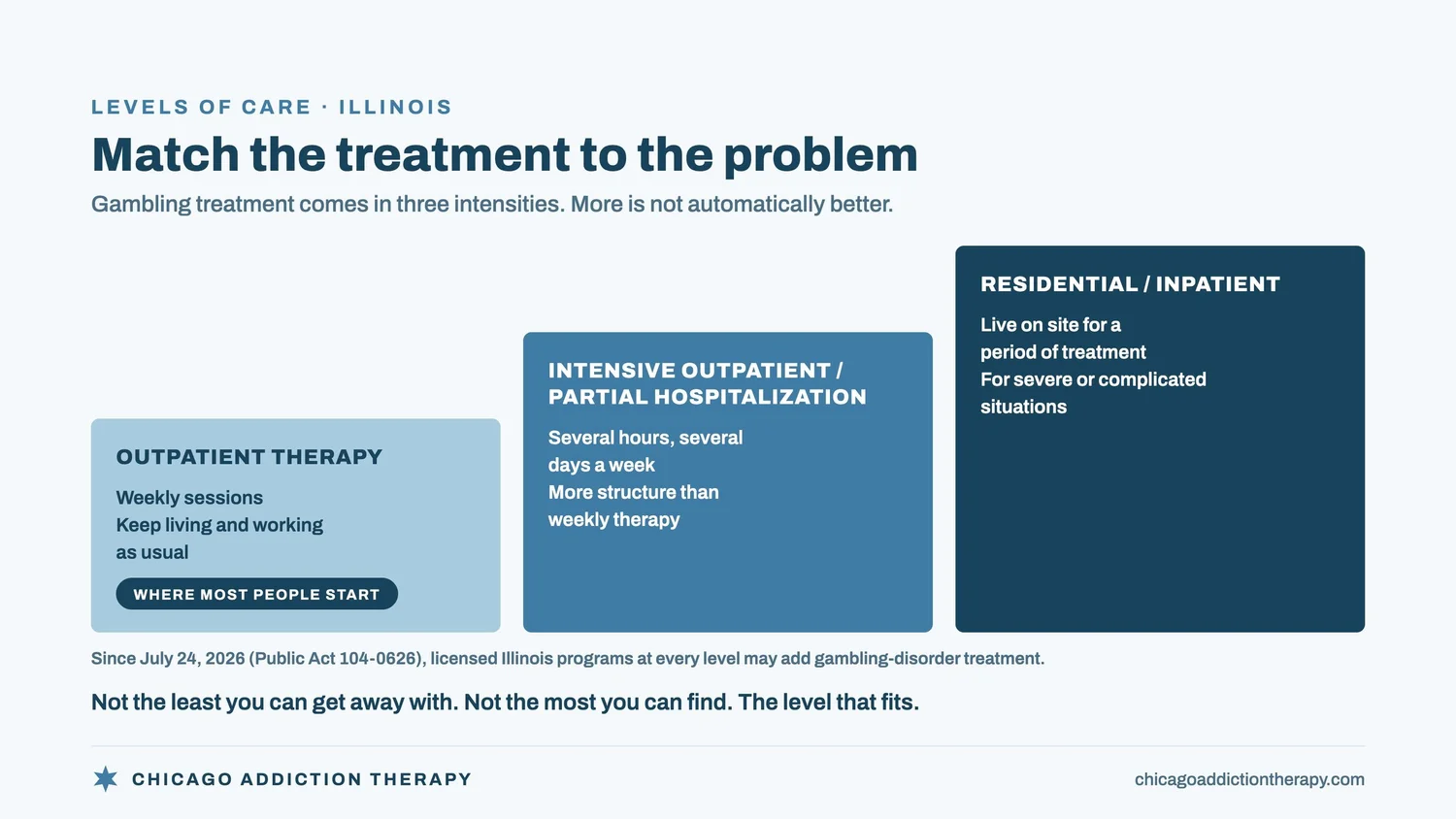
Outpatient Gambling Therapy
This is where most people begin. You keep living and working normally while meeting regularly with a therapist.
Outpatient treatment may be right when you are medically and psychiatrically stable but need help stopping or controlling gambling, managing urges, rebuilding trust, dealing with debt or preventing relapse. This is the level of care I provide at Chicago Addiction Therapy.
Intensive Outpatient or Partial Hospitalization
Some people need more structure and more treatment hours than weekly therapy can provide. Illinois law now expressly allows licensed intensive outpatient and partial-hospitalization programs to add gambling-disorder treatment, under standards set by the Department of Human Services. Whether a particular program actually offers gambling-specific treatment varies, so ask.
Residential Treatment
Residential treatment may be appropriate in more severe or complicated situations, particularly when someone cannot interrupt the gambling cycle in their current environment or has significant co-occurring mental health or substance use needs. The amended statute allows gambling treatment to be added to licensed residential/inpatient care as well.
That does not mean residential care is necessary for most people with a gambling problem. The goal is to match the level of treatment to the actual problem, rather than automatically choosing either the least intensive or the most intensive option.
How to Find Gambling Treatment in Illinois
There is more than one way in.
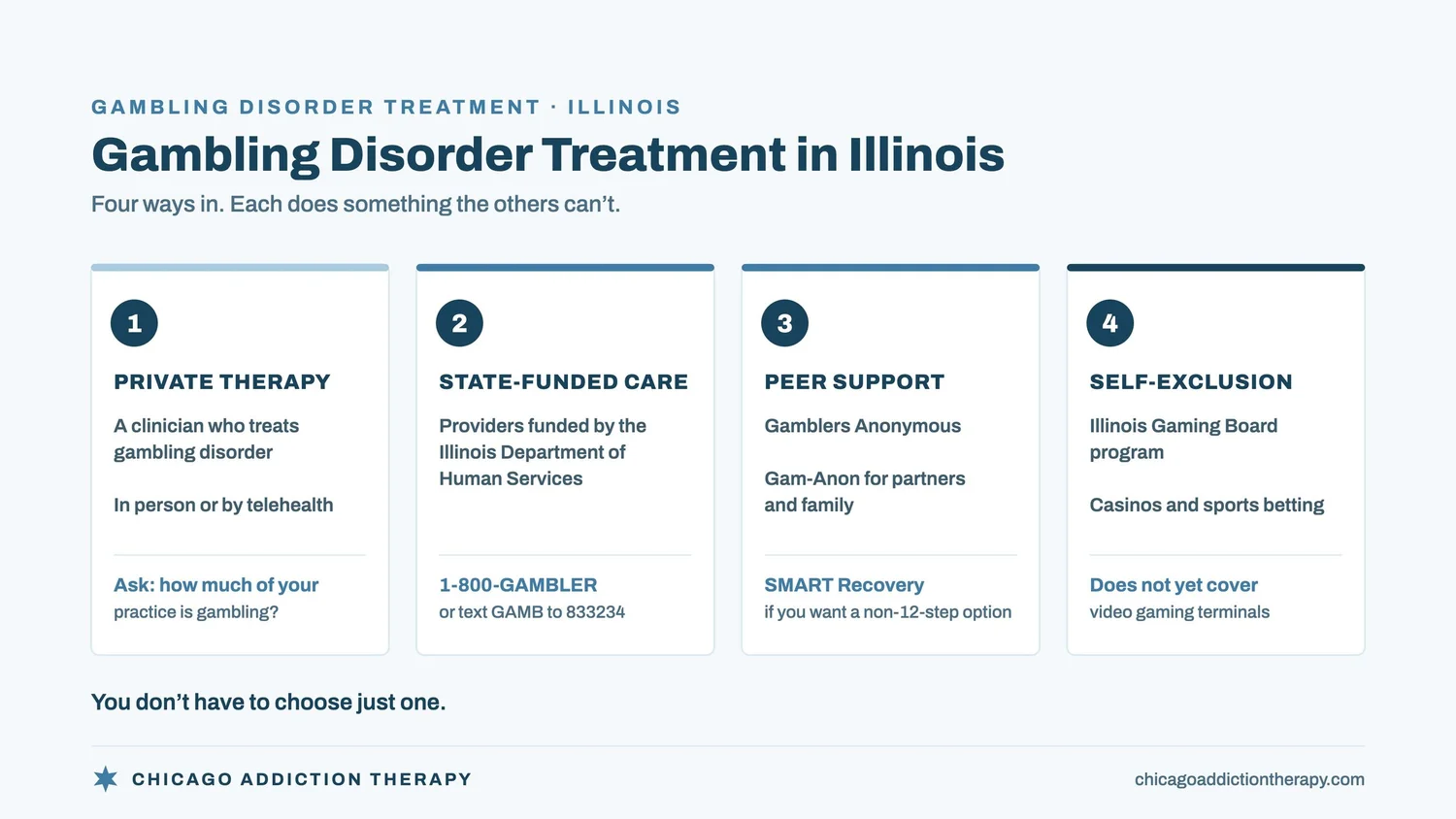
Private Gambling Therapy
You can work directly with a therapist who treats gambling disorder. Ask specifically about gambling experience. "Do you treat addiction?" is not the same question as "How much of your practice involves gambling disorder?"
A clinician can be very good at treating anxiety, depression or substance use and still have limited experience with chasing, sportsbook access, gambling-related thinking, self-exclusion and financial safeguards. If telehealth suits you better, online gambling therapy in Illinois explains what that looks like.
Illinois-Funded Gambling Treatment
Illinois also funds gambling-disorder services through the Illinois Department of Human Services. State-funded providers can offer screening, assessment, treatment and recovery support. Some offer services at no cost; others have eligibility requirements or a sliding fee.
The Illinois gambling helpline is free and confidential and can connect you with treatment anywhere in the state: call 1-800-GAMBLER (1-800-426-2537) or text GAMB to 833234. More state resources are listed on helplineil.org.
Peer Support
Some people use peer support alongside professional treatment. Gamblers Anonymous is for people struggling with gambling, and Gam-Anon is for partners and family members. SMART Recovery is a non-12-step option.
Peer support and therapy are not interchangeable, and you do not have to choose one or the other.
Self-Exclusion
The Illinois Gaming Board's Self-Exclusion Program covers casinos and sports wagering. Someone who has decided gambling has become a problem can voluntarily enroll to restrict access. It does not yet cover video gaming terminals, the slot-style machines in bars and gas stations across the state, so if those are your main form of gambling you will need other barriers too. The guide to stopping video gambling in Illinois covers them.
Self-exclusion can be very useful, but it works best as one part of a broader plan. Removing one outlet does not change the urge to gamble, and people sometimes move from one form of gambling to another when the underlying pattern has not been addressed. What enrolling in Illinois self-exclusion actually involves walks through the process step by step. The full list of resources is on the gambling resources page.
What Does Gambling Treatment Cost?
It depends on the route.
- State-funded providers may offer free or sliding-fee treatment for eligible Illinois residents. The helpline above is the fastest way to find one.
- Private therapy may be covered by insurance. You can check whether your plan covers sessions with me, and book, through my Headway profile. Otherwise sessions are self-pay.
- Intensive outpatient and residential programs cost considerably more, and coverage for gambling specifically varies by plan. Ask the program, and your insurer, directly whether gambling disorder is covered, not just "addiction."
- Peer support such as GA and Gam-Anon is free.
When Is It Time to Get Treatment?
You do not have to wait for a diagnosis. Consider getting help if you are:
- repeatedly gambling more than you intended
- chasing losses
- hiding gambling or financial activity
- borrowing money, or using credit, to gamble
- deleting gambling apps and reinstalling them
- thinking about gambling throughout the day
- anxious or irritable when you try to stop
- drinking or using drugs while gambling
- damaging a relationship because of gambling
- gambling to escape stress, depression or anxiety
- making rules for yourself and breaking them.
One of the clearest signs is simply this: you keep deciding you are going to gamble differently, and you keep ending up in the same place. That is enough reason to talk to someone.
Gambling Therapy With Chicago Addiction Therapy
I'm a Licensed Clinical Social Worker and Certified Alcohol and Drug Counselor in Chicago, and gambling is one of the primary focuses of my practice. I work with adults whose gambling involves sports betting, online casinos, casino trips, video gambling terminals, poker and daily fantasy, and high-risk trading that has started to work like gambling. The platform changes. The cycle is often remarkably similar.
Before private practice, my clinical work included hospital, residential and outpatient addiction treatment. That matters because gambling problems exist on a spectrum. Not everyone needs residential treatment, and not everyone needs the same recovery plan.
My approach is practical and direct: CBT for gambling-related thinking, motivational interviewing, urge management, access barriers and financial safeguards, relapse prevention, and whatever else is part of the picture, whether that is alcohol, anxiety, shame or a damaged relationship. The full description of how I work is on the gambling addiction therapy page, and partners can start with the page for partners and family.
I see clients in person in Logan Square, Chicago, and through secure telehealth throughout Illinois and Minnesota. You do not need to have stopped gambling before the first appointment, and you do not need to know exactly what you want to do. That is something we can figure out together.
Ready to Talk?
Start with a free 15-minute consultation. Tell me what has been happening, what you have already tried and what is getting worse, and we can talk about whether working together makes sense.
Schedule a free consultation → Check insurance on Headway
Chris Beerman, MSW, LCSW, CADC
Chicago Addiction Therapy · Logan Square, Chicago
In person and online throughout Illinois
Frequently Asked Questions About Gambling Disorder Treatment in Illinois
Is gambling disorder a recognized condition in Illinois?
Yes. Gambling disorder is a diagnosis in the DSM-5, and since July 24, 2026, Illinois law explicitly defines it and includes it in the state's behavioral-health prevention, treatment and recovery framework under Public Act 104-0626.
Can I get gambling therapy online in Illinois?
Yes. A clinician licensed in Illinois can provide telehealth to a client who is located in Illinois. Chicago Addiction Therapy provides online gambling therapy throughout Illinois as well as in-person treatment in Chicago.
Do I have to go to rehab for gambling addiction?
Usually not. Many gambling problems are treated successfully in outpatient settings. More intensive care may be appropriate when the problem is severe, outpatient treatment has not been enough, your environment makes stopping extremely difficult, or significant mental health or substance use problems are also present.
Does gambling treatment mean I have to go to Gamblers Anonymous?
No. GA is one recovery resource. Some people find it very helpful. Others prefer individual therapy, group therapy or a combination of professional treatment and peer support.
Do I have to stop gambling completely?
That decision should be based on your circumstances rather than a slogan. For someone who repeatedly loses control once gambling begins, abstinence may be the most realistic goal. Someone at an earlier stage may first want to find out whether meaningful limits are possible. Treatment should include an honest look at what has happened when you have tried to control your gambling in the past.
Can family members get help?
Yes. Gambling affects partners and families even when the person gambling is not ready for treatment. Family work may focus on financial protection, boundaries, communication, disclosure, rebuilding trust, and telling real support apart from things that unintentionally make continued gambling easier. See the pages for partners and family and for partners of someone with a gambling problem.
Where can I find state-funded gambling treatment in Illinois?
Call 1-800-GAMBLER or text GAMB to 833234. The Illinois gambling helpline is free and confidential and can refer you to state-funded providers anywhere in Illinois.
If you are in immediate danger or thinking about suicide or harming yourself, call or text 988 or go to the nearest emergency department. For Illinois gambling-treatment referrals, call 1-800-GAMBLER or text GAMB to 833234.
Sources: Illinois Public Act 104-0626 (full text, Illinois General Assembly); WTTW, July 27, 2026; NICE guideline NG248, Gambling-related harms (2025); American Psychiatric Association, DSM-5. How this site sources and reviews its content: editorial standards and clinical review policy.