
You Can Bet on Chicago’s Weather Every Day. That Tells You How Prediction Markets Are Built.
Kalshi has listed a bet on Chicago’s high temperature every day since 2021. What the Illinois data shows about how prediction markets are built, and why it matters if you’re trying to stop.
Written by Chris Beerman, MSW, LCSW, CADC · Published October 2026 · Data current as of October 12, 2026
Right now, you can bet on how hot it will get at Chicago Midway Airport tomorrow.
Not as a joke between friends. On Kalshi, a federally regulated prediction market, there has been a contract on Chicago’s daily high temperature every single day since August 2021. In the last 12 months it ran 365 days out of 365. Each one opens the morning before and closes after midnight, so tomorrow’s is already trading before today’s is done.
I went through Kalshi’s public market data for everything with Chicago or Illinois in it. I expected the story to be the Bears. Some of it is. But the clearest picture of how these platforms are built turned out to be the weather.
How a Weather Bet Works
Each day’s market is a ladder of yes-or-no questions. Will the high at Midway be above 70°? Above 72°? Above 74°? You buy “yes” or “no” on any rung for somewhere between a penny and a dollar. If you’re right, the contract pays $1. If you’re wrong, it pays nothing.
The official number is the maximum temperature recorded at the Chicago Midway weather station, as reported by The Weather Company. Kalshi’s own rules warn that the forecast on your phone may not match the reading it pays out on.
Nothing about this requires a team, a season or a game. It requires a morning. That is the point I want people to notice.
One a Day, Then Two, Then One an Hour
The Chicago weather markets have been getting more frequent, not less.
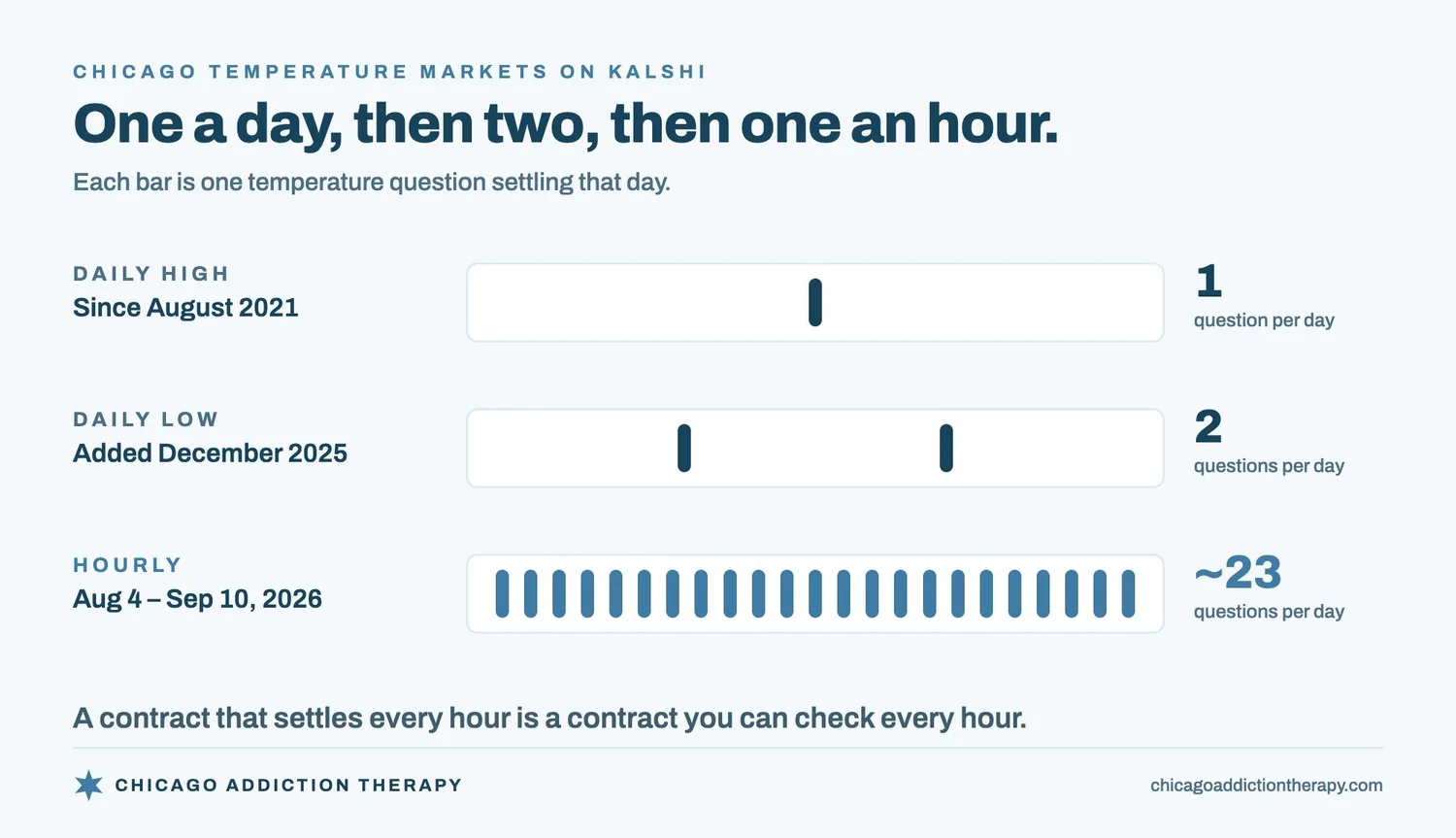
Daily high, since August 2021. One question a day: how hot will it get?
Daily low, since December 2025. A second daily question: how cold will it get overnight? It has run 304 days so far.
Hourly temperature, August 4 to September 10, 2026. For about five weeks, Kalshi listed roughly 23 Chicago contracts a day, each about a single hour. One asked whether it would be above 73.99° at 10 a.m. on September 10. None are open as I write this, but the product existed.
Alongside those sit monthly rain, monthly snowfall, and whether it would snow on Christmas.
Some people trade weather because they’re good with forecasts. But a contract that settles every hour is a contract you can check every hour. That is a design choice, and in my work it is the choice that matters most.
From 1.9 Million to 57 Million
In 2023, about 1.9 million contracts were traded on Chicago’s daily high. In 2026, through October 12, it was 57.3 million: more than thirty times as much, with the coldest months of the year still to come.
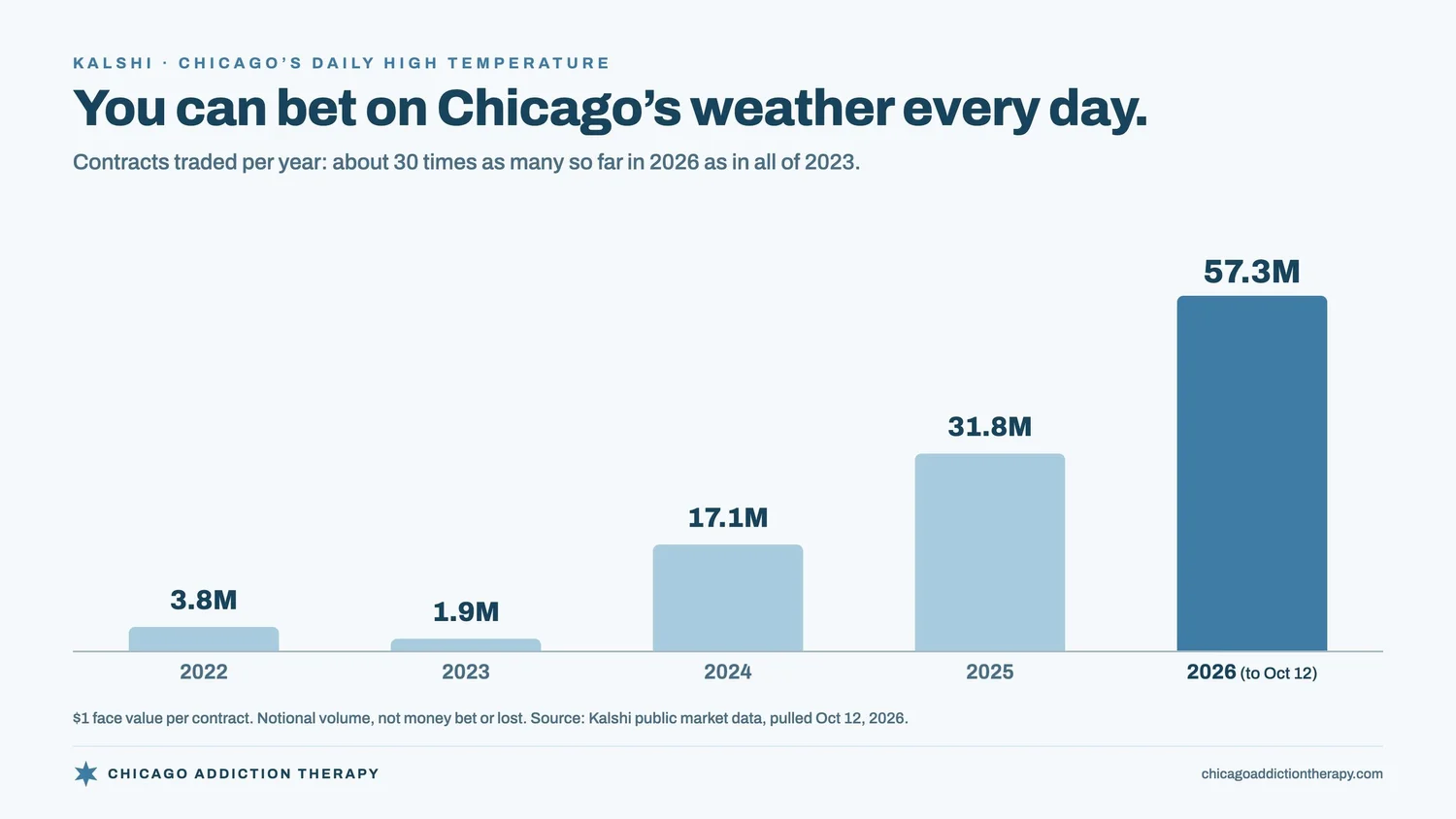
The busiest single day was January 23, 2026, at about 1.6 million contracts. Over the last 12 months the average was about 185,000 a day. Chicago isn’t the busiest city for this: New York’s daily high drew more. It is one of the steadiest.
Where the Trading Is, and Where It Isn’t
Weather is the steady background. Chicago sports are the spikes. Illinois politics barely registers.
The Bears. The Bears–Packers playoff game on January 10, 2026 drew about 84 million contracts on who would win. That was the most of any NFL game-winner market in Kalshi’s data from July 2025 to now. The Bears–Rams playoff game a week later was third, at about 82 million. In the 2025 regular season the Bears ranked 10th of 32 teams in trading per game.
The Cubs and White Sox. Trading on Cubs games went from roughly 0.2 million contracts a game in 2025 to 4.1 million in 2026, about twenty times as much. The White Sox went from 0.2 million to 3.3 million. Neither team was unusual: the Cubs ranked 11th of 30 and the Sox 27th. The whole sport grew at once.
Illinois politics. The governor’s race and the Chicago mayor’s race have drawn about 140,000 contracts each. The attorney general race, the Chicago Board of Education president and the Lollapalooza lineup are each under 40,000.
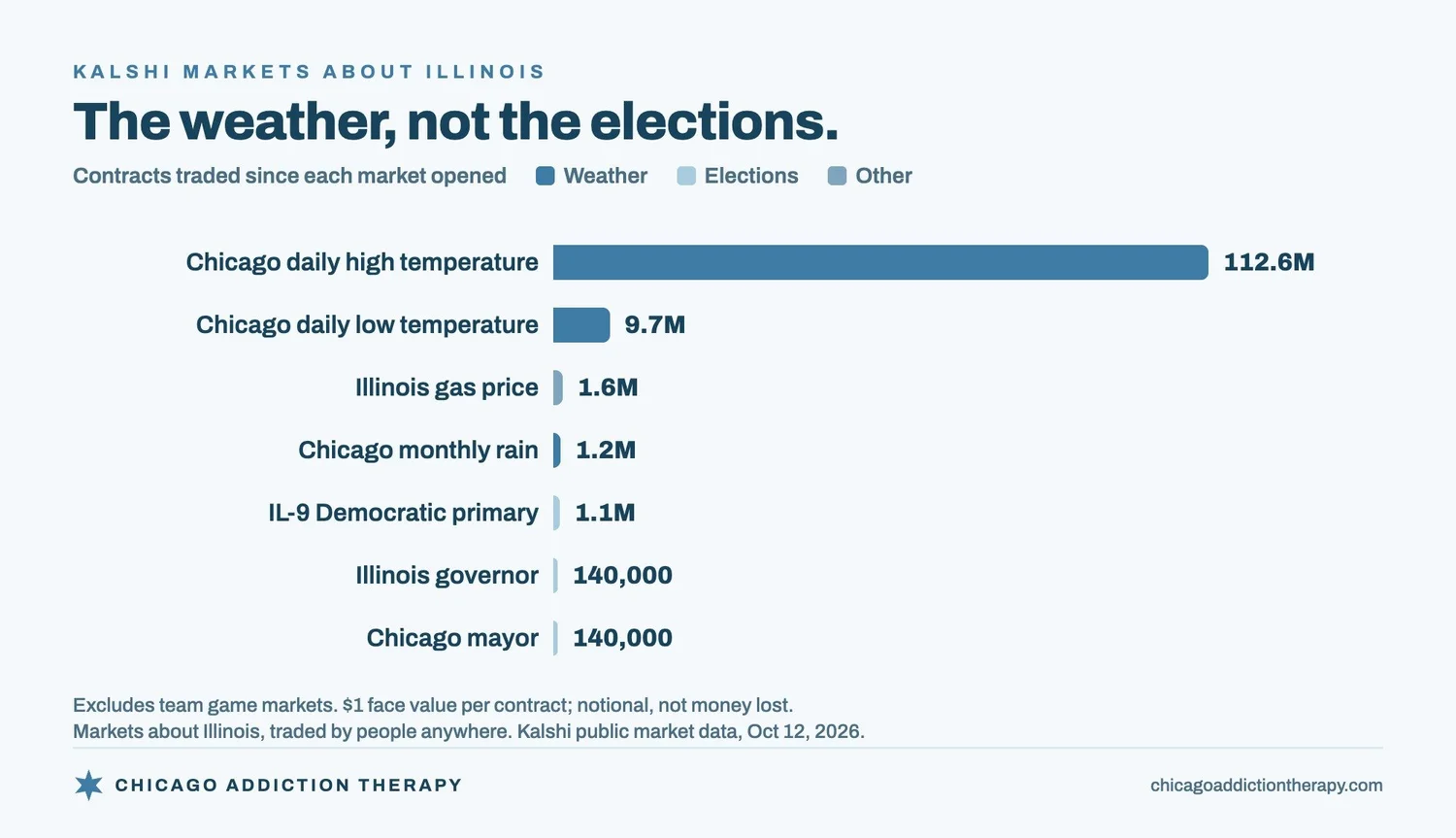
Put together, weather makes up more than 90% of the trading on Illinois topics outside team games. The markets that get the headlines are elections. The markets that get the steady volume are the ones that never stop.
I’m writing separately about election betting; that post goes up next Sunday.
Why This Matters If You’re Trying to Stop
Most of the people I work with didn’t lose control during one big game. They lost it in the gaps between games, when there was always something else to check.
Sports betting used to have natural stopping points. The game ended. The season ended. There was a Tuesday with nothing on. Those pauses were where a person could notice what they were doing and decide something different.
A weather market has no off-season. There is a new contract every morning, the next one opens before the last one closes, and for a few weeks there was one every hour. When I look at that design, I see a product with the stopping points taken out.
Three things follow from that:
“I’ll stop after this one” has no natural end. There is always a next one, and it is already open.
It doesn’t feel like gambling. Checking a forecast feels like being informed. That is part of what makes it easy to keep doing.
Skill can be real and still not protect you. Someone can be genuinely good at reading forecasts and still be unable to stop checking. Being right sometimes is not the same as being in control.
To be clear about the evidence: there is no published research yet on weather-market trading and gambling problems specifically. What I’m describing is how the product is built, and what that design has meant in other forms of gambling. I’ve written more about whether prediction markets are gambling and where the risk is.
Signs It’s Gone Past Interest
Ask yourself honestly:
Do you check the market before you check the actual weather?
Have you traded a contract on something you don’t care about, just because it was open?
Do you open the app at times you’d normally be asleep, working or with people?
After a loss, do you look for the next contract to win it back?
Have you moved money in that you’d told yourself you wouldn’t?
Would you be uncomfortable if someone you live with saw your trading history?
If several of those land, take the free, private gambling addiction test. It takes a few minutes and nothing you answer leaves your device.
What to Do Next
Close the door on the platform. Your Illinois self-exclusion doesn’t cover prediction markets. Here’s how to self-exclude from Kalshi, Polymarket, Robinhood and others, in the right order.
Plan the first 24 hours. The 24-Hour Betting Shutdown Plan covers blocking software, bank blocks and getting through the first night.
Talk to someone. I offer prediction market addiction therapy in person in Logan Square and online across Illinois and Minnesota. You can email me to schedule a free 15-minute consultation, or call or text (708) 665-5271.
Help is available now. In Illinois, call 1-800-GAMBLER or text GAMB to 833234. Nationally, call or text 1-800-MY-RESET (1-800-697-3738). If you’re in a mental health crisis or thinking about suicide, call or text 988. If you’re in immediate danger, call 911.
About These Numbers
Source. Kalshi’s public market data (API documentation), current and historical markets, pulled October 11–12, 2026. Settlement terms are from Kalshi’s temperature contract terms and each market’s rules.
What’s counted. Contracts traded. Each contract has a $1 face value, so these are notional figures. They are not the amount people bet, and not the amount anyone lost. One contract can change hands many times.
What’s not counted. Kalshi publishes nothing about where its users live. These are markets about Chicago and Illinois, traded by people anywhere Kalshi operates. They say nothing about how much Illinois residents trade.
Sports figures cover game-winner markets only. Point spreads, totals, player props and the Super Bowl are listed separately and aren’t included. 2025 baseball data begins April 16, 2025.
Kalshi only. Other platforms, such as Polymarket, aren’t included here.
This post is for general information and is not a substitute for individual assessment or treatment.