
Dostoevsky Knew the Trap: Why Winning Doesn’t Make Gambling Easier to Stop
A novelist who knew roulette from experience understood something uncomfortable about gambling: a win can be the beginning of the next loss.
Written by Chris Beerman, MSW, LCSW, CADC · Published October 2026
In May 1867, Fyodor Dostoevsky wrote to his new wife, Anna, from the German spa town of Homburg. She was waiting for him in Dresden. He had gone to play roulette, he had lost more than he could afford, and he was trying to explain what had happened. In the middle of the letter, he named the moment his judgment changed: “as soon as I begin to win, then immediately I take risks.” [1]
That sentence could have been written by someone describing sports betting today. The games, the technology and the speed have changed. The strange relationship between winning and losing has not. People often assume the worst danger for someone with a gambling problem is a long losing streak. Losses certainly drive people to chase. But winning can create its own momentum. A person who was prepared to stop after recovering a little money suddenly sees what else might be possible.
Dostoevsky understood that shift. Understanding it didn’t reliably protect him from it. That is part of what makes his writing on gambling worth revisiting.
A Novelist at the Roulette Table
The year before, Dostoevsky had raced to finish a short novel called The Gambler. Under a punishing contract, he had to deliver a new novel to the publisher Fyodor Stellovsky by November 1, 1866. If he missed the deadline, Stellovsky would gain the right to publish his work for nine years. He hired a young stenographer, Anna Grigoryevna Snitkina, and dictated the book in about twenty-six days. They married in February 1867. [2]
The situation almost invites an easy moral: here was a man who could write brilliantly about compulsive behavior yet couldn’t reliably change his own. That explanation is too tidy. Dostoevsky was under heavy financial pressure, his relationships were complicated, and roulette offered something more seductive than a chance at cash. It offered the possibility that his circumstances might change all at once.
The Gambler follows Alexei Ivanovich, a tutor to a Russian general’s family at a German resort, among people whose lives are tied to debt, inheritance and status. Alexei is in love with Polina, who sends him to the roulette tables to play for her. He becomes drawn into the gaming room with a certainty his knowledge can’t support. When Polina asks why he is so sure he will win, he answers: “To tell the truth, I do not know. I only know that I must win—that it is the one resource I have left.” [3]
The word must matters. When a bet stops feeling like a wager and starts feeling like the only available solution, ordinary calculations lose their authority. A person can understand the risk while also believing that declining it would mean accepting humiliation, financial ruin or a life smaller than the one they imagined.
Why a Win Can Make Stopping Harder
Imagine someone who has lost $30,000 on sports betting. They tell themselves that if they can recover $5,000, they will withdraw the money, close their accounts and stop. Then they win $5,000. Instead of ending the problem, the win raises a new question: if five thousand was possible, why not ten?
The target moves. What had been a stopping point becomes evidence that continuing might work.
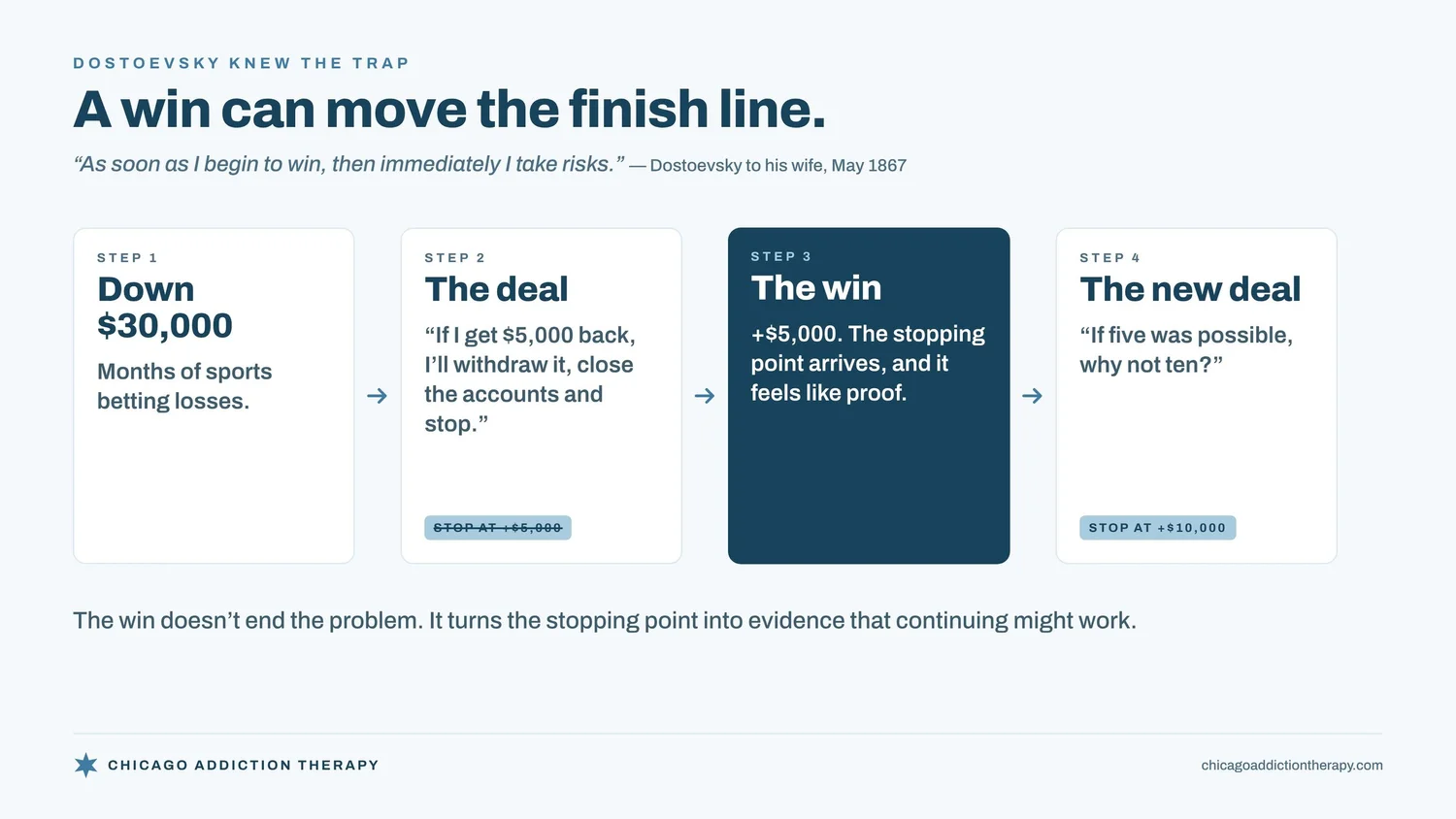
This isn’t just greed, and it isn’t necessarily ignorance about probability. A win can alter confidence, expectations and the emotional meaning of the next bet. It can make an uncertain outcome feel deserved or repeatable. It can also offer temporary relief from shame: for a few minutes, the person who was losing is again the person who might recover everything.
Sportsbooks and online casinos offer more chances to repeat this sequence than Dostoevsky could have imagined. A bettor can move from a winning wager to a new market without leaving the sofa. The balance stays on the screen. The next game starts. The question of whether to quit doesn’t come up in a quiet, neutral moment; it comes up while excitement and anticipation are already high.
Not everyone who wins keeps gambling, of course, and a single win doesn’t cause gambling disorder. The point is narrower. For a person already struggling to control their gambling, winning can strengthen the very expectations and habits that make stopping difficult.
What the Money Was Supposed to Fix
Dostoevsky’s novel is especially perceptive about how money gets tangled up with dignity, love and power. Alexei doesn’t want winnings only to buy things. He imagines money changing his place in the world and, in some measure, his standing with Polina. When he finally does win a fortune and brings it to her, it doesn’t give him what he wanted. She throws the money in his face, and he leaves for Paris with someone else while the winnings drain away. The novel refuses to make sudden wealth the cure for his unrest. [3]
This is familiar territory in gambling treatment. Someone may say they are betting to pay off a debt, but the debt is usually attached to a larger story. If they can win the money back, perhaps their partner will never learn what happened. Perhaps they can stop feeling foolish. Perhaps they can return to the version of themselves who had savings, credibility and options.
Those desires are understandable. They are also an enormous burden to place on the outcome of a game.
In cognitive behavioral therapy (CBT), one useful question isn’t only whether a client is likely to win. It is what they expect winning to accomplish. What will change once the money is recovered? Have earlier wins brought that change? What happened next? A client may discover that the short stretch of relief after a win was followed by bigger wagers, more secrecy or another financial crisis.
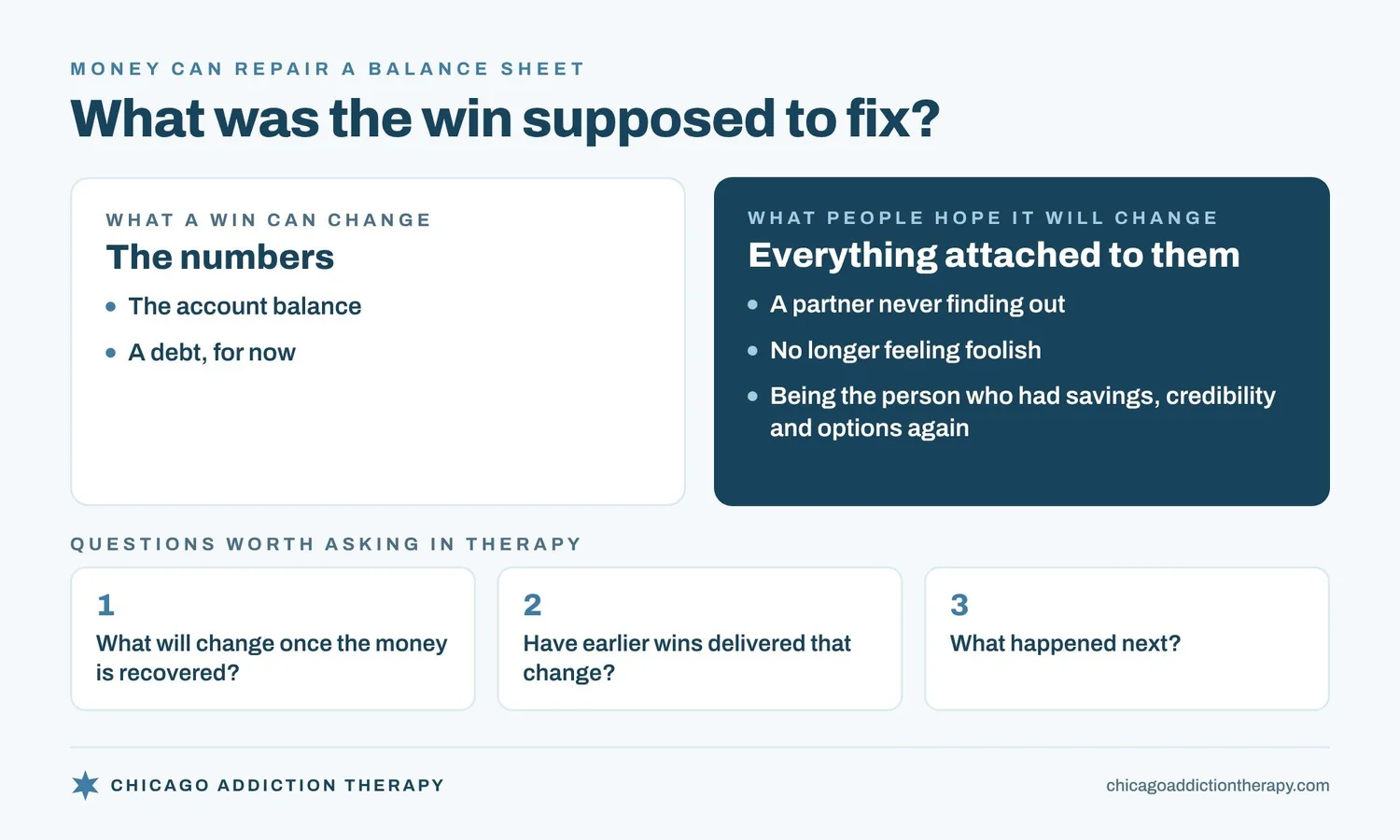
The work isn’t to scold the client for having hope. It’s to look at whether the hope is attached to a method that keeps making the original problem worse.
The Distance Between Knowing and Stopping
The letters to Anna make the contrast even sharper. Dostoevsky described his losses with painful clarity. He worried openly about her respect and about the marriage itself (“Can you, will you respect me now?” he asks in one), and he recognized how little sense his continued gambling made. Yet he was still negotiating with himself about the next decision. [1]
It would be a mistake to diagnose a nineteenth-century writer from a handful of letters. (Freud tried something like it in 1928, reading Dostoevsky’s gambling as self-punishment; I’ve written about why that theory doesn’t hold up as a general explanation.) Still, his account illustrates a distinction clinicians run into all the time: insight and behavior change are different achievements.
A person can describe the gambler’s fallacy accurately, understand a sportsbook’s built-in edge and name the triggers that lead them to bet. None of that guarantees they can stop when they are alone, distressed or holding a winning ticket. Knowledge can change what someone believes in a therapy office without yet changing habits they have practiced hundreds of times outside it.
That’s why effective gambling treatment does more than explain distorted thinking. It looks at what happens before a wager, the immediate relief or excitement it brings, the beliefs that follow a win or a loss, and the conditions that make the next bet available. The UK’s 2025 NICE guideline on gambling-related harms recommends CBT that includes a relapse-prevention component, and it asks clinicians to discuss practical barriers too: self-exclusion, blocking software, blocks on gambling payments through the bank, and ways to limit access to money, such as a family member taking over the finances for a while. [4] In Illinois, that can start with self-exclusion from casinos and sportsbooks; if you need to close doors today, the 24-Hour Betting Shutdown Plan walks through the first ones.
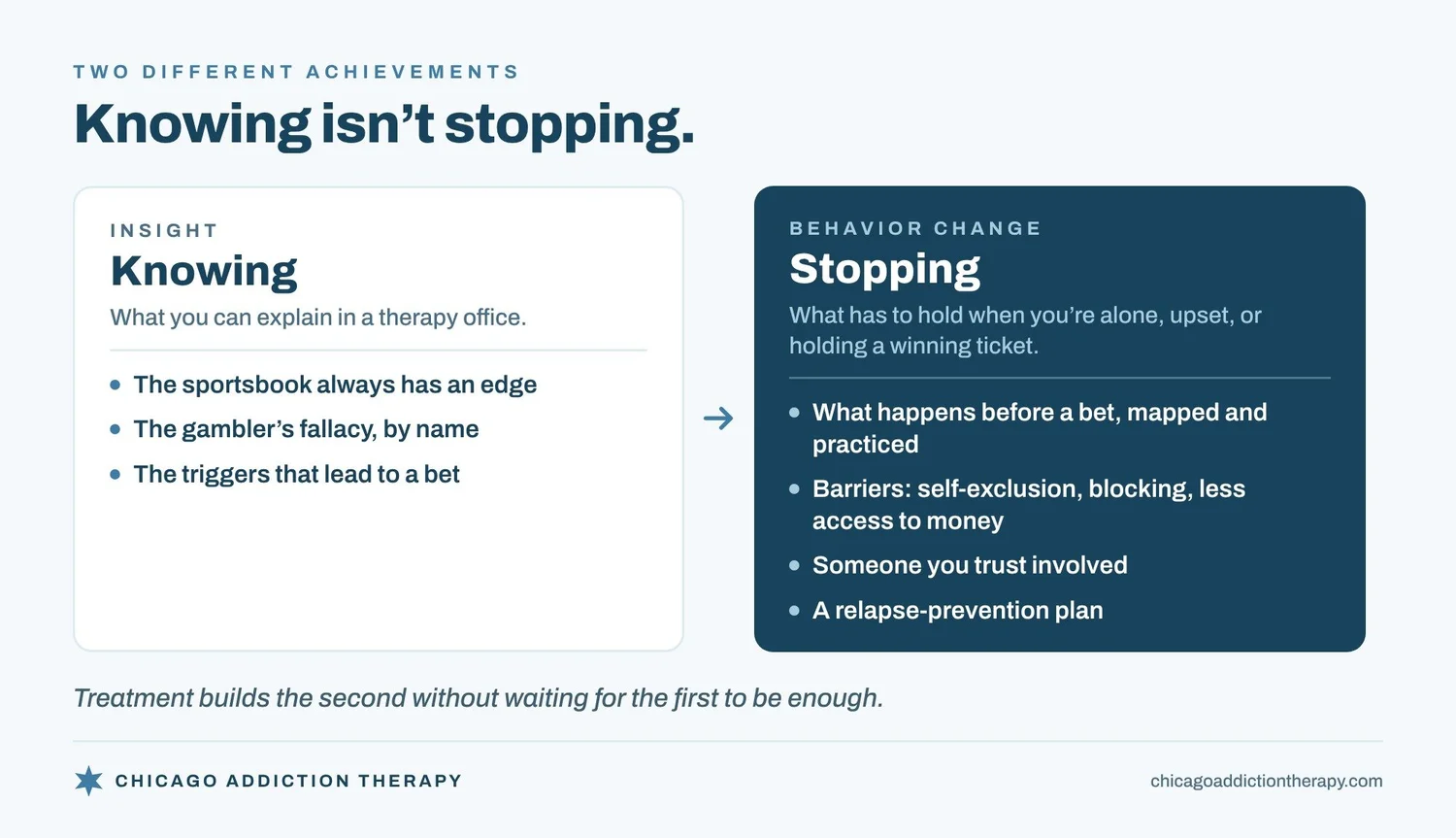
The aim isn’t to make someone so well informed that they never feel another urge. It’s to help them build a life in which an urge, or a sudden surge of confidence after a win, no longer decides what happens next.
How It Ended for Dostoevsky
There’s a temptation to turn a great writer’s suffering into proof that gambling fed his genius. It didn’t need to. Dostoevsky’s skill as a novelist and the harm his gambling caused are separate facts. The losses hurt other people, Anna above all, and shouldn’t be recast as a romantic price paid for literature.
His story does have an ending, and it isn’t a winning streak. In April 1871, after another trip to the roulette tables at Wiesbaden and another loss, he wrote to Anna that it was all over, that this really had been the very last time. By the accounts of his wife and his biographers, it was: he never played roulette again, even on later trips to Germany. [5] Nobody can say exactly why that promise held when so many earlier ones hadn’t. What we can say is that it didn’t come from a big win. The way out began on a day when he lost.
The Win Isn’t the Exit
Dostoevsky’s most useful legacy is the unflattering precision with which he described the trap. Winning didn’t always quiet his need to gamble. Sometimes it made the next risk feel irresistible. And in The Gambler, a large win doesn’t answer the questions about love, worth and belonging that brought Alexei to the table.
The same distinction matters now. Money can repair a balance sheet; it can’t, on its own, repair shame or restore trust. A win can change the numbers for a while without changing the relationship someone has developed with gambling.
For people trying to stop, this can be a hard idea to accept: the longed-for win may not be the exit. It may be one more reason to stay.
Dostoevsky knew how that worked. Knowing wasn’t enough. Recovery takes something else: the slower, less dramatic work of making a different choice before the next spin, the next game or the next chance to win.
If This Sounds Familiar
If you’ve promised yourself you’d stop once you were back to even, and then kept going when you got there, that pattern is worth taking seriously. The free, anonymous gambling addiction test is a private place to start. If you’ve already gone back after a stretch of not gambling, read what to do after a gambling relapse. And if the money is part of what keeps you betting, my guide to recovering financially after gambling losses covers the longer road.
I offer gambling addiction therapy in person in Logan Square and online anywhere in Illinois and Minnesota. You can reach out to schedule a free 15-minute consultation.
Help is available now. In Illinois, call 1-800-GAMBLER or text GAMB to 833234. Nationally, call or text 1-800-MY-RESET (1-800-697-3738). If you are thinking about suicide or are in crisis, call or text 988.
Sources
Sanju George, “Excerpts from The Letters of Dostoyevsky to His Wife, by Fyodor Dostoyevsky,” Advances in Psychiatric Treatment 17, no. 2 (2011): 103. Letters dated 19–24 May 1867. https://doi.org/10.1192/apt.17.2.103
Anna Dostoevsky, Dostoevsky: Reminiscences, trans. Beatrice Stillman (Liveright, 1975); Joseph Frank, Dostoevsky: The Miraculous Years, 1865–1871 (Princeton University Press, 1995).
Fyodor Dostoevsky, The Gambler (1866), trans. C. J. Hogarth, chapters I, V, XIV and XV. Project Gutenberg: https://www.gutenberg.org/files/2197/2197-h/2197-h.htm
National Institute for Health and Care Excellence (NICE), Gambling-related harms: identification, assessment and management, NG248 (January 2025), recommendations 1.1.14 and 1.5.13–1.5.15. https://www.nice.org.uk/guidance/ng248/chapter/recommendations
City of Wiesbaden, Stadtlexikon, “Dostojewski, Fjodor Michailowitsch” (letter of 28 April 1871). https://www.wiesbaden.de/en/stadtlexikon/stadtlexikon-a-z/dostojewski-fjodor-michailowitsch; see also Frank, The Miraculous Years.
This essay is an interpretation of Dostoevsky’s letters and fiction, not a diagnosis of him. It is for general information and is not a substitute for individual assessment or treatment.