
How to Self-Exclude From Prediction Markets: Kalshi, Polymarket, Robinhood & More
Written by Chris Beerman, MSW, LCSW, CADC · Published October 2026 · Platform details current as of October 5, 2026
There is no single list that bans you from prediction markets. Here’s how to close every door anyway — in the right order.
Prefer paper? Download the free printable checklist (PDF) — every step and every platform on three pages, no sign-up.
On October 2, 2026, NPR told the story of a man in Pennsylvania who had done almost everything right. After roughly $75,000 in debt, more than $50,000 lost to online sportsbooks, and a bankruptcy, he self-excluded from DraftKings and FanDuel and put himself on Pennsylvania’s statewide self-exclusion list. About two years later, an Instagram ad for Kalshi offered him a small cash bonus to sign up. Before long he had lost more than $25,000, much of it on crypto price contracts that settle every 15 minutes.
His state self-exclusion didn’t stop him because it was never designed to. Prediction markets aren’t licensed as gambling in most states. They’re regulated federally as derivatives, and they don’t participate in state self-exclusion programs.
I see this pattern in my practice. Someone closes the sportsbook door, and a few weeks later they’re betting the same NFL games as “event contracts” in an app filed under Finance in the App Store. This guide is the map I wish more people had before that happened: which platforms offer self-exclusion, which ones don’t, where the gaps are, and what to do first.
The short version
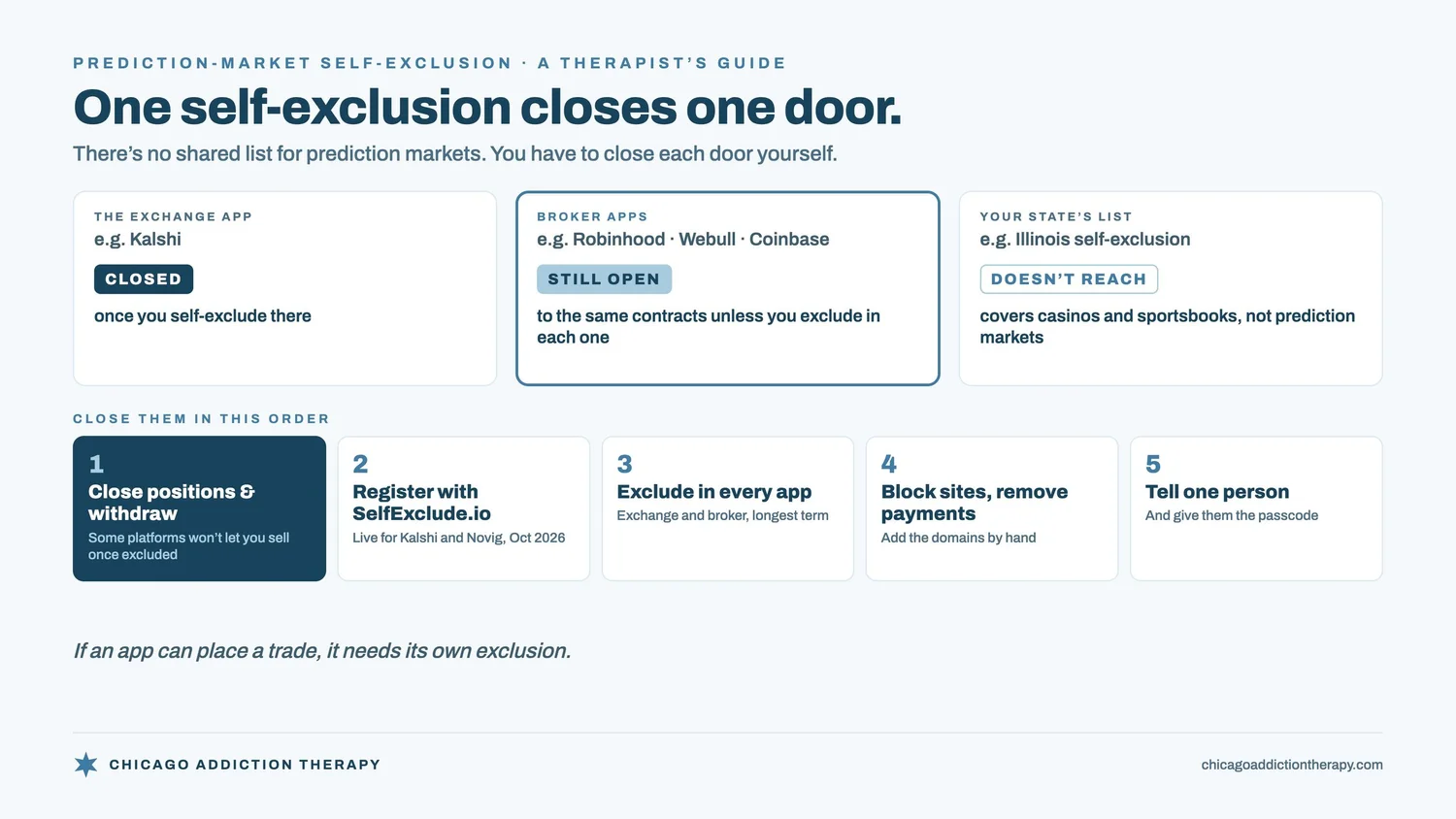
Your state self-exclusion list does not cover prediction markets. Not Illinois’s, not Pennsylvania’s. You have to exclude platform by platform.
Close your positions and withdraw your money first. On some platforms, you can’t sell open positions once you’re excluded.
Excluding from an exchange may not block its brokers. Kalshi says its self-exclusion doesn’t stop you trading Kalshi contracts through a broker — and Robinhood, Webull and Coinbase all offer them.
SelfExclude.io covers more than one platform at once — but as of October 2026, only Kalshi and Novig are live.
Then add barriers outside the apps: blocking software with the domains added by hand, payment methods removed, and one person who knows.
Why Your State Self-Exclusion Doesn’t Cover Prediction Markets
State self-exclusion programs are built on state gambling licenses. When you enroll, every licensed casino and sportsbook in that state has to keep you out. Kalshi, Polymarket US and most of their competitors don’t hold those licenses. They operate as exchanges and brokers regulated by the Commodity Futures Trading Commission (CFTC), and their position is that state gambling law doesn’t apply to them.
Illinois is in the middle of that fight. In June 2026 the state passed SB 3019, which brought sports “exchange wagers” under the Sports Wagering Act — requiring a sports wagering license — and added a per-transaction tax. On October 2, 2026, a federal judge in Chicago preliminarily blocked the state’s licensing requirements as applied to the Kalshi contracts at issue, and granted Coinbase partial relief too. She hasn’t yet ruled on the per-transaction fees, and a conflicting Wisconsin decision is already on appeal to the Seventh Circuit. I’ve covered the legal back-and-forth in more detail in Are Prediction Markets Gambling?
What matters for you is simpler: nothing in Illinois law today puts you on a prediction market’s blocked list because you joined the Illinois Gaming Board’s program. The Gaming Board’s September 2026 self-exclusion changes — new shorter terms, a possible online enrollment portal, ID readers for video gaming terminals and adding fantasy contests — don’t mention prediction markets at all. The same is true in Pennsylvania, where reporting this month confirmed the state list doesn’t reach Kalshi.
So if you’ve already self-excluded through the state, keep it. It still covers casinos and sportsbooks, and here’s how Illinois enrollment works. Just don’t assume it covers anything with “markets,” “predictions” or “trading” in the name. The Illinois Gambling Protection Gap Index shows what the state program does and doesn’t reach, product by product.
In Minnesota there’s no statewide list to join in the first place, and the state’s 2026 ban on prediction markets is on hold in federal court for registered exchanges like Kalshi. Here’s how to block gambling in Minnesota instead, venue by venue.
Before You Exclude: Close Positions, Then Withdraw
This is the step people skip, and it can cost real money.
Prediction-market platforms handle open positions very differently once you exclude:
Kalshi says you can’t sell open positions during a self-exclusion or trading break. Whatever you hold, you hold until it settles.
Robinhood requires you to close open event-contract positions before it will fully disable your access.
Coinbase requires you to sell all open contracts and cancel open orders before you can close a predictions account.
Fanatics Markets closes your open positions and returns your funds automatically when you self-exclude.
Polymarket US says you can still close positions or let them settle, and withdraw your available balance, after you exclude.
PrizePicks advises withdrawing your funds before you exclude.
Clinically, I care about this for a second reason. An open position is a reason to keep checking. If you exclude while holding a contract on Sunday’s game, you’ll probably open the app on Sunday to watch it — and the app will show you everything else you could be trading. Close out, withdraw, then exclude. If closing a position means taking a loss, take it. A known loss today is smaller than another month of watching.
One caution: “I’ll exclude after this weekend’s positions settle” is how exclusion gets postponed indefinitely. If you can’t close everything today, exclude from the platforms where you have no open positions today, and set a specific time for the rest.
Know Which Kind of Door You’re Closing
The single most important idea in this guide is that prediction markets have two layers.
Exchanges list the contracts: Kalshi, Polymarket US, Crypto.com’s derivatives exchange, ForecastEx, Novig, ProphetX, DraftKings’ new exchange and others.
Brokers (the legal term is futures commission merchant, or FCM) are apps that let you trade on those exchanges: Robinhood, Webull, Coinbase, Interactive Brokers, tastytrade and PrizePicks’ prediction product, among others. Some companies are both — Underdog, for example, launched its own exchange in July 2026.
Kalshi’s help page says excluding yourself there doesn’t stop you reaching its contracts through a broker. In plain English: you can be self-excluded on Kalshi and still trade Kalshi contracts in Robinhood. The same caveat applies to Kalshi’s trading breaks.
That means you need to exclude from every app you actually use — the exchange and each broker — and, ideally, from the ones you don’t use yet but might download at 11 p.m.
Step 1: Start With SelfExclude.io
SelfExclude.io, run by the responsible-gaming company IC360, is the closest thing prediction markets have to a shared list. Kalshi was the first platform to integrate it, in April 2026.
How it works: you create an account with your email, verify your identity with a government ID, and choose a term. Participating platforms activate the block within 24 hours of verification.
Durations: 1 month, 3 months, 6 months or 1 year. A term can be extended but not shortened.
Who it covers (as of October 3, 2026): Kalshi and Novig. Polymarket, Robinhood, ProphetX, Juice Exchange and Matchbook are listed as “coming soon.” DraftKings, FanDuel, Fanatics, Underdog, PrizePicks, Coinbase, Webull and Crypto.com are not listed.
Do it — it costs a few minutes, and coverage should grow. But be clear about the limits. It covers two live platforms today. It says nothing about brokers that route to Kalshi, and I couldn’t confirm whether a SelfExclude.io match blocks orders that reach Kalshi through a broker. Assume it doesn’t, and exclude from the brokers separately. Its longest term is also one year; if you want longer, use each platform’s own tools as well.
Step 2: Exclude From Each Platform You’ve Used — or Could
Here is what each major platform offers, from its own help pages unless noted. These change often. If a step below doesn’t match what you see, contact support and ask for self-exclusion by name, in writing.
Kalshi
Kalshi’s self-exclusion is self-serve: open the menu and go to Responsible Risk Management on the website or in the app. Kalshi says self-exclusions and trading breaks can’t be lifted or changed until they expire. It doesn’t publish the exact term options on its help pages, so choose the longest available. Kalshi also offers trading breaks of a day or more and a monthly funding cap, and links to SelfExclude.io for broader coverage.
Remember the two catches above: you can’t sell open positions once excluded, and Kalshi’s exclusion doesn’t block brokers.
Polymarket US
Polymarket added self-exclusion and deposit limits for US users at the end of September 2026. Its trust page describes exclusion from one month to one year, or permanently, taking effect as soon as you confirm. New trades are blocked; you can still close or settle open positions and withdraw your balance. Deposit limits can be daily, weekly or monthly — lowering one is immediate, while raising or removing one has a 72-hour cooldown. Polymarket doesn’t say whether an exclusion can be ended early, so choose “permanent” if you’re sure, and assume nothing about reversing it.
The international Polymarket site isn’t open to US users: US locations are restricted to closing existing positions, and Polymarket has reportedly restricted accounts that get around that with a VPN. I mention this because “I’ll just use the other Polymarket” is a thought people have — and a restricted account can have your money in it.
Robinhood
Robinhood offers prediction markets through Robinhood Derivatives, which routes orders to Kalshi and, according to news reports, other exchanges including its own. To self-exclude from all event contracts, you have to contact Robinhood support — the in-app setting alone doesn’t do it. Robinhood says a short waiting period applies before the restriction takes effect, that you must close open positions first, and that your event-contract balance moves back to your brokerage account after settlement.
Two warnings. First, Robinhood describes the opt-out as permanent, but also says you can contact support and request a review to re-enable event contracts. That makes it weaker than a fixed-term exclusion no one can shorten; undoing it is one support request away. Second, the in-app “hide sports prediction markets” toggle is not a barrier. Robinhood’s own page says you can still trade sports contracts regardless of that setting. It hides; it doesn’t block.
If Robinhood is where most of your trading happens, consider whether you need a brokerage account there at all. Moving long-term investments to a broker that doesn’t offer event contracts is a bigger step, but it removes the door rather than putting a sign on it.
Coinbase
Coinbase offers prediction markets operated by Kalshi through its own derivatives broker. There’s no self-serve exclusion: go to Help in the app and ask support to self-exclude you. You can also close your predictions account yourself, after selling all open contracts and cancelling open orders. Coinbase doesn’t publish terms or say whether a closure or exclusion can be reversed — ask, and ask for the answer in writing.
Webull
Webull offers event contracts through Kalshi. Its self-exclusion is in the app: Account → your Event Contract account → Menu → Voluntary Opt-Out, then choose a timeframe. Webull says this stops you opening new event-contract positions for the period you choose. It doesn’t list the durations or say whether you can end it early; pick the longest offered.
Interactive Brokers (ForecastTrader)
Interactive Brokers offers prediction markets to clients 21 and older through ForecastTrader, routing to ForecastEx, Kalshi and CME. I couldn’t find a documented self-exclusion tool. Prediction-market trading is a permission you request on your account, so ask IBKR to remove that permission and not to restore it — and ask what it would take to reinstate, so you know how strong the barrier really is.
Crypto.com
Crypto.com runs its own derivatives exchange and offers prediction markets in most states. I found no self-exclusion or limit tool in its help center. Contact support, ask for self-exclusion from prediction products by name, and if they can’t provide it, close the account.
DraftKings Predictions
DraftKings Predictions is a separate app from DraftKings Sportsbook. DraftKings says it offers deposit limits, cool-offs and self-exclusion through a Responsible Trading Center, but it doesn’t publish the terms. Its promotional terms refer to people ineligible to play on any DraftKings platform, “including DraftKings Predictions,” by way of self-exclusion — which suggests some cross-platform recognition, but DraftKings doesn’t state a policy. If you’ve excluded from the Sportsbook, don’t assume it carries over. Exclude in the Predictions app too, and ask support to confirm the Sportsbook exclusion covers it.
FanDuel Predicts
FanDuel Predicts, built with CME Group, is a separate app with its own sign-up, offering deposit limits, deposit alerts and self-exclusion. FanDuel’s own pages don’t publish the terms or say whether a Sportsbook exclusion carries over. As of October 2026 FanDuel’s map lists Illinois as Sportsbook-only, but Illinois residents may still be able to trade non-sports contracts on Predicts, and sports contracts are available in other states — so if you have the app, exclude there as well.
Fanatics Markets
Fanatics Markets has some of the clearest rules I found. Self-exclusion is in the profile section of the app, with a minimum of one year, and it automatically closes your positions and returns your funds. It also offers timeouts of 3 to 365 days that can’t be undone, plus deposit and session-time limits, with a 48-hour delay to raise or remove a limit.
Underdog
Underdog’s self-exclusion (Responsible Gaming Limits → Exclusion) offers 1, 3, 5 or 10 years, or lifetime, and Underdog says it can’t be removed. Its help articles don’t say whether exclusion covers Underdog Predict, so ask support to confirm. Underdog launched its own exchange in July 2026, so neither a Kalshi exclusion nor SelfExclude.io reaches it — exclude in the Underdog app itself.
PrizePicks
PrizePicks’ responsible-gaming page describes one set of tools for the whole app, which now also offers event contracts, though it doesn’t say explicitly that exclusion covers them — ask support to confirm. Use the in-app Responsible Gaming menu: 30 days or more, or lifetime. Settings can’t be changed until the period ends, and lifetime means no reactivation and no new account. PrizePicks’ event contracts reportedly trade on Kalshi, which is one more reason not to rely on a Kalshi exclusion alone.
Novig and ProphetX
Novig offers a “Time Out” in Settings of 1, 3 or 7 days, or 1, 3 or 6 months, which it says is locked in for the full term — neither you nor Novig can end it early. Permanent closure is by email, and Novig participates in SelfExclude.io. ProphetX handles self-exclusion through a request form, with permanent and time-limited options; it doesn’t publish the durations.
The rest
New brokers keep adding event contracts — tastytrade did in July 2026 — and few of them publish responsible-trading tools. The rule is the same everywhere: if an app on your phone can place an event-contract trade, ask that app for self-exclusion by name, and if it can’t give you one, ask it to remove event-contract permissions or close the account.
Choose the Exclusion You Can’t Talk Your Way Out Of
Not all exclusions are equal. Some say they can’t be shortened (Kalshi, Novig, SelfExclude.io, Underdog, PrizePicks). Fanatics sets a one-year minimum. Some can be reviewed on request (Robinhood). Many simply don’t say.
When you have a choice, pick the version you can’t undo, and pick a term longer than feels necessary. That isn’t about punishing yourself. It’s about who makes the decision. At 2 p.m. on a Tuesday, you can decide clearly that you’re done. At 11 p.m. after a bad day, or when a market you “know” about is moving, you’ll be in a very different state of mind. A barrier that can’t be renegotiated means the 2 p.m. version of you gets the final say.
Step 3: Block the Apps and Sites on Your Devices
Self-exclusion works at the account level. People get around it by opening a new account on a platform they haven’t excluded from. Device-level blocking closes that gap.
The problem is that prediction markets are often classified as finance, not gambling. Kalshi and Polymarket are both listed in the App Store’s Finance category. Gambling filters built around a “gambling” category may miss them.
Gamban says it adds any trading platform that offers event contracts to its block list. I couldn’t confirm whether it currently blocks Kalshi, Polymarket or Robinhood specifically. After installing it, test it: try to open each site and app you’re worried about.
BetBlocker is free and lets you add custom domains on some platforms. Add the sites yourself: kalshi.com, polymarket.com, polymarket.us, and any others you’ve used.
Your phone’s own controls (Screen Time on iPhone, Digital Wellbeing or Family Link on Android) can block specific apps and websites. They only work as a barrier if someone else holds the passcode.
If you trade through Robinhood, Webull or Coinbase, blocking gets harder: you can’t block event contracts without blocking the whole brokerage. That’s another reason to self-exclude inside those apps, or to move long-term investments elsewhere.
Step 4: Put Friction Between You and the Deposit
Money barriers matter even more with prediction markets than with sportsbooks, because the usual money barriers may not work.
Some banks and card issuers decline gambling transactions, using the merchant code that identifies a payment as gambling. But prediction-market platforms aren’t gambling merchants by their own description, and the codes their deposits actually carry aren’t publicly disclosed. I couldn’t confirm that any US bank’s gambling block catches a Kalshi or Polymarket deposit. Assume it doesn’t.
And platforms accept money in many ways. Kalshi lists debit cards, Apple Pay, Google Pay, bank transfers, PayPal, Venmo, Cash App, crypto and wires. A block on one card leaves the rest open. What works better:
Remove saved payment methods from every platform before or as you exclude, and unlink bank accounts.
Use any deposit limit the platform offers on accounts you can’t close — and set it to zero or the lowest possible amount.
Reduce how much money is instantly available to you. Many of my clients move savings into an account that takes a day or more to access, or that needs a second person to approve.
Treat crypto as a gambling access point. Crypto can fund prediction markets without passing through a bank’s gambling filter. If prediction markets are the problem, a crypto exchange account is part of the problem.
For the longer-term financial side, see my guide to gambling debt and financial recovery.
Step 5: Tell One Person
Everything above can be undone by someone determined enough at midnight. The barrier that holds up best in my experience is another person who knows what’s going on: who holds the Screen Time passcode, who sees the bank statement, and who you’ve agreed to call before you open a new account anywhere.
It doesn’t have to be your partner. It can be a sibling, a friend or a therapist. What matters is that the secret stops being only yours. If you’re worried about how that conversation will go, a partner or family member can read my guide for partners.
A Prediction-Market Self-Exclusion Checklist
List every app and site you’ve used to trade event contracts, including brokers.
Close open positions and withdraw balances, today if you can.
Register with SelfExclude.io for the longest term.
Self-exclude in each app, choosing the longest, non-reversible option. Where there’s no tool, contact support in writing or close the account.
Exclude from sportsbooks and the state program too, so betting doesn’t just move back the other way.
Install blocking software and add prediction-market domains by hand. Test it.
Remove saved payment methods, and close or limit crypto exchange accounts.
Tell one person, and give them the passcode.
This checklist is also available as a free three-page PDF you can print and check off — with a fill-in list of your apps and a script for asking support to exclude you.
If you need to stop today and this feels like too much, start with the 24-Hour Betting Shutdown Plan. It gets the most dangerous doors closed first.
Self-Exclusion Is a Barrier, Not Treatment
I recommend self-exclusion to almost everyone I see for gambling problems. I also tell them what it can’t do.
It doesn’t change why trading feels the way it does — the relief, the focus, the sense that you understand something the market doesn’t. It doesn’t touch the urge that shows up on Sunday afternoon or when a crypto market starts moving. And with prediction markets, new platforms keep launching faster than any list can track. The NPR story is a reminder that a person can close every door they know about and still find a new one.
That’s not an argument against self-exclusion. It’s an argument for treating it as the start, and for doing the work that makes the next new app less tempting. If you’re not sure how serious this has gotten, the free, anonymous gambling self-assessment takes about three minutes. If you’ve already slipped after excluding, read what to do after a gambling relapse before the next trade.
Frequently Asked Questions
Does the Illinois self-exclusion program cover Kalshi or Polymarket?
No. The Illinois Gaming Board’s program covers casinos and licensed sportsbooks. Prediction markets operate under federal CFTC regulation and don’t participate in state self-exclusion lists. You have to exclude on each platform, and through SelfExclude.io for the platforms it covers.
If I self-exclude from Kalshi, can I still trade on Robinhood?
Possibly yes. Kalshi says its self-exclusion doesn’t limit access to Kalshi products through a broker, and Robinhood routes to Kalshi as well as to other exchanges. Exclude separately in Robinhood by contacting its support, and do the same for any other broker you use.
Does a DraftKings or FanDuel sportsbook exclusion cover their prediction apps?
Don’t count on it. DraftKings Predictions and FanDuel Predicts are separate apps with separate accounts, and neither company publicly states that a sportsbook exclusion carries over. Exclude in each app and ask support to confirm in writing.
Can I reverse a prediction-market self-exclusion?
It depends on the platform. Kalshi, Novig, SelfExclude.io, Underdog and PrizePicks say their exclusions can’t be shortened, and Fanatics Markets sets a one-year minimum. Robinhood calls its opt-out permanent but lets you request a review to re-enable. Many others don’t say. If you have a choice, pick the one you can’t undo.
What happens to my money and open positions if I self-exclude?
It varies. On Kalshi you can’t sell open positions while excluded; Robinhood and Coinbase require you to close positions first; Fanatics closes them automatically; Polymarket US lets you close and withdraw. The safe rule everywhere: close your positions and withdraw your balance before you exclude.
If Prediction Markets Have Taken Over More Than You Meant Them To
I specialize in gambling, sports betting and gambling-like trading, including prediction markets, crypto and options. I see clients in person in Logan Square, Chicago, and online throughout Illinois and Minnesota. You can come in before you’ve excluded from anything — sometimes the first session is where we make the list together. Learn more about trading addiction therapy and gambling addiction therapy, or reach out to schedule a free 15-minute consultation.
My page on prediction market addiction therapy describes what treatment looks like for this specifically.
Illinois Gambling Helpline: call 1-800-GAMBLER or text GAMB to 833234. National Problem Gambling Helpline: call or text 1-800-MY-RESET, 24/7. If you’re in a mental health crisis or thinking about suicide, call or text 988. If you’re in immediate danger, call 911.
This article is for general information and isn’t legal, financial or clinical advice for your situation. Platform tools, availability and the law change quickly; the details here were checked against each platform’s own pages, or reporting where noted, on October 5, 2026. Confirm current terms with the platform before you rely on them.
Sources
Allyn, B. (2026, October 2). After bankruptcy, he was banned from sports betting sites. Then he discovered Kalshi. NPR. https://www.npr.org/2026/10/02/nx-s1-5981420/kalshi-betting-prediction-markets-gambling-addiction
Kalshi. Voluntary Self-Exclusion; Trading Break; Personalized Funding Cap; Responsible Trading Hub. help.kalshi.com, updated March–May 2026. https://help.kalshi.com/en/articles/13823789-voluntary-self-exclusion
Kalshi. Transfers FAQ (deposit methods). help.kalshi.com, updated August 24, 2026. https://help.kalshi.com/en/articles/13823791-transfers-faq
SelfExclude.io (IC360). Home and FAQ. https://selfexclude.io/, accessed October 3, 2026.
Polymarket US. Trust & Safety. https://polymarket.us/trust, accessed October 3, 2026; Polymarket launches new user protections (press release, September 30, 2026).
Polymarket. Geoblock documentation. https://docs.polymarket.com/api-reference/geoblock
Robinhood. Opting out of event contracts. https://robinhood.com/us/en/support/articles/opting-out-of-event-contracts/
Coinbase. Prediction markets: introduction; Close predictions account. help.coinbase.com.
Webull. Common Questions About Event Contracts. https://www.webull.com/help/faq/11052-Common-Questions-About-Event-Contracts
Interactive Brokers. ForecastTrader prediction markets. https://www.interactivebrokers.com/predictionmarkets/en/home.php
DraftKings. DraftKings debuts Predictions app (December 19, 2025); DraftKings Predictions terms.
FanDuel and CME Group launch FanDuel Predicts (December 22, 2025); FanDuel legal sports betting map, accessed October 3, 2026.
Fanatics Markets. Risk management. https://www.fanaticsmarkets.com/legal/risk-management
Underdog. How to set a self-exclusion period; Understanding deposit limits. help.underdogsports.com.
PrizePicks. Responsible gaming (updated June 2, 2026). https://www.prizepicks.com/help-center/responsible-gaming
Novig. Responsible trading at Novig. support.novig.com.
ProphetX. Responsible trading. https://pages.prophetx.info/responsible-trading/
Illinois Gaming Board. September 4, 2026 board meeting materials (proposed self-exclusion rule changes).
Federal court ruling on Illinois exchange-wager licensing, October 2, 2026, as reported by DeFi Rate; SB 3019 as summarized by Taft Law.
Gamban. Betting in disguise (December 11, 2025). https://gamban.com/blog/loopholes-in-betting
Apple App Store listings for Kalshi and Polymarket (Finance category), accessed October 3, 2026.