
You do not have to lose your job, empty your savings, or have your partner threaten to leave before gambling is serious enough to address.
Most people I see for gambling problems still have a lot of their life intact. They are working. They are paying at least most of their bills. Their friends may have no idea anything is wrong. What has changed is happening more privately.
They are checking bets throughout the day. Moving money between accounts. Trying to get back what they lost last weekend. Deleting a sportsbook app and reinstalling it three days later. Hiding transactions from a partner. Making rules about gambling that seem reasonable in the morning and disappear once a game starts.
Sometimes the clearest sign is much simpler: you keep deciding that you are going to gamble differently, and you keep ending up in the same place.
If that sounds familiar, you do not need to determine whether you are officially “addicted” before doing something about it.
Not Sure What You Need?
People arrive at this page in very different situations. Start wherever you actually are.
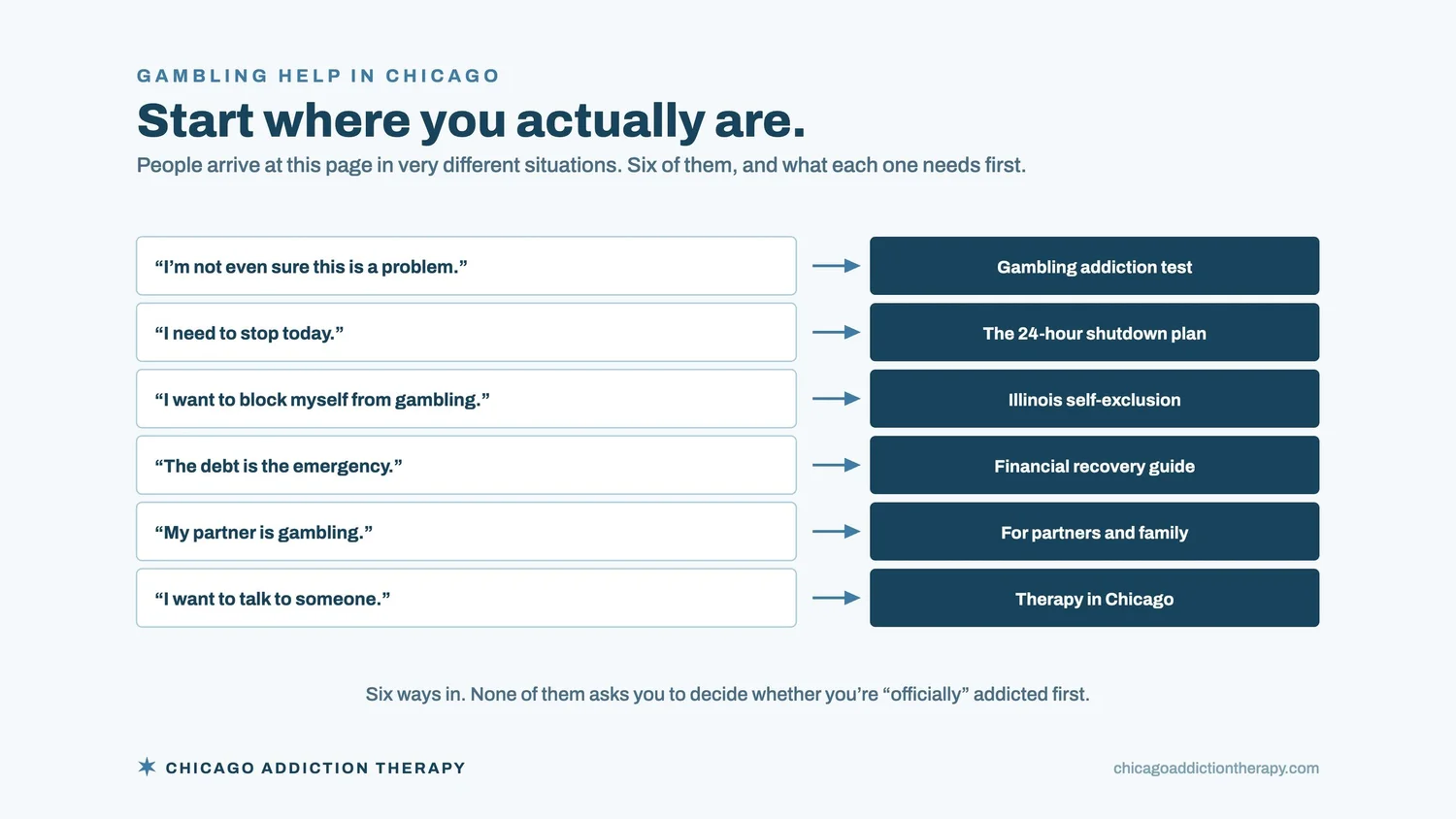
- “I’m not even sure this is a problem.” → Take the Gambling Addiction Test
- “I need to stop today.” → The 24-Hour Betting Shutdown Plan
- “I want to block myself from gambling.” → How to Self-Exclude From Gambling in Illinois
- “The debt is the emergency.” → Recovering Financially After Gambling Losses
- “My partner is gambling.” → My Partner Has a Gambling Problem. What Do I Do Now?
- “I want to talk to someone.” → Gambling Addiction Therapy in Chicago
Gambling Problems in Chicago Don’t Always Look Like Rock Bottom
There is an old picture of gambling addiction that still shapes how people think about getting help: someone loses everything, goes to a casino every night, hits an unmistakable bottom. That happens. But gambling problems usually develop much more quietly, and today the casino can be a phone sitting three feet from your bed.
Illinois has one of the largest legal gambling environments in the country. Alongside its casinos and sportsbooks, the state had roughly 8,900 licensed video gaming locations at the end of 2025 — bars, restaurants and truck stops with terminals inside. Sports betting has made gambling available almost continuously, including live bets placed while a game is underway.
That changes what a gambling problem looks like. Someone can gamble heavily without ever walking into a casino — while commuting, sitting at work, watching television with their family, or lying in bed at midnight. And because it happens privately, the problem can become serious long before anyone else notices.
How Do You Know When Gambling Has Become a Problem?
The amount of money you have lost matters. But it is not the only thing I look at.
I am often more interested in questions like:
- Can you reliably decide not to place the next bet?
- Can you set a limit and actually keep it?
- Can you lose money without immediately feeling you need to recover it?
- Can you tell your partner exactly how much you have gambled and lost?
- Can you have money in your account without eventually finding a way to gamble with it?
One person might lose $10,000 and stop. Another might lose $2,000, swear it will never happen again, and spend the next six months repeating the same cycle.
The dollar amount is important. Loss of control is often more important.

Some warning signs include:
- repeatedly trying to cut back or quit without being able to sustain it
- chasing losses in an attempt to get back to even
- gambling with money intended for bills, savings, debt repayment or other priorities
- hiding gambling or minimizing losses
- increasing bet sizes to create the same excitement
- borrowing money, using credit, or moving money between accounts to keep gambling
- becoming restless, irritable, anxious or preoccupied when trying not to gamble
- gambling to escape boredom, stress, loneliness, anger or depression
- letting gambling interfere with work, relationships, sleep or other responsibilities
You do not need every one of these to have a problem worth addressing.
If you are unsure where you fall, a structured screen helps. The Problem Gambling Severity Index (PGSI) is one of the most widely used.
Not sure how serious your gambling is? Take the Gambling Addiction Test. It is anonymous and takes about three minutes.
Chasing Losses Is One of the Biggest Warning Signs
One pattern deserves particular attention: chasing.
You lose $500. Instead of thinking I lost $500, your brain starts thinking I need to make $500.
That distinction gets expensive fast.
The next bet is no longer about entertainment, or even about winning. It is an attempt to repair the damage from the last one. If it loses, the number you need to recover gets larger. Now you are not trying to win $500. You are trying to win $1,200. Then $3,000. Then $8,000. The stakes rise because smaller bets no longer feel capable of solving the problem.

This is why someone can gamble at a stable level for months and then lose an enormous amount in a very short stretch. The belief that you can gamble your way out of gambling losses is the most dangerous idea in the cycle.
You do not have to win the money back before you stop. Trying to get back to even is often exactly what turns a gambling problem into a financial crisis.
Read more: How to Stop Chasing Gambling Losses
How Common Is Problem Gambling in Illinois?
This is not a rare problem.
Illinois’ first statewide gambling assessment, based on survey data collected in early 2021, estimated that 3.8% of Illinois adults — approximately 383,000 people — fell into the problem-gambling range. Another 7.7%, roughly 761,000 adults, were considered at risk of developing a gambling problem.
Those are estimates from a 2021 survey, not a measurement of Illinois today — legal sports betting was barely a year old when the data was collected. But they make the point. If gambling has gotten out of control, you are dealing with a recognized behavioral health condition affecting a substantial number of people in Illinois, not an unusual personal failure you are supposed to solve through willpower.
Why Sports Betting Can Be Particularly Hard to Control
Sports betting is now the most common gambling problem I see. Three reasons it gets sticky.
It can feel more like skill than gambling. If you know football, follow injuries, understand matchups, listen to podcasts and beat your friends in fantasy leagues, it can feel like better analysis should eventually produce better results. That feeling of expertise makes it much harder to walk away after a loss.
It creates an enormous number of chances to act. You are no longer limited to who wins. You can bet a quarter, a drive, a player’s performance, a live line that changes every few seconds. The distance between an urge and a wager is four taps.
It blends into something you already enjoy. You may not want to give up football. You may want to stop turning every football game into a financial event. That distinction matters a great deal in treatment.
Sports Betting Addiction Therapy
Online Casinos, Prediction Markets and Trading Can Do the Same Thing
Online casino games and slots produce an especially fast cycle, because there is almost no natural stopping point between wagers. Prediction markets blur the line between trading, politics, sports and gambling. And some stock, options or cryptocurrency trading starts functioning psychologically like gambling even though it happens in a brokerage account.
The question is not what the activity is called. Look at the behavior around it. Are you chasing losses? Increasing risk because you need to make money back? Checking positions compulsively? Hiding losses? Deciding based on what you need to win rather than what makes financial sense?
If so, the same mechanisms are running whether the screen says sportsbook, prediction market, crypto exchange or brokerage.
Stock & Options Trading Addiction Therapy
What Gambling Addiction Treatment Actually Does
Therapy for gambling is not sitting in a room while someone tells you gambling is bad. You already know what it has cost you. Effective treatment is more practical than that.
The UK’s National Institute for Health and Care Excellence published a clinical guideline on gambling-related harms in January 2025 recommending gambling-specific cognitive behavioral therapy — delivered by clinicians trained in it, and including relapse prevention — as the primary psychological treatment, and recommending motivational interviewing for people who are unsure about changing or starting treatment. A 2023 umbrella review and meta-analysis found CBT reduced gambling severity, frequency and intensity at the end of treatment, though longer-term durability is less well established.
In my work, that translates into four things.
We figure out exactly how your gambling cycle works
What happens before you gamble? Boredom. Stress. A drink. Getting paid. A game notification. A previous loss. A fight with your partner. A hotel room on a work trip. A good week where you suddenly feel confident again. The more precisely we understand the pattern, the less random it looks.
We make gambling harder to do impulsively
Insight is not enough when you are holding a phone with access to money and a sportsbook at 11:30 at night. That means removing apps, deleting stored payment methods, blocking gambling transactions where your bank allows it, reducing access to money, and using formal self-exclusion. The goal is not to never have another urge. It is that an urge does not have immediate access to your bank account.
We work on the thinking that makes the next bet feel reasonable
I’m due. This line is wrong. I only need one good weekend. I’ll quit once I’m back to even. I’ll just bet smaller. I know what I did wrong last time. This one is basically a lock.
In the moment none of those feel irrational. Treatment is partly learning to catch them before they turn into a deposit.
We deal with what gambling has been doing for you
Gambling is rarely only about money. It creates excitement when life feels flat. It shuts off anxiety for a while. It fills empty evenings. Stopping without understanding that function leaves a real hole. Recovery means addressing the gambling and building something that can take over the job it was doing.
More on the evidence: Can Therapy Help Gambling Addiction?
What You Can Do Today, Before You Ever See a Therapist
You do not have to wait for a first session to make the next bet less likely. Focus on access before motivation: motivation changes hour to hour, access can be changed concretely.
Delete the apps. Remove stored payment methods. Move money somewhere less immediately reachable. Tell one person what is happening. Use gambling-blocking tools. Consider self-exclusion.
And most importantly: do not make stopping conditional on winning the money back first.
If you are trying to get through the next 24 hours without betting, I wrote a step-by-step 24-Hour Betting Shutdown Plan for exactly that situation.
How Gambling Self-Exclusion Works in Illinois
Illinois runs a formal Self-Exclusion Program through the Illinois Gaming Board.
Enrollment is in person at approved sites, with valid ID, and the Gaming Board says it takes about 30 to 45 minutes. There is no fee. The minimum exclusion period is five years, and removal after that is not automatic — it requires a petition and documentation from a qualified clinician.
This is not the same as tapping a temporary “cool-off” button inside a sportsbook. For someone who deletes an app and reinstalls it three days later, that friction is the point. It is also worth knowing what the program does not reach.

In September 2026 the Gaming Board formally committed to bringing video gaming into the program, through card readers on the machines themselves. Nothing has taken effect yet, so the rules in force today are the ones to plan around.
If bar and gas-station machines are the specific problem, there is a separate guide to how to stop playing video gaming terminals in Illinois.
Self-exclusion does not treat the reasons you gamble. But it can dramatically change your access while you work on them.
Full guide: How to Self-Exclude From Gambling in Illinois
What About Gambling Debt?
For a lot of people, this is the part that feels most urgent. Therapy can wait. I need to fix the money.
That reaction makes sense. It is also one of the things that keeps gambling going, because financial panic makes a large win feel like the only realistic solution.
The first financial goal is not recovering your losses. It is stopping the number from getting bigger. Once gambling stops, this becomes a problem that can actually be assessed: balances, interest rates, income, minimum payments, repayment options. While gambling continues, the target keeps moving.
Therapy is not financial planning, and a therapist should not pretend to be your debt counselor. But treatment can address what makes financial recovery so hard: chasing, shame, avoidance, secrecy, and the pull to solve debt with another bet.
Recovering Financially After Gambling Losses
What If Your Partner Doesn’t Know?
Secrecy is one of the hardest parts of a gambling problem. You may be carrying two problems at once: the gambling itself, and the work of keeping anyone from finding out.
People delay disclosure because they are afraid their partner will leave, take over the money, or never trust them again. Those fears are often reasonable. But secrecy is also what gives gambling room to continue. Therapy can help you think through what needs to be disclosed, how, which financial safeguards change, and what rebuilding trust would actually require.
If you are the partner who found out rather than the person gambling, your questions are different — what accounts exist, whether the losses have stopped, what debt you are responsible for, and whether another promise to stop should be believed.
My Partner Has a Gambling Problem. What Do I Do Now?
Where to Get Gambling Help in Chicago and Illinois
Individual therapy is one option. It is not the only one, and it does not have to be the first one.
- Specialized therapy. Gambling responds to gambling-specific treatment. General addiction or anxiety therapy is not the same thing.
- Peer support. Gamblers Anonymous has both in-person and virtual meetings in the Chicago area, and Gam-Anon runs meetings for family members. Peer support works against the isolation that builds up around gambling.
- State-funded services. Illinois funds gambling disorder prevention, treatment and recovery support through the Department of Human Services Division of Behavioral Health and Recovery. In July 2026 the state enacted Public Act 104-0626, which brings gambling disorder into the Substance Use Disorder Act. What that changed, and what it did not, is covered on the page about gambling disorder treatment in Illinois.
- The helpline. The Illinois gambling helpline is 1-800-GAMBLER (1-800-426-2537), available 24 hours. You can also text GAMB to 833234.
- Financial counseling. A nonprofit credit counselor can help with the debt side once the gambling has stopped.
- Emergency support. If you are in crisis, call or text 988.
You do not have to pick only one. These work better together than any of them alone.
More Illinois gambling resources
What If I’m Not Ready to Quit Gambling?
You can still talk to someone. You do not have to walk in already calling yourself a gambling addict, or committed to never placing another bet, or pretending that part of you doesn’t still want to gamble.
Ambivalence is normal. A person can understand that gambling is hurting them and still want the feeling of placing a bet. Hiding that conflict makes treatment worse, not better.
A more useful starting point is to look honestly at what is happening. What are you getting from gambling? What is it costing you? How much control do you actually have? And what happens if nothing changes over the next six months?
Sometimes the goal becomes abstinence quickly. Sometimes someone wants to try moderation first. Repeatedly failing to gamble within your own limits is itself useful information. If every plan to stop ends with a new plan for gambling more carefully, that is worth paying attention to.
The point of a first conversation is not to force a conclusion. It is to make the problem clearer.
When I’d Recommend Getting Help Now
There is no exact dollar amount or number of bets that tells you when therapy becomes necessary. But there are situations where I would not recommend waiting to see what happens.
I would take it seriously now if:
- you have tried to stop more than once and cannot sustain it
- you are chasing significant losses
- you are gambling with borrowed money or credit
- you have hidden substantial losses or debt from someone close to you
- gambling is putting a relationship, job, housing, education or your financial stability at risk
- you no longer trust yourself with access to money
- your betting is escalating quickly
- depression, anxiety, or alcohol or drug use is increasing alongside the gambling
- you feel trapped by what you have already lost
One situation deserves particular urgency. Gambling-related harm carries real suicide risk, especially around severe losses and immediately after a gambling episode — the 2025 NICE guideline directs clinicians to ask about suicidal thinking directly whenever serious gambling-related harms are present.
If you are in a mental health crisis or thinking about suicide, call or text 988, or go to the nearest emergency department. If you don’t feel safe right now, call 911. That matters more than the gambling or the money today.
Gambling Addiction Therapy in Chicago
I’m Chris Beerman, MSW, LCSW, CADC, an addiction therapist in Chicago. Gambling is a primary focus of my practice.
I work with adults dealing with sports betting, online gambling, casino gambling, poker, daily fantasy sports, and high-risk trading that has started functioning like gambling — and with partners and family members affected by someone else’s gambling.
My approach is practical. We look at what keeps the cycle going, put barriers between you and the next bet, address chasing and gambling-related thinking, deal honestly with the financial and relationship consequences, and build a plan that holds up in the situations where you are most likely to gamble.
You do not have to have this figured out before the first session. You just have to be willing to look at what is actually happening.
I see clients in person in Logan Square, Chicago, and online throughout Illinois and Minnesota.
- Not sure whether therapy is necessary? Start with the Gambling Addiction Test.
- Know you need to stop betting today? Start with the 24-Hour Betting Shutdown Plan.
- Ready to talk? Schedule a free 15-minute consultation.
You do not have to hit rock bottom to take gambling seriously. Often the best time to get help is while enough of your life is still intact to protect.