
Alcohol and Anxiety: When Drinking to Relax Keeps You Stuck
By Chris Beerman, MSW, LCSW, CADC · Chicago Addiction Therapy · Reviewed September 2026
The first drink can feel like the moment your day finally ends. Your shoulders drop. Work feels farther away. The conversation you have been replaying matters a little less. If you are socially anxious, you may feel more comfortable joining in.
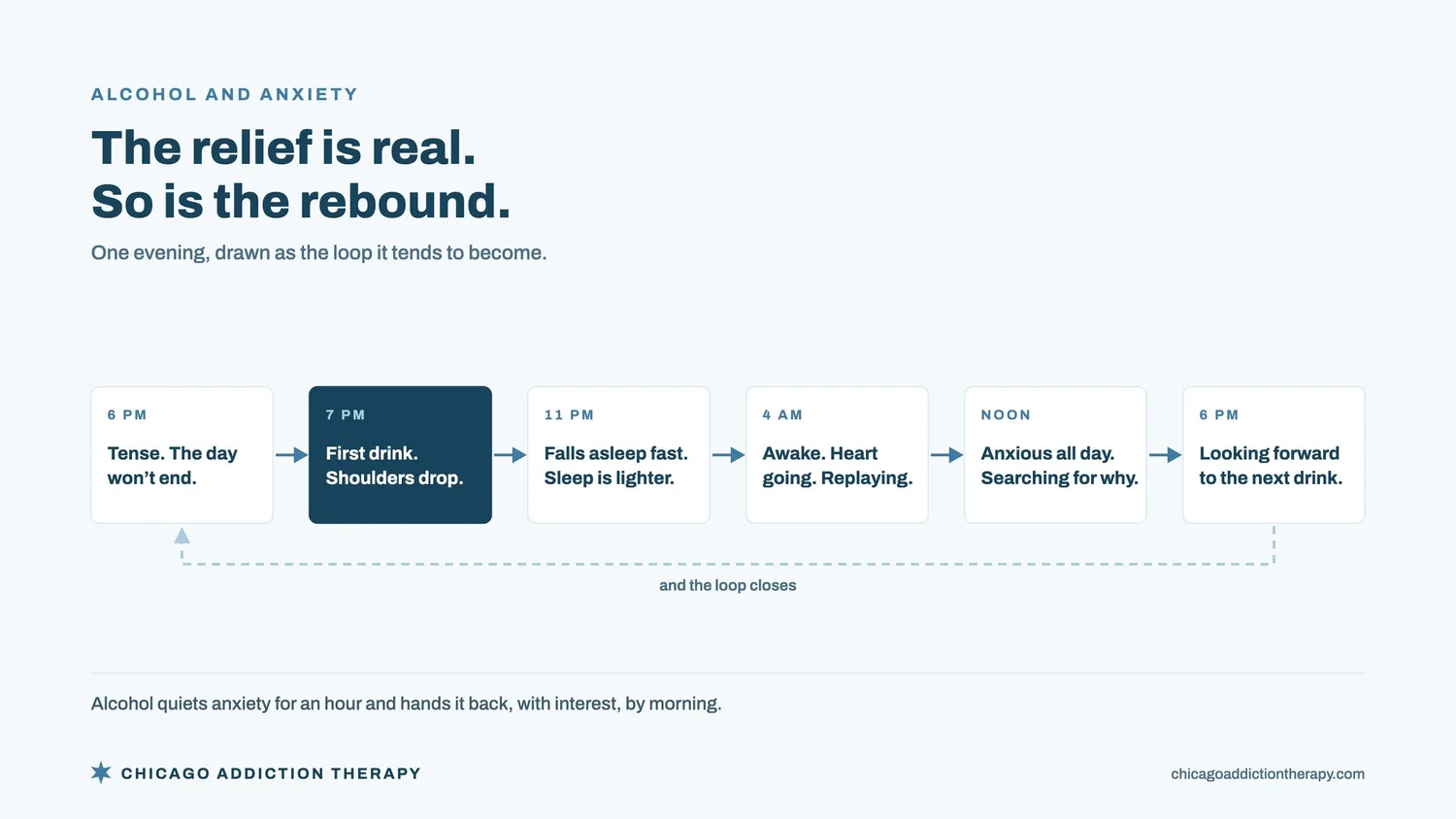
That relief can be real. It can also make it difficult to notice what drinking is doing to the rest of your day. You may wake in the early morning feeling tense, spend the next day unusually anxious, or begin looking forward to the next drink because you want that uncomfortable feeling to stop.
Alcohol can temporarily reduce anxiety while contributing to more anxiety afterward. For some people, drinking gradually becomes both a source of distress and the way they try to relieve it. NIAAA describes this as part of the cycle that can develop with repeated heavy drinking, in which a person eventually drinks less for the high and more to escape the low (NIAAA: The Cycle of Alcohol Addiction). The overlap is not rare: up to half of people in treatment for alcohol problems also meet criteria for an anxiety disorder (Anker and Kushner, Alcohol Research, 2019).
I am an addiction therapist in Chicago. When anxiety and drinking are connected, I want to understand the whole sequence: what you feel before drinking, what changes while you drink, and what happens afterward. That gives us something more useful to work with than simply telling you to relax another way.
Why alcohol can feel so effective for anxiety
Alcohol acts on brain systems involved in reward, stress, and emotional discomfort. Its ability to provide short-term relief helps explain why drinking can become especially compelling when you are anxious. With repeated heavy use, tolerance and changes in the brain’s stress systems can make that pattern harder to interrupt (NIAAA: The Brain in Addiction and Recovery).
You may not experience it as “drinking to cope.” You may think of it as winding down, becoming more sociable, or finally switching your brain off. A useful question is what you expect alcohol to make possible:
Finishing the workday without continuing to think about work.
Entering a room without feeling watched.
Sitting still without feeling restless.
Having a difficult conversation.
Falling asleep without replaying the day.
Those functions matter. If drinking is helping you accomplish something you otherwise find difficult, taking it away leaves a real task to address. The goal of therapy is to develop a workable response to that task while addressing the alcohol use itself.
Why anxiety can feel worse the next day
“Hangxiety” is a common informal term for anxiety after drinking. It is not a separate medical diagnosis, but the experience is well described, and several things contribute to it.
Alcohol disrupts sleep even when it helps you fall asleep. It suppresses REM sleep early in the night, and as it wears off in the second half of the night, sleep becomes lighter and more fragmented, which is why you may wake at 4 a.m. with your heart going (Sleep Foundation: Alcohol and Sleep; Koob and Colrain, 2020). NIAAA lists anxiety, irritability, and disrupted sleep among the experiences that come with a hangover (NIAAA: Hangovers).
There may also be circumstances you are worried about: an argument, money spent, unfinished responsibilities, or uncertainty about what you said. Those concerns can feed each other. You feel physically unsettled, start searching for a reason, remember something uncomfortable, and spend the morning reviewing it.
For treatment, it helps to separate what happened from what you fear happened. Both may deserve attention, but they call for different responses.
Is alcohol causing the anxiety, or are you drinking because you are anxious?
It may be either, or both. Anxiety may have been present long before drinking became a concern. Alcohol may be amplifying it. Some symptoms may be closely tied to intoxication, hangovers, or withdrawal. Other medical conditions and medications can also affect how you feel. This is why a careful history matters. Consider:
Did the anxiety begin before you drank regularly?
When is it strongest relative to your last drink?
Is it present in situations where you have not been drinking?
Has your drinking increased as your anxiety has become harder to manage?
What happens to sleep, mood, and anxiety during medically safe periods of reduced drinking or abstinence?
Have you discussed the symptoms with a medical professional?
Your answers help guide an assessment. They do not require you to decide the diagnosis yourself. If you have an anxiety disorder, it deserves treatment. You should not have to wait until every alcohol-related concern is resolved before someone takes your anxiety seriously.
Do not assume that shaking or a racing heart is just anxiety
Alcohol withdrawal can resemble anxiety, particularly when it includes agitation, sweating, nausea, tremor, or a rapid heartbeat.
If symptoms appear after reducing or stopping alcohol, seek prompt medical advice. If you drink heavily and regularly or have a withdrawal history, get medical guidance before abruptly stopping. Severe confusion, hallucinations, or seizures are emergencies: call 911 (MedlinePlus: Alcohol Withdrawal).
Do not use alcohol, borrowed medication, or extra doses of a prescription to manage suspected withdrawal on your own. The practical suggestions below are for understanding and changing a pattern, not for managing detox.
Signs drinking has become your main way of managing anxiety
You do not need to drink every day for the connection to matter. Pay attention if you:
Arrange plans around knowing alcohol will be available.
Drink before social events to make entering easier.
Feel unable to finish work emotionally without drinking.
Avoid activities you might enjoy if you cannot drink there.
Find yourself drinking to settle the aftereffects of earlier drinking.
Keep trying to reduce alcohol while leaving the same anxiety untreated.
These are prompts for reflection, not a diagnostic checklist. The free alcohol use test can help you look more broadly at your drinking. If you are still deciding whether the pattern is concerning, start with Do I Have a Drinking Problem?
How to start changing the pattern
1. Track the whole sequence
Counting drinks is useful, but add context. For several days, note what was happening before you wanted to drink, what you hoped alcohol would change, how much you consumed, and how you felt later and the next morning. Keep it brief:
“Finished work tense. Wanted the day to feel over. Drank while checking email. Fell asleep easily, woke early, felt on edge.”
“Worried about meeting new people. Drank before leaving. Felt easier at first, then worried the next day about how I came across.”
You are looking for a repeatable pattern. This record can also make a clinical appointment more useful. Do not delay medical care to collect more information.
2. Identify what needs to change before the first drink
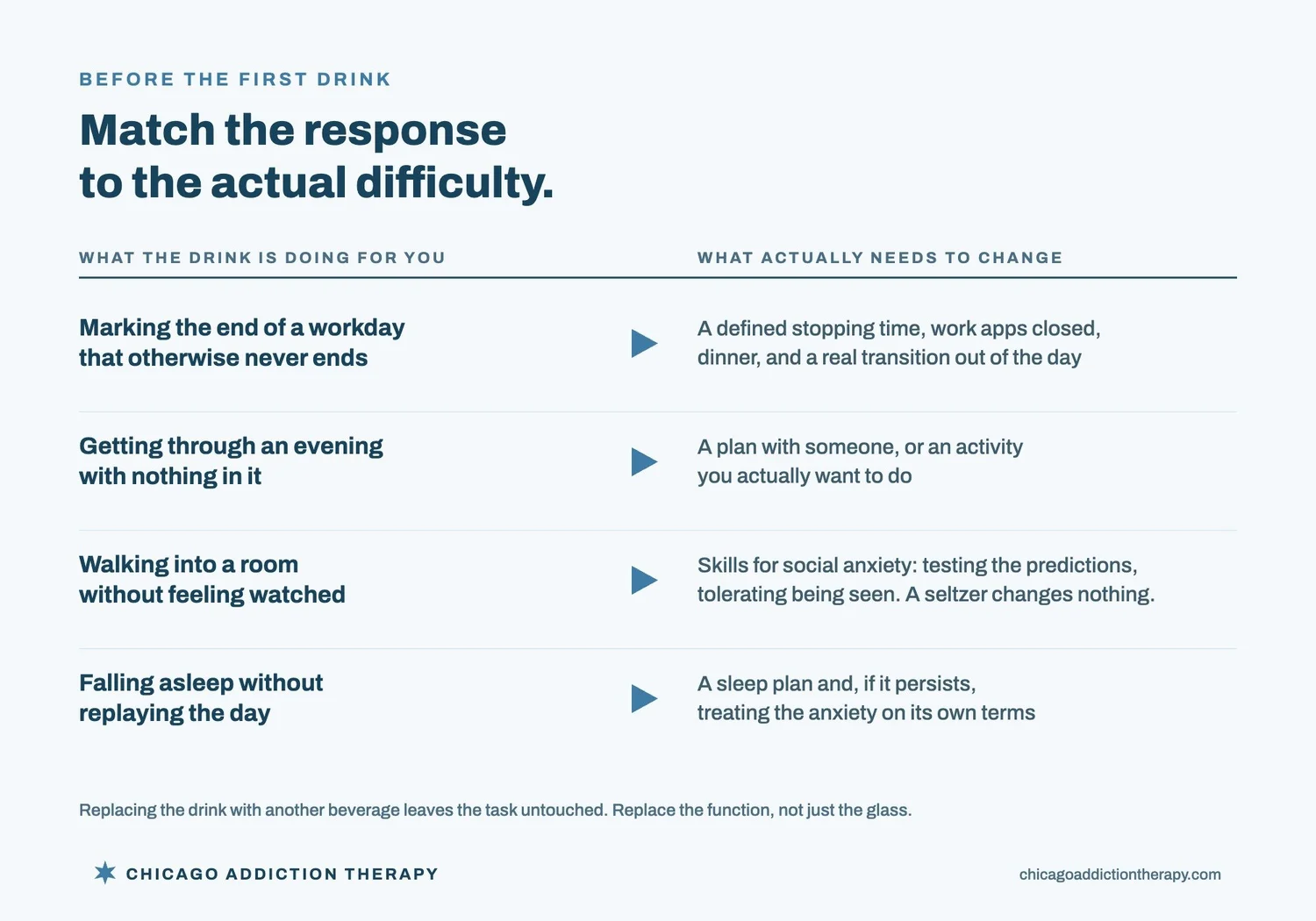
If you work until you pour a drink, alcohol may be the only clear signal that work is finished. A practical experiment might involve a defined stopping time, closing work applications, eating dinner, and arranging a transition that gives you some distance from the day.
If you are drinking because you dread an unstructured evening, the task may be making a plan with someone or finding an activity you want to do.
If the difficulty is social anxiety, replacing a drink with another beverage may leave most of the problem untouched. You may need help approaching social situations, responding to anxious predictions, and tolerating the discomfort of being seen. Try to match the response to the actual difficulty.
3. Make room for discomfort without treating every sensation as an emergency
When it is medically safe, part of anxiety treatment can involve learning that you can experience discomfort without immediately escaping it. That does not mean enduring unlimited distress or forcing yourself into the hardest possible situation.
You might begin with a brief conversation, a manageable social activity, or a short period after work when you notice the urge to drink and follow a different plan. The question becomes: “What can I do while this feeling is here?”
In cognitive behavioral therapy, people learn to examine unhelpful predictions and change responses that maintain anxiety. Acceptance and commitment therapy can also help people relate differently to anxious thoughts while acting in line with their values. Both are discussed in NIMH’s guidance on generalized anxiety disorder (NIMH: Generalized Anxiety Disorder). Exercises should fit your symptoms and circumstances. Suspected withdrawal needs medical care, not an anxiety exercise.
4. Review the goal for your drinking
Some people want to cut back. Others want to stop. Your health, withdrawal risk, ability to control drinking, and previous attempts all matter when deciding what is appropriate.
If drinking is repeatedly followed by anxiety and another attempt to drink for relief, include that sequence in the decision. Looking only at whether you stayed below a planned number can miss what the pattern is costing you. My guide to moderation versus quitting explores that choice in more detail, and if weekends are where the pattern lives, so does how to stop binge drinking on weekends. A clinician can help you choose a safe plan and assess whether it is working.
What therapy for alcohol and anxiety actually looks like
I would start by understanding what you are afraid of, what you do when that fear shows up, and where drinking enters the sequence.
For one person, the fear may be disappointing others. They stay available all day, feel resentful and overstretched, and drink when they finally stop. For another, the concern may be social judgment. They drink before meeting people, then review the evening afterward for evidence that something went wrong. For someone else, alcohol has become part of an attempt to manage sleep. These are illustrative patterns, not assumptions about everyone who drinks to relax.
Treatment should address the specific one in front of us. That may include changing work boundaries, examining anxious predictions, practicing difficult situations gradually, responding to cravings, and making a plan for nights when the usual strategies are not enough.
We also need to assess the alcohol use directly. Understanding why you drink is useful, but treatment should help you change what happens. Medical care may be part of that work. Alcohol treatment can include behavioral approaches, medication, and mutual-support groups, with intensity based on the person’s needs (NIAAA: Treatment for Alcohol Problems); my guide to choosing a level of alcohol treatment explains the options.
Be honest with your prescriber about alcohol
If you take medication for anxiety or sleep, tell your prescriber how much and how often you drink. Alcohol can interact dangerously with sedating medications, including benzodiazepines and some sleep medicines; combining substances that suppress breathing increases overdose risk (NIAAA: Understanding the Dangers of Alcohol Overdose). Do not add doses or use someone else’s medication to settle anxiety after drinking.
I do not prescribe medication. A qualified prescriber can assess options for anxiety, alcohol use disorder, or both, taking interactions and medical history into account.
Will the anxiety improve if you stop drinking?
It may improve, particularly when alcohol and disrupted sleep are contributing. But there is no reliable deadline by which everyone should feel better. Early symptoms after stopping may require medical attention. Anxiety that predates drinking, persists, or significantly interferes with your life deserves assessment and treatment.
You do not need to interpret continued anxiety as proof that you “need” alcohol. It may mean the anxiety needs its own treatment plan.
The useful measures are broader than whether you feel perfectly calm. Are you drinking less or maintaining your chosen goal? Sleeping more consistently? Participating in things you value? Responding to anxiety with more flexibility? Getting the medical or therapeutic help you need?
Frequently asked questions
How long does hangover anxiety last?
For most people it eases within a day, tracking the physical hangover and the sleep debt behind it. Anxiety that is still there two or three days later, or that is present on days you did not drink, is worth treating as its own problem rather than an aftereffect.
Is it a problem if I only drink to take the edge off a couple of nights a week?
Frequency is not the best test. The better questions are whether you can get through those evenings without it, whether the amount is creeping, and whether the anxiety is getting treated or only postponed. Two nights a week of the only coping tool you have is still a single point of failure.
Should I treat the anxiety first or the drinking first?
Usually both, together, with the medical safety question answered first. Treating anxiety while drinking heavily tends not to work well, and removing alcohol without addressing the anxiety leaves the reason you drank untouched. A clinician who works with both can sequence it for your situation.
You deserve a way to relax that works beyond the first hour
If alcohol is the only dependable way you have found to quiet your mind, changing it may feel like giving up your most effective coping tool. That concern belongs in treatment. We can take the relief seriously while looking honestly at what happens afterward.
I provide alcohol addiction therapy in Chicago, in person in Logan Square and online throughout Illinois and Minnesota. You can begin with the part that feels most familiar: anxiety after work, drinking before social plans, waking tense after a night out, or repeatedly trying to cut back without knowing what to do with the feelings that remain.
Schedule a free 15-minute consultation, or start with the free alcohol use test. The alcohol resources page lists more ways to find help in Chicago and Illinois.
If you need help now
Illinois Helpline: 833-234-6343 (1-833-2FINDHELP), text HELP to 833234, helplineil.org. Free, confidential, 24/7, including for family members.
SAMHSA National Helpline: 1-800-662-HELP (4357). Free, confidential, 24/7 treatment referral.
988 Suicide and Crisis Lifeline: call or text 988 if you or someone you love is in crisis.
Emergency: call 911 for seizures, hallucinations, or severe confusion after stopping or cutting back on drinking.
This article is educational and does not replace medical advice or an individual clinical assessment. If you drink heavily or daily, talk with a physician before stopping or cutting back, and tell any prescriber about your alcohol use.