
Written by Chris Beerman, MSW, LCSW, CADC, PCGC · Published November 2026
Most people who gamble already know they shouldn't chase losses. Many know they should set limits, stay away from borrowed money, and walk away when gambling stops being fun.
Knowing those rules and following them are two different things.
In my work as an addiction therapist in Chicago, I regularly meet people who understand the risks of gambling perfectly well. They can explain why chasing losses is a bad idea. They know the odds favor the house. They can see that gambling has started to interfere with their lives.
And they keep going.
Which raises a question that responsible gambling advice rarely addresses: at what point does responsible gambling stop being a matter of making better choices, and start being a problem of being able to follow through on the choices you have already made?
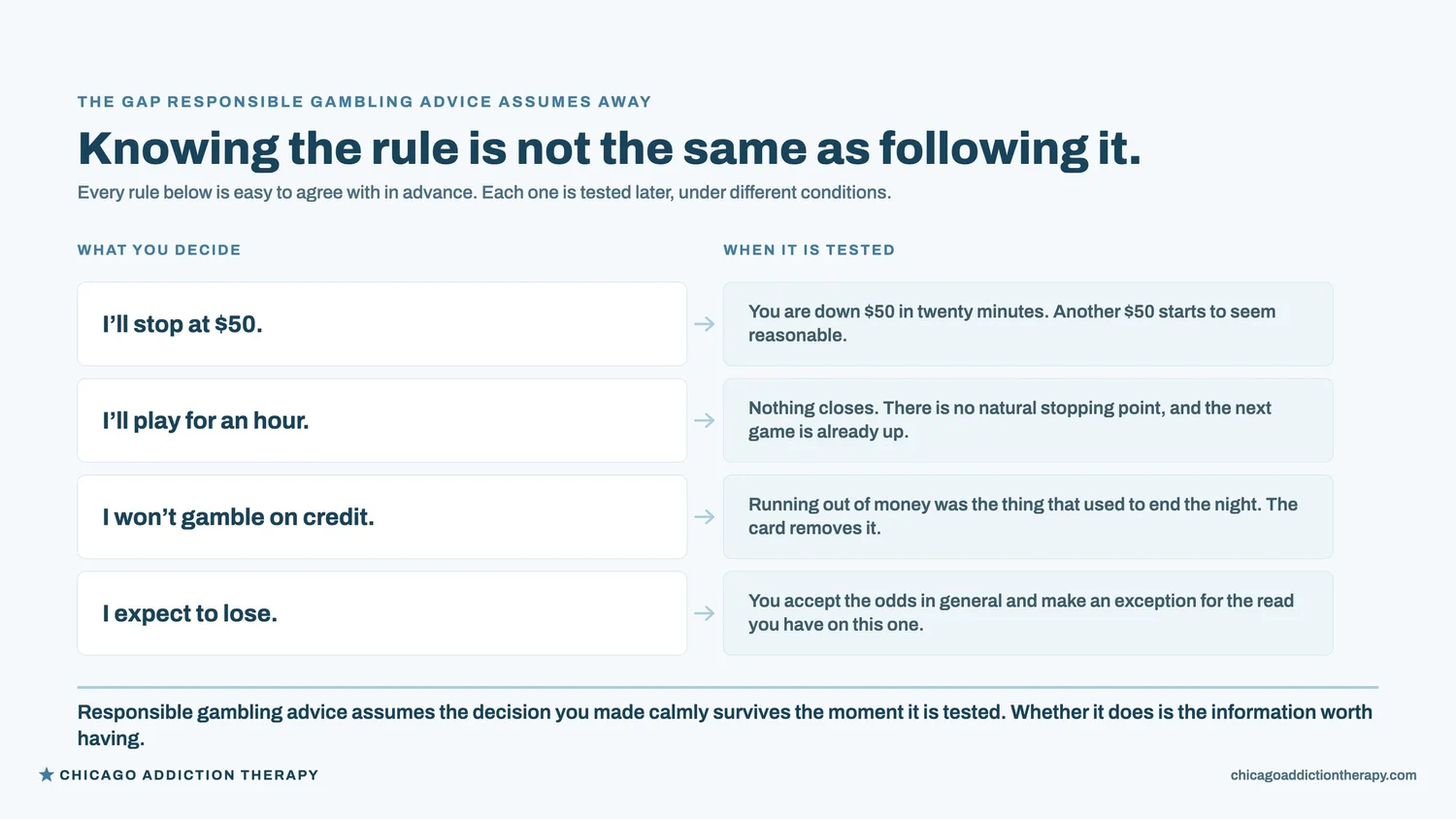
A note on what this article is and isn't. I am not arguing that responsible gambling guidance is useless. For most people who gamble, it works, and the rules below are sensible. What I want to add is the clinical observation that sits underneath them: the rules assume a particular ability, and noticing whether you actually have that ability is more informative than memorizing the list.
The 10 Rules of Responsible Gaming
The Illinois Council on Problem Gambling publishes a list it calls the 10 Rules of Responsible Gaming. It is a short, sensible set of guidelines, aimed mainly at people who gamble recreationally, and it is the list most Illinois prevention material draws from.
Below, each heading is my summary of one of ICPG's rules, followed by what I notice about it clinically. I'd encourage you to read the original list too — it takes a minute.
Each rule is also a question you can put to yourself.
1. Gamble for entertainment, not to make money
There is a difference between enjoying the possibility of winning and depending on it.
If you gamble because you like having something riding on a game you were going to watch anyway, that's one thing. If you're betting because you need to cover rent, pay down a balance, or get back to even, gambling is doing a different job.
Ask yourself: Would I still want to gamble if I knew I couldn't win anything?
2. Treat the money you lose as the cost of your entertainment
A $100 concert ticket costs $100 whether the show was great or disappointing. You don't spend another $200 afterward trying to recover the ticket price.
Gambling gets dangerous when losses stop feeling like the price of an activity and start feeling like money that is owed to you.
Ask yourself: When I lose, can I accept that the money is gone — or do I immediately start thinking about how to get it back?
3. Set a dollar limit and stick to it
Setting a limit before you gamble is easy. The real test comes when you reach it.
Someone can fully intend to spend $50. But after that $50 disappears in twenty minutes, another $50 can start to seem reasonable — not as a failure of resolve, but as a perfectly sensible-feeling decision in the moment.
The useful question isn't whether you set limits. It's whether your limits survive disappointment, excitement, and the pull to keep going.
Ask yourself: Have I ever raised my gambling budget after hitting the limit I set?
4. Set a time limit and stick to it
Time matters even when the money still looks manageable.
An hour of sports betting can turn into an afternoon of checking scores, researching picks, watching odds move, and looking for the next thing to bet. Online gambling makes this especially easy, because nothing closes and there is rarely a natural stopping point.
Ask yourself: Have I given up sleep, work, time with people, or things I used to do because I stayed with gambling longer than I meant to?
5. Expect to lose
Commercial gambling products are built to return money to their operators over time. That is not a flaw in the design; it is the design.
Understanding that intellectually doesn't necessarily change what happens emotionally when you lose. A person can acknowledge that the odds are against them while simultaneously believing that their research, their read on a matchup, or their feel for a game gives them an edge.
Ask yourself: Do I actually accept that losing is the likely long-run outcome — or do I believe I've found a way around it?
6. Make it a private rule not to gamble on credit
This is the rule where ICPG's own wording is worth keeping. It doesn't say never gamble on credit as a flat prohibition; it says to make it “a private rule not to gamble on credit” — something you decide for yourself, in advance, and hold yourself to.
That framing matters, because borrowing creates two separate problems. The obvious one is that credit cards, cash advances, personal loans, and money borrowed from family turn losses into obligations that outlast the session. The less obvious one is that borrowing removes the natural stopping point that running out of money provides.
Ask yourself: Have I borrowed, used money meant for something else, or let a bill slide because of gambling?
7. Create balance in your life
Money is only one of the things gambling can take.
Someone can be comfortably able to afford their losses while spending a steadily increasing share of their attention on betting — thinking about it, checking lines, reading injury news, planning the next one. A relationship with gambling can become unhealthy well before it produces a financial crisis.
Ask yourself: How much room does gambling take up in my head when I'm not gambling?
8. Avoid chasing lost money
Chasing is one of the clearest signals that gambling has moved past recreation.
What changes is the motive. Instead of gambling for enjoyment, you're gambling to reverse something that already happened. The next bet becomes the proposed solution to the problem the last bet created — and the bigger the hole, the more urgent that solution feels.
If this is the rule that keeps catching you, I've written a longer piece on how to stop chasing your losses.
Ask yourself: Have I ever placed a bet mainly because I couldn't stand to end the day down?
9. Don't gamble as a way to cope with emotional or physical pain
Gambling reliably produces excitement, anticipation, distraction, and a few hours of not thinking about something else. For someone carrying anxiety, depression, loneliness, anger, grief, or plain boredom, those effects are genuinely useful — which is the problem.
The concern isn't that someone occasionally enjoys a distraction. It's when gambling becomes the preferred tool for changing how you feel, because tools that work get used more.
Ask yourself: Am I more likely to gamble when I'm stressed, low, lonely, or trying not to think about something?
10. Learn the warning signs of problem gambling
The familiar signs are worth knowing: wagering more over time, repeated unsuccessful attempts to cut back, chasing, hiding gambling from people close to you, and putting relationships or responsibilities at risk.
But there's one warning sign I'd put above the others, because it's the one this whole article is about:
You repeatedly make rules for yourself that you can't follow.
If you promise yourself you'll stop at $100 and repeatedly stop at $500, the problem is probably not that you need better information about responsible gambling. It's that gambling has become hard to control.
What the Research Says a Limit Should Actually Be
One thing you'll notice about the ICPG list, and about most responsible gambling advice, is that it tells you to set a limit without telling you what the limit should be.
There is now research on that. In 2021, after a five-year international project, the Canadian Centre on Substance Use and Addiction published the Lower-Risk Gambling Guidelines — the first evidence-based attempt to put numbers on it. They drew on data from more than 60,000 people who gamble across eight countries.
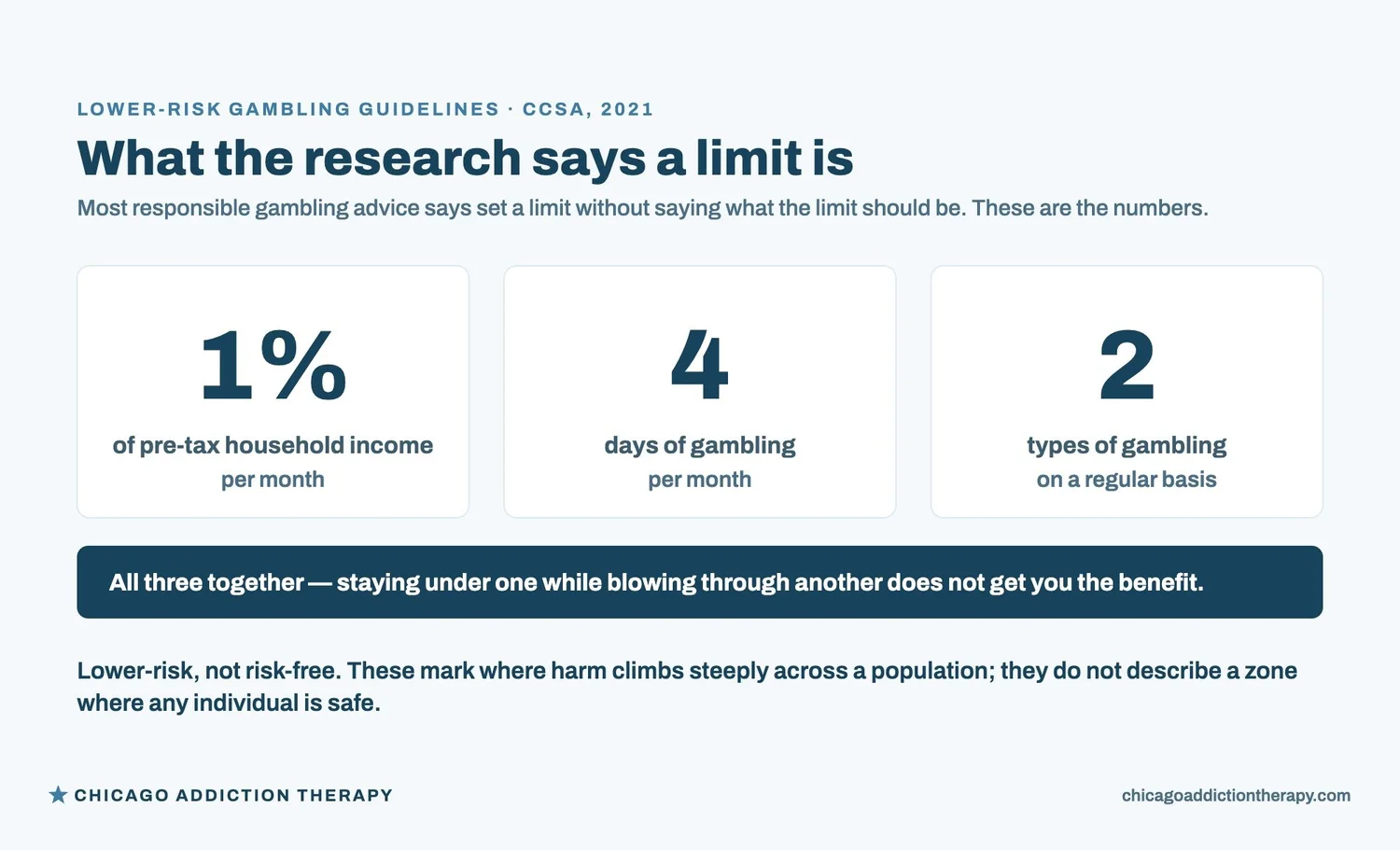
The guidelines are three thresholds, and the researchers are explicit that they only work together — staying under one while blowing through another doesn't get you the benefit:
No more than 1% of pre-tax household income per month.
No more than 4 days of gambling per month.
No more than 2 types of gambling on a regular basis.
Two things are worth saying about these numbers.
The first is that most people are surprised by how low they are. Four days a month is not four days a week. For someone with a sportsbook app, two game types can be reached without trying — a parlay and a live bet on the same night are already two different products behaving differently.
The second is more important: these are lower-risk guidelines, not safe-gambling guidelines. The researchers were careful about that word. The thresholds describe where risk of harm starts climbing steeply across a population. They don't describe a zone in which an individual is safe, and they explicitly don't apply to everyone — people gambling to escape, and people with a history of gambling problems or other addictions, carry elevated risk at any level.
Which is, in a different form, the same point as the rest of this article. The number is useful. Whether you can hold it is the actual information.
The Problem With Relying on Willpower
Responsible gambling advice assumes that a person can make a decision before gambling and keep following it during gambling.
For most recreational gamblers, that assumption holds, which is why the advice is worth giving.
But gambling disorder is defined partly by impaired control, and impaired control changes the equation. A person can set perfectly sensible limits while calm and abandon them in the middle of a winning streak or a bad run — not because they forgot the limit, and not because they didn't mean it, but because the thing that was supposed to enforce it isn't fully online in that moment.
When that's what's happening, another promise to gamble more responsibly is unlikely to be the answer. The more useful move is usually to stop gambling for a while, and to put practical distance between yourself and the opportunity to bet, so that the decision isn't being re-made every day under pressure.
In practice that means things like Illinois self-exclusion, removing the apps, blocking software, putting money somewhere you don't control alone, and letting one person you trust know what you're doing. If you want a concrete starting sequence, the 24-hour betting shutdown plan walks through it step by step.
A Better Question Than "Am I Gambling Responsibly?"
Rather than asking whether you know the rules, try three questions about what you're able to do.
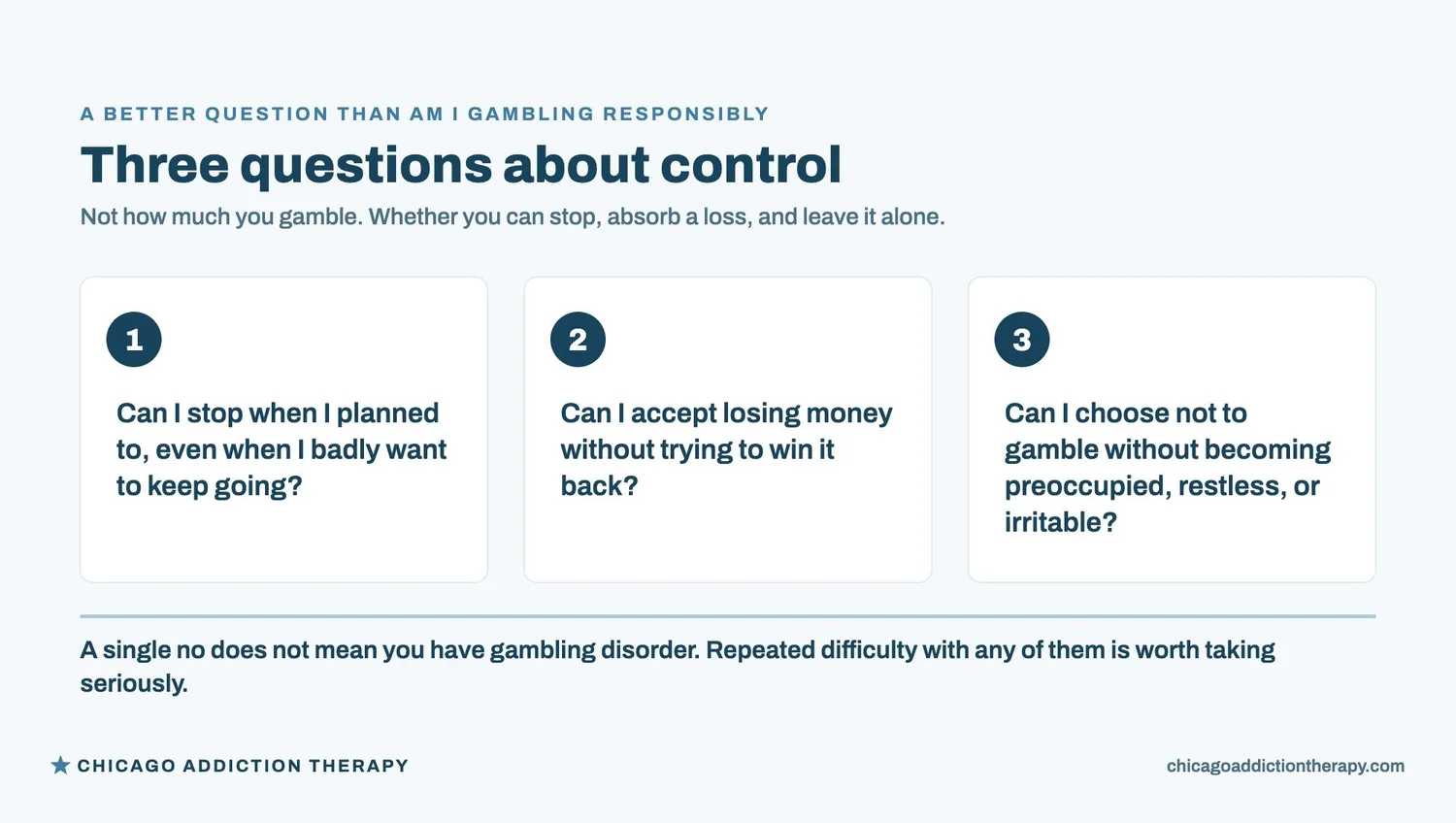
Can I stop when I planned to, even when I badly want to keep going?
Can I accept losing money without trying to win it back?
Can I choose not to gamble without becoming preoccupied, restless, or irritable?
A single "no" doesn't mean you have gambling disorder. People have bad nights. But repeated difficulty with any of these is worth taking seriously, and it's better information than any amount of familiarity with a list of rules.
If you want something more structured than three questions, the gambling assessment on this site uses the PGSI, a standard screening instrument. It doesn't diagnose anything and it doesn't collect your answers — it just gives you a clearer read on your own reported experience.
You don't need to lose your savings, damage a relationship, or arrive at a crisis before you're allowed to decide that gambling has become a problem.
When Responsible Gambling Isn't the Right Frame Anymore
Not everyone who gambles needs to quit. Plenty of people hold limits without much effort and treat gambling as occasional entertainment, and for them the ten rules are a reasonable description of how to keep it that way.
Other people find that every attempt at moderation eventually returns them to the same pattern they were trying to get out of.
For those people, continuing to pursue responsible gambling can quietly become another version of the same project — trying to regain control through willpower, with a new set of rules each time, and the failure of each set read as a personal failing rather than as information.
There's no requirement to keep gambling because you used to enjoy it. And there's no requirement to prove you can gamble moderately before you're entitled to stop.
If you've repeatedly tried to follow your own rules and repeatedly broken them, the next step probably isn't a better set of rules. It's changing the situation so you aren't testing them every day.
Where to Start
If any of this landed, here's what tends to be useful next, roughly in order of urgency:
If you want to stop now: the 24-hour betting shutdown plan — access first, motivation later.
If sports betting is the specific problem: how to stop sports betting.
If you want to block yourself: the Illinois self-exclusion guide, and what it does and doesn't cover.
If you're not sure how serious this is: the gambling assessment.
If you want to talk to someone: gambling disorder treatment in Illinois.
Frequently Asked Questions
Can someone with a gambling addiction ever gamble responsibly?
This deserves a longer answer than a FAQ can give, and it's genuinely contested. Controlled-gambling approaches have some research support, particularly for people with less severe problems, and some people do return to limited gambling without harm. But for someone who meets criteria for gambling disorder — especially with significant financial or relationship damage — abstinence is the more common clinical recommendation, because the thing that would have to do the controlling is the thing that's impaired. In practice this is a decision to make with a clinician who knows your history, not one to settle from an article.
Am I gambling too much?
Amount is a weaker signal than control. Someone betting $20 a week who can't stop thinking about it, and who has tried three times to quit, has a bigger problem than someone betting more and walking away easily. The Lower-Risk Gambling Guidelines above give you population-level thresholds to compare against, and the three questions in this article get at control directly.
Why can't I stop gambling even though I know I should?
Because knowing and doing run on different machinery. Gambling disorder involves impaired control, and insight doesn't repair it — which is why people can describe their own situation accurately and still gamble that evening. It also means the inability to stop isn't evidence of a weak character; it's the symptom itself.
Is responsible gambling advice useless, then?
No. For most people who gamble it's sound, and the rules in this article are worth following. The argument here is narrower: the rules assume an ability that not everyone has at all times, so if you find you can't follow them, that finding is itself the useful information — not a sign you need to try harder.
What if it's someone else's gambling I'm worried about?
Different problem, different approach. The family conversation guide covers how to raise it, and the page for partners and family covers the rest.
If You Need Help Now
Illinois and national: Call 1-800-GAMBLER (1-800-426-2537) or text GAMB to 833234. Free, confidential, 24/7.
Minnesota: Call 1-800-333-HOPE (1-800-333-4673) or text HOPE to 53342 for the Minnesota Problem Gambling Helpline. Free, confidential, 24/7.
If you are thinking about suicide or in emotional crisis: call or text 988 for the Suicide & Crisis Lifeline. If someone is in immediate danger, call 911 or go to your nearest emergency department. Gambling losses can produce acute crises — this is not an overreaction.
Work With Me
I'm a licensed clinical social worker, a certified alcohol and drug counselor, and an Illinois Problem Gambling Counselor (PCGC) in Logan Square, Chicago, and I work with gambling and sports betting specifically — in person in Chicago and online across Illinois and Minnesota.
If you've been testing your own rules for a while and would like to talk it through, you can reach out to schedule a free 15-minute consultation.
This article is general information, not clinical advice, and reading it does not create a therapeutic relationship. See our editorial standards.
Sources
Illinois Council on Problem Gambling. 10 Rules of Responsible Gaming.
Canadian Centre on Substance Use and Addiction. Lower-Risk Gambling Guidelines (2021).
Young, M. M., Hodgins, D. C., Currie, S. R., Brunelle, N., Dufour, M., Flores-Pajot, M.-C., & Nadeau, L. Not All Gambling Is Equal: Development of Lower-Risk Gambling Guidelines. Journal of Gambling Studies (2021).
Currie, S. R., et al. A research plan to define Canada's first low-risk gambling guidelines. Health Promotion International (2019).
American Psychiatric Association. Diagnostic and Statistical Manual of Mental Disorders, Fifth Edition, Text Revision (DSM-5-TR), gambling disorder criteria.
Illinois Department of Human Services, Division of Substance Use Prevention and Recovery — gambling helpline and treatment services.
More in this series
This guide is part of Gambling Addiction: Where to Start, a reading path through everything on this site about gambling. Next in the path:
I Gambled Again. What Do I Do Now? How to Stop a Gambling Relapse From Becoming a Spiral
Gambling Debt: How to Recover Financially After Gambling Losses
Not sure whether it’s a problem? Take the free gambling addiction test: nine questions, about two minutes, scored in your browser and never sent anywhere.