
I Gambled Again. What Do I Do Now? How to Stop a Gambling Relapse From Becoming a Spiral
Written by Chris Beerman, MSW, LCSW, CADC · Published September 2026
You had stopped.
Maybe for three days. Maybe three months.
Then last night you deposited $200.
You lost it.
You deposited another $500, because going to bed down $200 felt worse than risking another $500.
Now you’re waking up, looking at the number, and thinking two things at the same time.
I cannot believe I did this again.
And:
Maybe I can win some of it back today.
The second thought is the one I want you to take seriously.
A gambling relapse can do real financial damage in a few hours. But what turns one night of gambling into another month of gambling is usually what happens next. The most dangerous part of a relapse is often not the first bet. It’s what you do in the hours immediately afterward.
If you gambled again, your job today is not to repair your entire recovery.
Your job is to stop the next bet.
First: Don’t Try to Win the Money Back
Right now there are two impulses competing in your head.
One says: I already ruined it, so I might as well keep going.
The other says: This happened. Now I need to stop the next bet.
Everything in this article is meant to help the second one win.
The first impulse is persuasive because of what a loss does to your thinking. Within minutes, your mind reframes gambling as the solution to the problem gambling just created. The $700 stops feeling like money you spent and starts feeling like money that is temporarily missing, and the fastest way to find it appears to be the same app that took it.
That is chasing losses, and after a relapse it shows up with an extra argument attached: if you can get back to even, the relapse never really happened. Nobody has to know. The streak is sort of intact. You can quietly start over.
Notice what that plan requires. It requires more gambling, with larger bets, while you are ashamed, short on sleep, and desperate. Those are the worst conditions under which anyone gambles.
The money you lost last night is a fixed number. It does not grow unless you gamble again. Every chase bet puts a new, larger number at risk in order to erase an old, smaller one.
The loss will still need to be dealt with. It can be dealt with outside of gambling. It cannot be dealt with inside it.
What to Do in the Next 30 Minutes
You don’t need insight right now. You need distance between you and the next bet. Do these in order, and don’t wait until you feel ready.
Close the app or leave the building. If you are in a casino, a bar with machines, or anywhere else you were gambling, walk out before you do anything else on this list.
Withdraw whatever balance is left. Money sitting in a sportsbook account is already halfway to being bet. Request the withdrawal, and do not cancel it later.
Use the app’s own tools before you delete it. Most licensed sportsbooks and casino apps have a time-out or self-exclusion setting under “responsible gaming.” Turn it on for the longest period offered, then delete the app.
Turn on gambling blocks. Install blocking software on your phone and computer. Ask your bank or card issuer whether it can block gambling transactions on your cards.
Move accessible money. Transfer what you can into an account that is slower or harder for you to reach, or to a person you trust. Lower your ATM and daily transfer limits.
Tell one person. One text is enough: “I gambled last night. I’m not okay. Can you talk today?”
Do not do the math. Do not calculate what combination of bets would get you even. That calculation is not planning. It is the beginning of the next session.
If you need something more structured than this list, use the 24-Hour Betting Shutdown Plan. It is free, there is no sign-up, and it walks you through the first day one step at a time, with as little left to decide as possible.
For Illinois residents, the state program is worth starting this week even though it won’t help tonight. My guide to Illinois gambling self-exclusion covers what it closes, what it leaves open, and how to enroll.
Don’t Make the Relapse a Secret
Here is a thought I hear often:
If my wife doesn’t know, I can fix the money before she finds out.
Look at what that thought does. A relapse that was one bad night now has a secret attached to it. The secret creates a deadline. The deadline creates pressure. And the only thing that appears capable of producing enough money before the deadline is gambling.
The secrecy becomes another reason to gamble.
This is how a one-night relapse becomes a three-week relapse. Usually it isn’t an overwhelming urge to keep betting. It’s an escalating effort to keep anyone from finding out about the first night.
Telling someone interrupts that. It doesn’t have to be your partner first, and it doesn’t have to be today’s full accounting. It can be a therapist, a sponsor, a sibling, a friend who knows the history, or a stranger on a helpline. What matters is that within a few hours, one other human being knows what happened. A relapse that someone else knows about is much harder to continue.
A Relapse Does Not Erase the Time You Didn’t Gamble
I’m not going to tell you that relapse is part of the journey and leave it there. You’ve probably heard that, and it doesn’t feel true when you’re looking at your bank balance.
Here is a more useful way to think about it.
If you didn’t gamble for 43 days and you gambled on day 44, you have not discovered that the previous 43 days were meaningless. Those days happened. The money you didn’t lose during them is real. So are the urges you got through, the paydays you survived, and the things you learned about what helps.
What you have discovered is something specific about the conditions under which your current system failed.
That is information, and it’s information you could not have gotten any other way. For 43 days, your barriers, routines, and supports were enough. On day 44, something got through. Finding out exactly what, and closing it, is the entire task.
The clinical guidance points the same direction. The United Kingdom’s 2025 NICE guideline on gambling-related harms, one of the most thorough clinical guidelines on the subject, tells clinicians to explain that relapse “is not shameful,” that it does not indicate individual failure, and that it can be a learning event. It also says that having a plan to recover quickly increases confidence and reduces shame.
So don’t spend today on a verdict about yourself. Spend it on the plan.
Reconstruct the 60 Minutes Before the First Bet
When people try to understand a relapse, they usually start with the wrong question.
Why did I gamble?
That question invites answers like “because I’m an addict” or “because I have no discipline.” Those feel honest, but you can’t act on them.
Start with a different question: What happened before I gambled?
Then write it out as a sequence, as literally as you can. For example:
Friday afternoon → stressful meeting → drinks with coworkers → checked the Bears line “just to see” → a sportsbook notification → opened the app → $50 bet → lost → $300 live bet → chasing.
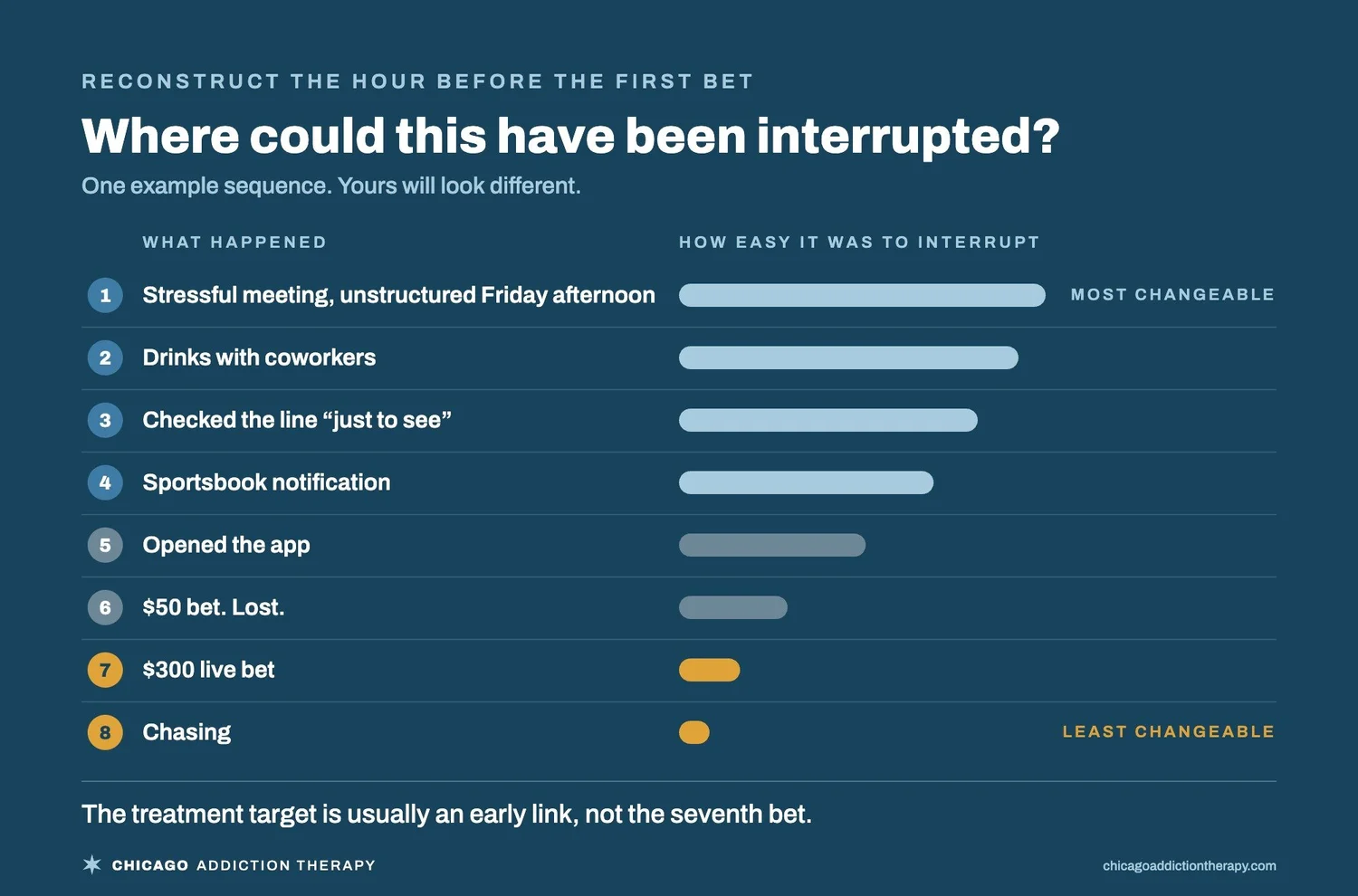
Now look at where that sequence could realistically have been interrupted. By the $300 live bet, almost nothing was going to stop it. At the notification, something might have. At the second drink, something very likely could have.
This is why the treatment target is often not the gambling itself. It may be the drinks, the notification, or the unstructured Friday afternoon. The seventh bet is the least changeable point in the entire chain. The first link is usually the most changeable.
Do the reconstruction today, while the details are fresh. In a week, your memory will have compressed all of it into “I just lost it,” and the useful part will be gone.
Find the Barrier That Failed
Once you have the sequence, match each point of failure to a specific repair. Don’t just promise to try harder.
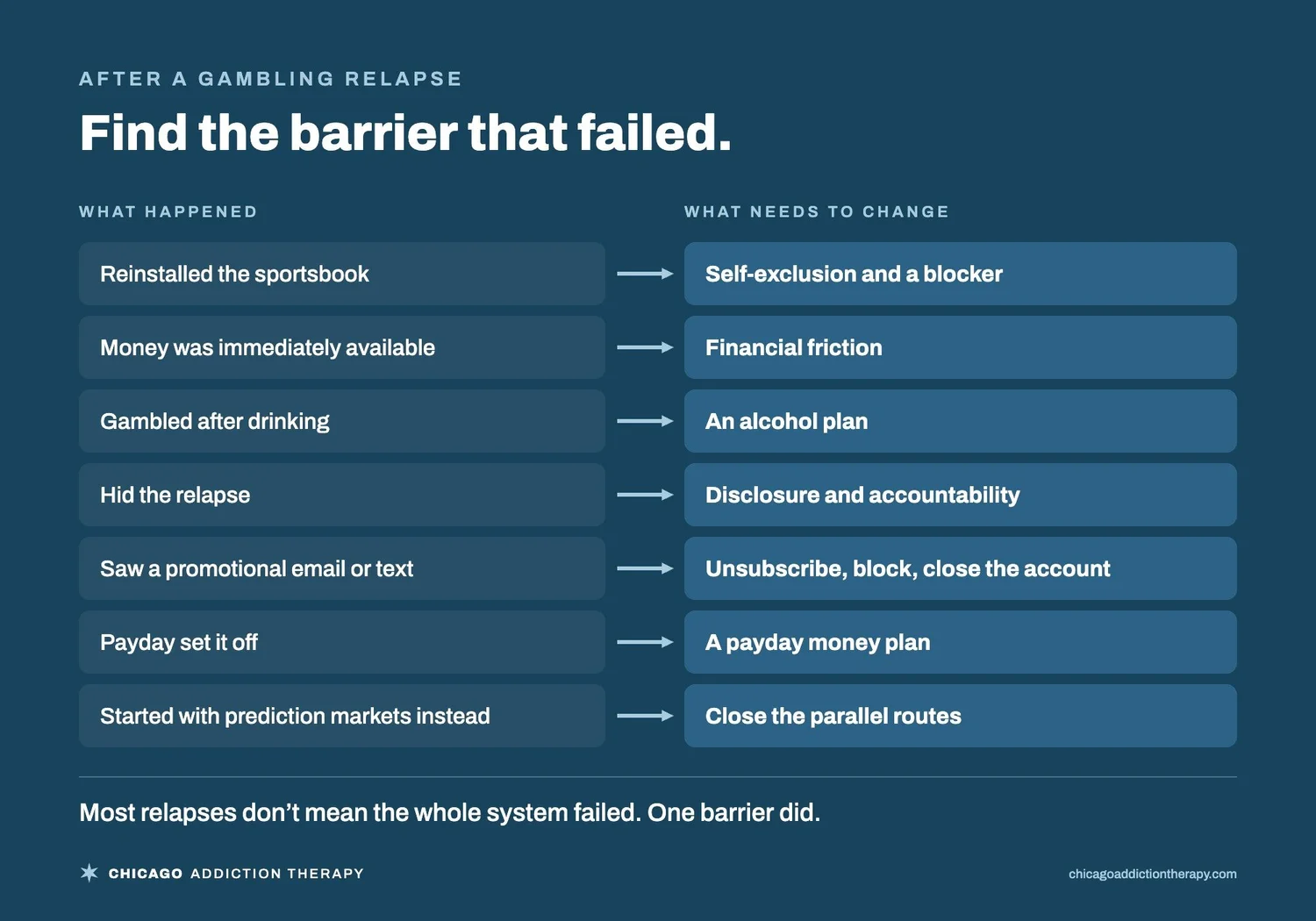
You reinstalled a sportsbook or opened a new account. Self-exclusion and blocking software, so that reinstalling stops being a thirty-second decision. If sports betting is your main form of gambling, How to Stop Sports Betting covers this in detail.
You had money immediately available. Financial friction: lower limits, a card block, a second set of eyes on the accounts, less cash within reach. My guide to gambling debt and financial recovery explains how to set this up.
You gambled after drinking. An alcohol plan. For a lot of people, this is the actual relapse-prevention work, and no amount of gambling-specific effort will make up for skipping it.
You hid it. Disclosure and accountability. Someone who knows, and who you have agreed to tell.
A promotional email, text, or notification started it. Unsubscribe, block the sender, turn off notifications, and close the account rather than leaving it dormant. Dormant accounts get “we miss you” bonus offers.
Payday triggered it. A payday money plan: automatic transfers and bill payments that run before you can touch the deposit, and a plan for where you will be during those first few hours.
You didn’t go back to your usual gambling. You started with something next to it. Close the parallel routes too. Prediction markets, daily fantasy, options trading, video gaming terminals in bars, and sweepstakes casinos are where a lot of relapses begin, precisely because they don’t feel like the thing you quit.
Most relapses don’t mean the whole system failed. They mean one barrier was missing, or was easy to take down. Find that one.
Be Careful With the “Fresh Start” Trap
After a relapse, a lot of people decide:
Tomorrow is Day 1 again.
It sounds like commitment. Look at what it permits. If tomorrow is Day 1, then tonight doesn’t count. Tonight is already ruined, so you might as well play out the rest of the balance, watch the late game with some action on it, and start clean in the morning.
No.
Recovery doesn’t restart tomorrow morning. The next decision starts now, with money still in the account and the game still on.
The same trap comes in larger sizes: I’ll stop after the weekend. After this season. After I get back to even. Each version gives you a period of permitted gambling first.
If counting days helps you, count them. But don’t let a reset counter turn into permission. The day you relapsed and then stopped, withdrew your balance, and told someone is not a wasted day. It may be the most important day in the whole count.
Should You Tell Your Partner You Relapsed?
Usually, yes. Secrecy almost always makes this worse, for the reasons above. And partners generally find out anyway, through a statement, a notification, or a change in your mood. Being told is painful. Finding out is worse, because a discovery confirms their deepest fear: that they cannot trust what you tell them.
But disclosure should be thoughtful, not impulsive.
Tell the truth about the money. Give one complete number, not a partial one that you will have to revise later.
Bring the plan with the confession. “I gambled Saturday, I lost $700, I’ve withdrawn the balance and excluded myself from the app, and I’ve emailed a therapist” is a very different conversation from “I gambled again.”
Don’t ask for reassurance. Your partner is allowed to be angry, frightened, or exhausted. Their reaction is not something for you to manage.
Get help first if the situation is complicated. If there are substantial hidden debts, shared finances at risk, or a relationship where you have reason to worry about how disclosure will go, plan the conversation with a therapist before you have it.
If you are the partner reading this, I wrote a separate guide for you: When Your Spouse or Partner Has a Gambling Problem.
When a Gambling Relapse Means You Need More Help
One relapse does not mean you need residential treatment. It also doesn’t necessarily mean that what you were doing wasn’t working. If you are weighing whether you need a more intensive level of care, gambling disorder treatment in Illinois explains how outpatient, intensive outpatient and residential care differ.
Look at the pattern, not the single event. It’s time for more help, or different help, if you recognize several of these:
Relapses are becoming more frequent, or the gaps between them are shrinking.
The amounts are escalating.
You are borrowing, using credit, or taking money that isn’t yours in order to gamble.
There is debt that no one else knows about.
You keep taking down your own barriers: reinstalling apps, lifting limits, finding the route the blocker doesn’t cover.
You gamble almost immediately after paydays.
You relapse when you drink.
You have thoughts of suicide after losses.
You stopped going to therapy or meetings because you were ashamed of relapsing.
That last one deserves a note. Shame after a relapse pulls people away from help at exactly the moment they need it. If you dropped out of treatment after gambling again, go back. No competent clinician is going to be shocked or disappointed. The NICE guideline explicitly tells treatment services to offer rapid re-entry after a relapse, because relapse is when support matters most. Relapse is also not evidence that treatment failed. The same guideline treats how to respond to a relapse as a standard component of cognitive behavioral therapy for gambling, which tells you that the people who study this expect it to come up.
If you haven’t had treatment, this is a reasonable moment to find out what it involves. Can Therapy Help Gambling Addiction? explains what the evidence shows, and the free, anonymous gambling addiction test takes a few minutes if you want a clearer read on where you stand.
If the Loss Feels Unbearable Right Now
I want to say this plainly, because it’s the most important section of this article.
The hours right after a gambling loss are dangerous. Gambling is strongly linked to suicidal thinking, and the NICE guideline warns that the risk may be highest immediately after a gambling episode. It also recognizes that a relapse, after a period of doing better, can be distressing enough to lead to self-harm.
If you are thinking about ending your life, or you don’t trust yourself to stay safe, call or text 988, the Suicide & Crisis Lifeline, now. Or go to the nearest emergency department. If you can, don’t be alone today.
If you are not in danger but you’re not okay either:
1-800-GAMBLER. The Illinois problem gambling helpline, free and confidential, 24 hours a day. You can also text GAMB to 833234.
1-800-MY-RESET (1-800-697-3738). The National Council on Problem Gambling’s national helpline, by call or text.
Gamblers Anonymous. Meetings in person, by phone, and online, where you will find people who have had this exact morning. Gam-Anon offers the same for family members.
More options are on my gambling resources page.
The number on your screen this morning feels like a verdict on your life. It isn’t. It is a debt, and debts have solutions: payment plans, credit counseling, time. People recover from losses much larger than yours.
Do not make an irreversible decision because of money.
Frequently Asked Questions
Is relapse normal in gambling recovery?
It’s common. Many people who stop gambling go through at least one return to it, and clinical guidelines treat relapse as something to plan for, not as a sign of failure. Common doesn’t mean harmless. A relapse is worth taking seriously because of the financial damage and the emotional crash that follows it. It is not proof that you can’t recover.
Does one bet count as a gambling relapse?
Some clinicians distinguish a lapse, meaning a single brief return to gambling, from a relapse, meaning a return to the old pattern. The label matters less than the response. For most people with a gambling problem, the realistic danger of “just one bet” is what comes after it: the chase if you lose, and the confidence if you win. Treat one bet as a signal that a barrier failed, and fix the barrier.
What should I do after losing money gambling?
Stop the session. Withdraw any remaining balance. Put barriers between yourself and the next bet. Tell one person. Then, once you’ve slept, deal with the loss as a financial problem, with a budget, a repayment plan, and honest numbers. The one thing not to do is attempt to recover the money by gambling.
Should I try to win back money I lost gambling?
No. Trying to win it back is chasing losses, and it’s the most reliable way to turn a painful loss into a devastating one. The money is gone in the way money spent on anything else is gone. It can be rebuilt through income, time, and a plan. It can’t be rebuilt at a sportsbook.
Should I tell my spouse I gambled again?
In most cases, yes, and sooner is better than later, with the full number and a concrete plan. Hidden relapses tend to grow, because the need to repair the money before anyone finds out becomes its own reason to gamble. If there are large debts or concerns about how the conversation will go, plan it with a therapist first.
How do I stop myself from gambling again tonight?
Make it physically harder. Turn on the app’s own time-out or self-exclusion setting, then delete it. Install a blocker. Move money out of easy reach. Then avoid being alone with the urge: call someone, go to a meeting, leave the house, or stay on the phone with a helpline. Urges rise, peak, and pass, usually faster than it feels like they will. You don’t have to win a permanent argument tonight. You have to get to tomorrow without a bet.
Does relapsing mean gambling treatment isn’t working?
Not necessarily. It may mean the plan has a gap: alcohol, payday, a gambling product the blocks didn’t cover, or a secret that built up pressure. Good treatment uses a relapse as data and adjusts. If relapses keep happening despite real effort, that’s a reason to increase the level of support, not to give up on it.
Gambling Therapy in Chicago, Illinois, and Minnesota
I’m a licensed clinical social worker and certified addiction counselor, and a large part of my practice is gambling: sports betting, casino and machine gambling, online gambling, and trading that has become compulsive. I see clients through Chicago Addiction Therapy, in person in Logan Square and online across Illinois and Minnesota.
The week after a relapse is a good time to start, because the sequence is fresh and the motivation is real. The first thing we usually do is what this article describes. We reconstruct what happened, find the barrier that failed, and build a plan that doesn’t depend on you feeling strong at 11 PM on a Saturday.
If you gambled again, reach out to schedule a consultation. You don’t need to have it figured out first, and you don’t need to be back to even.
If you need help right now: the Illinois gambling helpline is 1-800-GAMBLER, or text GAMB to 833234. Nationally, call or text 1-800-MY-RESET. If you are in crisis, call or text 988.
Source: National Institute for Health and Care Excellence (NICE). Gambling-related harms: identification, assessment and management (NG248), January 2025. This article is for general information and is not a substitute for individual medical, mental health, legal, or financial advice.