
Written by Chris Beerman, MSW, LCSW, CADC, PCGC · Published November 2026
You stopped gambling. You deleted the apps, closed the accounts, and decided you were finished. That was supposed to be the difficult part.
But now it's Friday night, and you can't sit still. Nothing sounds particularly interesting. You're irritable with people who haven't done anything wrong. You pick up your phone without knowing what you're looking for.
You might even find yourself missing gambling.
Not the losses. Not the shame. Not the experience of checking your bank account the next morning and wishing you hadn't.
You miss the anticipation.
If this sounds familiar, you may be experiencing withdrawal-like symptoms associated with stopping gambling. Or you may be experiencing something closely related: the loss of an activity that had become your primary way of managing boredom, stress, anxiety, and excitement.
The distinction matters clinically. The response to both involves more than simply telling yourself not to gamble.
The short version. Feeling restless or irritable when you try to stop gambling is real, and it is one of the diagnostic criteria for gambling disorder. Research has not established a fixed timeline, a dopamine "reset" date, or a physical syndrome like alcohol withdrawal. What helps is making gambling harder to reach, giving your days some structure, and learning to have an urge without obeying it.
On this page: Can You Actually Experience Withdrawal From Gambling? · What Are the Symptoms of Gambling Withdrawal? · Why Does Life Feel So Boring After Quitting Gambling? · Gambling May Have Been Doing Several Jobs for You · Does Your Brain Need to Reset Its Dopamine? · How Long Do Gambling Withdrawal Symptoms Last? · The Mistake of Trying to Eliminate Every Uncomfortable Feeling · What Actually Helps With Gambling Withdrawal Symptoms? · When Should You Seek Professional Help? · Frequently Asked Questions · Gambling Therapy in Chicago, Illinois, and Minnesota · If You Need Help Right Now
Can You Actually Experience Withdrawal From Gambling?
Yes, although gambling withdrawal is not identical to withdrawal from alcohol, opioids, or other drugs.
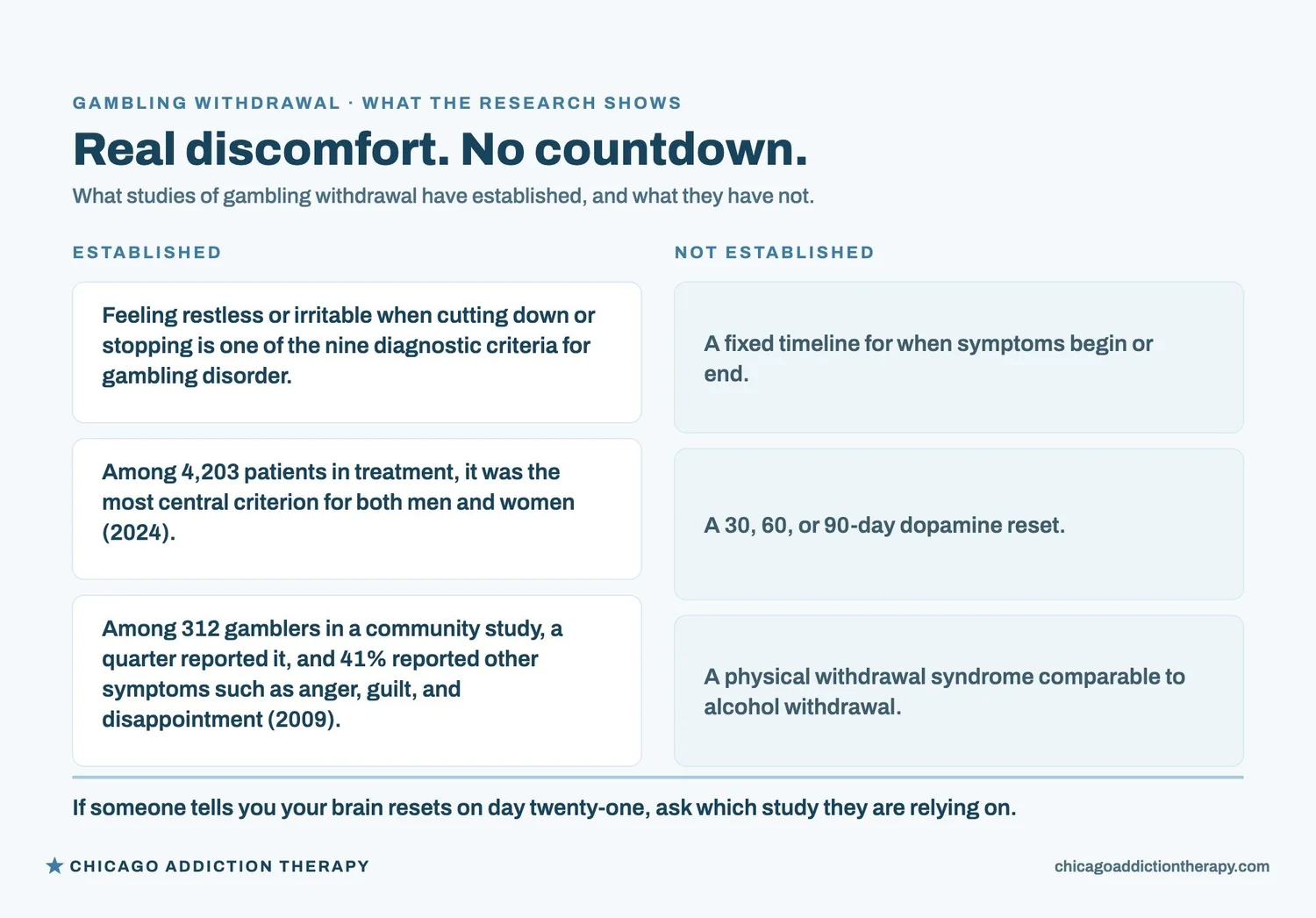
The American Psychiatric Association lists being restless or irritable when trying to cut down or stop gambling as one of the nine diagnostic criteria for gambling disorder.
That means a person can experience meaningful distress when gambling is removed, even though no chemical substance is being discontinued.
The research is more complicated when we move beyond that one criterion.
A 2009 study by Cunningham-Williams and colleagues interviewed 312 adult gamblers recruited from the community. About a quarter reported the restlessness or irritability the diagnostic criteria describe. A larger share, 41 percent, reported other withdrawal-like experiences when they tried to quit or control their gambling, including anger, guilt, and disappointment. Those experiences overlapped with depressive symptoms and with withdrawal from substances, but the overlap did not fully account for them.
Reporting a symptom after cutting back does not establish that stopping gambling caused it. The study relied on people's own accounts, and depression, anxiety disorders, substance use, financial stress, and other factors can produce similar experiences.
A more recent study, published in European Psychiatry in 2024, analyzed the DSM-5 criteria in 4,203 patients seeking treatment for gambling disorder at a hospital unit that specializes in behavioral addictions. In the statistical model, restlessness or irritability when trying to cut down or stop was the most central criterion for both men and women, meaning the one most closely tied to all the others.
That finding supports taking the symptom seriously. It does not establish a fixed withdrawal timeline or demonstrate that everyone who stops gambling will experience the same symptoms.
The practical point is simpler: stopping gambling can produce real discomfort, and that discomfort deserves attention rather than dismissal.
What Are the Symptoms of Gambling Withdrawal?
People trying to stop gambling may experience several changes.
Restlessness and irritability. You have trouble relaxing, feel easily annoyed, or experience a persistent sense that you should be doing something.
Strong urges to gamble. You find yourself thinking about betting, checking odds, opening an app, or returning to a casino, even after deciding to stop.
Anxiety. You feel on edge, particularly during times when you previously gambled or when you think about money you've lost.
Low mood or emptiness. Activities that once seemed enjoyable feel less interesting. You may feel unmotivated or have difficulty looking forward to things.
Sleep difficulties. You may have trouble falling asleep, particularly if gambling previously occupied your evenings or continued late into the night.
Difficulty concentrating. Your attention keeps drifting toward gambling, financial consequences, or the uncomfortable fact that something important has disappeared from your routine.
These experiences don't all qualify as established diagnostic withdrawal symptoms. Only the first is in the diagnostic criteria. The others may reflect cravings, changes in routine, emotional distress, or another mental health condition.
And not everyone experiences them.
If your symptoms are significant, persistent, or worsening, don't automatically assume they are just gambling withdrawal.
Why Does Life Feel So Boring After Quitting Gambling?
This is one of the more interesting parts of gambling recovery, and one that deserves considerably more attention.
Imagine someone who bets on football every weekend.
By Thursday, they're studying the matchups. Friday is spent comparing lines. Saturday involves college games. Sunday begins with checking the injury reports, reviewing bets, and waiting for kickoff.
During the games, there is always something to monitor.
A touchdown changes the live odds. A missed field goal changes a parlay. A fourth-quarter drive could turn a losing afternoon into a profitable one.
There's anticipation before the event, excitement during it, and an almost endless stream of information to absorb.
Now remove the gambling.
The football game is still there. The couch is still there. The same friends might still be watching.
But the entire experience feels different.
The person may conclude that football is boring without betting. Sometimes that's true, at least initially. More often, what's missing is the additional layer of stimulation that gambling provided.
The game wasn't just entertainment anymore. It was a sequence of financial consequences that required constant attention.
And gambling doesn't have to be enjoyable to occupy that much psychological space. Plenty of people continue doing it long after the fun has disappeared.
You can miss the function gambling served without wanting the damage that came with it.
That's an important distinction.
Gambling May Have Been Doing Several Jobs for You
One question I work on in gambling therapy is straightforward:
What did gambling do for you besides offer the possibility of winning money?
The answers vary.
For one person, gambling makes an otherwise dull evening interesting.
For another, it creates a sense of competence. They understand point spreads, statistics, probabilities, and line movement. They know the language and feel connected to a community.
For someone else, gambling is a way to stop thinking about work, a difficult relationship, loneliness, or anxiety.
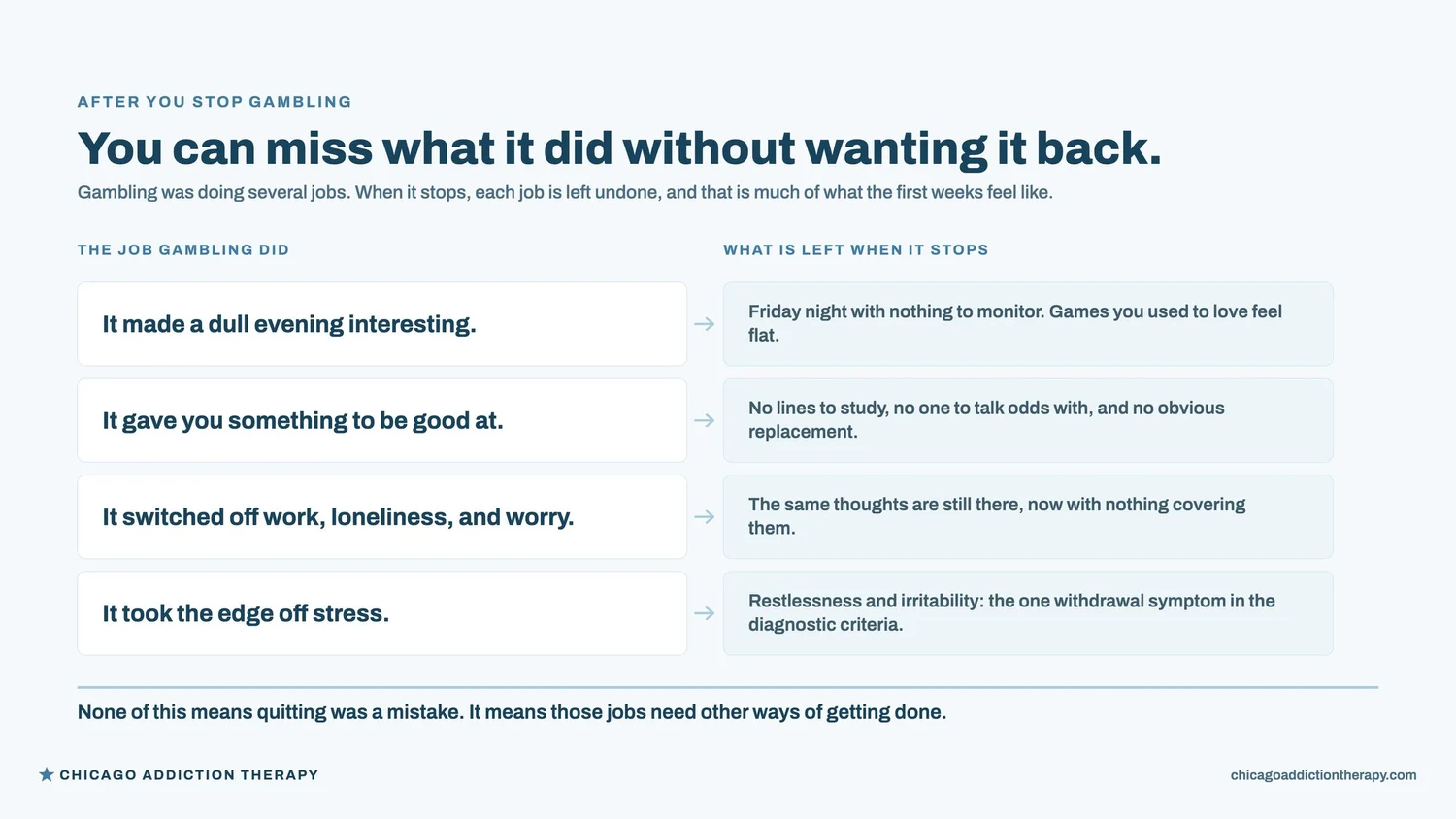
And sometimes gambling provides something that looks almost like emotional regulation.
You're stressed, so you bet.
You feel a little better while waiting for the outcome.
You lose, which creates more stress.
Now you need relief from the stress the gambling just created.
So you bet again.
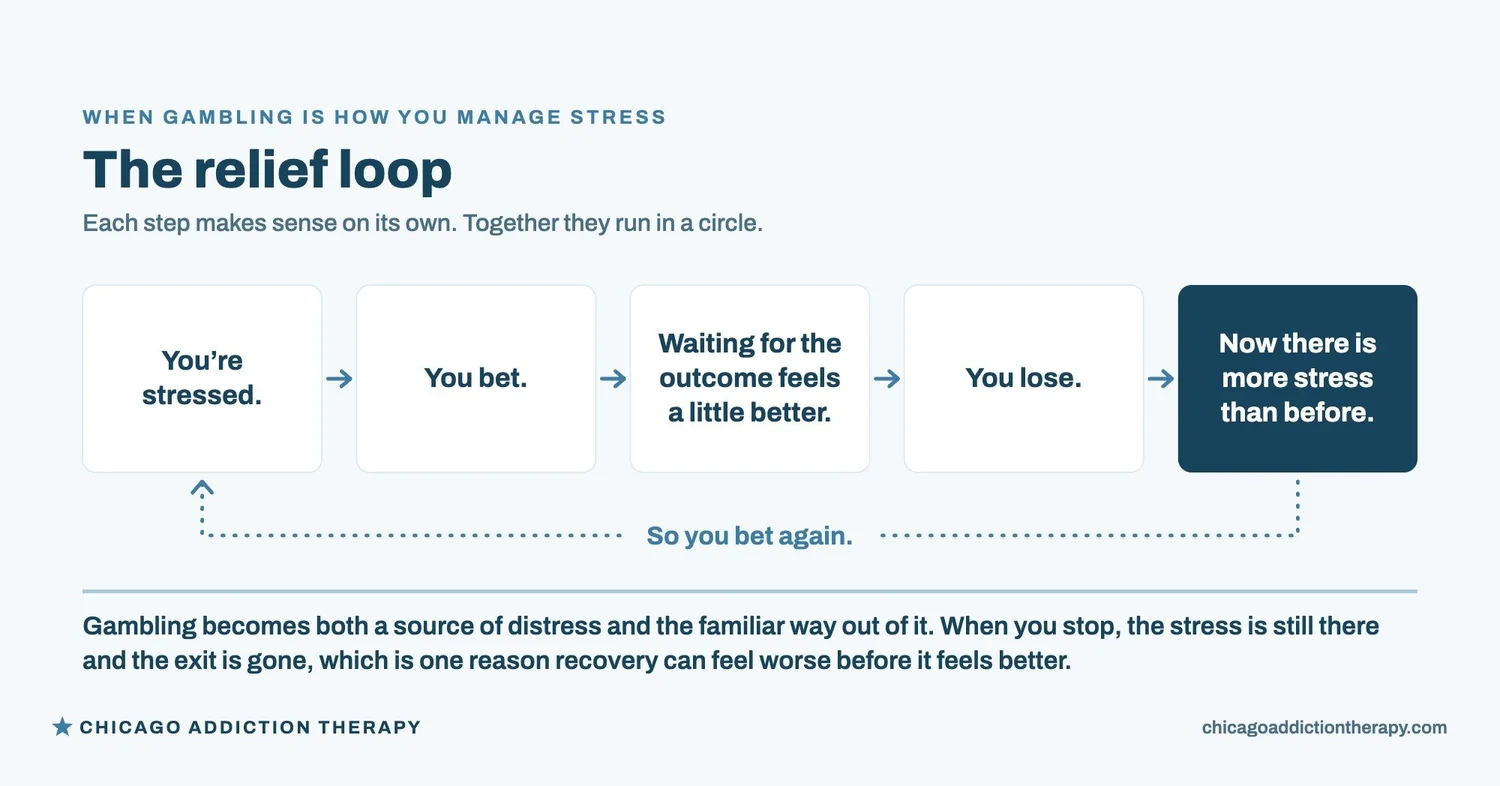
The activity becomes both a source of distress and a familiar way of escaping that distress. It is the same engine that drives chasing losses.
Once you stop, the underlying problems are still there. So is the habit of turning toward gambling whenever those problems become uncomfortable.
This is one reason recovery can feel worse before it feels better. Not because recovery is harming you, but because gambling is no longer covering up everything you were using it to avoid.
Does Your Brain Need to Reset Its Dopamine?
You'll find plenty of articles explaining that gambling withdrawal happens because your brain has become accustomed to dopamine and now needs thirty, sixty, or ninety days to reset.
There is some legitimate neuroscience behind the general idea that gambling involves reward learning, motivation, reinforcement, and brain systems that respond to anticipated rewards.
But that doesn't establish a particular recovery schedule.
Dopamine is not simply a pleasure chemical, and recovery is not a matter of draining it from your brain until a normal supply returns.
The brain's reward systems are considerably more complicated than that.
There is also no scientifically established thirty-day gambling withdrawal protocol that predicts when your sleep, mood, motivation, or cravings will return to normal.
If somebody tells you that your brain will be reset on day twenty-one, ask what study they're relying on.
The answer matters, because people can become discouraged when they reach an arbitrary milestone and still feel terrible.
Recovery isn't a countdown to a guaranteed neurological event.
It's a process of changing behavior, reducing exposure to gambling, developing alternative ways of responding to discomfort, and addressing whatever else is happening psychologically.
How Long Do Gambling Withdrawal Symptoms Last?
There is no single, well-established timeline.
Some people experience significant discomfort during the first few days without gambling. Others notice symptoms in particular situations, such as payday, weekends, sporting events, or periods of financial stress.
Someone might feel relatively comfortable for three weeks and become intensely restless during the first weekend of March Madness.
Another person might struggle initially with anxiety or sleep, then find that the larger problem is boredom several months later.
Those experiences are not necessarily evidence of the same withdrawal process.
It's more useful to pay attention to patterns than to count days.
Ask yourself:
When do the symptoms show up?
What was happening immediately beforehand?
What feeling does gambling seem capable of changing?
How long does the urge last when you don't act on it?
Does the discomfort become easier to tolerate with practice?
Are your mood, sleep, and daily functioning improving overall?
If symptoms persist, worsen, or interfere substantially with your life, an evaluation is appropriate. Depression, anxiety, ADHD, sleep disorders, substance use, and other conditions may need treatment in their own right.
The Mistake of Trying to Eliminate Every Uncomfortable Feeling
When someone stops gambling, the initial goal is often to feel normal again.
That's understandable.
But it can become another trap.
You're anxious, so you think something has gone wrong with recovery.
You're bored, so you conclude that life without gambling isn't sustainable.
You have an urge, so you worry that you're going to relapse.
These interpretations can make the original discomfort worse.
One of the approaches I use in therapy is acceptance and commitment therapy, or ACT.
The central idea is not that you should enjoy anxiety, boredom, or cravings.
It's that you can experience them without allowing them to make your decisions.
You might notice a thought:
I can't stand another Saturday night like this.
Instead of debating whether that's true, you can recognize what it is: a thought produced while you're uncomfortable.
You can feel restless and not gamble.
You can miss betting and still decide that betting isn't something you want in your life.
You can have a terrible Saturday and not turn it into an expensive Sunday.
The feeling doesn't have to disappear before you choose what to do.
This is different from white-knuckling your way through recovery. You're learning that uncomfortable internal experiences are tolerable, even when they don't immediately go away.
What Actually Helps With Gambling Withdrawal Symptoms?
I would focus on four areas: access, structure, your response to discomfort, and whatever else is going on with your health.
1. Make Gambling Harder to Access
If you can reinstall a sportsbook app and deposit $500 in less than a minute, you're asking a great deal of yourself during a difficult moment.
This is where self-exclusion, blocking software, removing saved payment methods, reducing transfer limits, and involving a trusted person in financial safeguards can help.
None of these measures eliminates cravings.
They make it harder for a craving to become a financial event.
I put together a free 24-Hour Betting Shutdown Plan that walks through these steps.
2. Replace the Structure, Not Just the Activity
If you spent twenty hours a week gambling, you now have twenty hours to account for.
That doesn't mean you need a new hobby that provides exactly the same excitement.
In fact, trying to replace the intensity of gambling with another immediately rewarding activity can become its own problem.
Start with ordinary structure.
Exercise. A regular sleep schedule. Making plans with friends. Going somewhere you won't be gambling. Cooking. Reading. Getting outside. Attending a support group.
The activity does not have to be exciting.
It has to give the day some shape while you learn to function without constant betting-related stimulation.
3. Learn What an Urge Actually Does
Cravings often create a convincing story about urgency.
If I don't bet on this game, I'll miss my opportunity.
I just want to check the odds.
One small bet would take the edge off.
In cognitive behavioral therapy, we examine the thoughts that make gambling seem reasonable and compare them with what actually happens.
You may believe that one small bet will help you relax. But your history might show that a small bet usually produces another bet, followed by checking, chasing, and more anxiety.
The thought feels persuasive because it promises immediate relief.
That doesn't make it accurate.
An urge is an experience. It isn't an instruction.
Sometimes the useful thing is to stop debating with the urge, leave the situation, contact someone, and let the feeling change without acting on it. And if an urge does win, what you do in the next few hours matters more than the slip itself.
4. Pay Attention to Sleep, Alcohol, and Other Mental Health Symptoms
If you're sleeping four hours a night, drinking heavily, and spending the rest of the day worrying about your finances, it may be difficult to tell which symptoms are related to stopping gambling.
That doesn't make the symptoms less real.
It means the treatment plan needs to look at more than gambling.
Alcohol is particularly relevant because the two activities often reinforce one another. I explain the relationship in Alcohol and Gambling: Why They Feed Each Other.
And if you're physically dependent on alcohol or sedatives, withdrawal from those substances can be medically dangerous. Don't assume severe symptoms are caused by gambling, and don't attempt an unsafe home detox.
When Should You Seek Professional Help?
You don't need a certain number of gambling-free days before talking to a therapist.
Consider an assessment if you're repeatedly trying to stop and returning to gambling, experiencing significant anxiety or depression, having difficulty functioning, or finding that gambling was your primary way of dealing with emotions.
If you've experienced large financial losses, hopelessness, or thoughts of suicide, take that seriously. Gambling-related distress can become an acute mental health crisis, particularly around significant losses or relationship consequences.
The UK's 2025 NICE guideline on gambling-related harms recommends evidence-based treatment, including cognitive behavioral therapy focused on gambling, and emphasizes assessing mental health and suicide risk.
The work is not simply helping someone resist the next bet. It's understanding why the bet became so important and building a life in which it no longer has to perform so many jobs.
Frequently Asked Questions
Can gambling withdrawal cause physical symptoms?
Some studies and clinical reports describe physical complaints, including headaches, sleep difficulties, and other bodily symptoms, when people try to reduce or stop gambling. However, these symptoms are not specific to gambling withdrawal, and research has not established a consistent physical withdrawal syndrome comparable to alcohol withdrawal. New or concerning physical symptoms should be medically assessed.
Can quitting gambling make you depressed?
Some people experience low mood after stopping gambling. This can reflect withdrawal-like distress, loss of stimulation, financial consequences, relationship problems, or an independent depressive disorder. Persistent or severe depression deserves clinical attention rather than an assumption that it will resolve on its own.
Do I need medical detox to stop gambling?
Gambling disorder by itself generally does not require medically supervised detoxification. However, withdrawal from alcohol, benzodiazepines, or other substances may require medical care. Co-occurring mental health crises also need appropriate assessment.
Why do I still want to gamble when I know it makes me miserable?
Because gambling may have become a learned response to discomfort. You can understand the financial consequences and still experience a strong urge for the stimulation or temporary relief gambling provides. Recognizing that pattern is part of treatment.
Will I ever enjoy watching sports without betting?
Many people learn to enjoy sports without gambling, but the experience may change. If betting has become the main reason you watch, ordinary games may initially feel less exciting. You may need time, different routines, or a period away from sports-related gambling cues while you rebuild your relationship with them.
Gambling Therapy in Chicago, Illinois, and Minnesota
I'm Chris Beerman, MSW, LCSW, CADC, PCGC. I specialize in gambling and addiction therapy, including sports betting, online casinos, video gambling terminals, and gambling-like trading behavior.
I work with clients in person in Logan Square, Chicago, and through telehealth throughout Illinois and Minnesota.
My approach combines cognitive behavioral therapy, acceptance and commitment therapy, motivational interviewing, and practical relapse-prevention work.
If you've stopped gambling but are struggling with what comes afterward, that's something we can work on.
You can learn more about gambling addiction therapy in Chicago or reach out to schedule a free 15-minute consultation.
You do not have to feel good about quitting every day to keep making progress.
Some days, the accomplishment is simply that gambling didn't get to decide what happened next.
If You Need Help Right Now
Illinois gambling helpline: call 1-800-GAMBLER or text GAMB to 833234. Free and confidential, any hour.
National Problem Gambling Helpline: call or text 1-800-MY-RESET (1-800-697-3738).
Minnesota: 1-800-333-HOPE (1-800-333-4673) or text HOPE to 53342.
If you're in a mental health crisis or thinking about suicide, call or text 988. If you're in immediate danger, call 911.
This article is general information, not clinical advice, and reading it does not create a therapeutic relationship. See our editorial standards.
Sources
American Psychiatric Association. What Is Gambling Disorder? Diagnostic criteria from the Diagnostic and Statistical Manual of Mental Disorders, Fifth Edition, Text Revision (DSM-5-TR).
Cunningham-Williams, R. M., Gattis, M. N., Dore, P. M., Shi, P., & Spitznagel, E. L. (2009). Towards DSM-V: Considering Other Withdrawal-Like Symptoms of Pathological Gambling Disorder. International Journal of Methods in Psychiatric Research, 18(1), 13–22.
Lucas, I., Mora-Maltas, B., Granero, R., et al. (2024). Network Analysis of DSM-5 Criteria for Gambling Disorder: Considering Sex Differences in a Large Clinical Sample. European Psychiatry, 67(1), e65.
National Institute for Health and Care Excellence. (2025). Gambling-Related Harms: Identification, Assessment and Management (NICE guideline NG248).
More in this series
This guide is part of Gambling Addiction: Where to Start, a reading path through everything on this site about gambling. Next in the path:
I Gambled Again. What Do I Do Now? How to Stop a Gambling Relapse From Becoming a Spiral
Gambling Debt: How to Recover Financially After Gambling Losses
Alcohol and Gambling: Why They Feed Each Other, and How to Break the Link
Not sure whether it's a problem? Take the free gambling addiction test: nine questions, about two minutes, scored in your browser and never sent anywhere.