
By Chris Beerman, MSW, LCSW, CADC · Chicago Addiction Therapy · Reviewed September 2026
When someone comes to me about gambling, one of the first things I ask is whether alcohol is usually involved.
Not just whether they drink. What, how much, and when, because the answer is often part of the gambling story.
In my experience, the biggest losses people describe rarely happen sober at 10 a.m. on a Tuesday. They happen after the third beer at a bar with video gaming terminals in the corner. During a football game, phone in one hand and a drink in the other, adding a live bet every few minutes. On a Friday night that started with “just one” and ended at an ATM.
Alcohol doesn’t just show up alongside gambling. For many people, it changes what happens once the gambling starts: limits loosen, bets get bigger, and stopping gets harder.
The overlap shows up from the other direction, too. People who come to me about their drinking sometimes mention, almost as an aside, that they’ve also been losing money on a betting app or the machines at their bar.
If both have started to worry you, you’re probably not dealing with two separate problems that happen to share a calendar. They tend to feed each other. The good news is that it works the other way too: progress on one can make the other easier, as long as the plan covers both.
The short version
Drinking and gambling problems overlap a lot. In one large US survey, almost three in four people who met the criteria for pathological gambling had had an alcohol use disorder at some point in their lives.
Alcohol can make gambling harder to stop. In some lab studies, people who had been drinking kept playing longer, and sports bettors who drink while betting tend to bet more.
In Illinois, the law’s standard home for a video gambling machine is a place that serves alcohol, so the drinks and the machines are often in the same room.
Treat them as one problem with two parts: screen for both, plan for the nights they happen together, and if you drink heavily or regularly, don’t stop drinking abruptly without medical guidance.
On this page: How Common Is It to Have Both a Drinking and a Gambling Problem? · Does Alcohol Make You Gamble More? · Why Drinking and Gambling Feed Each Other · In Illinois, the Machines Are Where the Drinks Are · Game Day: Drinking and Sports Betting · Signs Your Drinking and Gambling Are Feeding Each Other · Should You Quit Drinking and Gambling at the Same Time? · What Treatment for Both Looks Like · If Someone You Love Drinks and Gambles · Therapy for Alcohol and Gambling in Chicago · Related Reading · Frequently Asked Questions · Need Support Right Now?
How Common Is It to Have Both a Drinking and a Gambling Problem?
More common than most people assume, and it runs in both directions.
In the US National Epidemiologic Survey on Alcohol and Related Conditions, which interviewed 43,093 adults, almost three-quarters (73.2%) of people who met the criteria for pathological gambling, the diagnosis that preceded today’s gambling disorder, had had an alcohol use disorder at some point in their lives.
A review that pooled 11 population surveys put the rate of alcohol use disorder at about 28% among people with problem or pathological gambling.
Among people who seek treatment for gambling, about one in five (21.2%) has a current alcohol use disorder.
Going the other way, about 14% of people in treatment for substance use have pathological gambling, and about 23% have gambling problems somewhere on the broader spectrum.
The numbers differ because the studies measured different things: problems at any point in life versus right now, the general population versus people already in treatment. The pattern holds: where one problem shows up, the other is worth asking about.
Part of the overlap may be built in. A large Australian twin study estimated that one-half to two-thirds of the link between disordered gambling and alcohol use disorder comes from shared genetic vulnerability. That isn’t destiny. It does mean that if one of these has been a problem for you, it’s worth keeping an eye on the other.
Does Alcohol Make You Gamble More?
For a lot of people, yes, although the lab evidence is more mixed than you might expect. Alcohol is usually described as the thing that makes gambling more fun. In the studies that did find an effect, the bigger change was in stopping: people who had been drinking kept playing.
In an Australian lab study, 40 young men who regularly played poker machines and regularly drank were given either three drinks or a placebo before a simulated gambling game. The men who had been drinking played twice as many rounds, and half of them lost their entire starting stake, compared with 15% of the placebo group. The researchers concluded that “relatively small quantities of alcohol have a significant effect on the psychological processes that underpin self-control over gambling.” A Canadian study of video lottery terminals, close cousins of the terminals in Illinois bars, found that a moderately intoxicating dose of alcohol increased how long people played and how often they doubled their bets early in a hand, especially among people who already had gambling problems.
Not every experiment agrees. A 2022 review that combined 20 lab studies found no consistent effect of alcohol on risk-taking while gambling. The difference showed up mainly when the comparison group knew they weren’t drinking; compared with people who only thought they’d had alcohol, people who actually drank took no more risks. That suggests part of the effect comes from what people expect drinking to do.
Outside the lab, the link is more consistent. In a recent study of Canadian sports bettors, drinking while betting was linked to making more bets and spending more money on them. And a two-year study of US adults published in JAMA Psychiatry found that sports betting frequency and alcohol-related problems moved together: when one went up, the other tended to go up too.
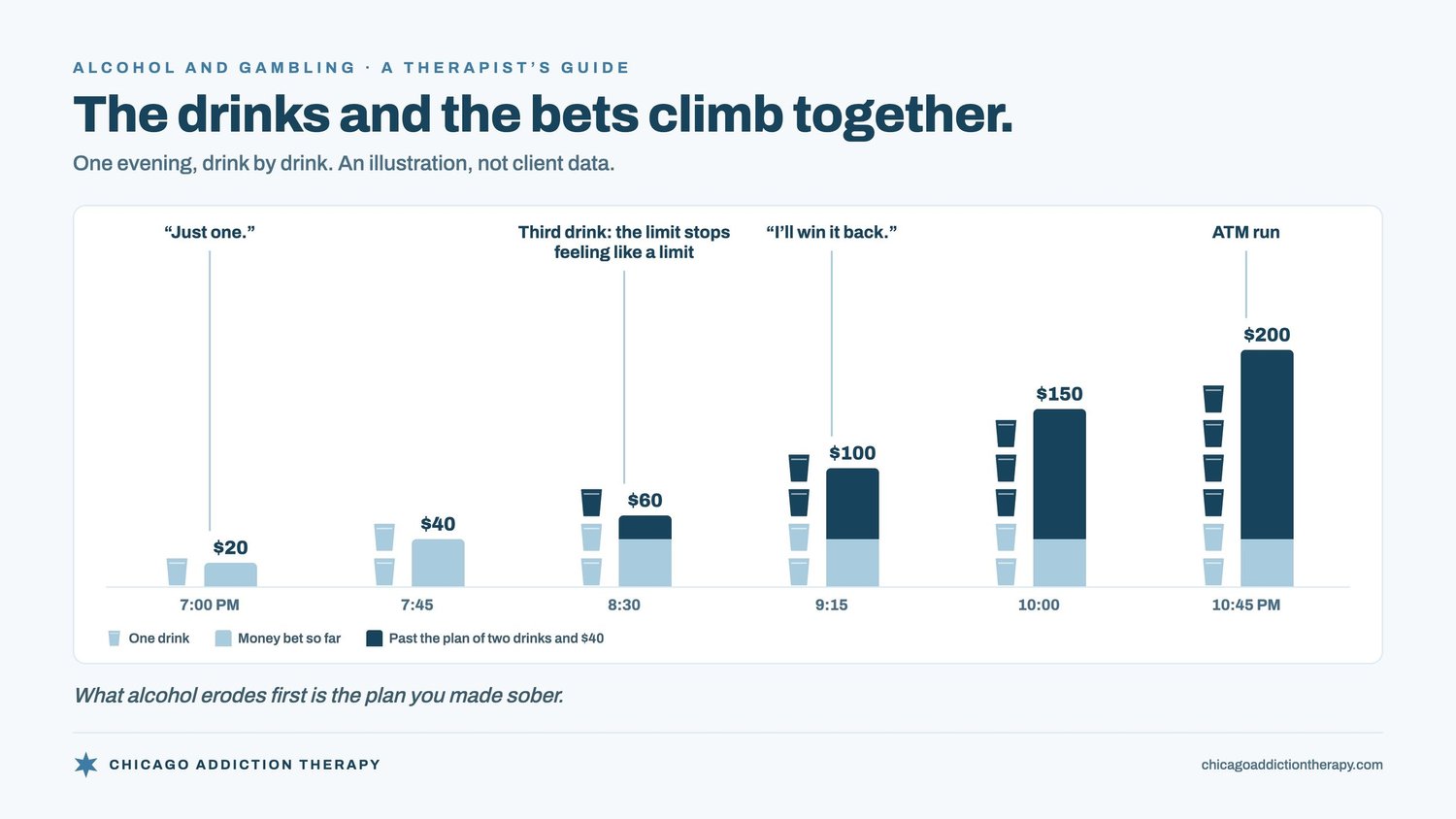
Whether it’s the alcohol itself or what people expect it to do, the night often goes the same way. What alcohol erodes first is the plan you made sober. The limit you set walking in stops feeling like a limit, “I’ll win it back” starts to sound reasonable, and the evening you meant to spend on two drinks and $40 turns into four hours. If chasing is the part you recognize, my guide to how to stop chasing your losses goes through it step by step.
Why Drinking and Gambling Feed Each Other
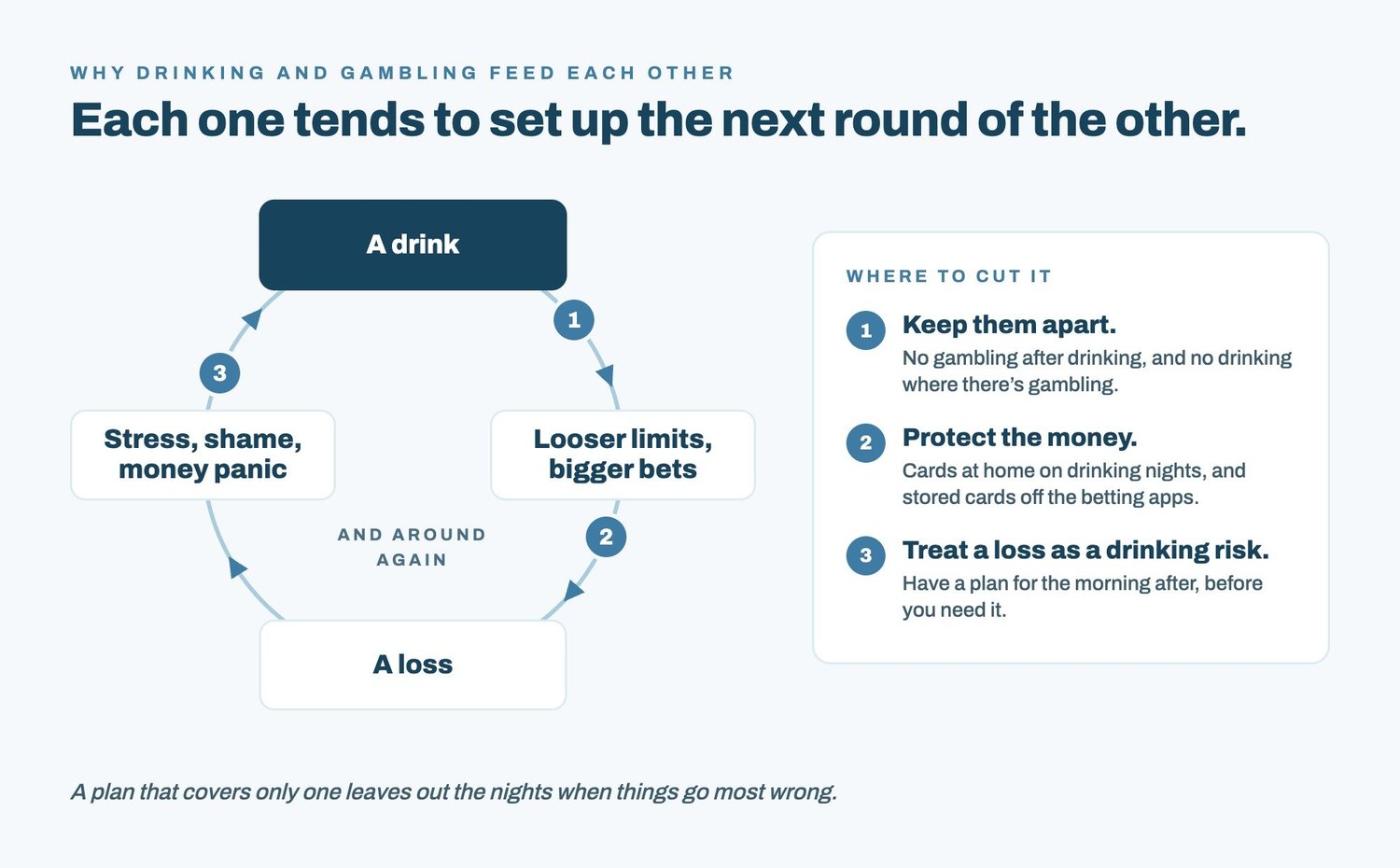
Each one tends to set up the next round of the other, in four ways.
Drinking leads to losses, and losses lead to drinking. A loss brings stress, shame and money panic, and alcohol is a fast, familiar way to turn those down. The next drink lowers the guardrails again, and now there’s a loss to win back.
Wins lead to drinking, too. A win gets celebrated with a round. The round loosens the limits. The winnings go back in.
They share triggers. The same bar, the same friends, the same game on TV, the same bad day at work, the same empty Sunday afternoon. When two behaviors share a setting, the setting starts to cue both.
They do similar jobs, so one can stand in for the other. For a lot of people, both are ways to switch off from work, money, a relationship or anxiety for a few hours. Take one away without replacing that job, and the other can quietly expand: the person who stops drinking and starts spending evenings on a betting app, or the person who quits the machines and drinks more at home. That doesn’t mean change is pointless. It means the plan should name both from the start.
In Illinois, the Machines Are Where the Drinks Are
In Illinois, video gambling is unusually intertwined with places that serve alcohol.
Under the Illinois Video Gaming Act, a “licensed establishment” for video gaming terminals is a retail business “where alcoholic liquor is drawn, poured, mixed, or otherwise served for consumption on the premises.” Truck stops and veterans and fraternal clubs can host terminals too, but the law’s default home for a machine is a place that serves drinks. The Illinois Gaming Board puts the total at about 49,000 terminals in about 9,000 licensed locations, and calls it the largest distributed video gaming network of its kind in the world.
Put that next to the lab studies above. The machines are very often where people have been drinking. You don’t have to plan a trip to a casino: you stop for a beer after work, and the machine is a few feet away, with no closing time except the bar’s. That’s the most practical point in this article: if the machines are in your bar, your bar is part of the plan.
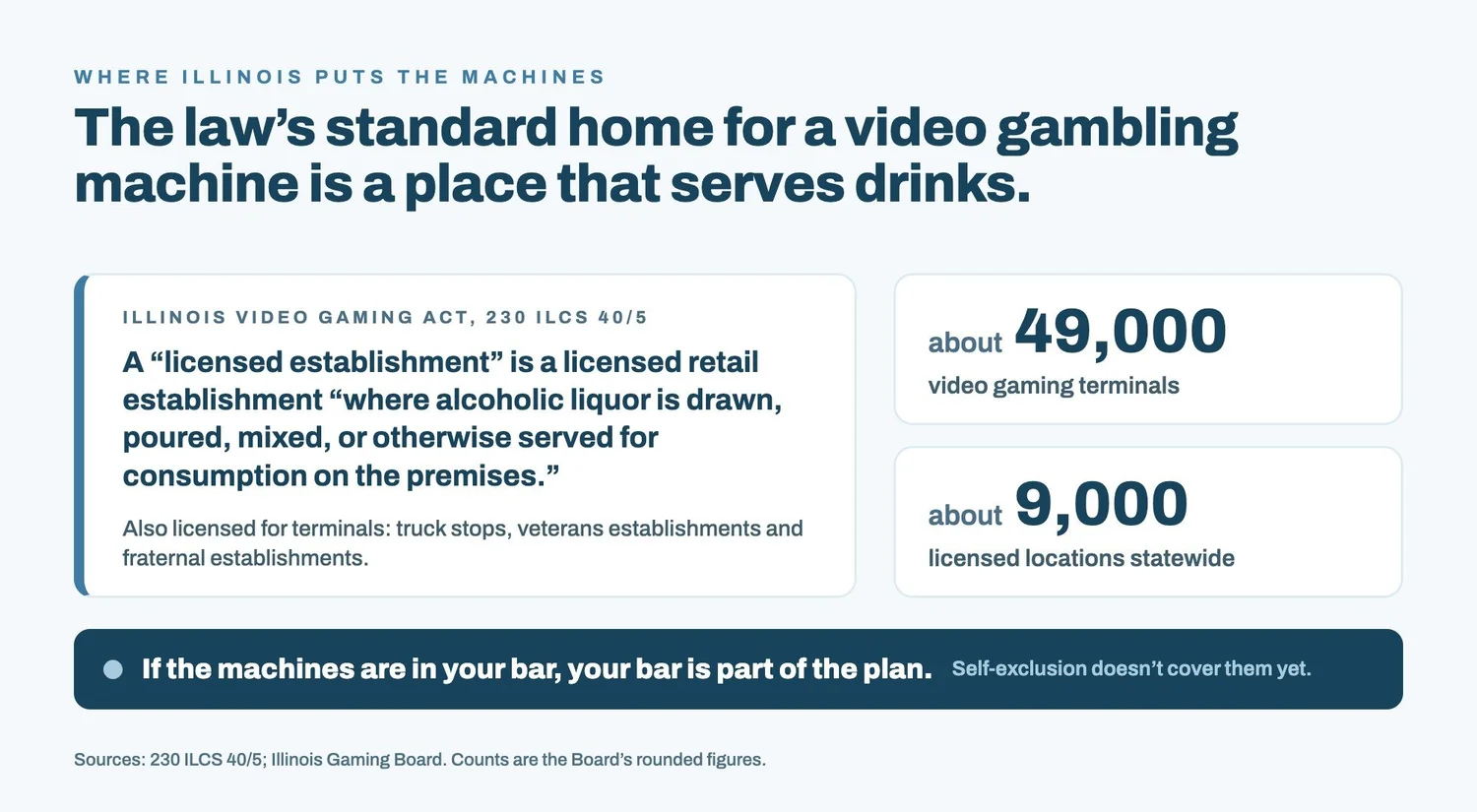
One gap to know about: the state’s self-exclusion program covers casinos and sports betting, not these terminals. At its September 2026 meeting, the Illinois Gaming Board, which runs the program, adopted a resolution to bring video gaming into it. Technical standards and new rules have to come first, so for now the machines still aren’t covered.
My guide to how to stop video gambling in Illinois covers the barriers that do exist for the machines, and the Illinois video gambling data page shows how much money they take in, town by town.
Game Day: Drinking and Sports Betting
Sports betting has its own version of the same problem, and it lives on your phone.
A game is a three-hour window with a drink in your hand and a betting app in your pocket. Live betting means there is always another bet available: the next drive, the next at-bat, the next quarter. Each one feels small. After a few drinks, the total isn’t.
The patterns worth watching for:
The bets you place during a game are bigger or more frequent than the ones you place sober before kickoff.
Parlays and live bets show up mostly on nights you’ve been drinking.
You check the app during the game the way you’d check the score, except you’re adding money.
The morning after a big game, you’re afraid to open your bet history.
The relationship may run in both directions. A 2026 study in Health Economics used the state-by-state rollout of legal sports betting to look at drinking. In the first years after states legalized online sports betting, young men 35 and under who binge drink did so about 10% more often. That suggests easier access to gambling can change drinking, not only the other way around.
If you’re trying to stop betting, the barriers in my guide to how to stop sports betting matter more on game days than any other time. If you haven’t decided what you want yet, keep the two completely separate for now. That’s a cleaner experiment than trying to decide how many drinks are safe to bet on.
Signs Your Drinking and Gambling Are Feeding Each Other
You gamble more or bet bigger when you’ve been drinking, and the limits you set sober don’t survive the second or third drink.
You drink to deal with the stress, shame or anxiety after a loss.
You choose bars partly because of the machines, or drink more when you’ve got money on a game.
You cut back on one and noticed the other growing.
You hide both: the bar tab and the betting history.
When someone close to you raises one, you find yourself defending the other.
If several of these fit, the two free, private screening tools on this site are a good place to start: the gambling addiction test, which uses the Problem Gambling Severity Index, and the alcohol use test, which uses the World Health Organization’s AUDIT. Neither is a diagnosis. Taking both gives you a clearer picture than either one alone.
Should You Quit Drinking and Gambling at the Same Time?
Usually, you should at least plan for both at the same time.
Start with safety. If you drink heavily or regularly, don’t stop abruptly without medical guidance, because alcohol withdrawal can be dangerous. Symptoms usually start within about eight hours of the last drink, though they can begin days later. They can include shaking, sweating and a racing heart, and in severe withdrawal, confusion, hallucinations and seizures. If that could be you, talk to a doctor before you change anything. My guide to choosing between therapy, IOP, rehab and detox explains the options.
Stopping gambling doesn’t carry that physical danger, but the first weeks can bring restlessness, irritability and strong urges: exactly the feelings many people reach for a drink to manage.
For the first month, I usually suggest three things:
Separate them. No gambling after drinking, and no drinking where there’s gambling. That means the bars with machines, the watch party with the betting app open, the casino.
Protect the money on drinking nights. Leave your cards at home, carry a set amount of cash, and remove stored cards from betting apps, or delete the apps. The 24-hour betting shutdown plan walks through this in one sitting.
Decide both goals together. Whether you quit drinking or cut back affects the gambling goal, and the reverse. If you keep drinking while you stop gambling, the drinking rules need to be specific enough to protect the gambling goal. If moderation keeps leading back to betting, that’s useful information, not a failure.
What Treatment for Both Looks Like
It’s tempting to treat them one at a time, drinking first and gambling later, or the reverse. But because each one triggers the other, a plan that covers only one leaves out the nights when things go most wrong.
When both are involved, I work on them together:
An honest picture of both. How much, how often, where, with whom, and what happens on the nights they overlap.
The shared cycle. What comes before the first drink and the first bet, what the combination is doing for you, and where the evening turns.
Barriers for both. Blocking tools, money controls and self-exclusion for gambling; changes to what’s at home and where you go for drinking.
The thinking that keeps both going. “I’ll win it back.” “I deserve a drink after that.” Cognitive behavioral therapy is built for exactly these thoughts.
Relapse planning that crosses over. A drinking night is treated as a gambling risk, and a big loss is treated as a drinking risk.
Medication is worth asking about. Naltrexone is one of three FDA-approved medications for alcohol use disorder, along with acamprosate and disulfiram. For gambling, a 2022 Cochrane review found preliminary evidence, rated low to very low certainty, that opioid antagonists such as naltrexone may improve gambling symptoms in the short term. I’m not a prescriber, but I can coordinate with your doctor or psychiatrist.
Some people need more than weekly outpatient therapy: for example, when daily heavy drinking makes withdrawal a risk, or when the gambling has created a financial or safety crisis. An intensive outpatient program or medically supervised withdrawal may need to come first, with therapy alongside or after. For gambling, my page on gambling treatment in Illinois lays out the levels of care, including state-funded options.
If Someone You Love Drinks and Gambles
If you’re the partner or parent, you may be dealing with two sets of consequences at once: the drinking you can see and the money you can’t account for.
A few things matter more than usual when both are involved:
Safety before ultimatums. If the drinking is heavy, a sudden stop can be dangerous. Push for a medical conversation rather than a promise to quit tonight.
Protect your own money. Separate accounts, freeze your credit, and think hard before covering a gambling debt on the promise that it won’t happen again.
Pick your moment. A conversation started while someone has been drinking, or in the middle of a game they’ve bet on, rarely goes well.
Get support for yourself. Gam-Anon exists for families affected by gambling and Al-Anon for families affected by drinking, and you can come to therapy yourself whether or not they do.
The guides for parents and partners in the related reading below go into more detail.
Therapy for Alcohol and Gambling in Chicago
I’m Chris Beerman, an addiction therapist in Chicago. Gambling and alcohol are the two things I work with most, and they show up together more often than most people expect.
I see adults in person in Logan Square and online anywhere in Illinois or Minnesota. You don’t need to have decided what to do about either one before we talk, and you don’t need to call yourself an addict or an alcoholic. You can read more about how I work on my gambling addiction therapy and alcohol addiction therapy pages.
Schedule a Free 15-Minute Consultation
Or call or text (708) 665-5271, or check your coverage and book online with Headway.
Related Reading
Parlay Addiction: Why Same-Game Parlays Can Be So Hard to Stop
When Someone You Love Is Gambling, Drinking, or Trading, for parents and families
Frequently Asked Questions
Does alcohol make you gamble more?
For many people, yes, though the research is mixed. In some lab studies, people who had been drinking kept gambling longer, but a 2022 review of 20 lab studies found no consistent effect on risk-taking. Among sports bettors, drinking while betting is linked to more bets and more money wagered.
Is it common to have both a drinking problem and a gambling problem?
Yes. In a large US survey, almost three-quarters of people who met the criteria for pathological gambling had had an alcohol use disorder at some point, and about one in five people seeking treatment for gambling has a current alcohol use disorder.
Should I quit drinking and gambling at the same time?
Plan for both at the same time, because each one is a trigger for the other. But if you drink heavily or regularly, don’t stop drinking abruptly without medical guidance, because alcohol withdrawal can be dangerous.
Can I keep drinking if I’m quitting gambling?
Some people do, with very specific rules: no drinking anywhere with machines or betting, no betting apps on the phone, and limits decided in advance. If drinking keeps leading back to gambling, that tells you something important about the plan.
Is there medication for alcohol and gambling problems?
Three medications are FDA-approved for alcohol use disorder: naltrexone, acamprosate and disulfiram. No medication is FDA-approved for gambling disorder, though a 2022 Cochrane review found preliminary support for opioid antagonists such as naltrexone. Ask your doctor whether medication makes sense for you.
Where can I get help in Illinois?
For gambling, call 1-800-GAMBLER or text GAMB to 833234. For alcohol, call the Illinois Helpline for Opioids and Other Substances at 1-833-2FINDHELP. My alcohol resources and gambling resources pages list helplines, meetings and other support in Illinois.
Need Support Right Now?
Free, confidential support is available 24/7.
Illinois gambling helpline — 1-800-GAMBLER, or text GAMB to 833234.
National Problem Gambling Helpline — call or text 1-800-MY-RESET (1-800-697-3738), or chat at 1800myreset.org.
SAMHSA National Helpline — 1-800-662-HELP (4357). Free, confidential treatment referral and information, English and Spanish.
Illinois Helpline for Opioids and Other Substances — 1-833-2FINDHELP (833-234-6343), or text HELP to 833234. Free and confidential, 24 hours a day. helplineil.org
If you or someone else has a seizure, hallucinations, severe confusion or another medical emergency while stopping alcohol, call 911.
If you’re in a mental health crisis or thinking about suicide, call or text 988.
This article is for general information and is not a substitute for individual medical or mental health care. If you drink heavily or regularly, talk with a physician before stopping abruptly, because alcohol withdrawal can be dangerous.
Research and Sources
Petry, N. M., Stinson, F. S., & Grant, B. F. (2005). Comorbidity of DSM-IV pathological gambling and other psychiatric disorders: results from the National Epidemiologic Survey on Alcohol and Related Conditions. Journal of Clinical Psychiatry, 66(5), 564–574.
Lorains, F. K., Cowlishaw, S., & Thomas, S. A. (2011). Prevalence of comorbid disorders in problem and pathological gambling: systematic review and meta-analysis of population surveys. Addiction, 106(3), 490–498.
Dowling, N. A., Cowlishaw, S., Jackson, A. C., Merkouris, S. S., Francis, K. L., & Christensen, D. R. (2015). Prevalence of psychiatric co-morbidity in treatment-seeking problem gamblers: a systematic review and meta-analysis. Australian & New Zealand Journal of Psychiatry, 49(6), 519–539.
Cowlishaw, S., Merkouris, S., Chapman, A., & Radermacher, H. (2014). Pathological and problem gambling in substance use treatment: a systematic review and meta-analysis. Journal of Substance Abuse Treatment, 46(2), 98–105.
Slutske, W. S., Ellingson, J. M., Richmond-Rakerd, L. S., Zhu, G., & Martin, N. G. (2013). Shared genetic vulnerability for disordered gambling and alcohol use disorder in men and women: evidence from a national community-based Australian twin study. Twin Research and Human Genetics, 16(2), 525–534.
Kyngdon, A., & Dickerson, M. (1999). An experimental study of the effect of prior alcohol consumption on a simulated gambling activity. Addiction, 94(5), 697–707.
Horn, T. L., Whelan, J. P., & Weil, G. T. (2022). Does acute alcohol consumption increase risk-taking while gambling? A systematic review and meta-analysis. Addiction, 117(11), 2780–2790.
Ellery, M., Stewart, S. H., & Loba, P. (2005). Alcohol’s effects on video lottery terminal (VLT) play among probable pathological and non-pathological gamblers. Journal of Gambling Studies, 21(3), 299–324.
David, J., Kim, H. S., Grubbs, J. B., Pfund, R. A., & Keough, M. T. (2026). Drink more, bet more, spend more: examining who engages in simultaneous drinking while sports betting and impact on betting behaviour. Journal of Behavioral Addictions. Advance online publication.
Grubbs, J. B., Connolly, A. J., Graupensperger, S., Kim, H. S., & Kraus, S. W. (2025). Sports gambling and drinking behaviors over time. JAMA Psychiatry, 82(5), 526–530.
Dasgupta, K., & Ghimire, K. (2026). Gambling and substance use: Early evidence from sports betting laws. Health Economics, 35(6), 851–865.
Dowling, N. A., Merkouris, S. S., Lubman, D. I., Thomas, S. A., Bowden-Jones, H., & Cowlishaw, S. (2022). Pharmacological interventions for the treatment of disordered and problem gambling. Cochrane Database of Systematic Reviews, 2022(9), CD008936.
National Institute on Drug Abuse. (2025, November). Gambling disorder in the age of mobile sports betting. Nora’s Blog.
Illinois General Assembly. Video Gaming Act, 230 ILCS 40/5 (definitions) and 230 ILCS 40/35 (hours of play).
Illinois Gaming Board. About IGB (terminal and location counts).
Illinois Gaming Board. IGB Approves Modernization Measures to Expand the Voluntary Self-Exclusion Program (September 4, 2026).
National Institute on Alcohol Abuse and Alcoholism. Treatment for Alcohol Problems: Finding and Getting Help.
MedlinePlus. Alcohol withdrawal.
More in this series
This guide is part of Gambling Addiction: Where to Start, a reading path through everything on this site about gambling, and it also appears in Drinking and Substance Use: Where to Start. Next in the path:
How to Self-Exclude From Gambling in Illinois: Casinos, Sportsbooks, Lottery & More
Online Gambling Therapy in Illinois: What to Expect From Telehealth Treatment
Can You Moderate Your Drinking? A Therapist’s Guide to Moderation vs. Quitting
Not sure whether it’s a problem? Take the free gambling addiction test: nine questions, about two minutes, scored in your browser and never sent anywhere.