
Freud Thought Gamblers Wanted to Lose. Was He Right?
An old psychoanalytic theory raises a question that still matters in gambling treatment: what if a destructive pattern is doing something for the person who wants to stop?
Written by Chris Beerman, MSW, LCSW, CADC · Published October 2026
A man loses $8,000 gambling and spends the next week trying to win it back. That part is familiar. What happens next is less so. He gets ahead. Instead of cashing out, he raises the stakes, keeps playing and leaves with nothing. Afterward he says he knew how it would end. He says he hated every minute. And then, sometimes, he does it again.
It is tempting to ask whether he wanted to lose. Sigmund Freud asked something close to that nearly a century ago, and his answer was unsettling: gambling, he suggested, could be a form of self-punishment. The apparent pursuit of a win might hide a different psychological need.
Freud’s theory does not explain gambling disorder as we understand it today. But tracing how it developed, and how later clinicians challenged it, brings up a question worth taking seriously: can gambling serve a purpose that works against what the gambler consciously wants?
Freud’s Reading of Dostoevsky
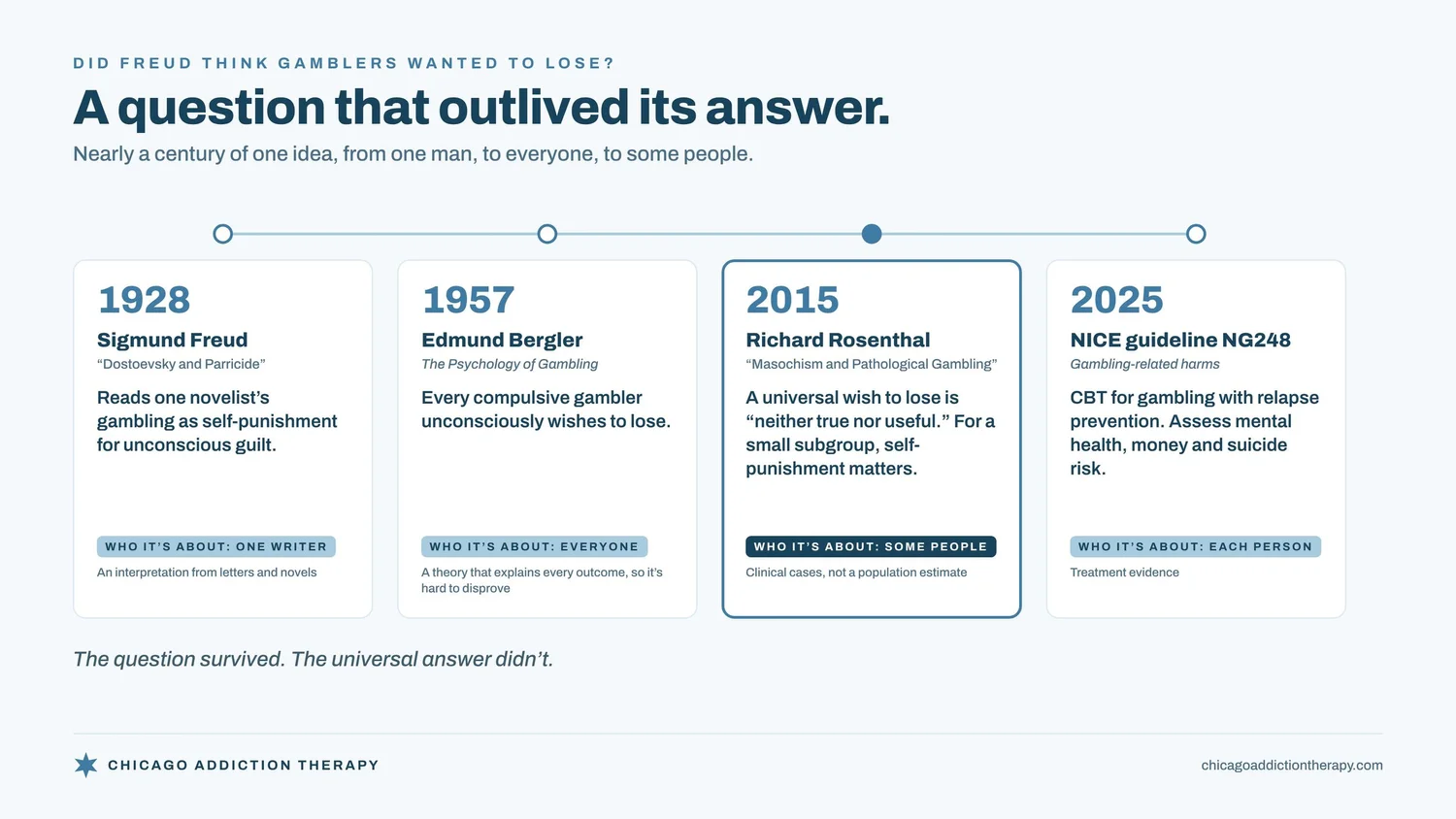
Freud made the argument in his 1928 essay “Dostoevsky and Parricide.” The novelist Fyodor Dostoevsky had struggled with roulette, debt and repeated promises to stop. Freud read those episodes through his theories of unconscious guilt, the relationship with the father and the need for punishment. In his account, a ruinous night at the tables offered temporary relief from guilt: after the losses came remorse, contrition and a chance to begin again. He pointed to a detail from the memoir of Dostoevsky’s wife, Anna: his writing seemed to go best after they had lost everything. Once the guilt had been paid off in losses, Freud suggested, the inhibition on his work eased. [1]
It’s worth being precise about what Freud was doing. He was interpreting a dead writer from letters, biography and novels. He was not assessing a patient, and he was not testing a theory of gambling on a group of gamblers. His reading of Dostoevsky rests on assumptions about childhood conflict and unconscious wishes that can’t simply be taken as established fact.
Still, Freud noticed something a purely financial explanation can miss. If getting money were the only goal, why would anyone keep betting after recovering what they needed? Why would relief turn so quickly into another risk? The contradiction is real, even if Freud’s explanation is not the only one, or the strongest. Dostoevsky’s own letters point to a simpler one: why a win can make gambling harder to stop.
When a Theory Tries to Explain Everyone
The psychoanalyst Edmund Bergler went further. In The Psychology of Gambling (1957), he argued that compulsive gamblers are driven by an unconscious wish to lose. Winning, in his view, was part of a larger drama involving fantasies of special power, rebellion against limits set by parents and authority, and an eventual need to be punished. [2]
The theory has obvious narrative appeal. It seems to explain why a gambler turns a lucky streak into a disaster, why promises get broken, and why the cycle so often ends in shame. The trouble is that a theory that can explain every outcome (wins, losses, confidence, remorse) is very hard to disprove. And it was never tested the way treatments are tested today. A 1999 review of the field by the National Research Council found no controlled studies of psychoanalytic treatment for gambling at all. [5]
It also risks a troubling reversal of responsibility. When someone is devastated by debt, it is a serious error to assume they secretly wanted the consequences. Gambling products are built around uncertain rewards, rapid repetition and easy access. Financial pressure, conditioning, alcohol and other substances, emotional distress and distorted beliefs about odds can all keep a person gambling. None of them requires a hidden wish for defeat.
A person may keep playing after a win because the win makes them feel confident. They may keep playing after a loss because they are desperate to repair it, which is the pattern of chasing losses. They may gamble late at night because it briefly interrupts anxiety, low mood or loneliness. Those are different pathways, and treatment gets less useful when we force them into one explanation.
The Correction Came From Inside Psychoanalysis
In 2015, the psychiatrist Richard Rosenthal, a longtime gambling clinician and researcher, revisited the question in a paper titled “Masochism and Pathological Gambling.” He called the idea that all pathological gamblers have an unconscious wish to lose “neither true nor useful.” But he also argued that clinicians had been wrong to drop the question entirely. In his experience, there is a small but clinically significant subgroup for whom self-punishing dynamics really do matter: people for whom losing can feel more comfortable than winning, or who sabotage their own chances of success. [3]
His distinction is worth keeping. A pattern of seeking out loss or humiliation may be psychologically meaningful for some people. That does not make it a universal feature of gambling disorder. Rosenthal built his argument from clinical vignettes and a detailed treatment account. It is not a population estimate, and it doesn’t prove that an unconscious motive caused anyone’s gambling.
For a clinician, the practical value is not sorting someone into a “type” after hearing a few details. It’s resisting two equally unhelpful assumptions: that every gambling loss is secretly desired, and that the emotional meaning of repeated losses never matters.
The Question Beneath the Question
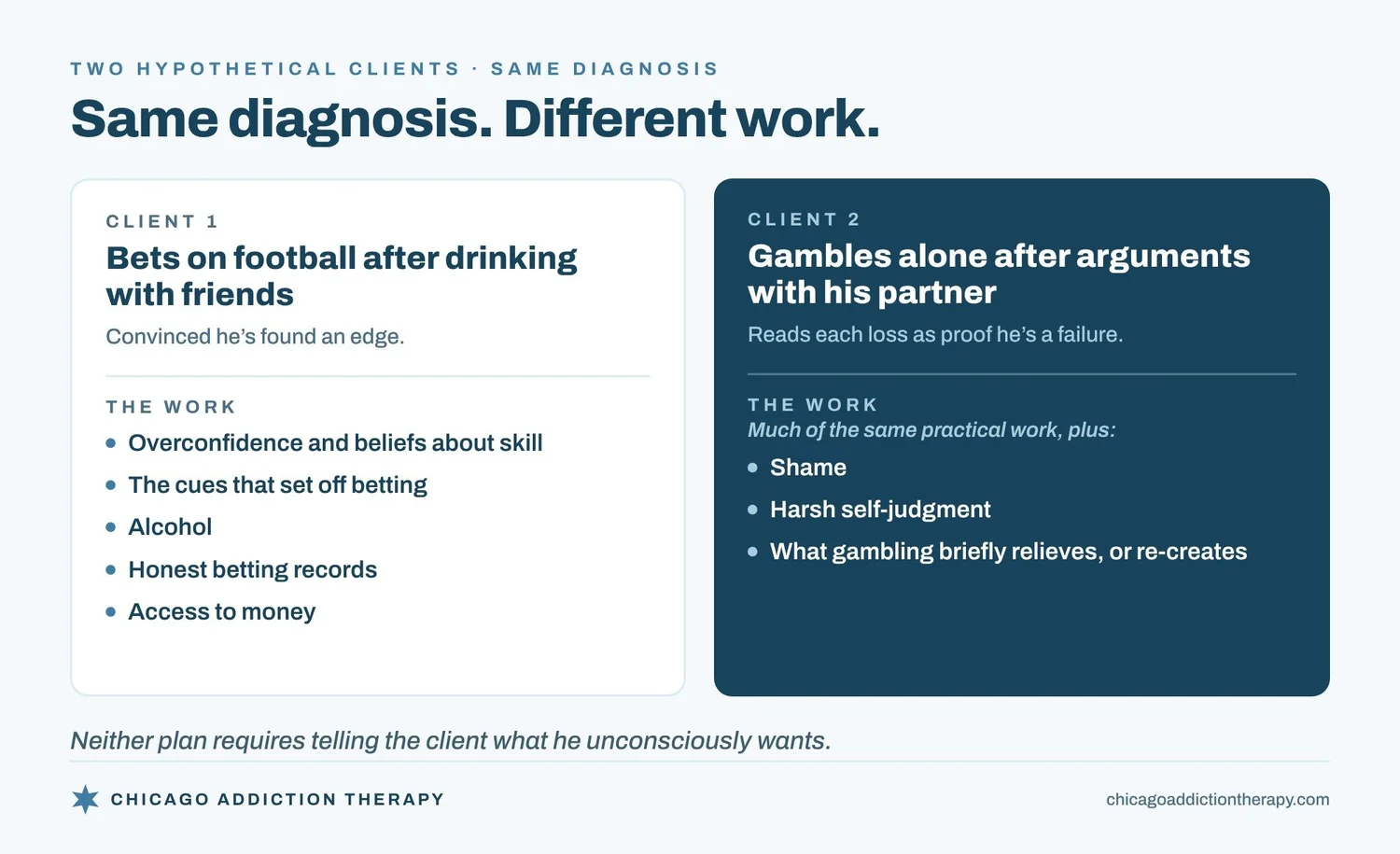
Consider two hypothetical clients. One bets on football after drinking with friends and becomes convinced he has found an edge. The other gambles alone after arguments with his partner, then describes the losses as proof that he’s a failure. Both may meet the criteria for gambling disorder, but the treatment plan shouldn’t look the same.
With the first, a therapist might focus on overconfidence, the cues that set off betting, alcohol, honest betting records and access to money. With the second, the work might also involve shame, harsh self-judgment, and the way gambling briefly relieves, or re-creates, a familiar feeling. Neither plan requires telling the client what he unconsciously wants.
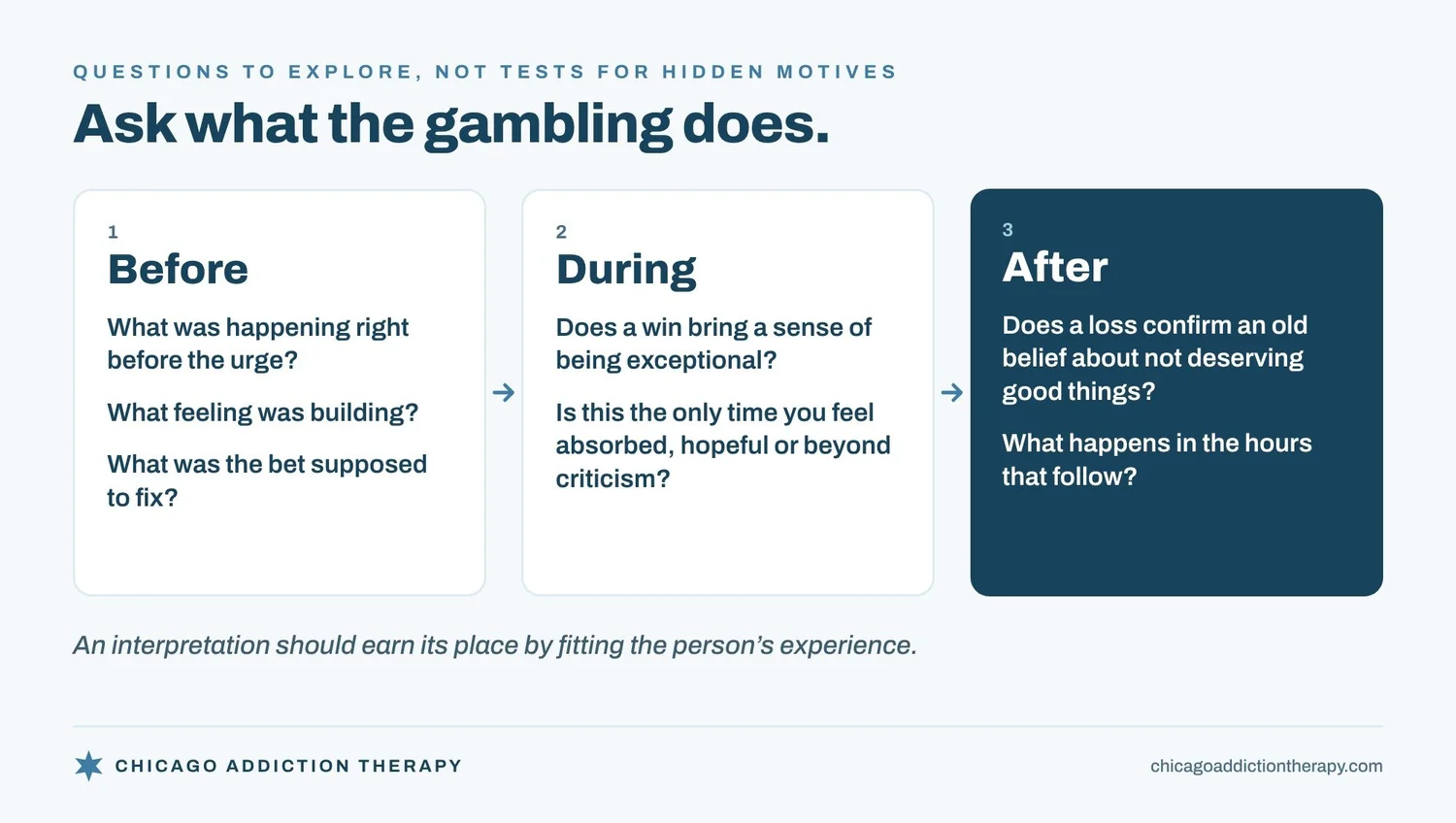
A more useful question is: what happens emotionally before, during and after gambling? Does a win bring a brief sense of being exceptional? Does a loss confirm an old belief about not deserving good things? Is gambling the only time the person feels absorbed, hopeful or beyond criticism? And what happens in the hours after?
These questions are for exploring, not tests for hidden motives. An interpretation should earn its place by fitting the client’s own experience, and when it doesn’t fit, it should be dropped. A therapist’s elegant explanation isn’t necessarily the client’s truth.
What Modern Treatment Adds
Today’s gambling treatment has something Freud and Bergler didn’t: evidence about learning, reinforcement, thinking errors, and interventions that actually reduce gambling harm. The UK’s 2025 NICE guideline on gambling-related harms recommends cognitive behavioral therapy (CBT) delivered by practitioners with gambling-specific training, with a relapse-prevention component built in. It also calls for assessing mental health, alcohol and drug use, the financial damage and the risk of suicide, not just the gambling itself. [4]
In practice, that looks like several kinds of work happening together. CBT can test the prediction that the next bet will solve an unbearable problem. Behavioral steps can cut off access to betting accounts and money when judgment is weakest. Acceptance-based work can help a person sit with regret without acting on the urge to erase it. And a psychodynamic conversation, when it fits, can add curiosity about what winning, losing, secrecy and shame mean for this particular person. (For more on how those layers fit together, see can therapy help gambling addiction?)
These approaches don’t have to compete. Understanding what gambling does for someone emotionally can deepen a treatment plan. It should never be used to delay urgent safety steps, skip financial protection, or imply that a person is to blame for developing a disorder. And an interpretation about unconscious punishment should be held far more loosely than an observable pattern, like gambling after every argument or raising the stakes after every win.
That’s a good test for any treatment theory: does it help the person see their pattern more accurately, make safer decisions and build a life less organized around gambling? If it only sounds profound, it isn’t enough.
The Answer Freud Couldn’t Give
Freud saw a paradox and told a powerful story to explain it. Bergler turned that story into a theory about everyone. Rosenthal restored the qualification it needed: a self-punishing pattern may matter for some people, but not for everyone who gambles compulsively.
So, did Freud think gamblers wanted to lose? He read Dostoevsky’s gambling partly that way, and the idea shaped decades of psychoanalytic writing. Was he right? Not as a general explanation of gambling disorder. The evidence doesn’t support telling people that their suffering is what they really wanted.
But the question underneath his theory is still useful. A person can sincerely want to stop gambling while also depending on it for hope, relief, excitement or a familiar sense of who they are. Those competing pulls deserve careful attention, alongside treatment that addresses the behavior directly.
The goal isn’t to uncover a secret desire for ruin. It’s to understand why gambling keeps making sense in the moment, and to help the person find another way to live when it no longer does.
If This Sounds Familiar
If you keep gambling after you’ve told yourself you’re done, or a win somehow never feels like a reason to stop, you don’t need a theory about your unconscious to take it seriously. The gambling addiction test is a private place to start, and gambling addiction therapy is available in person in Logan Square or online anywhere in Illinois and Minnesota. You can also reach out to schedule a free 15-minute consultation.
Help is available now. In Illinois, call 1-800-GAMBLER or text GAMB to 833234. Nationally, call or text 1-800-MY-RESET (1-800-697-3738). If you are thinking about suicide or are in crisis, call or text 988.
Sources
- Sigmund Freud, “Dostoevsky and Parricide” (1928), in The Standard Edition of the Complete Psychological Works of Sigmund Freud, vol. 21. Bibliographic record: https://www.benjamins.com/catalog/llsee.31.04fre
- Edmund Bergler, The Psychology of Gambling (Hill and Wang, 1957). https://openlibrary.org/books/OL18955696M/The_psychology_of_gambling
- Richard J. Rosenthal, “Masochism and Pathological Gambling,” Psychodynamic Psychiatry 43, no. 1 (2015): 1–25. https://doi.org/10.1521/pdps.2015.43.1.1; abstract: https://pubmed.ncbi.nlm.nih.gov/25734872/
- National Institute for Health and Care Excellence (NICE), Gambling-related harms: identification, assessment and management, NG248 (January 2025), recommendations 1.1.13, 1.1.21 and 1.5.13–1.5.15. https://www.nice.org.uk/guidance/ng248/chapter/recommendations
- National Research Council, Pathological Gambling: A Critical Review (National Academies Press, 1999), chapter 6, “Treatment of Pathological Gamblers.” https://www.ncbi.nlm.nih.gov/books/NBK230629/
This article is for general information and is not a substitute for individual assessment or treatment. The clients described are hypothetical composites, not real people.