
Written by Chris Beerman, MSW, LCSW, CADC · Published October 2026
You wake up and check the news. A new poll came out overnight.
So you check the prediction market. The price moved three points.
You read the poll’s methodology. Then you check another poll. Someone on X thinks the first poll is wrong. You open the market again.
Now you buy another 200 contracts.
At lunch there’s another headline. You check again.
By 4 p.m., you’ve read more political news than you normally would in an entire week.
But you’re not really following politics anymore. You’re monitoring a position.
That distinction matters more as the November 3, 2026 midterm elections approach. Prediction markets now let people put money on control of Congress, individual House and Senate races, governor’s races, ballot measures and political events that once were simply things people argued about, read about or watched on television.
Kalshi launched a dedicated Midterms Hub in July that puts live market odds side by side with polling averages, fundraising data and campaign news — and says roughly three out of four visitors come to check the odds. In other words, the news and the market now sit on the same screen.
You don’t need to walk into a casino — or think of yourself as a gambler — to get caught in that. You may think of yourself as someone who understands politics. And that can be exactly what makes political betting hard to recognize as a problem.
Four questions before you read further
Would I follow this much political news if I had no money on it?
Am I checking markets during work, meals or conversations?
Have I increased a position after a loss to get back to even?
Have I tried to stop trading political markets and gone back?
If you answered yes to two or more, the rest of this article is written for you.
“I’m Not Gambling. I Know Politics.”
This is one of the more interesting things about prediction markets. The person trading political contracts may look nothing like the stereotype of a gambler he carries in his head.
Maybe you’ve never played blackjack. You don’t care about the NFL spread. You’ve never downloaded a sportsbook app.
But you’ve followed elections for 15 years. You know which counties matter. You read polling cross-tabs. You understand turnout. You listen to political podcasts while you drive and watch election returns until 2 a.m.
Then a prediction market asks a very appealing question: If you know so much, why not make money from it?
That’s a powerful psychological shift. Your knowledge no longer just helps you understand what’s happening. Now it feels monetizable. And once money gets attached to your opinion, following politics can start behaving very differently.
The platforms lean into this. Researchers writing in Science this spring argued that the scientific framing of prediction markets — the language of forecasting and probability — combined with gambling-like design and regulatory gaps creates the risk of a new behavioral addiction. That was an analysis piece, not a study with new data. But the framing point rings true clinically: “I’m forecasting” is a much easier story to tell yourself than “I’m betting.”
Prediction Markets Have Changed What Political Betting Looks Like
Betting on elections isn’t new. What’s new is how easily, how often and how visibly someone can now trade political outcomes.
The scale has grown fast. Pew Research Center’s analysis of data from The Block found that combined trading volume on Kalshi and Polymarket reached about $53 billion in July 2026 — roughly double May’s level. That figure counts every contract at its $1 face value, so it isn’t money lost, and about $42 billion of it was sports. Politics was a small slice this summer. But during the 2024 presidential election, politics was the dominant category on both platforms — and a general election is exactly when that pattern tends to return.
Prediction markets offer contracts whose prices move as traders react to polls, news, speeches, economic reports and everything else. Political contracts can be bought and sold at any point before the election is decided.
That means you aren’t making one prediction in October and waiting until Election Day. You can keep interacting with the position.
The poll changes. The price moves. You buy more.
A candidate has a bad interview. You sell.
A new poll comes out. You buy back.
A rumor hits social media. You check the market again.
The election happens once. The opportunity to react to it can happen hundreds of times.
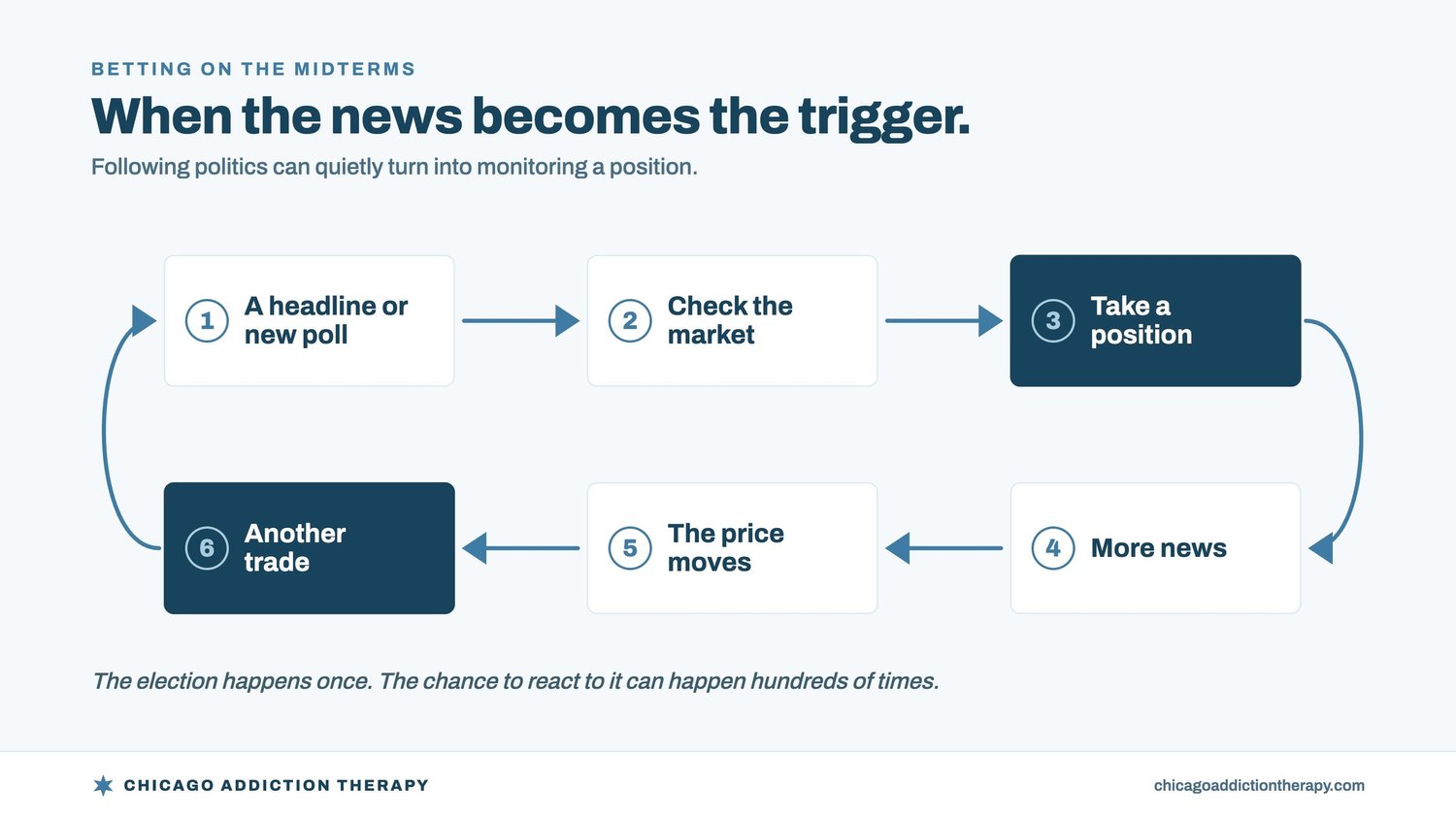
The News Can Become the Slot Machine Lever
Political prediction markets have an unusual characteristic: the trigger is information.
With sports betting, the trigger may be Sunday football. With casino gambling, it might be driving past the casino. With political markets, almost anything can become a trigger:
a breaking-news alert
a new poll
a debate
a candidate interview
a court decision
an endorsement
an economic report
a viral post
a podcast
an election forecast
a push notification telling you the market moved
Suddenly the news isn’t just news. It’s a possible trading signal.
That’s when I would start paying attention to what the behavior is doing to you. Someone can tell himself, “I need to stay informed because I have money on this.” But that logic can easily run in the opposite direction: having money on it is what’s creating the need to stay informed constantly.
Seven Signs Election Betting Is Becoming a Problem
You don’t need to identify as a “gambling addict” before taking a behavior seriously. I would be concerned if you notice several of these patterns.
1. You’re checking political markets more than you’re checking the actual news
You read a headline and immediately want to know: what did the market do? The market becomes the second screen behind every political event.
2. You’re following politics because you have money riding on it
Ask yourself: If I had no money in these markets, would I still be consuming this much political information? If the answer is no, the trading may be driving the information consumption rather than the other way around.
3. Every new piece of information feels like an opportunity to trade
A poll comes out — you need a position. A debate ends — you need a position. A new market opens — you need a position.
This is worth noticing even if the dollar amounts still seem manageable. Gambling problems aren’t defined only by catastrophic losses. Preoccupation matters too.
4. You’re increasing your position because you’re convinced the market is wrong
Political knowledge can create a particularly convincing justification for chasing:
“These people don’t understand the electorate.”
“The market is overreacting.”
“I’ve followed this race for six months. I know what’s happening.”
Maybe your analysis is good. That still doesn’t tell you whether increasing your financial exposure is healthy. Knowing a lot about the subject of a wager doesn’t make anyone immune to gambling problems.
5. Losing feels like being wrong twice
Political betting can combine two emotionally charged experiences: you lose money, and your read on the world was wrong.
That combination can make the urge to correct the mistake particularly strong. Instead of accepting the loss, you look for the next market where you can prove your analysis was right. That’s chasing losses, even if you’re doing it with charts and polling models instead of a roulette table.
6. You’re hiding how much you’re trading
Maybe your spouse knows you “mess around on Kalshi.” They don’t know you’ve deposited another $2,000. Or that you check it throughout the workday. Or how much you have exposed across several races.
Secrecy is one of the behaviors I take seriously regardless of what the platform calls the transaction.
7. Politics has become less interesting without money attached
This one can sneak up on people. You used to enjoy reading about politics. Now an election you can’t trade feels boring. You used to watch election night because you cared what happened. Now you’re mostly watching your positions.
That’s worth examining. If several of these sound familiar, the free, anonymous gambling self-assessment takes about three minutes. It asks about gambling generally, not prediction markets specifically — but the questions about chasing, borrowing and guilt apply either way.
Try This Test: Follow Politics for 48 Hours Without Trading It
If you’re wondering whether prediction markets are changing your relationship with politics, run a simple experiment.
For 48 hours, follow whatever political news you normally follow. Read the paper. Listen to the podcast. Watch the interview. Look at the polls.
But don’t open a prediction-market app or website. Don’t check the price. Don’t look at your P&L. Don’t look at what the market “thinks.” Just take in the information.
Then notice what happens:
Are you relaxed — or thinking constantly, I wonder what that did to the market?
Do you reach for the app automatically?
Does reading a poll create an urge to place a trade?
Are you less interested in the news when you can’t bet on it?
That experiment can tell you quite a bit. And if you can’t make it 48 hours, that tells you something too.
If You Want to Stop Betting on Politics, Separate the News From the Money
One of the first changes I would make is deliberately breaking the connection between political information and the trading platform — removing as many bridges between the two as possible.
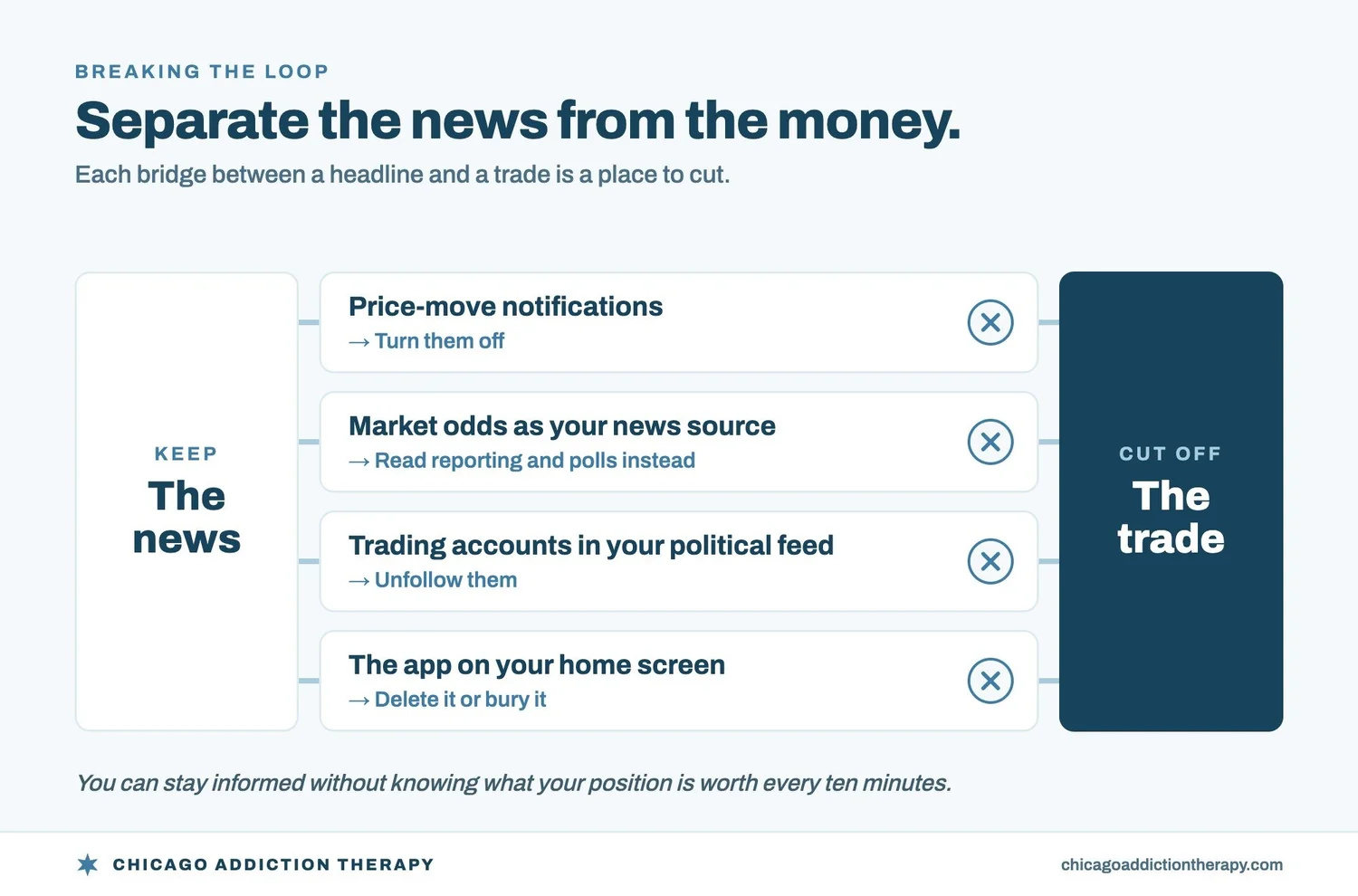
Turn off prediction-market notifications
A price alert isn’t neutral if it keeps pulling you back into trading. If you’re trying to stop, you don’t need to know that a contract moved six cents while you’re at dinner.
Robinhood, for example, lets you turn off event-contract push notifications under Account → Notifications → Event contracts. That won’t stop you from trading, but it removes one of the pulls.
Stop using market prices as your political news source
You don’t need the current contract price to follow an election. Read reporting. Read polling. Watch the debate. If your goal is to stay informed, you can do that without knowing what your position is worth every ten minutes.
Take the market out of your political feed
If the same feed contains breaking news → political commentary → prediction-market odds → a trade link, you’ve built a very efficient behavioral loop. Make it less efficient. Unfollow the trading accounts. Remove the market bookmarks. Take the app off your home screen — or delete it.
Add friction.
Put Politics Back Into a Time Window
Another useful experiment is putting limits around news consumption itself. Not because following politics is inherently unhealthy, but because around-the-clock political information can become the fuel for around-the-clock trading.
Instead of checking constantly, try something like:
Morning: 20 minutes.
After work: 20 minutes.
Then stop. No checking election markets in bed. No refreshing polling feeds at midnight. No waking up and immediately looking at positions.
You’re trying to make politics something you choose to engage with again, rather than something that demands your attention all day because money is attached to it.
Be Especially Careful With “The Market Is Wrong”
Prediction markets create a seductive story: everyone else is wrong, and I know something they don’t.
Sometimes markets are wrong. That’s obvious — if they were never wrong, nobody would take the other side. The problem isn’t believing you have a better forecast. The problem begins when certainty about your analysis becomes permission to keep increasing your risk.
Consider the difference between:
“I think the market has this wrong.”
and:
“Because I think the market has this wrong, I should put another $5,000 into it.”
The first is an opinion. The second is a financial decision. Keep them separate.
Don’t Chase a Bad Poll
This is election betting’s version of chasing a sports loss.
You own a contract. A poll comes out against your position. The price drops. You immediately feel the urge to buy more because now it’s “cheap.”
Pause. Maybe buying more makes sense according to your analysis. Maybe it doesn’t. But if the emotional experience is I need to get this loss back, you’re no longer updating a forecast. You’re chasing.
The same warning applies if you sell at a loss and immediately start looking for another political market to win the money back.
If Your Goal Is to Stop, Use an Access Barrier
Budget rules can work for people who are comfortably in control of their behavior. They’re much less useful when someone keeps breaking his own rules.
If you’ve told yourself “I’ll only put in $100” and then deposited $500, the next intervention probably shouldn’t be another promise to yourself. Make the behavior harder.
Kalshi offers trading breaks, monthly deposit limits and voluntary self-exclusion. Two cautions from Kalshi’s own help center: you can’t sell open positions during a self-exclusion period, so close anything you don’t want to be stuck holding before you exclude — and self-exclusion does not stop you from reaching Kalshi’s contracts through a brokerage that routes orders to it.
Robinhood lets you self-exclude from event-contract trading by contacting support. You’ll need to close open event-contract positions first, and turning it back on requires contacting support and requesting a review. (Its “hide sports prediction markets” toggle is not a barrier — Robinhood says you can still trade sports contracts regardless of that setting.)
That brokerage gap is why one account-level exclusion is rarely enough. I explain it in more detail in Are Prediction Markets Gambling? If you trade political contracts in more than one place, exclude everywhere you have an account, and pair it with a money barrier. If your goal is to stop, an actual access barrier is usually more useful than repeatedly testing your willpower.
Tell Someone What Is Actually Happening
“I’ve been following the election” sounds very different from “I’ve been trading political markets four hours a day and I’m down $6,000.”
Use the second sentence if it’s the accurate one. Compulsive behaviors grow well in vague language. Be specific with someone you trust:
How much money have you deposited?
How much have you lost?
How often are you checking?
Are you trading during work?
Have you borrowed money?
Have you hidden the losses?
Have you tried to stop and gone back?
The point isn’t confession for its own sake. It’s getting the behavior out of the private system where you can keep redefining it.
Election Night Is a High-Risk Event If You’re Already Struggling
If you’re already having trouble controlling political betting, don’t wait until November 3 to decide what you’re going to do on November 3. Make the plan beforehand.
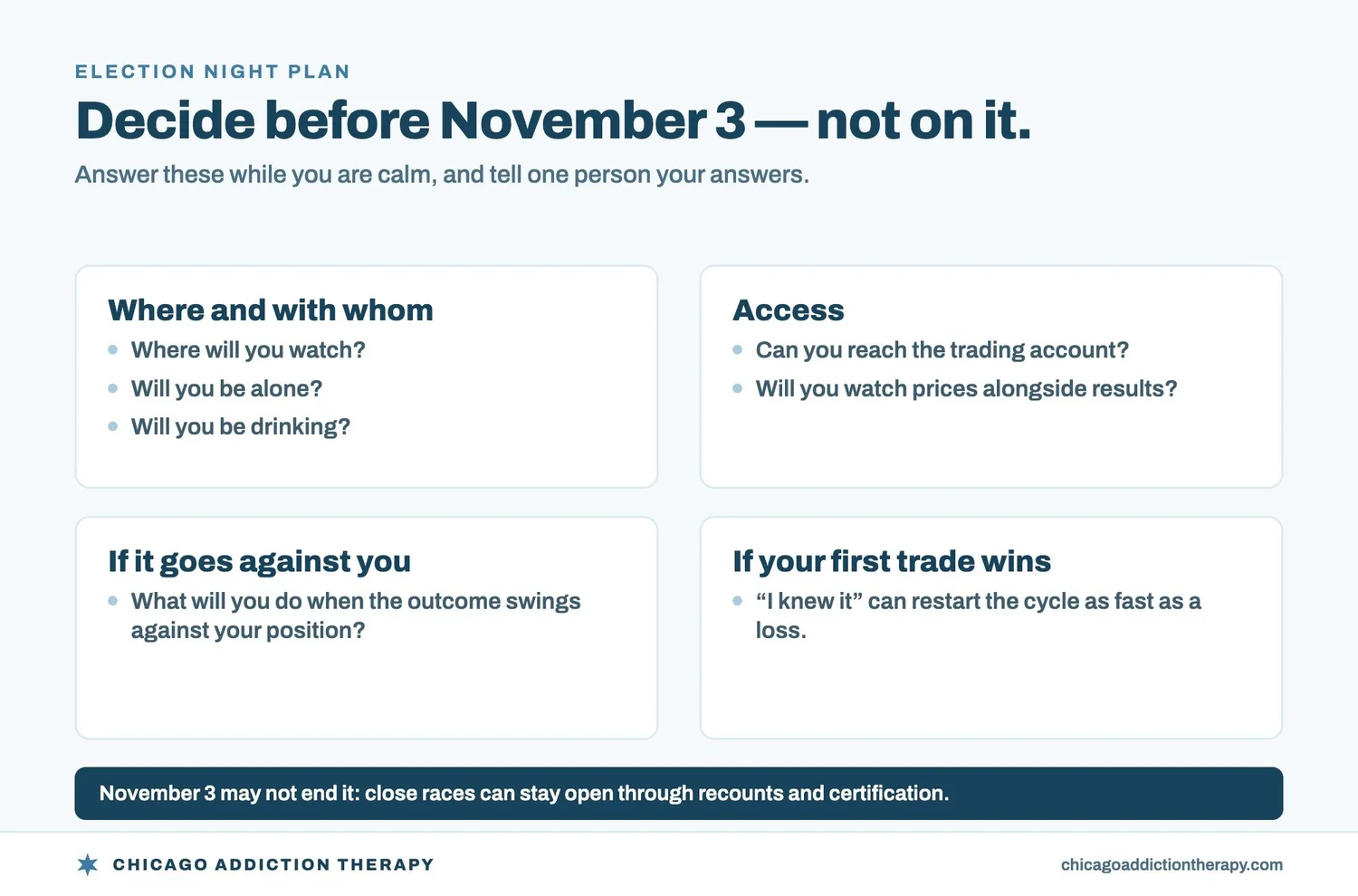
Where will you watch?
Will you have access to the trading account?
Will you be alone?
Will you be drinking?
Will you be following market prices along with the results?
What happens if the outcome moves sharply against your position?
What happens if your first trade wins?
That last question matters too. Winning can restart the cycle just as effectively as losing. You may decide, I knew it — and suddenly the win becomes evidence that you should put considerably more money into the next race.
Election Day May Not End the Betting
November 3 is the scheduled federal general election date. But some political outcomes take longer to resolve because of vote counting, recounts, runoffs, certification or litigation. Kalshi’s own election contract rules give certified results precedence over preliminary ones and allow a contract to stay open for up to a year after the election if the outcome can’t be determined sooner.
So don’t assume I’ll just get through Election Day and then this stops. If you’ve developed a pattern of compulsively trading political events, another event will appear. Then another. Then the presidential cycle begins.
The particular election isn’t the core issue. The relationship with uncertainty, money and repeated trading is.
And if you stop and then find yourself trading again in December, that isn’t proof the effort was pointless. Read what to do after a gambling relapse — the first few hours afterward matter more than most people realize.
You Can Be Interested in Politics Without Having a Position
This may sound obvious. But for someone who has been trading elections every day, it can take some adjustment.
A poll can come out and you can simply read it. You can watch a debate without making money from it. You can have an opinion about who will win. You can be wrong. Nothing has to happen afterward.
That’s one of the things I would want someone struggling with political prediction markets to relearn: not every opinion needs a financial position attached to it. You’re allowed to be curious without betting.
The Most Important Question Isn’t Whether Prediction Markets Are “Really Gambling”
I wrote separately about the legal and financial question of whether Kalshi, Polymarket and Robinhood prediction markets count as gambling. That debate matters. But clinically, there’s a simpler question: what happens to you when you use them?
Are you spending more than you intended?
Checking constantly?
Chasing losses?
Increasing the size of your positions?
Hiding the behavior?
Neglecting work or relationships?
Trying to stop and finding that you can’t?
Those behaviors matter whether the button on your phone says bet, trade, buy or contract. And you don’t need to wait until November 3 — or until you’ve lost an amount of money that feels sufficiently dramatic — to take them seriously.
Frequently Asked Questions
Is betting on elections gambling?
Legally, political event contracts on platforms like Kalshi are regulated as financial derivatives rather than as state-licensed gambling, and that classification is being fought in court. Clinically, the more useful question is what the behavior does to you: if you’re checking constantly, chasing losses, hiding how much you trade or can’t stop, it’s working like gambling regardless of the label.
How do I know if political betting has become a problem?
Watch for preoccupation (following news mainly because you hold positions), trading in reaction to every poll or headline, increasing positions after losses, secrecy about deposits or losses, and losing interest in politics you can’t bet on. Try following the news for 48 hours without opening a market — the urges you notice are the answer.
How do I stop betting on prediction markets?
Break the link between news and trading first: turn off market notifications, stop using prices as your news source, and remove trading accounts and apps from your feed and home screen. Then add a real access barrier — self-exclusion on every platform you use plus a money barrier — and tell one person the specific numbers.
Can I self-exclude from Kalshi or Robinhood?
Yes. Kalshi offers voluntary self-exclusion, trading breaks and monthly deposit limits; Robinhood lets you self-exclude from event contracts by contacting support. Close open positions first, and know that Kalshi’s exclusion does not block access to its contracts through a brokerage — so exclude everywhere you have an account.
Will the urge stop after Election Day?
Not necessarily. Close races can stay unresolved through recounts, certification or litigation, and there’s always another market — the next special election, the next primary, the next presidential cycle. The pattern of trading on uncertainty is the thing to address, not the date on the calendar.
Help for Prediction-Market or Election Betting Problems
If prediction markets have become difficult to control, start with my guide Are Prediction Markets Gambling? Kalshi, Polymarket, Robinhood & the Risk of Addiction, which covers the broader behavioral and financial issues. If you need to stop today, the 24-Hour Betting Shutdown Plan was written for sports betting, but the access-and-money steps apply to event contracts too.
I work with people struggling with gambling, sports betting, prediction markets, high-risk trading and other gambling-like financial behaviors, in person in Logan Square, Chicago, and online throughout Illinois and Minnesota. Learn more about gambling addiction therapy, or email me to set up a consult.
Illinois Gambling Helpline: call 1-800-GAMBLER or text GAMB to 833234. National Problem Gambling Helpline: call or text 1-800-MY-RESET, 24/7. If you’re in a mental health crisis or thinking about suicide, call or text 988. If you’re in immediate danger, call 911.
This article is general information, not legal, financial or investment advice.
Sources
Pew Research Center. (2026, September 23). Prediction markets’ trading volume doubled between May and July, largely driven by sports. www.pewresearch.org/short-reads/2026/09/23/prediction-markets-trading-volume-doubled-between-may-and-july-largely-driven-by-sports/
Packin, N. G., & Rabinovitz, S. (2026). Prediction markets as a public health threat. Science, 392(6795), 257–260. doi.org/10.1126/science.aee3932
Kalshi. (2026, July 22). Kalshi launches Midterms Hub for live election odds. news.kalshi.com/p/kalshi-midterms-hub-launch-2026
Kalshi Help Center. Voluntary Self-Exclusion. help.kalshi.com/en/articles/13823789-voluntary-self-exclusion
Kalshi. USELECTION contract rules. kalshi-public-docs.s3.amazonaws.com/contract_terms/USELECTION.pdf
Robinhood. Opting out of event contracts. robinhood.com/us/en/support/articles/opting-out-of-event-contracts/