
What Your Sportsbook Promo Is Really Saying
Written by Chris Beerman, MSW, LCSW, CADC · Published October 2026
Profit boosts, bet insurance, VIP offers — and what the sportsbook may already know about how you bet.
Your phone buzzes at 6:43 p.m.
25% PROFIT BOOST — TONIGHT ONLY
You hadn’t been thinking about betting. Now you’re checking the games. A few minutes later, you’ve found something you like.
Maybe the boost really does improve the payout. Maybe the terms are reasonable. Maybe you’re getting objectively better odds than you would have gotten without it.
As a gambling therapist, that isn’t the first thing I’m interested in. I’m interested in a simpler question:
Were you going to bet before the promotion arrived?
A sportsbook promotion looks like an offer. Clinically, I’m more interested in what it asks you to do: open the app, look at the games, find a bet, put money at risk — or come back when you weren’t planning to gamble at all.
And unlike the sportsbook commercial during an NFL game, the sportsbook inside your phone isn’t talking to an anonymous audience. It has an account history. It can see how you’ve been betting. At least one major operator publicly describes monitoring that behavior for signs of risk.
That’s where sportsbook promotions get much more interesting.
The short version
A promotion can be a good deal and still make you gamble more. The research shows inducements change whether people bet, how much and what kind of bet.
Unlike a billboard, your sportsbook account can see your deposits, wagers and patterns.
The most useful question isn’t “Is this a good offer?” It’s “Was I going to bet before my phone told me to?”
In a 2026 randomized trial, bettors who opted out of operator marketing bet less, spent less and reported fewer harms within two weeks.
A Sportsbook Promotion Can Be a Good Deal and Still Make You Gamble More
Let’s get one thing out of the way first: not every sportsbook promotion is a scam.
A legitimate profit boost can improve the price you’re getting on a wager. A bonus bet can have real financial value. A money-back offer can reduce the downside of a particular bet. If we pretend otherwise, we’re not having an honest conversation about why these offers work. They’re attractive partly because some of them actually give the bettor something of value.
The more important question is what happens to your behavior because the offer exists.
Researchers at Ireland’s Economic and Social Research Institute tested this directly. In a randomized experiment with 622 men under 40 betting on Euro 2024 soccer matches, inducements increased the amount spent on bets by more than 10% and nearly halved the share of participants who chose not to bet at all. Participants were also about three times more likely to choose an objectively worse bet when a promotion was attached to it — and those showing signs of problem gambling were disproportionately affected.
That’s an important distinction. The promotion doesn’t need to trick you about its value. It can change the first decision — do I gamble at all? Then the second — how much? And sometimes the third — what kind of bet do I make?
So Let’s Translate a Few Sportsbook Promotions
The exact wording changes constantly, but the basic categories are familiar if you’ve spent much time on a sportsbook. Here’s how I read them clinically.
“25% Profit Boost”
What you’re meant to hear: If you win, we’ll give you more.
Mathematically, that may be true. If you were already planning to place the exact same wager, a boost may improve its expected value. But that isn’t the only effect of the offer.
What I want you to ask: Was I already planning to make this bet?
If the answer is no, the comparison isn’t regular odds versus boosted odds. It’s no bet versus a bet. That distinction gets lost surprisingly easily. You’ve saved nothing by getting better odds on $100 you weren’t going to wager in the first place.
And if the boost nudges you from a straightforward wager into a longer-odds bet or a parlay, the promotion may be changing the risk you’re willing to take. An earlier Australian experiment with 299 sports bettors found that wagering incentives led people to choose longer-odds, riskier bets — even though the incentive gave them no financial reason to.
So before calculating the value of a profit boost, ask the more basic question: did this promotion create the bet?
“No Sweat Bet” or “Bet Insurance”
What you’re meant to hear: This one is safer.
That’s why the language works. Insurance. Protection. Second chance. Money back. These words soften what is otherwise a plain transaction: you are putting money on an uncertain outcome.
In a qualitative study of young Australian men who bet on sports, participants described cash-back offers and bonus bets as “safety nets” that softened how risky gambling felt. One called a refund offer “an insurance type of bet.”
That feeling matters. Once a bet feels protected, you may make a bet you otherwise wouldn’t — or risk more than you otherwise would.
What I want you to ask: Would I risk this much if there were no insurance attached to it?
Also read what actually happens if you lose. “Money back” often doesn’t mean cash back in your bank account. It may mean site credit or a bonus bet that has to be wagered again before it produces withdrawable money. That isn’t necessarily deceptive if the terms explain it. But psychologically, there’s a large difference between hearing “Get $50 back” and understanding “If this loses, I’ll receive another opportunity to gamble.”
“Bet $5, Get $50 in Bonus Bets”
What you’re meant to hear: You’re getting $50.
But a bonus bet isn’t the same thing as someone handing you $50. Its purpose is to be wagered. The promotion isn’t only an incentive to place the first bet; it’s a reason to come back and place several more.
That matters most early in someone’s gambling history. The first objective isn’t to get you to bet $1,000. It’s to turn “I don’t really bet” into “I have a sportsbook account,” then “I have bonus bets I should use,” then “there’s a game tonight.” That’s how betting becomes part of watching sports.
What I want you to ask: If these bonus bets disappeared tonight, would I put my own money into the account tomorrow?
If the answer is no, pay attention to that. The promotion may be building a gambling routine that wasn’t there before.
“Expires Tonight”
What you’re meant to hear: You have an opportunity right now.
What the deadline actually changes: your ability to wait.
If the same boost were available for the next six months, there would be little reason to open the app tonight. An expiration date makes not gambling feel a little like losing something. That’s especially important when someone is trying to take a night off. You weren’t going to bet. Then the notification comes in, the offer disappears at midnight, and abstaining starts to feel like wasting value.
What I want you to ask: If this offer were still available next month, would I feel any urgency to use it tonight? If not, the deadline is doing some of the work.
“We’ve Got an Exclusive Offer for You”
Now we get to the part that separates an app notification from a billboard.
A billboard doesn’t know you. Your sportsbook account does.
What Your Sportsbook Can See
Depending on the operator, an account holds a detailed record: deposits, withdrawals, wagers, wins, losses, time on the platform and changes in betting behavior over time.
We know at least some operators analyze those patterns because they say so. In an August 2026 letter to members of Congress, FanDuel said its responsible-gaming team monitors customers’ deposit and withdrawal history, increases in wager size, cancelled withdrawals and statements customers make in the app’s chat, and that when it identifies risk it reaches out with actions ranging from education to a mandatory limit, temporary suspension or permanent exclusion.
FanDuel’s Real-Time Check-In tool, launched in 2025, goes further: it uses a customer’s deposit history and machine learning to predict what that person would normally deposit, then alerts them when a deposit looks out of line with their usual pattern.
FanDuel also told The New York Times this September that it uses machine learning and other technology to look for signs of harmful play, and the Times reported that FanDuel and Fanatics have signed up for third-party risk-scoring tools.
Think about what that means. The same digital environment that could let you see your own behavior clearly also lets the operator see patterns in it. That’s why I sometimes tell clients:
Your sportsbook may notice that your betting has changed before you’ve decided to call it a problem.
That doesn’t mean an algorithm has diagnosed you with gambling disorder. It hasn’t. And it doesn’t mean every promotion you receive was individually generated because of your losses — that would be an overstatement, and I don’t know how any particular offer was chosen.
But it does mean we should stop thinking about sportsbook marketing as a generic coupon dropped into millions of identical mailboxes. Digital gambling produces behavioral data. A lot of it. And that data can be pointed in two directions.
The Same Data Can Protect You — or Decide Who Gets the Offers
In September 2026, The New York Times published an investigation into how DraftKings uses that data. Based on internal documents and interviews with more than 40 former employees, the Times reported that in 2023 DraftKings built a machine learning model that scored customers on how much they were likely to lose for each promotion they received — drawing on things like how often they played, their daily account balances and how much they typically lost relative to what they bet — and that the model was used to steer free bets and bonuses. Six former employees who worked on promotional targeting told the Times they regretted it. One analyst who tested the model described the uncomfortable logic plainly: by strict financial reasoning, “the best investment would be a problem gambler.”
The Times also reported that DraftKings sidelined internal efforts to build a model that would have given customers gambling-risk scores, and that its responsible-gaming chief said the company decided such prediction tools weren’t evidence-based. DraftKings instead relies on more than two dozen behavioral triggers, such as large deposits in a short period or a spike in time spent gambling.
DraftKings rejects the characterization. It told the Times its promotions go to customers who show sustained, engaged use of the platform, not to customers based on their losses; that it does not send promotions to bettors who have been flagged or who have excluded themselves; and, in a later statement, that it does not use A.I. to target anyone based on losses or market to customers based on indicators of potential problem gambling. Days after the story, the Massachusetts Gaming Commission said it would look into how DraftKings and the other licensed operators in the state use A.I. That inquiry had just begun as this was written, and no regulator has made findings.
One detail from the Times story stays with me as a clinician. A man who had just started therapy for his gambling said his inbox began to feel like a relapse risk: he received 40 promotions from DraftKings in the first two weeks of December 2024, and bet again on Christmas Day before putting himself on self-exclusion lists.
You don’t have to settle the dispute between DraftKings and its former employees to take the clinical point. The same account data that can identify someone at risk can also be used to decide who receives which offers. Which way it points is a business decision you can’t see from your side of the app.
And the messages themselves appear to matter. A 2025 Australian study followed 814 people who bet at least every two weeks, surveying them seven times over two weeks. Each additional direct message from a wagering operator — email, text or app notification — was associated with more bets, more spending and more short-term betting harm. The operator messages were particularly potent for higher-risk bettors.
Then There Are VIP Programs
For a smaller group of bettors, the relationship with the sportsbook becomes more personal.
High-volume customers may be assigned a VIP host or account manager. Depending on the operator, VIP treatment can include one-on-one contact, individualized offers, promotional credits, gifts, event tickets, trips and hospitality.
The industry’s position is that these are customer-service and loyalty programs like any other. FanDuel told Congress that its VIP account managers are salaried and that their pay isn’t tied to how much their customers wager or whether they win, that they receive additional responsible-gaming training, and that they discuss spending tools, limits, timeouts and self-exclusion with customers.
VIP programs have also drawn serious scrutiny. In April 2025, The Washington Post reported on VIP bettors who said sportsbooks kept them playing regardless of what it was costing them, as lawsuits accusing VIP programs of enabling addiction were piling up. Sportsbooks told the paper their hosts are trained to identify signs of addiction and that their apps let customers limit spending or exclude themselves.
The issue returned in 2026 through a lawsuit filed in March by a bettor named Terry Thompson, who alleges he lost more than $1.5 million and that FanDuel, his VIP host and other defendants encouraged excessive betting with perks such as event tickets and travel. Part of the story involved a personalized video from Phillies star Bryce Harper, recorded through Cameo, that his host allegedly sent him. In July 2026, Harper said he had thought he was recording a personal holiday greeting and did not consent to FanDuel using it. FanDuel has said its employees are trained to recognize and flag signs of problem gambling. The allegations in Thompson’s lawsuit are allegations, not findings.
After the Harper story, three members of Congress asked FanDuel, among other things, whether it targets VIP promotions at bettors on losing streaks or bettors who are cutting back. As reported, the company’s reply didn’t answer that question directly.
I’m less interested in deciding the lawsuit than in what the VIP model tells us. At a certain level of gambling, the marketing can stop feeling like marketing. It starts to feel like a relationship. Someone knows your name. Someone texts you, asks how you’re doing, gets you tickets. Someone sends you an offer after a rough weekend.
That’s where one question becomes useful.
Ask Yourself: What Made Me Valuable to the Sportsbook?
This isn’t an accusation. It’s a financial question.
Sportsbooks are businesses. Promotions cost money. Bonus bets cost money. VIP programs and personal account managers cost money. Companies don’t spend those resources at random. So if you’re receiving a significant amount of sportsbook attention, ask:
How much am I wagering, and how much am I depositing?
How often am I betting, and how much have I lost?
Has my betting increased? Have I started playing more parlays?
Am I betting on sports I never used to follow, or throughout the day?
Do I come back quickly after large losses?
None of those questions proves that a sportsbook is deliberately targeting a gambling problem. They’re questions about your own behavior — and that’s the part you can actually control.
The Most Important Promotion May Be the One That Brings You Back
Suppose you haven’t bet for five days. You weren’t consciously quitting; you just hadn’t gambled.
Then Sunday morning: NFL PROFIT BOOST.
You open the app and make one bet. While you’re there, you see another. Then a live bet. Then the Sunday night game. Then Monday Night Football. By Tuesday, you’ve wagered $600.
What was that promotion worth? Mathematically, maybe the boost added $6 of expected value. Behaviorally, it brought you back into an environment where you wagered hundreds of dollars. Those are two completely different calculations.
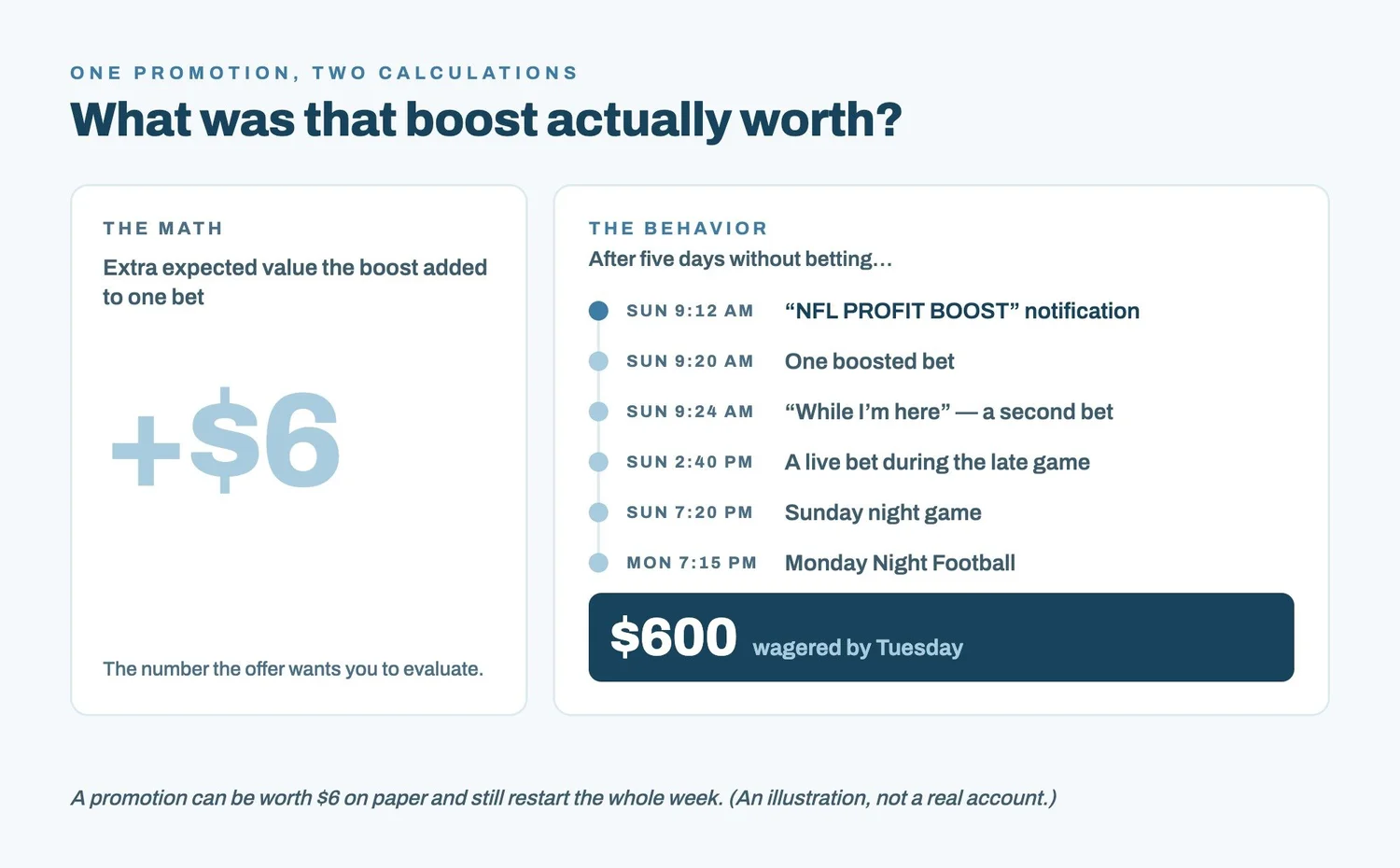
This is why judging a promotion only by its math can miss what’s happening. For someone trying to control gambling, the relevant question isn’t is this a good promotion? It’s what happens after I use it? If what usually happens is chasing losses into Monday night, you already know the answer.
A 60-Second Sportsbook Promo Test
The next time an offer shows up, don’t immediately decide whether it’s valuable. Run this first.
Was I already planning to bet? If not, the promotion isn’t improving a bet. It’s creating one.
Would I bet the same amount without it? If a boost turns a planned $20 wager into a $100 wager, notice what actually happened.
Would I choose this type of bet without the offer? Promotions are often attached to parlays, longer odds or particular markets. Make sure you’re choosing the wager, not the promotion.
Am I treating bonus credit like cash? Understand what has to happen before promotional credit becomes money you can withdraw.
Is the expiration date changing my decision? If “expires tonight” is the main reason you’re betting tonight, that’s useful information.
Did this offer arrive after I hadn’t gambled for a while? Notice whether promotions tend to restart betting after natural breaks.
Am I getting more offers as my betting or losses increase? You may not know why a particular offer was sent. Don’t assume — but do watch the pattern.
Would turning off every promotional message make it easier to gamble less?
That last one may be the most useful question on the list. If the answer is yes, you don’t need to get better at evaluating sportsbook promotions. You need to stop receiving them.
Turn Them Off
If you’re trying to cut down, this is one of the simplest changes you can make — and it now has experimental evidence behind it.
In a randomized field experiment published in Addiction in 2026, Australian sports and race bettors scoring in the moderate-risk or problem range were randomly assigned either to opt out of direct marketing from every wagering operator they had an account with, or to keep receiving it as usual. Over the next 14 days, the opt-out group placed 23% fewer bets, spent 39% less and reported 67% fewer short-term gambling harms than the group that kept getting messages.
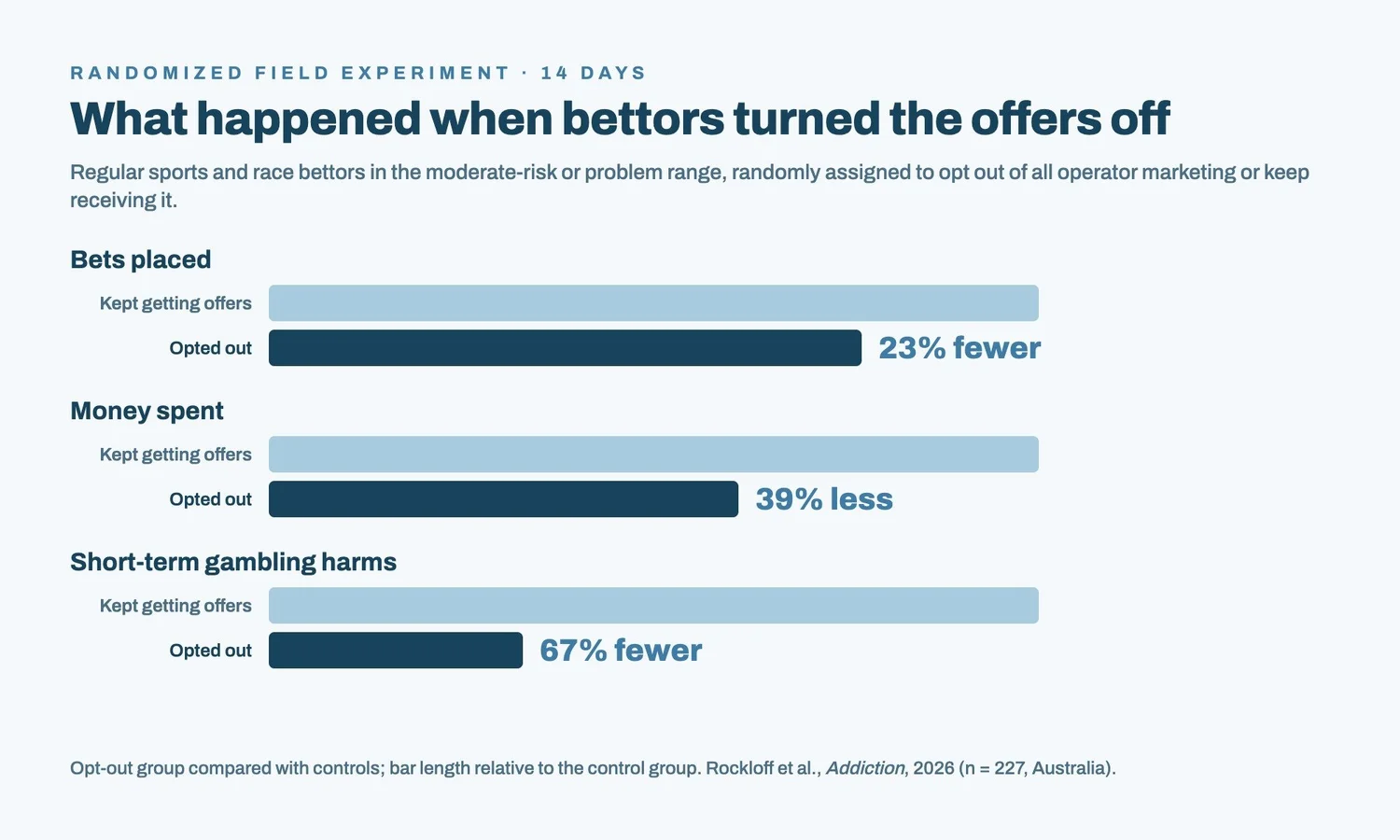
That was a two-week study, not a cure. But it’s about as direct as the evidence gets: fewer offers, less betting. So:
Turn off sportsbook push notifications — in the app and in your phone’s settings.
Unsubscribe from marketing emails and opt out of promotional texts.
In each account’s settings, withdraw consent for marketing communications.
Delete sportsbook bookmarks, and take betting apps off your home screen — or delete them.
Unfollow sportsbook and tout accounts on social media.
The point isn’t that you’ll never think about gambling again. The point is to stop letting a gambling company decide when you think about gambling. That’s a meaningful difference.
If You’re Trying to Stop, Stop Shopping for the Best Offer
There’s another trap I see. Someone has decided gambling has become a problem, but he still spends time comparing boosts across apps, deposit bonuses, odds and whether today’s offer is +EV.
Technically, he isn’t betting. Mentally, he’s still completely inside the gambling ecosystem.
If your goal is to stop, you don’t need the best sportsbook promotion, the best odds or the highest-value bonus. You need to make placing the next bet less likely. Those are different goals.
Don’t Make Willpower Do All the Work
If you’ve tried repeatedly to control gambling and promotions keep pulling you back in, add real barriers. Sportsbooks offer responsible-gambling tools, though the options differ by company and state. They can include deposit limits, wager limits, maximum-bet limits, loss limits, time limits, temporary time-outs and self-exclusion. FanDuel, for example, currently lists deposit, wager, maximum-wager-size and loss limits alongside its spending dashboard.
For someone whose gambling is getting hard to control, I generally prefer a barrier you can’t easily negotiate with in the moment. At 11 a.m., you may sincerely intend not to deposit another $500. At 9:30 p.m., after losing the first four bets, your thinking may be very different. A limit doesn’t have to win that argument. It just has to be there.
A limit set inside one app, though, is still a door you can walk back through at another app. If you’re in Illinois, the Illinois Gaming Board’s self-exclusion program covers casinos and sports wagering statewide — here’s how enrollment works. For the whole plan — self-exclusion, blocking software, money barriers and the riskiest parts of the football week — see how to stop sports betting. If you need to stop today, start with the 24-Hour Betting Shutdown Plan.
Sportsbook Promotions Aren’t the Whole Problem
I don’t want to leave the impression that a push notification causes gambling addiction. It doesn’t. Millions of people receive gambling promotions without developing gambling disorder, and the sportsbook isn’t responsible for every decision a customer makes.
But it would be equally unrealistic to pretend these offers exist without a purpose. Promotions are designed to affect customer behavior; that’s what promotions do in every industry. In sports betting, the behavior being encouraged is repeatedly putting money at risk. And the experimental evidence increasingly suggests inducements can increase betting, reduce the chance that someone decides not to gamble and, in some circumstances, lead to worse betting decisions.
That matters much more when the person receiving the offer is already struggling to control his gambling. Promotions are one input. So are the group chat, the game on TV and the phone in your hand. The goal is to reduce all of them.
Read the Promotion Backwards
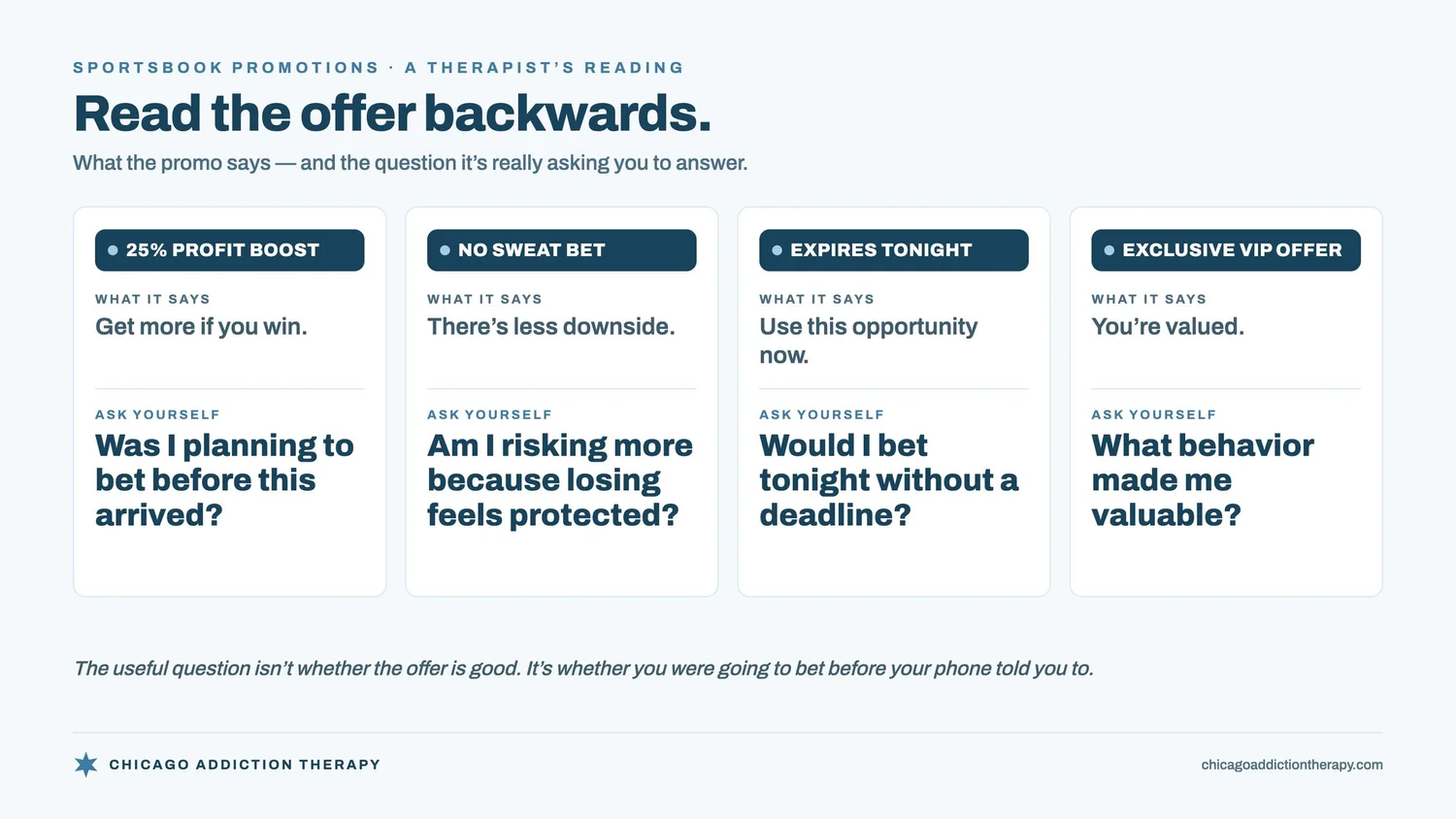
When you see PROFIT BOOST, don’t just ask how much extra you can win. Ask: why am I opening the sportsbook right now?
When you see NO SWEAT BET, don’t just ask what you get if you lose. Ask: would I take this risk without the protection?
When you see EXPIRES TONIGHT, ask: why does this bet need to happen tonight?
When you see EXCLUSIVE VIP OFFER, ask: what about my gambling made me valuable enough to receive this?
And when an offer arrives after you’d decided you weren’t going to gamble, ask the simplest question of all:
Was I going to bet before my phone told me to?
Sometimes that tells you more than the promotion’s terms and conditions ever will. Not sure how serious your betting has become? The free, anonymous gambling self-assessment takes about three minutes.
Frequently Asked Questions
Are sportsbook profit boosts worth it?
Sometimes, mathematically. A boost can improve the price on a bet you were already going to make. The catch is behavioral: in experiments, inducements increase how much people spend, reduce how many choose not to bet, and push some toward worse or riskier bets. If the boost created the bet, it cost you money rather than saving it.
Is a “no sweat” bet or bet insurance really risk-free?
No. Your stake is still at risk, and a refund is often paid as bonus bets or site credit that has to be wagered again before it becomes withdrawable cash. Research with sports bettors finds these “safety net” offers make gambling feel less risky than it is.
Do sportsbooks track how you bet?
Yes. Accounts record deposits, withdrawals, wagers and results, and at least some operators say they analyze these patterns. FanDuel, for example, says it monitors deposit and withdrawal history, increases in wager size, cancelled withdrawals and in-app chat for signs of risk, and uses machine learning to flag unusual deposits. A September 2026 New York Times investigation reported that DraftKings also used customer betting data to score who was likely to lose the most per promotion — a characterization DraftKings disputes.
How do I stop getting sportsbook promotions?
Turn off push notifications in the app and in your phone’s settings, unsubscribe from emails, opt out of texts and withdraw marketing consent in each account’s settings. Self-exclusion should also end marketing from the operators it covers. In a 2026 randomized trial, bettors who opted out of operator marketing bet less, spent less and reported fewer harms within two weeks.
What is a sportsbook VIP host?
An employee assigned to a high-volume customer who provides one-on-one contact and can offer individualized promotions, gifts, tickets or travel. Sportsbooks describe it as customer service and say hosts are trained to spot problem gambling; critics and several lawsuits argue it keeps heavy bettors wagering. If you have a host, ask what behavior earned you one.
If Sportsbook Promotions Keep Pulling You Back Into Betting
If you’ve tried to stop sports betting but promotions, bonuses, VIP contact or game-day offers repeatedly bring you back, the problem may no longer be finding the right limit or the right offer. It may be time to change your access to gambling itself: removing sportsbook accounts and apps, putting financial barriers in place, self-excluding, telling someone what’s actually happening, or getting professional help. If you’ve already slipped, read what to do after a gambling relapse before the next bet.
I specialize in gambling and sports betting therapy and work with people dealing with compulsive sports betting, online gambling, prediction markets and gambling-like trading. I see clients in person in Logan Square, Chicago, and online throughout Illinois and Minnesota. Learn more about sports betting addiction therapy, or email me to set up a consult.
Illinois Gambling Helpline: call 1-800-GAMBLER or text GAMB to 833234. National Problem Gambling Helpline: call or text 1-800-MY-RESET, 24/7. If you’re in a mental health crisis or thinking about suicide, call or text 988. If you’re in immediate danger, call 911.
This article is for general information and isn’t legal, financial or clinical advice for your situation. Company practices, investigations and lawsuits described here are as publicly reported at the time of writing (September 2026). The companies named dispute the critical accounts, and allegations in pending litigation have not been proven.
Sources
Ó Ceallaigh, D., Timmons, S., Robertson, D., & Lunn, P. (2025). Effects of inducements on sports gambling and decision-errors: An experimental study. Journal of Behavioral Addictions, 14(2). https://doi.org/10.1556/2006.2025.00056
Hing, N., Browne, M., Russell, A. M. T., Rockloff, M., & Rawat, V. (2025). The high cost of direct marketing from wagering operators, tipsters and affiliates: An ecological momentary assessment of how wagering promotions drive betting, expenditure, and harm. Journal of Behavioral Addictions, 14(3), 1355–1367. https://doi.org/10.1556/2006.2025.00067
Rockloff, M., Browne, M., Hing, N., Russell, A. M. T., Rawat, V., & Newall, P. (2026). Direct gambling marketing, direct harm: A randomised experiment. Addiction, 121(7), 1907–1919. https://doi.org/10.1111/add.70369
Rockloff, M., Browne, M., Russell, A. M. T., Hing, N., & Greer, N. (2019). Sports betting incentives encourage gamblers to select the long odds: An experimental investigation using monetary rewards. Journal of Behavioral Addictions, 8(2), 268–276. https://doi.org/10.1556/2006.8.2019.30
Deans, E. G., Thomas, S. L., Derevensky, J., & Daube, M. (2017). The influence of marketing on the sports betting attitudes and consumption behaviours of young men. Harm Reduction Journal, 14, 5. https://doi.org/10.1186/s12954-017-0131-8
Maese, R. (2025, April 4). ‘VIP’ bettors say sportsbooks keep them playing, no matter the cost. The Washington Post.
Klavens, A., Bogdanich, W., & Vrentas, J. (2026, September 19). How DraftKings uses A.I. to target the gamblers likeliest to lose. The New York Times. https://www.nytimes.com/2026/09/19/business/draftkings-ai.html
Vrentas, J., Klavens, A., & Bogdanich, W. (2026, September 24). Massachusetts is investigating gambling companies’ use of A.I. The New York Times. https://www.nytimes.com/2026/09/24/business/massachusetts-draftkings-ai-gambling.html
ESPN. (2026, July 13). Bryce Harper denies giving FanDuel consent for video to customer.
FanDuel letter to Sen. Richard Blumenthal and Reps. Paul Tonko and Valerie Foushee (2026, August 14), as reported by SportsBettingDime and Casino.com.
FanDuel. Tools to manage your play (Real-Time Check-In, deposit, wager, max wager size and loss limits). fanduel.com, accessed September 2026.