
Are Sweepstakes Casinos Gambling? What Illinois and Minnesota Players Should Know
Written by Chris Beerman, MSW, LCSW (IL), LICSW (MN), CADC · Published October 2026 · Legal and regulatory details current as of October 4, 2026
You can be playing what looks exactly like an online slot machine, spending real money, trying to win back what you lost and cashing out when you win, and the website will tell you that you aren’t gambling.
You’re playing at a “social casino.” Or entering a “sweepstakes.” Instead of depositing dollars, you buy virtual coins, and a second kind of coin can be played for prizes. That distinction has let sweepstakes casinos occupy a strange space between social gaming and online gambling, and states are increasingly challenging it.
Clinically, I think there’s a simpler question: what happens when you use it? If you’re chasing losses, spending more than you planned, hiding purchases, thinking about the games throughout the day, or trying and failing to stop, the label on the website doesn’t make the problem any less real.
I’m an addiction therapist licensed in Illinois and Minnesota, and gambling is a primary focus of my practice. Increasingly, that means looking beyond casinos and sportsbooks at products that don’t feel like gambling at first. Sweepstakes casinos are one of the clearest examples.
The short version
Legally, it depends on the state, and both of these states have taken a side. Illinois’s gaming regulator and Minnesota’s attorney general both say real-money sweepstakes casinos are illegal gambling, and both have told operators to stop.
Clinically, the answer is simpler. If you’re chasing losses, hiding purchases or failing to stop, the name of the coin doesn’t change the problem.
Your state self-exclusion won’t block these sites. Illinois’s program covers licensed casinos and sportsbooks, and sweepstakes casinos aren’t licensed.
Stopping means closing the account, the money routes and the substitutes, not just one website.
Help now: in Illinois, call 1-800-GAMBLER or text GAMB to 833234. In Minnesota, call 1-800-333-HOPE or text HOPE to 53342.
What Is a Sweepstakes Casino?
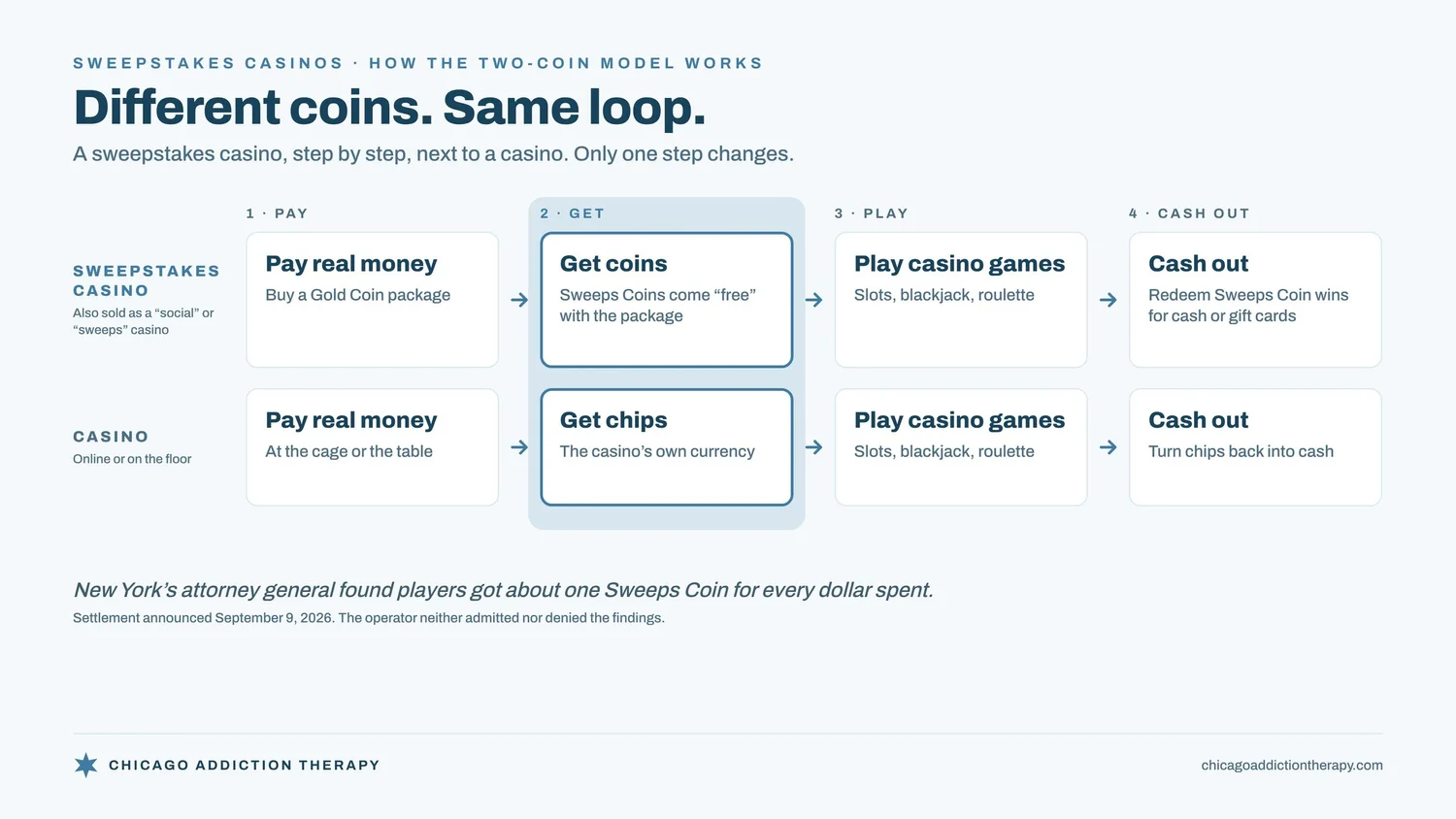
Sweepstakes casinos offer games that look very much like a conventional online casino: slots, blackjack, roulette, poker and jackpot-style games. The difference is mostly in how money gets in and out.
Most use two virtual currencies. One, often called Gold Coins, is for play only and can’t be redeemed for anything. The other, usually called Sweeps Coins, is played in the same games, and eligible Sweeps Coin winnings can eventually be redeemed for cash or prizes such as gift cards.
The sites say you never have to pay for Sweeps Coins. You can get them through promotions or by mailing in a request, and when you buy a package of Gold Coins, Sweeps Coins come “free” with it. That structure is the heart of the argument that these are sweepstakes rather than casinos.
Regulators have looked at the same structure and seen something else. In September 2026, New York’s attorney general announced an $8 million settlement with VGW, the company behind Chumba Casino, LuckyLand Slots and Global Poker. Her office said its investigation found that players could get Sweeps Coins “the same way one might purchase chips in a casino,” receiving about one coin for every dollar spent. The settlement describes a $5 purchase that came with 5.05 Sweeps Coins, and it says VGW placed no limit on how many packages a player could buy. VGW settled without admitting or denying the findings.
From a player’s side, the experience can be simpler still: I put money in. I play casino games. I can lose. I can win. And if I win enough, I can cash something out. That’s why the legal definition and the lived experience don’t always feel like the same conversation.
Are Sweepstakes Casinos Really Gambling?
There are two questions here, and they have different answers.
The first is legal: does the law treat the product as gambling? That depends on the state, the exact design of the product, and how regulators read existing gambling and sweepstakes law. In both Illinois and Minnesota, the officials who enforce gambling law have said yes. I go through each state below.
The second is clinical: can someone develop a gambling problem using it? That answer is much less complicated. A gambling problem doesn’t depend on what a company calls its product. It develops around risk, reward, uncertainty, anticipation, chasing, endless chances to play again, and the possibility that the next outcome will undo the last one. If you lose $500 and suddenly feel that winning it back is urgent, your brain doesn’t much care whether the balance on the screen said dollars, credits or Sweeps Coins.
Players themselves seem to know this. In a 2025 online survey commissioned by the American Gaming Association, 90% of sweepstakes casino players said playing was gambling (59% “definitely,” 31% “probably”), and 68% said winning real money was their main reason for playing. Read that with its source in mind: the AGA represents the licensed casino industry, which competes with sweepstakes operators and has campaigned against them. It’s still a striking answer from the people who actually play.
Why Sweepstakes Casinos Are So Easy to Rationalize
The most interesting thing about these sites isn’t only that they resemble gambling. It’s that they make it easier to tell yourself you’re not gambling.
Maybe you’ve already stopped betting on sports. Maybe you stopped going to casinos, or you self-excluded. Then you find a product that seems slightly different. You aren’t making a deposit; you’re buying coins. You aren’t placing a bet; you’re playing a game. It isn’t technically an online casino; it’s a sweepstakes.
For someone trying to control their gambling, those distinctions can become surprisingly powerful. The internal argument becomes: this isn’t the thing I have a problem with. Sometimes that’s true. Sometimes it becomes a route back into exactly the same cycle.
How Sweepstakes Casinos Become a Way Back Into Gambling
This matters most for people who have already recognized a gambling problem.
A good recovery plan usually starts by closing doors. You delete the betting apps. You self-exclude. You stop going to casinos. You put limits around money. You tell another person what has been happening. Then another product appears that is close enough to gambling to produce the same excitement, but different enough to feel exempt from the rules you made for yourself.
Sweepstakes casinos can fill that role. So can prediction markets, daily fantasy contests or high-risk trading. The product changes. The pattern may not:
You start thinking about it during the day.
You increase the amount.
You chase.
You tell yourself you’ll stop once you’re back to even.
You hide what you spent.
You delete the app, and then you come back.
At that point I’m much less interested in debating which category the product belongs in. I’m interested in the fact that the old cycle has restarted. If you’ve gone back after a stretch of not gambling, read what to do after a gambling relapse before the next session.
What Does the Research Say?
The research calls for some caution. There isn’t yet a substantial body of peer-reviewed research on today’s American dual-currency sweepstakes casinos specifically.
Researchers have, however, studied social casino games for more than a decade. These are free-to-play, casino-style games that sell virtual credits but don’t pay out prizes. They aren’t the same as sweepstakes casinos, and the terms shouldn’t be used interchangeably. But the findings point in a consistent direction:
A small U.S. study followed social casino players who had never gambled online. About a quarter of them had started gambling online within six months, and spending money on the games was the only factor that independently predicted it (Kim and colleagues, 2015).
A 2017 study found that social casino players who bought virtual credits reported more impulsivity, more reward sensitivity and higher problem-gambling severity than players who didn’t. Among the buyers, reward sensitivity predicted buying credits to chase lost credits: chasing, in a game where there was no money to win back.
Australian studies found that people who said social casino games had led them into real-money gambling tended to have higher problem-gambling severity and to pay for in-game items, and that among people with gambling problems, more frequent play and bigger spending on social casino games went with more problematic use of the games themselves. The symptom reported most often was playing to escape a bad mood.
None of this proves that playing at sweepstakes casinos causes gambling disorder. Most of it is cross-sectional, and people who already have gambling problems may simply be drawn to these games. But it makes it hard to treat casino-style digital games as unrelated to gambling, and the case gets stronger, not weaker, when the coins you’re playing with can be turned into cash.
Signs Sweepstakes Gambling Is Becoming a Problem
Set the product label aside for a minute and look at what your behavior actually looks like. Pay attention if:
You routinely spend more than you intended.
You keep playing after losing because you want to get back to even.
Wins make you want to play more rather than stop.
You’ve hidden purchases, transfers or losses from someone close to you.
You think about the site when you’re supposed to be doing something else.
You’ve deleted an account or app and then gone back.
You play more when you’re stressed, bored, lonely, angry or drinking.
You move money between accounts or use credit to keep playing.
You’ve decided to stop more than once and found yourself back on the site.
Thirty days without playing sounds much harder than you think it should.
You don’t need to lose your savings before this counts. Loss size is actually a poor way to measure how serious a gambling problem is. The better questions are how much control you’ve lost and how much room gambling is taking up in your money, your attention, your relationships and your honesty. If you’re not sure where you land, the free, anonymous gambling addiction test takes about three minutes, and your answers never leave your browser.
Are Sweepstakes Casinos Legal in Minnesota?
Minnesota is an especially interesting case, because there’s a sharp disagreement between much of what you’ll find online and what state officials say.
Search for sweepstakes casinos in Minnesota and you’ll find gambling-affiliate websites listing sites you can supposedly play and, in some cases, describing them as legal for Minnesota residents, with links to sign up. Affiliate sites typically earn a commission when readers do.
Minnesota Attorney General Keith Ellison’s office takes a very different position. On November 5, 2025, it announced letters to 14 online gambling operators (three sweepstakes casinos, the rest offshore sportsbooks and casino sites) directing them to stop offering gambling to Minnesotans. The Alcohol and Gambling Enforcement Division of the Minnesota Department of Public Safety had written to the same 14 operators that June about potential criminal violations, and according to the attorney general, they hadn’t stopped.
The attorney general’s reasoning is direct. Minnesota law defines a lottery as a plan that hands out prizes by chance to people who paid for the chance, and the office says sweepstakes casinos fit, because “consumers can and do purchase packages of virtual coins that include redeemable sweeps coins.” As the announcement put it, “The sale of sweeps coins to play a game of chance for a real-world prize turns these sites — which often claim to be only entertainment — into illegal gambling.” Or, in Ellison’s own words: “Trying to rebrand poker chips as virtual currencies does not change the fact that these online gambling operations are unlawful.”
The office also pointed to something that gets lost in the legal debate: these sites aren’t regulated in Minnesota. “The State does not audit or regulate gambling websites, because they are not legal in Minnesota,” the announcement said, so players have “no guarantee that they will be paid what they win, that the contest will not be rigged, or that they will be able to get their money back if they are not treated fairly.” The letter to the sweepstakes operators added that the sites “lack robust age verification measures or tools to allow self-exclusion.”
Minnesota lawmakers also considered making the ban explicit. SF 4474, which would have prohibited online sweepstakes games built on a dual-currency model, passed the Senate 62–3 on April 30, 2026. It was referred to a House committee on May 4 and went no further before the session ended, so it didn’t become law.
That’s where much of the confusion comes from. An affiliate site may point to the failed bill and conclude that sweepstakes casinos remain legal. The attorney general’s argument is different: the activity was already illegal under Minnesota’s existing gambling statutes and never needed a new, sweepstakes-specific law.
For a consumer, the safest way to put it is this: Minnesota’s chief law-enforcement office considers real-money sweepstakes casinos illegal gambling and has told the operators to stop serving Minnesotans. Whether a website still lets you create an account tells you nothing about whether Minnesota considers it lawful.
Why Minnesotans Should Pay Particular Attention
There’s another reason I think Minnesotans should know about these products. Legal gambling is narrower in Minnesota than in Illinois. The attorney general’s office lists it as licensed charitable gambling, pari-mutuel horse racing, the Minnesota Lottery and tribal gambling. Sports betting isn’t legal in Minnesota, and neither are online casinos.
That doesn’t make online gambling disappear. It can move into less obvious channels: sweepstakes casinos, offshore sportsbooks, and prediction-market apps that present themselves as trading. People sometimes assume that where online casinos and sportsbooks aren’t legal, the risk must be lower. The phone changes that. Someone can reach gambling-like products privately, continuously and without ever walking into a casino.
Minnesota Has State-Funded Gambling Treatment
If you live in Minnesota and gambling has become a problem, private therapy isn’t your only option. The Minnesota Department of Human Services funds gambling treatment through state-approved providers. For residents who meet the clinical criteria and show financial need, state funds can cover some or all of the cost, and family members and other concerned people can get help of their own, even if the person gambling isn’t in treatment.
The Minnesota Problem Gambling Helpline is 1-800-333-HOPE (1-800-333-4673), and you can text HOPE to 53342 for free, confidential referrals to services near you.
This is important enough that I bring it up with prospective Minnesota clients. Private therapy is one route and the state-funded system is another; the right choice depends on your situation, your insurance, your treatment needs and your finances. I provide gambling therapy in Minnesota by telehealth under my Minnesota LICSW license, but I don’t think a private practice should pretend it’s the only option.
Are Sweepstakes Casinos Legal in Illinois?
Illinois is challenging these sites too. In February 2026, the Illinois Gaming Board, working with Attorney General Kwame Raoul’s office, issued more than 60 cease-and-desist letters to companies it believes are running illegal online casino or sweepstakes platforms in Illinois. The recipients included many of the best-known sweepstakes brands, among them VGW’s Chumba Casino, LuckyLand Slots and Global Poker.
According to the Gaming Board, the letters went to companies it has reason to believe are offering “games of chance over the internet that award money or other things of value without the required licensure, in violation of Illinois criminal law.” Illinois allows a lot of gambling, including casinos, licensed online sportsbooks, video gaming terminals, horse racing and the Lottery, but online casino games aren’t on the list. Bills to legalize online casinos have been filed in several recent sessions, including 2026, and none has passed. Like Minnesota’s attorney general, the Gaming Board isn’t persuaded that switching to virtual coins takes a casino-style product outside gambling law.
One more thing worth knowing: a cease-and-desist letter is a warning, not a wall. Less than two weeks after the letters went out, the trade publication Gambling Insider reported that only two of the 65 recipients had restricted Illinois players. If a site still works on your phone, that doesn’t mean it’s legal here, and it doesn’t mean anyone will stop you from using it.
Illinois and Minnesota: Different Rules, Same Clinical Question
The contrast between the two states is striking. An Illinois client may have legal sportsbooks on the same phone as sweepstakes casinos, prediction markets and other gambling products. A Minnesota client lives in a state without legal sports betting or online casinos, and can still find plenty of ways to gamble online, or to use products that work a lot like gambling.
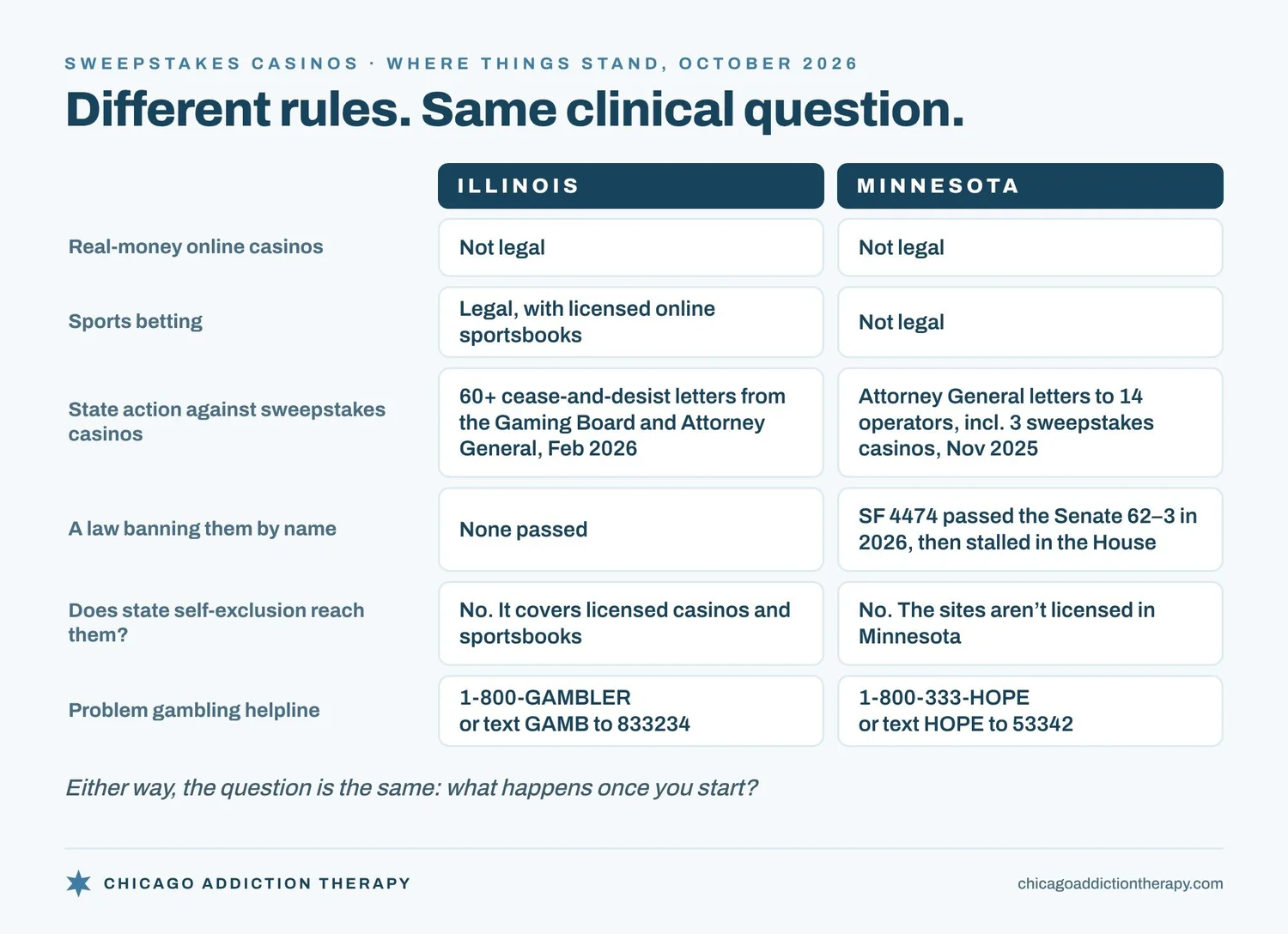
The regulatory structures are different. The treatment question usually isn’t. What happens once you begin? Can you stop when you planned to? Can you tolerate a loss without trying to reverse it? Are you still making deliberate decisions, or has gambling started making them for you? Those questions travel across state lines remarkably well.
Does Self-Exclusion Block Sweepstakes Casinos?
Don’t assume it does. Self-exclusion programs generally work inside a particular regulated system. Illinois’s program covers licensed casinos and licensed sportsbooks (here’s how Illinois self-exclusion works), and the Illinois Lottery runs its own. A sweepstakes casino isn’t licensed in Illinois or Minnesota, so it isn’t part of that system, and excluding yourself from casinos and sportsbooks doesn’t reach it. See what Illinois self-exclusion does and doesn’t block across ten kinds of gambling. Minnesota has no statewide self-exclusion list at all; my Minnesota self-exclusion guide covers what you can block there, sweepstakes sites included.
That creates a real vulnerability. Someone can take the major step of self-excluding and then discover that another casino-style product is still one tap away on the same phone. It’s why I think of self-exclusion as one layer of a gambling shutdown, not the whole thing. If sweepstakes casinos are part of the problem, the plan has to address those accounts directly, which means using each site’s own tools and reading the terms closely.
Take Chumba Casino. Its responsible-gameplay policy (the latest version I could find is dated July 2025) offers “take a break” periods of 1 to 30 days, self-exclusion for six months to five years or indefinitely, and permanent account closure through customer support. The fine print matters. A timed self-exclusion reactivates automatically when it ends. An “indefinite” one can be lifted after six months, followed by a seven-day cooling-off period. Each covers only that one site, so VGW’s sister sites need separate requests. The policy describes closing your account as irreversible. If you’re sure, that’s the stronger door to close.
How to Stop Playing Sweepstakes Casinos
If you already know you want to stop, start with access rather than motivation. Motivation rises and falls; a closed account stays closed.
Close or exclude every account. Use the strongest option each site offers: closure if you’re sure, otherwise the longest self-exclusion available. Ask support to confirm in writing which sites it covers.
Remove the money routes. Delete saved cards and payment apps from each account and unlink your bank. If your bank or card offers a gambling block, turn it on, but don’t assume it catches coin purchases.
Block the sites and apps. Gamban says its block list includes social casinos; BetBlocker is free and lets you add sites by hand on some devices. Test whatever you install against every site you’ve used. Screen Time on an iPhone, or Digital Wellbeing on Android, only works as a barrier if someone else holds the passcode.
Turn off the prompts. Unsubscribe from promotional emails and texts and switch off app notifications. Bonus offers exist to bring you back.
Look at what funds the play. Which cards and accounts have you been using? Can you make less money instantly available, with an account that takes a day to reach or that needs a second person to approve? My guide to recovering financially after gambling losses covers the longer-term side.
Tell one person. If you’ve been keeping this secret, telling someone takes away a lot of its power. It doesn’t have to be a partner. It can be a friend, a sibling or a therapist.
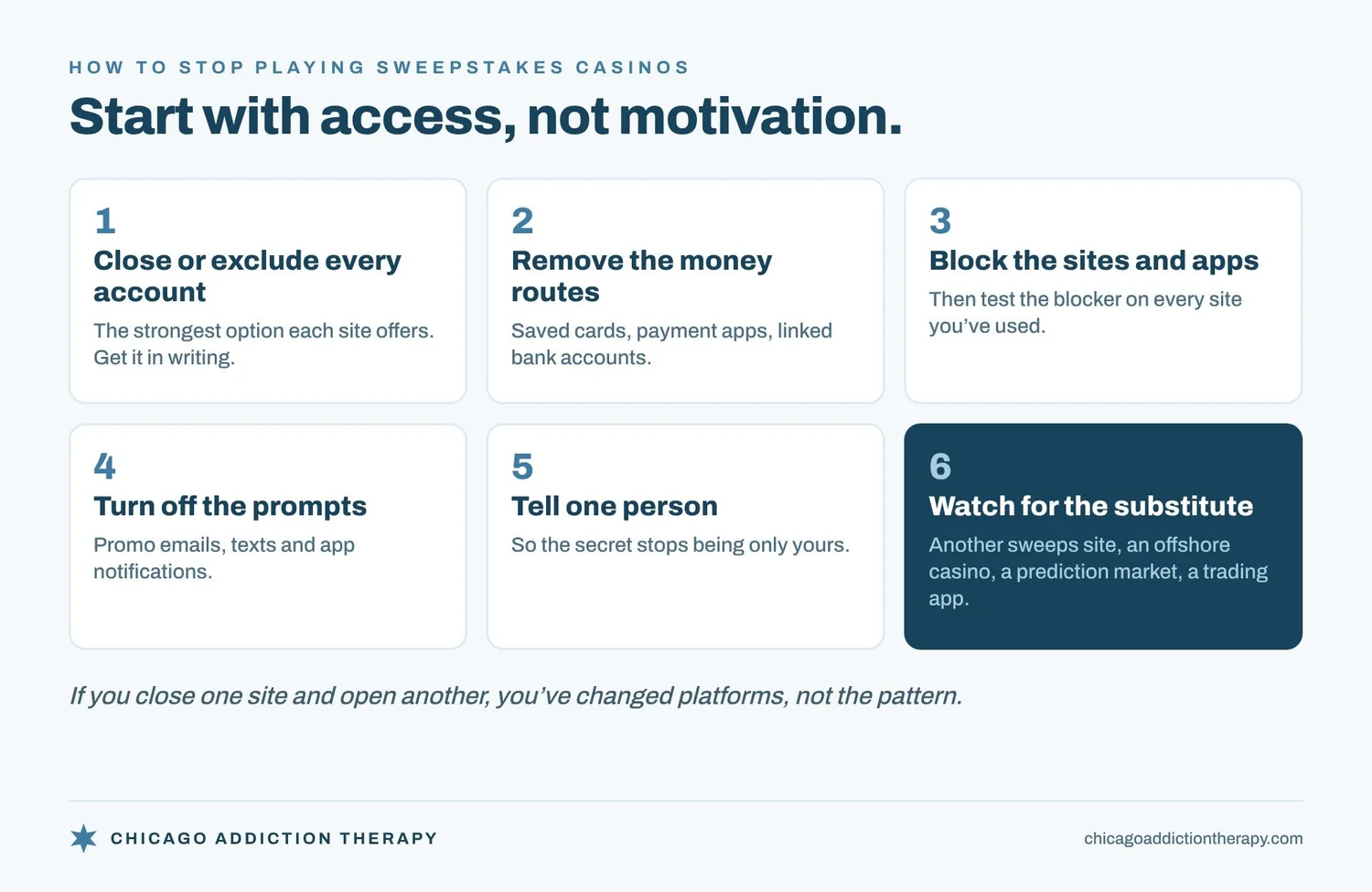
Then look at the adjacent products. This part matters. If you close Chumba but immediately start using another sweepstakes site, an offshore casino, a prediction market or high-risk trading to reproduce the same experience, you’ve changed platforms rather than changed the pattern. (If prediction markets are part of it, here’s how to self-exclude from prediction markets.) The question isn’t simply which website do I need to stop using? It’s what behavior am I trying to stop recreating?
If you need to stop today and this list feels like too much, start with my 24-Hour Betting Shutdown Plan. It’s written around sports betting, but it closes the most dangerous doors first, and most of them are the same doors.
Pay Particular Attention to Chasing
Chasing is one of the defining features of gambling disorder. You lose money. The loss creates anxiety. You want the anxiety to stop, and winning the money back starts to feel like the fastest way to do it. So you play again, and now the original loss has become the reason for more gambling.
That’s the trap: the next session feels like a solution to the last one, when it’s actually an extension of it. Sweepstakes sites can make this easier to miss, because buying another coin package doesn’t feel like making another deposit. Remember the social casino research above: among players who bought credits, the most reward-sensitive were more likely to be buying them to chase what they’d lost.
If you’re in that position, the immediate goal isn’t to design the perfect long-term recovery plan. It’s to interrupt the next decision to play. My guide to how to stop chasing gambling losses goes further.
When Does Sweepstakes Gambling Become Gambling Disorder?
There’s no separate diagnosis called “sweepstakes casino addiction” or “Chumba addiction.” The relevant diagnosis is gambling disorder, and it’s based on the pattern of behavior, not the name of the company. The DSM-5 lists nine signs:
Needing to gamble with more money to get the same excitement.
Feeling restless or irritable when trying to cut back or stop.
Repeated, unsuccessful efforts to control, cut back or stop.
Being preoccupied with gambling.
Gambling when feeling distressed.
Going back after losing to try to get even.
Lying to hide how much you’re gambling.
Jeopardizing or losing a relationship, job, or educational or career opportunity because of gambling.
Relying on others for money to get out of a financial crisis caused by gambling.
A diagnosis requires four or more of these within 12 months, assessed by a clinician. But you don’t need to meet any threshold before asking for help, and you don’t need to call yourself a gambling addict. “I don’t like where this is going” is a perfectly reasonable reason to change it.
The Label Matters Less Than the Pattern
The gambling landscape is moving faster than our language for it. Sports betting can feel like fandom. Prediction markets can feel like investing. High-risk trading can feel like finance. Sweepstakes casinos can feel like social gaming. The distinctions can matter legally.
But if your question is whether you have a problem, start somewhere else. Are you chasing? Are you hiding it? Are you spending money you’d planned to use for something else? Do you keep telling yourself the next session will be different? Have you tried to stop and gone back? If so, you don’t need to settle the legal definition of a sweepstakes before deciding that the behavior has become a problem.
If It’s Someone You Love
Partners sometimes find this before the person playing is ready to talk about it, often as card charges from a site that sells coins. Because the purchases don’t look like gambling, they’re easy to dismiss at first. If you’re worried about a partner, my guide for partners of someone with a gambling problem covers what to do first, and the partner gambling test can help you sort out what you’re seeing. You can come to therapy yourself, whether or not they’re ready.
Frequently Asked Questions
Are sweepstakes casinos gambling?
Legally, it depends on the state. In Illinois and Minnesota, the officials who enforce gambling law say yes, and both states have told sweepstakes operators to stop serving their residents. Clinically, if you’re spending money, chasing losses and playing for prizes you can cash out, it can create the same problems as any other gambling, whatever the coins are called.
Can you get addicted to Chumba Casino or other sweepstakes casinos?
Yes. There’s no separate diagnosis for a particular site, but gambling disorder is diagnosed by the pattern (loss of control, chasing, preoccupation, hiding it), not by the product. Research on social casino games has linked spending on casino-style games to higher problem-gambling severity, and sweepstakes sites add the possibility of cashing out.
Are sweepstakes casinos legal in Illinois?
The Illinois Gaming Board says no. In February 2026, working with the Attorney General’s office, it issued more than 60 cease-and-desist letters to operators it believes are running illegal online casino or sweepstakes platforms. Real-money online casino gambling isn’t legal in Illinois.
Are sweepstakes casinos legal in Minnesota?
Minnesota’s attorney general says no. In November 2025, the office told sweepstakes casino operators that selling sweeps coins for casino-style games with real-world prizes is illegal gambling under existing Minnesota law. A 2026 bill to ban them by name passed the Senate but not the House; the attorney general’s position doesn’t depend on it.
Does Illinois self-exclusion block sweepstakes casinos?
No. The Illinois Gaming Board’s program covers licensed casinos and licensed sportsbooks. Sweepstakes casinos aren’t licensed in Illinois, so you need to close or exclude from each site yourself and block them on your devices.
How do I stop playing sweepstakes casinos?
Start with access. Close or self-exclude every account using the strongest option each site offers, remove saved payment methods, install blocking software and test it, turn off promotions, and tell one person. Then watch for substitutes, such as another sweepstakes site, an offshore casino or a trading app, that recreate the same experience.
Gambling Therapy in Illinois and Minnesota
Gambling is one of the primary focuses of my practice. I work with adults dealing with sports betting, online and sweepstakes casinos, casino gambling, video gambling, high-risk trading and other gambling-like behavior. I see clients in person at my Logan Square office in Chicago and by secure telehealth throughout Illinois and Minnesota.
Treatment is practical. We look at what keeps the gambling cycle going, build barriers between you and the next session, address chasing and gambling-related thinking, work through the financial and relationship damage, and understand what gambling has been doing for you psychologically. You don’t have to be abstinent before the first appointment, and you don’t have to wait until things get worse. Learn more about gambling addiction therapy or the routes into gambling treatment in Illinois, or reach out to schedule a free 15-minute consultation.
Illinois Gambling Helpline: call 1-800-GAMBLER or text GAMB to 833234. Minnesota Problem Gambling Helpline: call 1-800-333-HOPE (1-800-333-4673) or text HOPE to 53342. National Problem Gambling Helpline: call or text 1-800-MY-RESET, 24/7. If gambling losses have left you thinking about suicide, or you don’t feel safe, call or text 988 or go to the nearest emergency department.
This article is for general information and isn’t individualized legal, medical or financial advice. Gambling laws and what platforms offer change quickly; the legal and regulatory details here were checked against primary sources, or reporting where noted, on October 4, 2026.
Sources
American Gaming Association. (2025). Sweepstakes casino player profile & advertising trends (online survey of 2,250 online casino, free-to-play casino and sweepstakes casino players, conducted by Interpret, June 11–24, 2025). https://www.americangaming.org/resources/sweepstakes-casino-player-profile-advertising-trends/
American Psychiatric Association. (2013). Diagnostic and statistical manual of mental disorders (5th ed.). Gambling disorder.
Gainsbury, S. M., Russell, A. M. T., King, D. L., Delfabbro, P., & Hing, N. (2016). Migration from social casino games to gambling: Motivations and characteristics of gamers who gamble. Computers in Human Behavior, 63, 59–67. https://doi.org/10.1016/j.chb.2016.05.021
Gainsbury, S. M., King, D. L., Russell, A. M. T., Delfabbro, P., & Hing, N. (2017). Virtual addictions: An examination of problematic social casino game use among at-risk gamblers. Addictive Behaviors, 64, 334–339. https://doi.org/10.1016/j.addbeh.2015.12.007
Gamban. What does Gamban block? https://kb.gamban.com/en-gb/11-/19-gamban
Gambling Insider. (2026, February 17). Only 2 of 65 sweepstakes casinos comply after Illinois C&D orders. https://www.gamblinginsider.com/news/112448/illinois-sweepstakes-3-percent-compliance-cd-letters-sb1705
Illinois Gaming Board. Cease and desist letters. https://igb.illinois.gov/casino-gambling/cease-and-desist-letters.html; and Illinois Gaming Board and Attorney General’s Office issue more than 60 cease-and-desist letters to illegal online casino and sweepstakes operators (press release, February 5, 2026).
Kim, H. S., Wohl, M. J. A., Salmon, M. M., Gupta, R., & Derevensky, J. (2015). Do social casino gamers migrate to online gambling? An assessment of migration rate and potential predictors. Journal of Gambling Studies, 31(4), 1819–1831. https://doi.org/10.1007/s10899-014-9511-0
Kim, H. S., Hollingshead, S., & Wohl, M. J. A. (2017). Who spends money to play for free? Identifying who makes micro-transactions on social casino games (and why). Journal of Gambling Studies, 33(2), 525–538. https://doi.org/10.1007/s10899-016-9626-6
Minnesota Attorney General. (2025, November 5). Attorney General Ellison directs illegal gambling websites to stop offering services in Minnesota. https://ag.state.mn.us/Office/Communications/2025/11/05_IllegalGamblingWebsites.asp; and the letter to social sweepstakes casino websites. https://www.ag.state.mn.us/Office/Communications/2025/docs/AGE_SweepstakesWebsites_Ltr.pdf
Minnesota Department of Human Services. Gambling programs and services. https://mn.gov/dhs/mental-health/addiction-and-recovery/program-gambling/gambling-program-services/
Minnesota Legislature, Office of the Revisor of Statutes. SF 4474, 94th Legislature (2025–2026), bill status. https://www.revisor.mn.gov/bills/94/2026/0/SF/4474
New York State Office of the Attorney General. (2026, September 9). Attorney General James secures $8 million from leading operator of illegal online sweepstakes casinos. https://ag.ny.gov/press-release/2026/attorney-general-james-secures-8-million-leading-operator-illegal-online; and the Assurance of Discontinuance with VGW Holdings Pty. Ltd. https://ag.ny.gov/sites/default/files/settlements-agreements/vgw-holdings-pty-ltd-aod-2026.pdf
SBC Americas. (2026, February 3). Illinois lawmaker starts again down long road to legalizing online casinos. https://sbcamericas.com/2026/02/03/illinois-online-casino-bill-2026/
SBC Americas. (2026, February 6). Illinois hits most of the social gaming industry with C&Ds. https://sbcamericas.com/2026/02/06/illinois-sweepstakes-c-and-ds/
VGW. Chumba Casino Responsible Social Gameplay Policy, version 4.0 (July 10, 2025).