
By Chris Beerman, MSW, LCSW, CADC · Chicago Addiction Therapy · Reviewed September 2026
Not wanting AA is a perfectly reasonable choice. But “not AA” isn’t a recovery plan yet. Here’s how to build one.
Maybe you already know you want to stop drinking.
What you don’t want is AA.
Maybe you’ve been to a meeting and didn’t connect with it. Maybe the spiritual language isn’t for you. Maybe you don’t like the idea of calling yourself an alcoholic, getting a sponsor, or organizing your recovery around meetings.
Or maybe you’ve never tried AA. You just know it isn’t how you want to approach this.
So the question becomes: can you stop drinking without AA?
Yes.
The short version
You can stop drinking without AA. Therapy, medication, secular support groups and the people in your own life are all legitimate routes.
If you’ve been drinking heavily or regularly for a long time, talk to a doctor before you stop. Alcohol withdrawal can be dangerous.
Skipping AA is a preference, not a plan. Work out what AA would have done for you, then decide what will do each of those jobs instead.
A plan beats willpower: decide before the craving, change the environment, know who you’ll call, and treat a slip as information.
AA Works for Many People. It Isn’t the Only Way.
Alcoholics Anonymous has helped a lot of people, and there is good research behind it. A 2020 Cochrane review of 27 studies found high-certainty evidence that structured programs designed to get people involved in AA, known as Twelve-Step Facilitation, led to more people staying continuously abstinent at one year than other established treatments such as cognitive behavioral therapy. AA deserves to be taken seriously as an option.
It isn’t, however, a requirement for recovery.
The National Institute on Alcohol Abuse and Alcoholism (NIAAA) describes several evidence-based approaches to alcohol use disorder, including behavioral therapy, medication and mutual-support groups, and it is plain about choosing between them: “there is no one-size-fits-all solution, and what may work for one person may not be a good fit for someone else.”
So the more important question isn’t whether you go to AA. It’s whether you’ve built something strong enough to replace what drinking has been doing for you.
That’s where I would start.
First, Make Sure It’s Safe for You to Stop
Before cravings, routines, therapy or support groups, there’s one medical question that matters more.
If you’ve been drinking heavily or regularly for a long time, stopping abruptly can cause withdrawal. Severe alcohol withdrawal can involve seizures and other complications that can be life-threatening.
That matters most if you’ve had symptoms before when you stopped or cut back: shaking, sweating, significant anxiety, nausea, a racing heart, hallucinations or seizures.
If that sounds like you, or you simply aren’t sure, talk with a physician or an addiction-medicine provider before you stop suddenly. They can tell you whether you can stop at home, need medication to make it safer, or should be in a supervised setting. My guide to choosing between therapy, IOP, rehab and detox explains what each level of care involves.
This article is about changing your relationship with alcohol. It isn’t a home-detox guide.
Not Going to AA Is a Preference. It Isn’t Yet a Plan.
This distinction matters.
Someone will sometimes tell me, “I want to quit, but I’m not doing AA.”
That’s useful information. Then comes the more important question: what are you going to do instead?
AA does more than provide the Twelve Steps. For someone actively involved in it, AA can provide regular contact with other sober people, somewhere to go when drinking sounds appealing, accountability, a structure for thinking about recovery, support after a setback, and a social world where not drinking is normal.
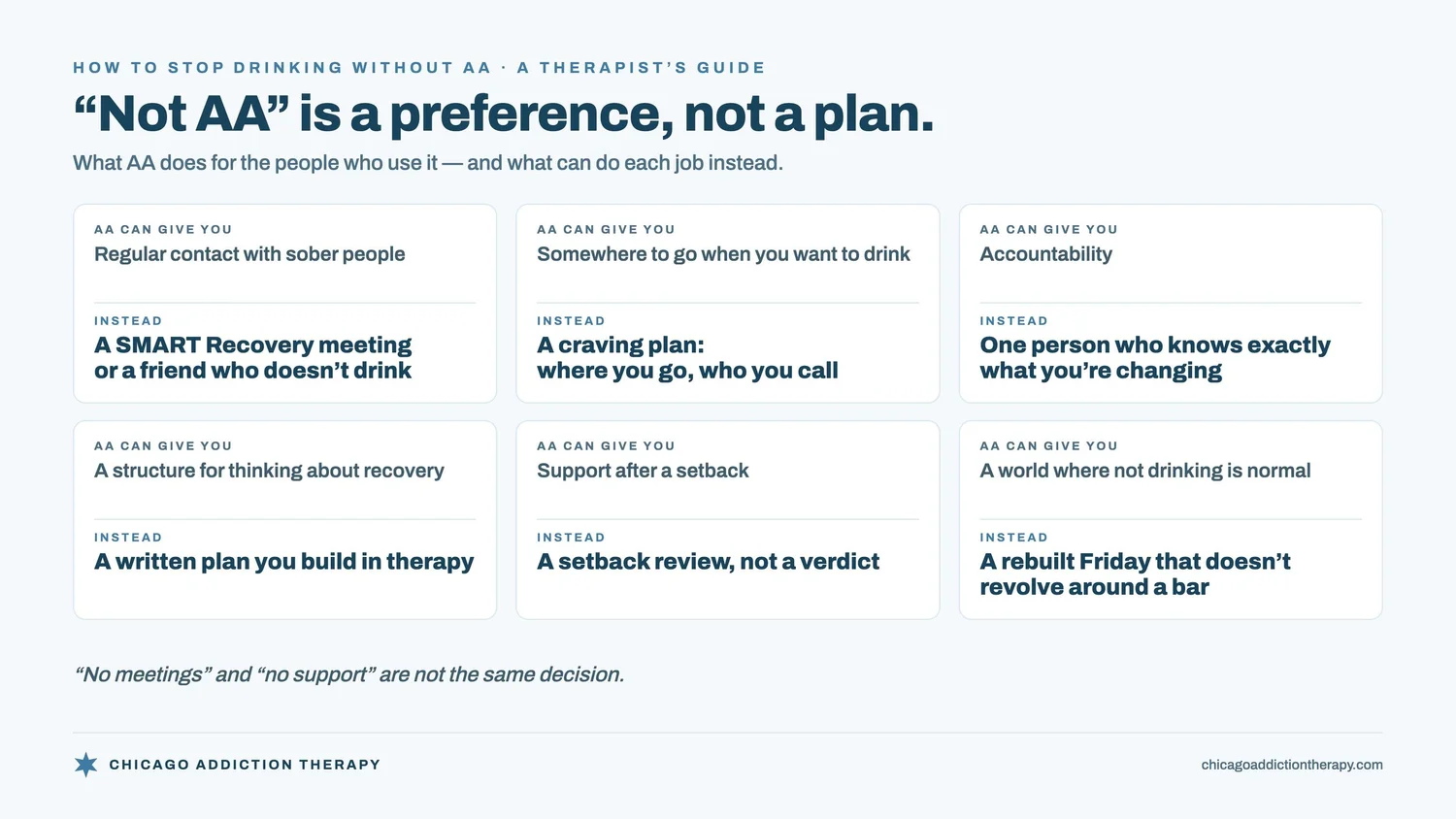
If you take AA out of the equation, you don’t need to rebuild AA under another name. But you should decide how each of those jobs is going to get done.
“No meetings” and “no support” are not the same decision. Neither are “I don’t want AA” and “I should figure this out entirely by myself.”
Start With the Job Alcohol Has Been Doing
Stopping drinking removes alcohol. It doesn’t automatically remove the reasons you kept wanting it.
Think about the hour before you usually drink. What are you expecting the first drink to change?
Maybe alcohol tells you the workday is finished. Maybe it makes social situations easier. Maybe Friday night feels empty without it. Maybe it turns down anxiety. Maybe drinking with your friends is one of the main ways you stay connected to them.
Maybe you don’t particularly like being drunk anymore, but you still like the first forty-five minutes: the shift from tense to relaxed, responsible to off-duty, restless to settled.
That part matters. I’ve written separately about alcohol and anxiety and weekend binge drinking because the reason someone drinks often tells us where the intervention needs to happen.
If alcohol has become your main way of ending the workday, for example, simply removing it leaves you with the original problem: how do I actually stop working, mentally, at 6 p.m.?
If you don’t solve that problem, alcohol will keep looking unusually useful.
Build a Plan That Doesn’t Depend on Willpower
You don’t need Twelve Steps. You do need steps. Here’s where I would start.
1. Make the decision before the craving shows up
“I’m going to try not to drink tonight” puts the decision in exactly the wrong place.
At 7:15 p.m., after a difficult workday, while your partner pours wine or your friends are deciding which bar to meet at, your reasoning will be different than it was that morning.
Decide earlier. If your goal is not to drink, make tonight an alcohol-free night before tonight begins. Then build the environment around that decision, and don’t make the first hour harder than it needs to be just to prove you have willpower.
If you normally stop at the liquor store on the way home, take another route.
If you always drink while making dinner, change the sequence.
If Friday happy hour reliably becomes six drinks, you probably don’t need another experiment to find out what happens when you go to Friday happy hour.
Changing your environment isn’t avoiding the “real” work. It is part of the real work.
2. Look at the first decision, not the fifth drink
When people describe a drinking episode afterward, they tend to focus on the moment things became obviously bad: “I should have stopped after the fourth drink.”
Maybe. But clinically, I’m often much more interested in what happened hours earlier.
Why did you go to the bar when you had already decided not to drink?
Why was there alcohol in the apartment?
Why did you agree to an open-ended night instead of meeting your friends for dinner?
Why did you wait until you were exhausted and hungry to figure out what you were doing that evening?
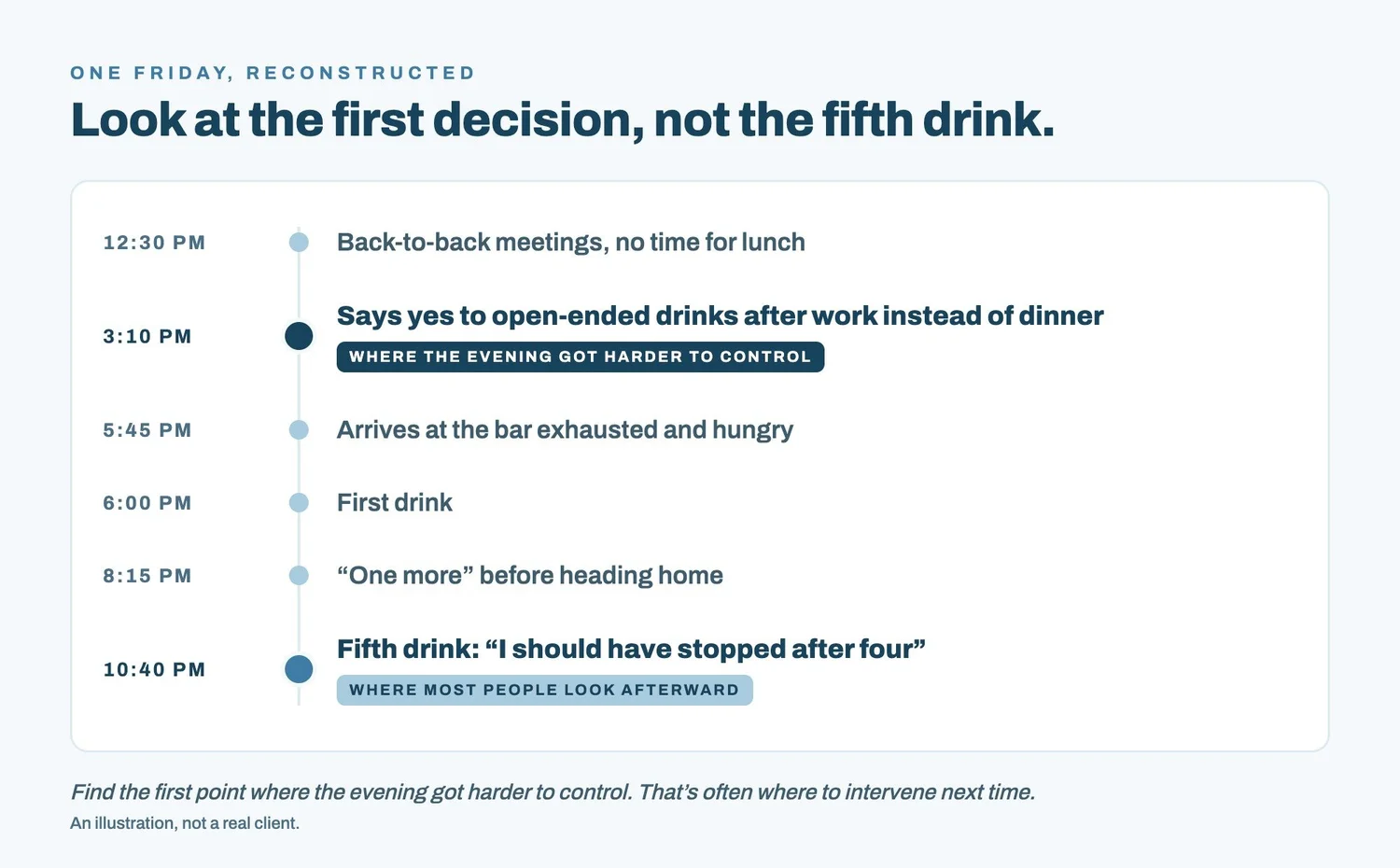
The most useful intervention usually happens earlier than people expect. Reconstruct your last few drinking episodes and look for the first point where the evening became substantially harder to control. That’s often where to intervene next time.
3. Have a plan for cravings before you need it
Cravings feel persuasive because, for a while, drinking seems like the obvious solution. You don’t need to win an intellectual argument with every craving. You need to get through enough time for the situation to change.
Change rooms. Leave the store. Eat something. Call someone. Go outside. Start the workout you already planned. Drive somewhere alcohol isn’t available. Take the dog for a walk. Get yourself into the next hour.
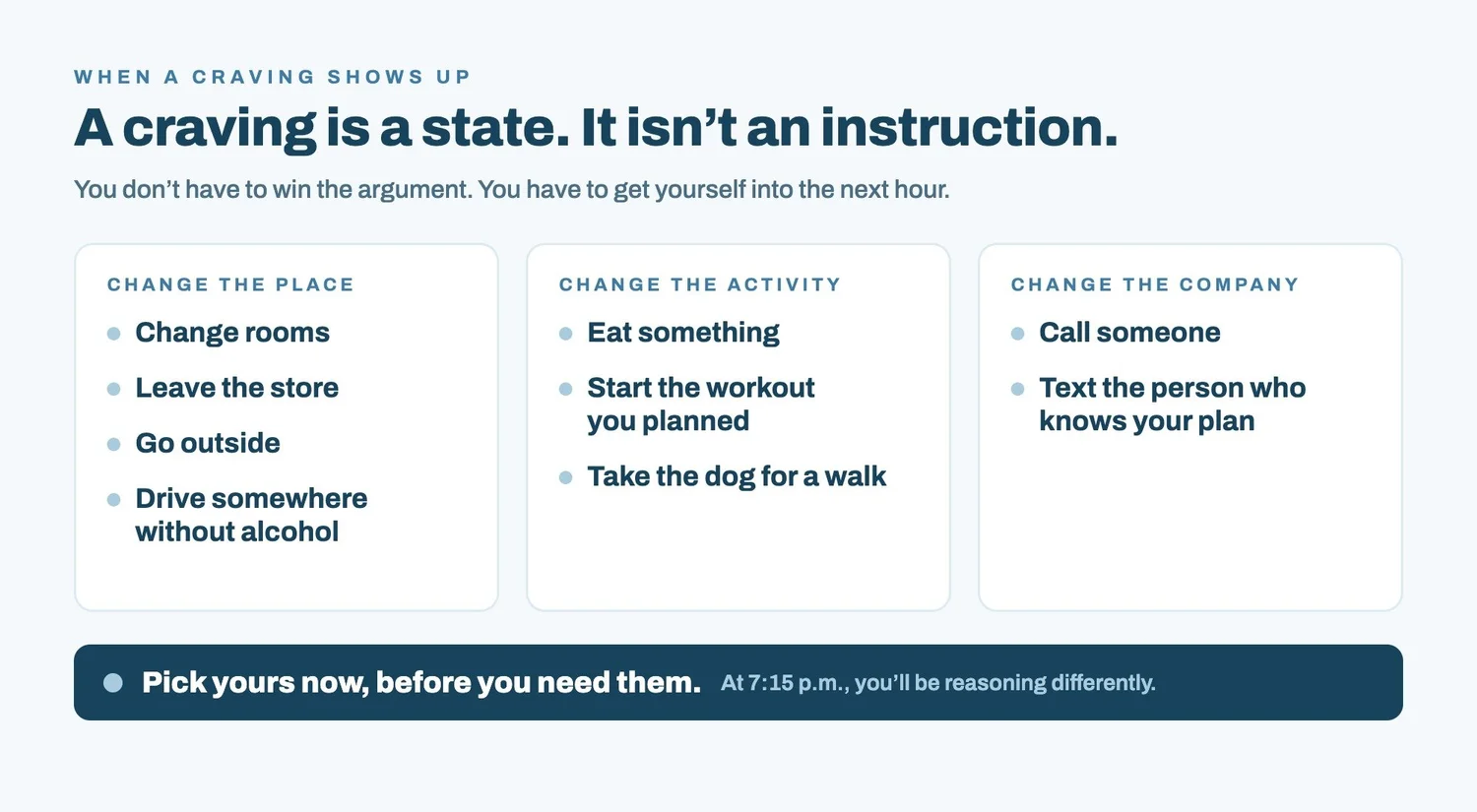
The specific strategy matters less than recognizing this: a craving is a state. It isn’t an instruction.
NIAAA’s Rethinking Drinking site has practical worksheets for exactly this, one on handling cravings and one on building drink refusal skills, alongside guidance on professional treatment, medication and support from friends and family. Its page on quitting is blunt: if you think you might have alcohol use disorder and decide to stop completely, “don’t go it alone.”
You can learn to have the thought “I really want a drink” without turning it into “therefore I’m going to drink.” That’s a skill, and skills improve with practice.
4. Consider individual therapy
You don’t have to swap one recovery group for another. For some people, the main treatment is individual therapy.
Evidence-supported behavioral treatments for alcohol use disorder include cognitive behavioral therapy, motivational enhancement and couples or family counseling, according to NIAAA’s treatment guide.
Therapy should involve more than being reminded that alcohol is bad for you. You probably already know the reasons you want to change. The useful work is more specific:
Why does the drinking keep happening despite those reasons?
What situations reliably come before it?
What thought makes drinking feel reasonable again after you’d decided not to?
What do you do when you’re anxious, angry, lonely, bored, exhausted or celebrating?
What happens in your relationship when alcohol is involved?
What have your previous attempts to quit taught you?
What needs to change so you aren’t fighting the same battle every Friday night?
Those are treatment questions, and they’re the ones I work on in alcohol addiction therapy.
5. Ask a physician about medication
This option is still surprisingly unfamiliar to people.
The FDA has approved three medications for alcohol use disorder: naltrexone, acamprosate and disulfiram. They work differently and aren’t right for everyone. NIAAA notes that all three are non-addictive and can be used on their own or alongside other treatment.
I don’t prescribe medication. But I do think people should know it exists.
You don’t have to prove you can quit “naturally” before discussing medication with a physician. And medication doesn’t mean your problem has to be extraordinarily severe. A qualified prescriber can review your drinking pattern, your health, your other medications, your goals and any reason a drug wouldn’t be safe for you, and decide whether any option makes sense.
For some people, therapy plus medication is a much more useful plan than repeatedly trying to force themselves not to drink.
6. If you want meetings but not AA, try something else
AA doesn’t have a monopoly on peer support.
NIAAA lists several secular mutual-support groups, including SMART Recovery, LifeRing, Women for Sobriety (for women), Secular Organizations for Sobriety and Secular AA (AA meetings without the religious language). It also notes that SMART Recovery, LifeRing and Women for Sobriety “appear comparable in effectiveness to 12-step programs for people who have a goal of abstinence,” based on a study that followed members of each for a year.
SMART Recovery is probably the alternative I’m asked about most often. It’s secular and skills-based. Its 4-Point Program covers building and maintaining motivation, coping with urges, managing thoughts, feelings and behaviors, and living a balanced life, and its free meetings run online and in person.
You don’t have to agree with every element of a program to get something useful from it. And you don’t have to adopt a recovery organization as an identity. You can use a meeting because being around people who understand the problem helps on Tuesday nights. That may be enough.
My alcohol resources directory covers AA and SMART Recovery in Chicago, with what to expect at each.
What If You Don’t Want Any Kind of Meeting?
Then don’t assume you need one. But look carefully at your support system.
Who knows you’re trying to stop?
Who could you contact at 8 p.m. when you’re reconsidering the decision?
Who will notice if you quietly start drinking again?
Who can you talk to after a setback without spending the conversation defending yourself?
For some people, the answer is a therapist, a physician, a partner, a sibling or a close friend rather than a group. (If you’re the partner reading this, start with what to do when your partner drinks too much.)
The important distinction is between choosing privacy and creating secrecy. Secrecy gives alcohol an unusually protected place in your life. If nobody knows what you’re trying to change, every decision stays yours to renegotiate.
Rebuild the Part of Your Week That Was Organized Around Drinking
This part gets underestimated. Removing alcohol can leave a surprising amount of empty space.
Friday used to mean drinks after work. Dinner meant wine. Watching football meant beer. Vacation meant cocktails. A date meant a bar. Seeing certain friends meant drinking. Finishing a hard project meant drinking.
You aren’t just changing a substance. You may be changing an entire calendar of cues.
The answer isn’t to spend the rest of your life avoiding restaurants and watching television alone. It’s to build new associations deliberately:
Meet a friend for breakfast instead of drinks.
Make Saturday morning important enough that Friday night matters.
Exercise at the hour you usually start drinking.
Choose restaurants because you actually like the food.
See what happens when you leave the party at ten instead of staying until one.
Some of those things will feel less exciting at first. That doesn’t mean sober life is inherently boring. It means your brain has had a lot of practice associating alcohol with reward. The new associations need practice too.
Learn to Say No Without Giving a Speech
People sometimes imagine that quitting means announcing a new identity every time someone offers them a drink. It doesn’t. You can say:
“No thanks.”
“I’m not drinking tonight.”
“I’m taking a break.”
“I feel better without it.”
“I’m good.”
The conversation usually ends faster than people expect. And if someone repeatedly needs you to justify why you aren’t drinking, that tells you something useful about the relationship.
You don’t owe everyone your treatment history in order to turn down a beer.
Don’t Turn One Drink Into a Verdict
Suppose you stop drinking for six weeks and then drink one night. There are two separate problems available to you.
The first is that you drank. The second is deciding the next morning that this proves the whole attempt was pointless. That second decision can do much more damage.
NIAAA’s guidance is matter-of-fact: “Setbacks are common, but you learn more each time,” and if one happens, “get back on track as quickly as possible.” If a slip turns into several days of heavy drinking, call your doctor before you stop again, because the withdrawal risk can come back.
So instead of issuing a verdict, investigate:
What happened? Where were you? What were you feeling?
Had you been thinking about drinking for several days?
Did you stop doing something that had been helping?
Was the decision impulsive, or had you slowly been giving yourself permission?
What would you change if the same circumstances came up next week?
A setback should produce information. Not a sentence.
Can You Stop Drinking Completely on Your Own?
Some people change their drinking without formal treatment. But “I don’t want AA” can quietly turn into “I shouldn’t need anyone,” and those are different ideas.
Alcohol problems exist on a spectrum. How much support you need depends on how severe the drinking is, your withdrawal risk, your mental health, what you’ve tried before, your relationships and your environment.
If you’ve tried to quit several times and keep returning to the same pattern, consider changing the treatment, not just trying harder. That could mean therapy. It could mean medication. It could mean SMART Recovery, an intensive outpatient program or a medical evaluation. It could mean telling somebody the truth.
The goal isn’t to recover with the fewest possible resources. The goal is to build something that works.
You Don’t Have to Call Yourself an Alcoholic
This is another reason some people avoid AA: they don’t identify with the word. You don’t need it.
Clinicians diagnose alcohol use disorder, which NIAAA describes as mild, moderate or severe depending on how many of its criteria someone meets. It’s the clinical term for what people have variously called alcohol abuse, alcohol dependence, alcohol addiction and alcoholism.
More importantly, you don’t need any diagnosis before changing something that isn’t working. If you keep drinking more than you intended, keep trying unsuccessfully to cut back, repeatedly regret what happens when you drink, or simply dislike how much space alcohol takes up in your life, you’re allowed to address it. You don’t need to wait until your situation looks like somebody else’s idea of alcoholism.
If you’re still unsure whether your drinking is a problem, start with Do I Have a Drinking Problem? How to Tell When Your Life Still Looks Fine, or take the free, private alcohol use test. If the real question is whether you need to stop completely, read Can You Moderate Your Drinking? A Therapist’s Guide to Moderation vs. Quitting.
What Stopping Without AA Might Actually Look Like
Imagine someone who drinks heavily on Fridays and Saturdays and has repeatedly promised himself he’ll stop. He doesn’t want AA. His plan might look like this:
He talks with his physician first, because there’s a question about withdrawal, and asks whether medication makes sense for him.
Once he’s medically cleared, he gets the alcohol out of his apartment.
He tells his partner what he’s doing rather than quietly “trying” again.
He books therapy for Thursdays, because Friday is historically the hard night.
He skips Friday happy hour for the first several weeks and starts meeting a friend on Saturday mornings to work out.
When he realizes the hardest part is the feeling that his workweek never ends without a drink, that becomes the work in therapy.
Maybe he tries SMART Recovery. Maybe he doesn’t. None of this requires AA. But notice what it does require: a plan.
Alcohol Therapy Without a One-Size-Fits-All Recovery Model
At Chicago Addiction Therapy, I work with adults who are concerned about their drinking. Some already know they want to stop completely. Some are still working out whether moderation is realistic. Some have been to AA and liked parts of it. Others tell me in the first conversation that they have absolutely no interest in a meeting.
I don’t need everyone to make the same recovery choices. I want to understand what’s actually happening with you: what your drinking looks like, what you’ve already tried, when control gets difficult, what alcohol does for you, what happens when you stop, and what level of support you actually need. From there, we build a plan.
I provide outpatient alcohol addiction therapy in person in Logan Square, Chicago, and online throughout Illinois and Minnesota. Email me, or call or text (708) 665-5271, to set up a free 15-minute consultation about what’s happening and whether working together makes sense. If you’re still trying to understand where your drinking falls, start with the free alcohol use test.
Frequently Asked Questions
Can you really quit drinking without AA?
Yes. AA is one evidence-supported route to recovery, but it isn’t the only one. Treatment for alcohol use disorder can include behavioral therapy, medication, secular mutual-support groups, medical care, or a combination.
What is the best alternative to AA?
There isn’t one best alternative for everyone. SMART Recovery is a widely available secular option. Others include LifeRing, Women for Sobriety (for women), Secular Organizations for Sobriety, individual therapy, medication and structured outpatient programs. The useful question is which combination fits your drinking pattern and is something you’ll actually keep using.
Is SMART Recovery better than AA?
The research doesn’t crown a winner. NIAAA notes that SMART Recovery, LifeRing and Women for Sobriety appear comparable to 12-step programs for people aiming for abstinence, based on one year-long study of members, while a 2020 Cochrane review of mostly randomized trials found high-certainty evidence that AA-based programs help more people stay continuously abstinent. Fit matters.
Can therapy help me quit drinking?
Yes. Evidence-supported behavioral treatments for alcohol use disorder include cognitive behavioral therapy, motivational enhancement and couples or family counseling. Therapy can help you identify triggers, change routines, respond differently to cravings, address anxiety or low mood, and build a longer-term plan for staying changed.
Is there medication that helps people stop drinking?
Yes. Naltrexone, acamprosate and disulfiram are FDA-approved for alcohol use disorder. They work differently, they’re non-addictive, and they aren’t right for everyone, so talk with a qualified prescriber.
Do I have to go to meetings to stay sober?
Not necessarily. Peer support helps many people, but recovery plans vary. If you don’t want meetings, decide deliberately where support, accountability and help in high-risk moments will come from.
Is it dangerous to quit drinking cold turkey?
It can be. People who have been drinking heavily for a long time can develop dangerous alcohol withdrawal when they stop suddenly. If you drink heavily or regularly, have had withdrawal symptoms before, or aren’t sure of your risk, talk with a doctor before you stop.
Need Support Right Now?
Free, confidential support is available 24/7.
SAMHSA National Helpline — 1-800-662-HELP (4357). Free, confidential treatment referral and information, English and Spanish.
Illinois Helpline for Opioids and Other Substances — 1-833-2FINDHELP (833-234-6343), or text HELP to 833234. Free and confidential, 24 hours a day. helplineil.org
If you or someone else has a seizure, hallucinations, severe confusion or another medical emergency while stopping alcohol, call 911.
If you’re in a mental health crisis or thinking about suicide, call or text 988.
This article is for general information and is not a substitute for individual medical or mental health care. If you drink heavily or regularly, talk with a physician before stopping abruptly, because alcohol withdrawal can be dangerous.
Research and Sources
Kelly, J. F., Humphreys, K., & Ferri, M. (2020). Alcoholics Anonymous and other 12-step programs for alcohol use disorder. Cochrane Database of Systematic Reviews, CD012880.
National Institute on Alcohol Abuse and Alcoholism. Treatment for Alcohol Problems: Finding and Getting Help.
National Institute on Alcohol Abuse and Alcoholism. Understanding Alcohol Use Disorder.
National Institute on Alcohol Abuse and Alcoholism. Recommend Evidence-Based Treatment: Know the Options (Healthcare Professional’s Core Resource on Alcohol).
NIAAA Rethinking Drinking. Support Strategies for Quitting.
NIAAA Rethinking Drinking. Professional Support.
NIAAA Rethinking Drinking. How to Stop Alcohol Cravings and Building Your Drink Refusal Skills.
Zemore, S. E., et al. (2018). A longitudinal study of the comparative efficacy of Women for Sobriety, LifeRing, SMART Recovery, and 12-step groups for those with AUD. Journal of Substance Abuse Treatment, 88, 18–26.
SMART Recovery. The 4-Point Program and meetings.
MedlinePlus. Alcohol withdrawal.