
Parlay Addiction: Why Same-Game Parlays Can Be So Hard to Stop
Written by Chris Beerman, MSW, LCSW, CADC · Published September 2026
Five legs hit.
One didn’t.
You lost the bet.
But it doesn’t necessarily feel like you were wrong. It can feel like you were one dropped pass, one missed field goal, one meaningless fourth-quarter touchdown or three receiving yards away from turning $25 into $1,400.
So instead of thinking I lost $25, the thought becomes:
I almost hit it.
That distinction matters.
I work with people struggling with sports betting, and parlays, especially same-game parlays, come up constantly. Someone who would never put $500 on the Bears spread might place $25 on a six-leg parlay, another $20 on a four-leg parlay and another $40 after the first two die.
By the end of Sunday, each bet still feels small.
The total often isn’t.
547 Million NFL Bets Tell the Same Story
There is now unusually large-scale research suggesting this shift toward parlays matters. A study published in Finance Research Letters in September 2026 analyzed all 547 million NFL wagers placed at a large, regulated U.S. sportsbook across the 2018 to 2023 seasons.
Three findings stand out:
Bettors moved sharply from single bets to parlays. Over those six seasons, wagering shifted markedly away from single-leg bets and toward multi-leg parlays.
The same people changed how they bet. The increase wasn’t just new customers who happened to like parlays. The researchers found parlay use rising within the same bettors over time.
More parlays, bigger losses. Greater parlay use was associated with meaningfully higher losses, even when the researchers held constant how often people bet and how much money they put at risk.
The authors describe bettors as reallocating toward “higher-margin contract structures”: products the sportsbook designs, and on which it keeps more of each dollar.
That’s worth paying attention to. Not because placing a parlay means someone has a gambling problem. It doesn’t. But because the way sports betting is offered has changed, and the product itself can make it easier to keep gambling.
What Is a Parlay?
A parlay combines several bets into one wager. Instead of betting only that the Bears will win, you might bet:
Bears moneyline
Bears quarterback over 225 passing yards
A receiver over 60 receiving yards
A running back to score a touchdown
Game total over 44.5 points
Every leg has to win for the parlay to pay. A same-game parlay builds all of those legs out of a single game.
Adding legs creates a larger potential payout, which is the attraction. A small wager can look capable of producing a very large return.
But there is another side to that equation. Sportsbooks generally build larger margins into parlays than into ordinary straight bets, because the house edge on each leg compounds. The 547-million-wager study found bettors moving toward exactly these higher-margin products.
The payout looks better. The underlying math for the bettor generally gets worse.
Illinois Betting Has Changed Too
You can see a similar shift in Illinois. I maintain an Illinois sports betting data page built from the Illinois Gaming Board’s monthly reports.
Illinois sorts sports wagers into two categories. A Tier 1 wager is a traditional pre-game bet on the final result of an event. Tier 2 is everything else: parlays, player props and in-play bets.
For the first three years of legal betting, Tier 2 held steady at roughly 47% to 48% of the money wagered. Then it started climbing: about 51% in 2023, 55% in 2024 and 64% in 2025. For the fiscal year ending June 2026, Tier 2 wagers made up about 65% of all money bet on sports in Illinois.
Over the same period, sportsbook hold, the share of every dollar wagered that the sportsbooks keep, rose from 7.5% in 2021 to about 9.5% in 2025.
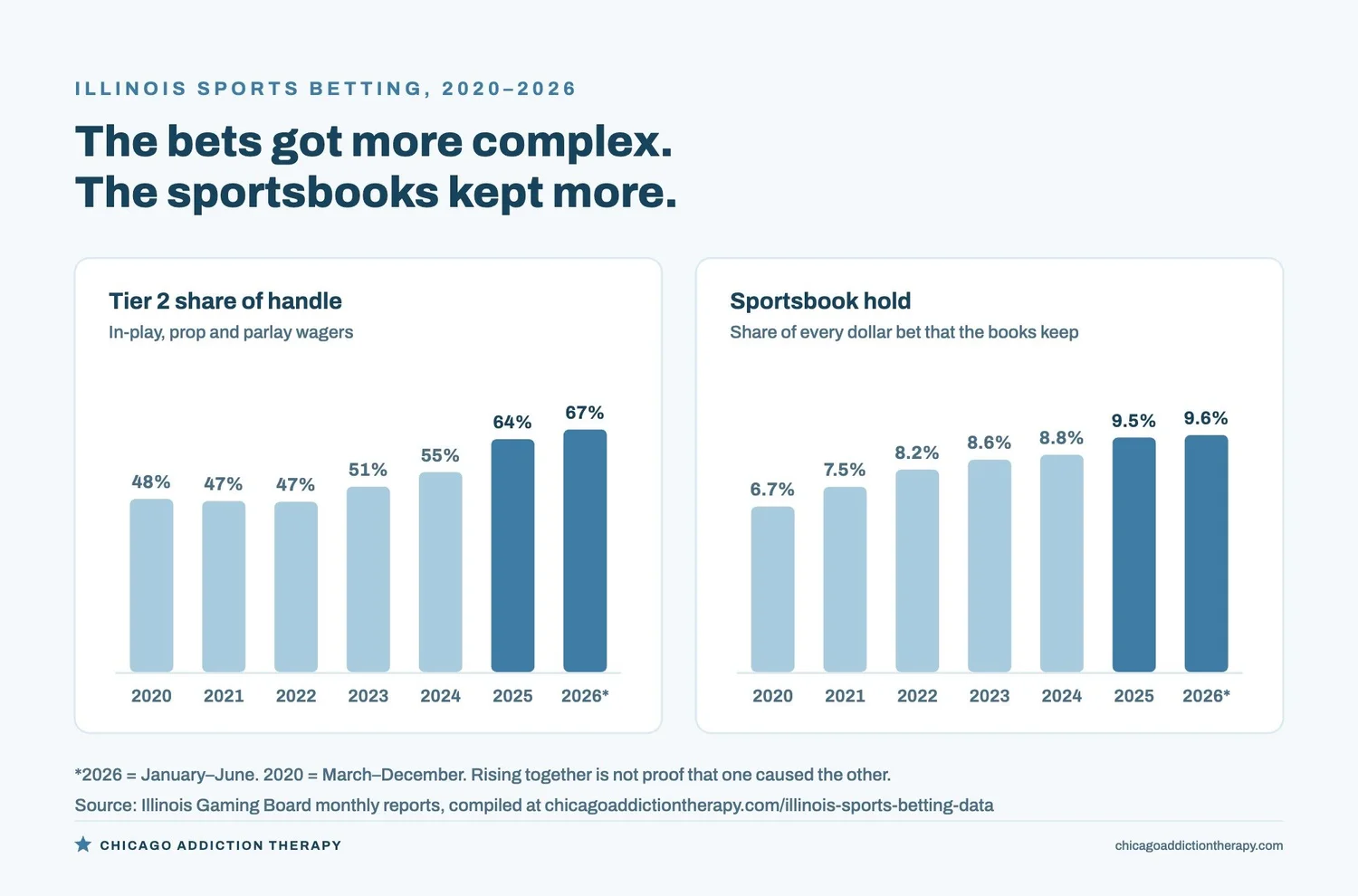
Tier 2 contains several products, so we can’t look at the Illinois numbers and say parlays alone drove the increase. Two lines moving together isn’t proof that one caused the other.
But the direction is hard to miss. Sports betting has moved away from pick who wins the game and toward build a collection of bets around the game.
That’s a very different gambling experience.
Why Parlays Can Feel Different From Straight Bets
Imagine two people watching the same football game. One has $50 on the spread. The other has a six-leg same-game parlay.
The first is mostly following one outcome.
The second may be tracking the score, the quarterback’s passing yards, a receiver’s catches, rushing yards, touchdowns and total points. Almost every possession now carries gambling significance.
A garbage-time reception can decide whether the ticket wins. A quarterback taking a knee can matter. A coach pulling a starter can matter. An overturned touchdown can matter.
The game hasn’t simply become something you bet on. The whole game can become a sequence of gambling outcomes.
That matters most when parlays meet live betting. If one parlay dies in the first quarter, the sportsbook doesn’t close. You can build another parlay. You can bet the second half, or the next drive. You can try to hedge. You can try to win the original money back before the game ends.
What the Research Says About Live Betting and Same-Game Parlays
This evidence deserves some caution. Most of it is observational, so it can’t tell us that live betting causes gambling problems. People who are already struggling may simply be drawn to faster products.
But the association with harm is consistent enough to take seriously:
A 2023 study of 920 sports bettors in Ontario found that people who bet in-play reported higher problem-gambling severity, more gambling-related harms across several areas of life, and more mental health and substance use difficulties than people who only bet before games.
A 2026 study comparing higher-risk and lower-risk bettors found the higher-risk group used in-play betting and instant cash-out more often, and was more likely to stream games inside a betting app.
A February 2026 viewpoint in JAMA Health Forum flagged both in-play betting and same-game parlays as product features with public-health implications, pointing to rapid betting cycles that can feed chasing, longer-odds bets that can concentrate losses, and salient wins that reinforce the urge to play again.
One detail from that 2026 study is worth being honest about: it found no difference between higher-risk and lower-risk bettors in how often they placed multi-bets, which is another name for parlays. That’s a useful reminder that a parlay on its own isn’t the warning sign.
The clinical question isn’t simply whether someone bets parlays.
It’s what happens after the parlay starts to lose.
The Five-Out-of-Six Problem
This is one of the patterns I find most interesting about parlays.
Suppose you make six predictions and five are right. Objectively, the result is simple: you lost the wager.
But psychologically, five out of six can feel very different from zero out of six. You remember the five you got right. The failed leg becomes an exception:
If that receiver hadn’t dropped the ball…
If the coach hadn’t pulled him…
If they hadn’t taken that touchdown away…
I was one leg away.
That can build a powerful argument for another bet.
It’s tempting to call this the “near-miss effect” and treat the question as settled. We should be more careful than that. The classic near-miss experiments used gambling tasks like simulated slot machines, not NFL same-game parlays.
In one well-known 2009 brain-imaging study, near misses felt worse than clear misses but increased people’s desire to keep playing, even though they paid nothing. They also activated brain regions that respond to real wins. Notably, the boost in motivation appeared when participants had chosen the outcome themselves. A parlay is nothing but outcomes you chose yourself. A 2010 brain-imaging study of 22 slot-machine gamblers found that near misses activated win-related brain regions in the 11 with pathological gambling and loss-related regions in the 11 without it, even though both groups rated the outcomes similarly.
None of that proves that missing the sixth leg of a parlay produces the same response.
But clinically, the difference between a loss and an almost-win is important. If every losing parlay gets read as evidence that you’re getting closer, losing can paradoxically become a reason to keep betting.
Parlays Can Make You Feel Better at Betting Than You Are
Parlays also invite a peculiar kind of selective accounting. Take this six-leg ticket:
✓ Bears win
✓ Quarterback over 225 passing yards
✓ Top receiver over 5.5 receptions
✓ Game over 44.5 points
✓ Opposing quarterback over 20.5 completions
✗ Running back anytime touchdown
Someone might say, “I went five for six.” That’s true as a description of the picks.
Financially, you went 0 for 1. The ticket lost.
It sounds obvious written down. It doesn’t always feel obvious on Sunday night.
Because sports involve real knowledge, it’s easy to blend accurate football analysis with inaccurate conclusions about gambling. You may know the game extremely well. You might read injuries, matchups, coaching tendencies and player usage better than most people.
That doesn’t remove the sportsbook’s mathematical edge. And knowing a lot about football doesn’t make it easier to notice when gambling has stopped being recreational.
Sometimes it makes it harder.
Why the Sportsbook Keeps Showing You Parlays
Open a sportsbook during football season and notice how much of the screen is built around combining bets: same-game parlay, popular parlays, parlay boosts, suggested picks, trending bets, add another leg. If you want to know what those boosts are built to do, I wrote about what sportsbook promos and VIP offers are really saying.
The apps aren’t neutral menus that show every possible wager with equal weight. They’re designed products.
Marketing matters too. A 2025 systematic review in the journal Addiction pulled together 22 studies of sports-related gambling advertising, most of them from Australia. Exposure was associated with gambling more often, spending more, unplanned gambling and, in a couple of studies, placing more complex or riskier bets. The self-reported effect looked stronger in people already at higher risk. The authors were clear about the limits: the studies were mostly observational and used inconsistent measures.
That doesn’t mean an ad forces anyone to gamble. It means the environment matters.
If the product you have the hardest time controlling is also the one offered to you constantly while you watch games, check scores and scroll social media, relying on willpower alone is a hard strategy.
When Parlay Betting May Be Becoming a Problem
There’s no separate diagnosis called “parlay addiction.” The clinical diagnosis is gambling disorder, and betting parlays by itself doesn’t mean someone has it.
I’m much more interested in the pattern around the betting. Warning signs I listen for include:
You regularly spend more on parlays than you planned.
One losing parlay immediately leads to another.
You deposit more money during games.
You bet on sports, teams or players you wouldn’t otherwise care about, just to fill out a ticket.
Your bets get bigger later in the day because earlier parlays lost.
You spend most of the game checking stats instead of watching it.
A near-hit makes you more determined to place another bet.
Sunday afternoon rolls into Sunday night and Monday Night Football because you’re trying to recover the weekend.
You delete the sportsbook apps and then reinstall them.
You set deposit or betting limits and keep changing them.
You hide how much you’ve wagered from a partner.
You think more about the parlays that “almost hit” than about how much you’ve actually lost.
You’ve decided to stop more than once, and football season keeps pulling you back.
The amount of money matters. Loss of control matters more.
If several of these sound familiar, the confidential gambling addiction test takes about two minutes and uses the same screening questions clinicians use.
“But I Only Bet $10 or $20 at a Time”
This is another reason sports betting problems are hard to recognize. A $20 parlay doesn’t feel serious.
The problem is repetition.
Twenty dollars before kickoff. Another $20 when that loses. Thirty on the afternoon games. Forty on Sunday Night Football because you’re down. A few live bets. A Monday night parlay.
Then Thursday Night Football arrives three days later.
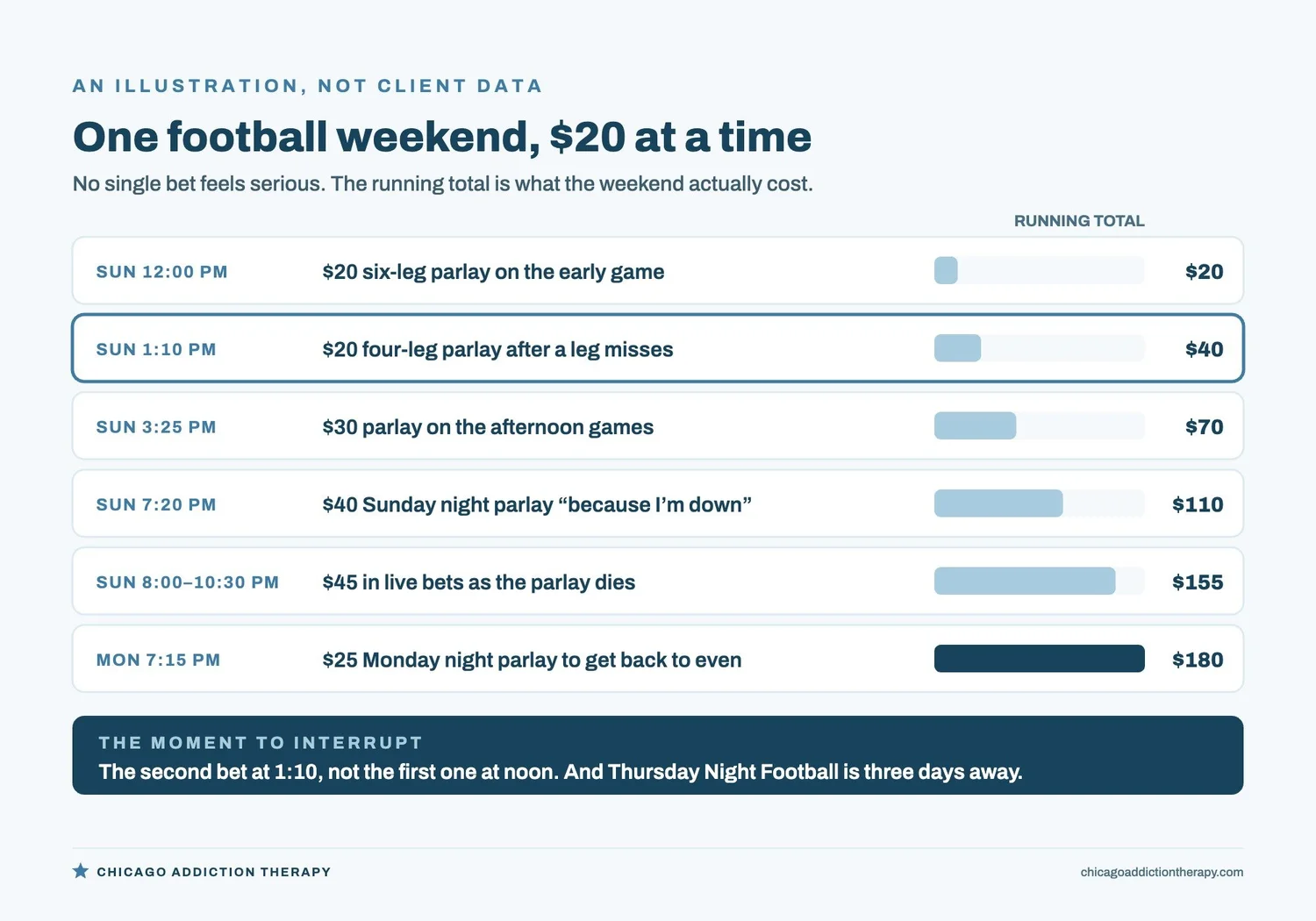
Modern sportsbooks let hundreds of small decisions pile up without any single bet feeling consequential. Illinois bettors placed about 355 million sports wagers in 2025, and nearly 98% of the money bet on sports in Illinois in the year ending June 2026 was wagered online.
For most people, sports gambling isn’t a trip somewhere anymore. It’s on the phone, all the time.
That changes how I approach treatment.
How to Stop Betting Parlays
If parlays have become hard to control, I wouldn’t start by trying to get better at picking them. I’d start by changing access. (For the broader plan, see my guide on how to stop sports betting. What follows is specific to parlays.)
1. Stop treating the almost-hit as a win
Five of six feels close. Financially, it’s still zero of one.
Track money deposited, money withdrawn and net gambling losses, not how many legs you predicted correctly. That gives you a much clearer picture of what gambling is actually costing you.
2. Remove the sportsbook before Sunday
Don’t wait until you’re watching a game, seeing odds and fighting an urge to decide whether you’re going to gamble. Make the decision earlier.
Delete the apps. Turn off sportsbook emails, texts and push notifications. Remove saved payment methods. If you’ve deleted and reinstalled the apps before, move to a stronger barrier.
3. Use self-exclusion when willpower hasn’t worked
Illinois offers sports-wagering self-exclusion, and my guide to Illinois gambling self-exclusion walks through how it works and what it does and doesn’t cover.
Self-exclusion isn’t an admission that you’ve hit some imaginary rock bottom. It’s a practical way to remove access to a product you’ve repeatedly had trouble controlling. If you’ve spent months proving you can override your own limits, one more limit probably isn’t the answer.
4. Pay particular attention to the second bet
People focus on preventing the first bet. I also want to know what happens after the first loss.
That may be the more important moment. If a $25 noon parlay loses and your next move is depositing $100 for the afternoon games, that’s the point in the cycle we need to interrupt. If that pattern sounds familiar, read How to Stop Chasing Gambling Losses.
5. Have a plan for Sunday afternoon
If football has become tightly linked with betting, simply deciding “I’m not gambling today” can leave a big hole in the day. Know what you’ll do when the urge shows up:
Watch with someone who knows you’re trying not to bet.
Watch somewhere without your usual betting setup.
Exercise during part of the afternoon.
Give someone else temporary control of the money if you need to.
Use blocking software.
Leave your phone in another room during the game.
The plan doesn’t need to be elegant. It needs to make the next bet harder to place.
If you need to stop today, not next Sunday, the 24-Hour Betting Shutdown Plan walks through the first day step by step. And if you already quit and just placed a parlay again, read what to do after a gambling relapse.
You Don’t Need to Quit Watching Sports
One fear I hear a lot: “If I stop betting, am I even going to enjoy football anymore?”
At first, maybe not in the same way. If every drive has carried financial weight for years, just watching a game can feel strangely slow.
That isn’t evidence that you need gambling to enjoy football. It’s evidence that your brain got used to watching football with gambling layered on top. That association can change.
The goal isn’t to stop caring about sports. It’s to watch a game without needing your phone, six player props and a four-figure payout hanging over the fourth quarter to make it interesting.
For a lot of people, the hardest part isn’t the game. It’s the group chat, the shared parlay and the friends who still bet every Sunday. I wrote a separate guide for that: how to quit sports betting when all your friends bet.
Frequently Asked Questions
Why are parlays so addictive?
Parlays combine a small stake, a very large potential payout and many outcomes that play out one at a time during a game. Losing tickets often feel like near-wins (“I went five for six”), and each loss is followed by an easy opportunity to build another. Research also shows the house keeps more of each dollar on parlays than on straight bets. None of that makes parlays addictive for everyone, but it can make them hard to stop for someone already losing control.
Is parlay addiction a real diagnosis?
No. “Parlay addiction” is how people describe the problem, not a clinical diagnosis. The diagnosis is gambling disorder. What matters is loss of control: betting more than you intended, chasing losses, hiding it, or being unable to stop despite trying.
Are same-game parlays worse than regular bets?
For the bettor’s wallet, generally yes. Parlays carry higher sportsbook margins than straight bets, and the 547-million-wager study linked heavier parlay use to bigger losses even after accounting for how much people bet. Whether same-game parlays are more likely to cause gambling problems hasn’t been established. The stronger evidence so far points to fast, in-game features like live betting and cash-out.
Is a $10 parlay a problem?
One $10 parlay usually isn’t. The concern is what follows it: the second bet after it loses, the deposits during the game, and the Sunday that turns into Monday night. Many people with serious sports betting problems never place a single large bet.
How do I stop betting parlays?
Remove access before game day, not during it: delete the apps, turn off notifications, remove saved cards, and use Illinois self-exclusion if deleting apps hasn’t held. Count results in dollars, not legs. Plan specifically for the moment after your first loss of the day, and for Sunday afternoon. If you’ve tried and it keeps coming back, that’s a good reason to talk to someone.
If Parlays Are No Longer Fun
You don’t have to wait until gambling wrecks your finances. You don’t have to convince yourself things are “bad enough” before asking for help.
If you keep promising yourself that next Sunday will be different and keep ending up in the same place, that’s worth taking seriously.
I’m Chris Beerman, MSW, LCSW, CADC, an addiction therapist in Chicago, and gambling is a primary focus of my practice. I work with people dealing with sports betting, online gambling, casino and video gambling, compulsive trading, and the financial and relationship problems that often come with them. You can read more about sports betting addiction therapy and how I approach gambling disorder treatment in Illinois.
Treatment isn’t about convincing you football is bad. We look at the actual cycle:
What triggers the bet?
What happens after you lose?
What gets you to deposit again?
What barriers have you tried, and why haven’t they held?
What needs to change before next Sunday arrives?
I see clients in person in Logan Square and through secure telehealth throughout Illinois.
If you’re not ready to contact a therapist, start by looking honestly at your gambling with the gambling addiction test. If you are ready, reach out to schedule a consultation.
You don’t have to lose everything before you do something about it.
If you need help right now: the Illinois gambling helpline is 1-800-GAMBLER, or text GAMB to 833234. Nationally, call or text 1-800-MY-RESET. If you are in crisis, call or text 988.
Sources
Borghesi R, Salaga S, Williams J, Mondello M. Contract choice, parlay adoption, and sportsbook margins. Finance Research Letters, vol. 105, September 2026.
Vieira JL, Coelho SG, Snaychuk LA, et al. Who makes in-play bets? Investigating the demographics, psychological characteristics, and gambling-related harms of in-play sports bettors. Journal of Behavioral Addictions, 2023.
Farrell H, Bennett D, Myles D. More frequent use of live sports-betting features is associated with increased risk of gambling harm: Evidence from a case-control design. Journal of Behavioral Addictions, 2026.
Eisenberg MD, Westermeyer B, Meiselbach MK. Online Sports Betting Is a Public Policy Issue and a Public Health Issue. JAMA Health Forum, February 2026.
McGrane E, Pryce R, Field M, et al. What is the impact of sports-related gambling advertising on gambling behaviour? A systematic review. Addiction, 2025.
Clark L, Lawrence AJ, Astley-Jones F, Gray N. Gambling near-misses enhance motivation to gamble and recruit win-related brain circuitry. Neuron, 2009.
Habib R, Dixon MR. Neurobehavioral evidence for the “near-miss” effect in pathological gamblers. Journal of the Experimental Analysis of Behavior, 2010.
Illinois figures: Illinois Gaming Board monthly sports wagering reports, compiled on the Illinois sports betting data page (current through June 2026).