
How to Quit Sports Betting When All Your Friends Bet
Written by Chris Beerman, MSW, LCSW, CADC · Published October 2026
You decide you’re done betting on Sunday night.
By Wednesday, you’ve deleted the sportsbook apps. Maybe you’ve closed the accounts. You’ve told yourself you’re not putting another dollar on a game.
Then Thursday afternoon your phone lights up. Someone in the group chat posts a four-leg parlay. Another guy replies:
“This is free money.”
“Who’s tailing?”
Three screenshots show up. By kickoff, everybody is talking about the bet.
And now quitting sports betting doesn’t feel like giving up gambling. It feels like leaving your friends.
I see versions of this regularly with men who are trying to stop sports betting. Betting wasn’t something they did completely by themselves. It was part of how the group interacted: sending slips, arguing about lines, sweating out parlays together, roasting whoever had the worst beat, texting through Sunday football.
Take away the gambling and a reasonable question appears: what happens to the friendship?
You don’t necessarily have to abandon your friends because they still bet. But you probably do need to change the rules.
The Group Chat Rule
When your friends still bet, you have three workable options. Pick the one that matches what actually happens when you see a bet — not the one that feels least awkward.
Stay, with a boundary. You can hear about bets. Nobody sends you picks or asks you to tail.
Split the chat. Betting moves to a separate thread. You stay in the original one for everything else.
Leave for 30 days. Tell one friend why, and have him pull you back in later.
Whichever you choose: no tailing, no “just this one,” and no friend placing a bet for you.
Why the Group Chat Can Make Sports Betting So Hard to Quit
This isn’t only anecdotal.
A 2026 U.S. study followed 221 young adult sports bettors — average age 24, mostly men — and looked specifically at what they believed about their friends. Two weeks later, the ones who thought their friends approved of bigger wagers placed more bets, and the ones who thought their friends wagered more put more money down and reported more betting-related problems. The same participants also believed their peers wagered much more than they themselves reported wagering.
That last part matters. A betting group chat gives you a distorted sample. Nobody posts:
“Lost $180 today. Didn’t have much fun. Going to bed.”
You see the eight-leg parlay that somehow hit. You see the screenshot of the $400 win. You see five guys discussing bets at the same time. It can start to feel as if everyone is betting constantly and you’re the only one sitting out.
You’re not seeing anyone’s bank statements. You’re seeing the highlight reel.
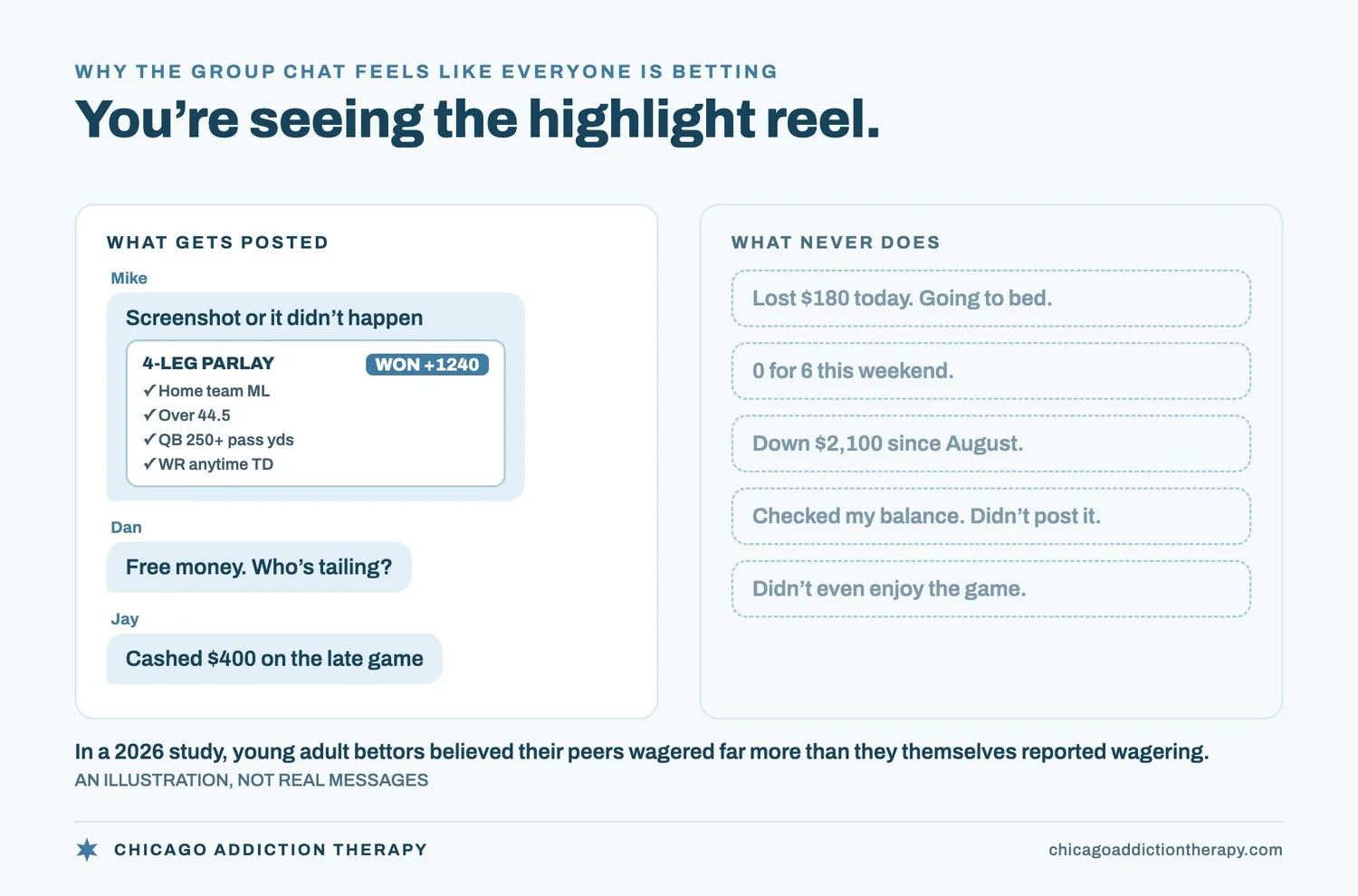
Messaging apps can also keep gambling going when friends aren’t physically together. In a 2022 Australian study of young men who bet on sports, participants described group chats where “we send our screenshots of our multis” (their word for parlays). One explained why cutting back was hard: “you’re in group chats and someone posts something and then that sort of triggers stuff, you’re thinking about it again.” The researchers concluded that those notifications prompted betting even when participants were trying to reduce it. The sportsbook sends its own notifications too, and I wrote separately about what sportsbook promos are designed to do and why turning them off helps.
The UK Gambling Commission reached a similar conclusion in qualitative research published in December 2025: among the teenage boys and young men it studied, gambling that was part of friendship, sport and social life was the kind most likely to persist. It also flagged the opposite signal as a warning sign — gambling that shifts from something done with the group to something done alone.
So if the group chat is a trigger, treating it like a trigger isn’t antisocial. It’s practical.
First: Decide What You Actually Need From Your Friends
You don’t need to make a big announcement about having a gambling problem if you don’t want to. You do need a clear boundary. Those aren’t the same thing.
Before you say anything to the group, decide which of these describes you.
Option 1: “I can hear about betting. I just don’t want anyone trying to involve me.”
Your boundary might simply be:
“I’m done betting. Don’t send me picks to tail or ask me to jump into anything.”
You can still talk football. You can still make fun of the Bears. You can still hear that somebody lost the under because of a meaningless touchdown with 14 seconds left.
The line is participation.
Option 2: “Seeing bets makes me want to gamble.”
Then you need a stronger boundary:
“I’m taking betting pretty seriously right now. Can we keep the slips and picks out of this chat, or make a separate betting thread?”
This is one of my favorite solutions when the group chat existed before sports betting took it over. Don’t leave the friendship. Separate the gambling from the friendship. Let the guys who want to discuss bets have another thread, and keep the original one for everything else.
Option 3: “The entire chat is basically a sportsbook.”
Then leaving may be the simplest answer — and you don’t have to leave forever. Try 30 days. Tell one friend:
“I’m staying off betting, and that chat makes it a lot harder. Pull me back in later if it stops being all slips and picks.”
Thirty days is easier to act on than deciding you’ve permanently withdrawn from a friendship you’ve had for ten years.
What Do I Say to the Group Chat?
Keep it short. The more you explain, the easier it becomes for the conversation to turn into a debate. You don’t need unanimous approval. You need them to know the rule.
A low-disclosure version:
“I’m off betting for a while. Don’t send me anything to tail.”
A more direct version:
“Betting has gotten away from me more than you guys probably realize. I’m done with it. Keep me out of the slips and picks.”
If the chat itself is the problem:
“I’m staying off gambling and this chat is making that harder. Can you guys start a separate betting thread? Keep me in the normal one.”
If you’re leaving:
“I’m jumping out of this chat for a while because I’m done betting. Nothing personal. Text me about literally anything else.”
That’s enough.
What If Someone Says, “Just Tail My Pick”?
This deserves its own rule: don’t make exceptions for other people’s bets.
You’ll hear:
“It’s only $20.”
“You don’t even have to research it.”
“This one is basically free.”
“I’m 8–2 this week.”
“You don’t have to start betting again. Just tail this one.”
Your answer can be:
“Nah. I’m not putting anything down.”
That’s it. Don’t argue about whether the pick is good. The quality of the pick is irrelevant. If you’ve decided that betting is causing problems for you, a supposedly excellent bet is still a bet.
This is also where people sometimes build a loophole into their own self-exclusion:
“I’ll Venmo you $100 and you put it in for me.”
Don’t do that either. If you’ve created barriers between yourself and gambling, don’t recruit your friends to become the workaround.
You Can Stay in the Conversation Without Staying in the Betting
This is the part I would actively practice.
When somebody says, “I love Detroit −3.5,” you don’t have to contribute another line. Talk about Detroit. Who’s hurt? What’s the matchup? Is the offensive line healthy? What did the defense look like last week?
Sports existed before sportsbooks were built into nearly every broadcast.
There may be an adjustment period where watching a game without money on it feels strangely flat. That doesn’t necessarily mean you no longer like sports. It may mean your brain has gotten used to watching two competitions at once — who wins the game? and do I win money? For a while, removing the second one changes the experience.
Give the first one some time to come back.
Use One Friend as Your Ally
You don’t need the entire group to understand gambling addiction. You need one person who gets the assignment.
Pick the guy least likely to respond to your decision by telling you about a deposit bonus. Tell him privately:
“I’m serious about stopping. If the betting stuff starts getting heavy in the chat, help me change the subject or tell me to get off my phone.”
He doesn’t need to monitor you. He’s not your probation officer. He’s just somebody inside the social environment who knows what you’re trying to do — and that changes the room.
Have a Rule for Game Day Before Game Day Starts
Sunday at 12:57 p.m. is a terrible time to decide how you’re going to handle Sunday football. Make the decision earlier.
If the group chat starts filling with parlays Saturday night, mute it until after the early games.
If opening the thread makes you immediately want to check a line, don’t open it.
If you’re watching with friends, tell one person before you arrive that you’re not betting.
Especially early on, don’t sit on the couch holding the phone you used to bet with for four straight hours. Put it somewhere else.
The goal isn’t to prove you can stand three feet from the thing that causes the problem. The goal is to get through the game without placing a bet.
When Muting the Chat Isn’t Enough
People sometimes tell me, “I muted it.” Then they check the muted chat 35 times.
Muting solved the sound. It didn’t solve the behavior.
If you keep opening the conversation specifically to see what everybody is betting, muting isn’t the right level of barrier. Archive it. Hide it. Ask for a second chat. Or leave for a while.
Match the barrier to what actually happens, not to what sounds least disruptive.
What If They Give You a Hard Time?
Some joking is predictable. If your group has spent five years calling each other idiots over fantasy trades and bad beats, they’re probably not going to become solemn because you decided to quit gambling. You don’t have to treat every joke like a betrayal.
But there’s a difference between joking and repeatedly pushing past a boundary you’ve made clear.
If somebody says, “Come on, one bet,” say: “Nope. I’m out.”
If they do it again: “Seriously. Don’t send me bets.”
You shouldn’t have to make the same request ten times. At that point the answer probably isn’t explaining yourself better. It’s putting more distance between yourself and the situation.
Don’t Turn Quitting Into a Test of the Friendship
Avoid one trap here: deciding that if they’re really my friends, they’ll immediately understand everything I’m going through.
They may not. Someone who can put $25 on a game, lose it and forget about it may have real trouble understanding why you can’t do exactly the same thing.
That’s okay. They don’t have to understand your relationship with gambling perfectly. They do have to respect what you’ve asked them to do.
That’s the useful test.
Replace the Ritual, Not Necessarily the Friends
For some groups of men, betting slowly became the activity without anybody noticing. Five years ago you watched football together. Now everybody watches six bets together. Those aren’t quite the same thing.
So deliberately put something else back into the friendship: watch the game, go to the game, hit the gym, play golf or pickup basketball, meet for breakfast, get dinner. Talk about whatever you talked about before every conversation turned into whether a quarterback would throw over 1.5 touchdowns.
You aren’t just trying to remove gambling. You’re trying to keep the part you actually wanted from it: connection.
When You Probably Should Leave the Betting Chat
There isn’t a clinical formula for this, but I would take leaving seriously if you notice the same sequence repeating:
You feel fine.
You open the chat.
You see a bet.
You check the odds.
You reinstall an app or look for another way to wager.
You place a bet.
Then the group chat isn’t merely annoying. It’s part of your gambling sequence — and the earlier you break the chain, the less willpower it takes.
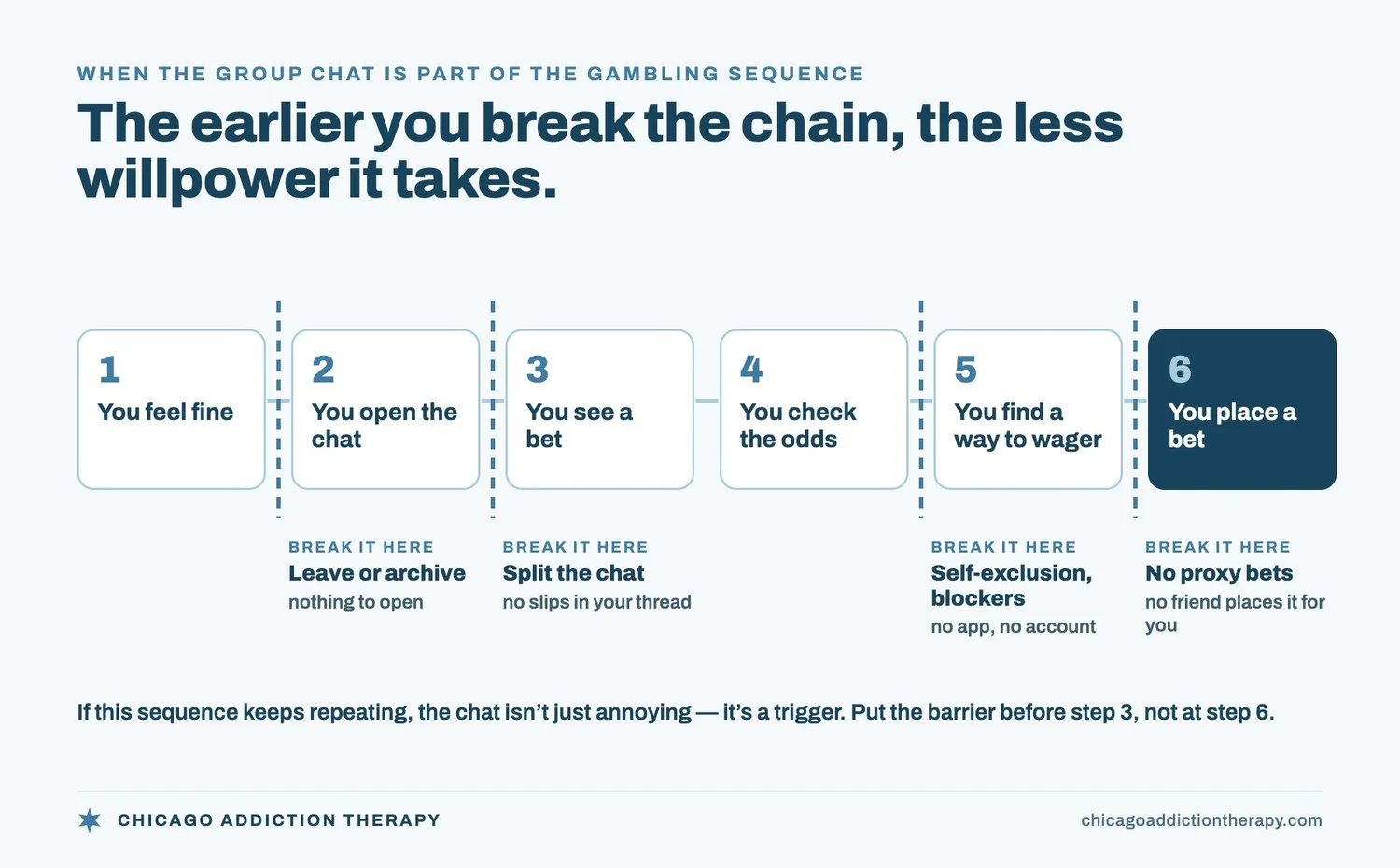
A trigger doesn’t become harmless because your friends created it. Create some distance. You can always reconsider later.
What If You Slip and Bet With Them Again?
Don’t turn one bet into the weekend.
A guy sends you something. You tail it. Now you’re angry with yourself because you broke the rule, and the next thought may be: well, I already screwed up.
That’s the dangerous part. One bet does not require a second bet.
Stop. Tell somebody. Then figure out how the bet got through:
If the answer was the group chat, change the group-chat plan.
If the answer was that you still had access to a sportsbook, fix the access.
If the answer was that a friend placed the bet for you, close that loophole.
Treat the slip as information about which barrier needs work, not permission to keep gambling. I’ve written a separate guide on what to do after a gambling relapse, because the hours immediately afterward matter much more than most people realize — and if the urge is to win it back, read how to stop chasing losses.
Do I Have to Stop Watching Sports Too?
Not necessarily.
Some people need a period away from sports because every game is too closely connected to betting. Others can keep watching once gambling access and social triggers are addressed. There isn’t much value in turning this into a toughness contest.
If watching football without betting feels manageable, watch football. If watching sends you into a two-hour fight with yourself about downloading a sportsbook, take a break.
The NFL will still exist next month.
The Goal Isn’t to Become the Guy Who Hates Gambling
You don’t have to lecture your friends. You don’t have to convince them to quit. You don’t have to announce every gambling statistic you’ve learned. And you don’t have to sit silently furious because they can do something you’ve decided you can’t safely do right now.
Your job is simpler: don’t place the next bet.
For some people that means staying in the group chat with a clear boundary. For others it means asking the guys to move betting into another thread. And for some it means leaving for a while. All three are legitimate.
The important question isn’t what will make this least awkward? It’s what gives me the best chance of doing what I already decided I want to do?
Start there.
If You Need More Than the Group-Chat Plan
If sports betting has become difficult to control, changing the group chat is one part of the solution. Access to sportsbooks, money, betting content and the ability to place a wager in seconds matter too.
My guide on how to stop sports betting lays out the broader plan — self-exclusion, blocking software, money barriers and the highest-risk parts of the sports week. If you need to stop today, start with the 24-Hour Betting Shutdown Plan. If you’re in Illinois, the Illinois Gaming Board’s self-exclusion program covers Illinois casinos and sports wagering; here’s how enrollment works. Not sure how serious this is? The free, anonymous gambling self-assessment takes about three minutes.
Frequently Asked Questions
Do I have to leave the group chat to quit sports betting?
Not always. If you can hear about bets without wanting to place one, stay and set a clear boundary: no picks, no tailing. If seeing slips triggers urges, ask for a separate betting thread. If the whole chat is betting, leave for 30 days and tell one friend why.
What should I tell my friends when I quit betting?
Keep it short: “I’m off betting for a while. Don’t send me anything to tail.” You don’t owe anyone a full explanation or a diagnosis. The more you explain, the easier it becomes for the message to turn into a debate.
Is it okay if a friend places a bet for me?
No. If you’ve self-excluded or deleted your accounts, having a friend bet for you rebuilds the access you just removed. Treat it the same as placing the bet yourself.
Why does watching sports feel boring after I stop betting?
Betting adds a second contest — whether you win money — on top of the game. When you remove it, games can feel flat for a while. For many people, interest in the game itself returns once the money is out of it.
What if I bet with my friends again after quitting?
Stop at one bet. Tell someone, then work out how the bet got through — the chat, remaining sportsbook access, or a friend placing it for you — and fix that barrier. A slip is information, not permission to keep going.
Talk to Someone
I specialize in gambling and sports betting therapy and see clients in person in Logan Square, Chicago, and online throughout Illinois and Minnesota. Learn more about sports betting addiction therapy, or email me to set up a consult.
Illinois Gambling Helpline: call 1-800-GAMBLER or text GAMB to 833234. National Problem Gambling Helpline: call or text 1-800-MY-RESET, 24/7. If you’re in a mental health crisis or thinking about suicide, call or text 988. If you’re in immediate danger, call 911.
Sources
Lambuth, J., Shaygan, A., Lostutter, T. W., & Graupensperger, S. (2026). All my friends are doing it: Perceived social norms predict heavier sports betting behavior among young adults. Health Education & Behavior. https://doi.org/10.1177/10901981251350877
Nyemcsok, C., Pitt, H., Kremer, P., & Thomas, S. L. (2022). Young men’s perceptions about the risks associated with sports betting: A critical qualitative inquiry. BMC Public Health, 22. https://doi.org/10.1186/s12889-022-13164-2
UK Gambling Commission. (2025, December 11). Lived experiences of gambling in teenage boys and young men: Qualitative research. https://www.gamblingcommission.gov.uk/report/lived-experiences-of-gambling-in-teenage-boys-and-young-men-qualitative